





— Blogs —
—Products—
 Consumer hotline +8618073152920
 WhatsApp:+8615367865107
Address:Room 102, District D, Houhu Industrial Park, Yuelu District, Changsha City, Hunan Province, China
Product knowledge
Time:2026-01-18 19:58:30 Popularity:6
In the fields of agriculture and environmental monitoring, the Portable USB Type-C 7 In1 Soil Sensor Free Android APP Soil Tester Temp Moisture NPK pH Ec Nutrient Meter has become an efficient tool for measuring soil parameters. Launched by NiuBoL, this portable soil sensor connects to Android or HarmonyOS phones via a USB Type-C interface, enabling real-time monitoring of multiple indicators such as soil temperature, moisture, EC value, salinity, and NPK content. Equipped with a free Android APP, this soil tester is not only easy to operate but also supports data storage, export, and analysis. It is suitable for various scenarios including water-saving irrigation, greenhouse planting, and scientific experiments. This article provides a detailed introduction to its features, applications, and comparison with IoT soil sensors to help users better understand and select appropriate soil monitoring solutions.
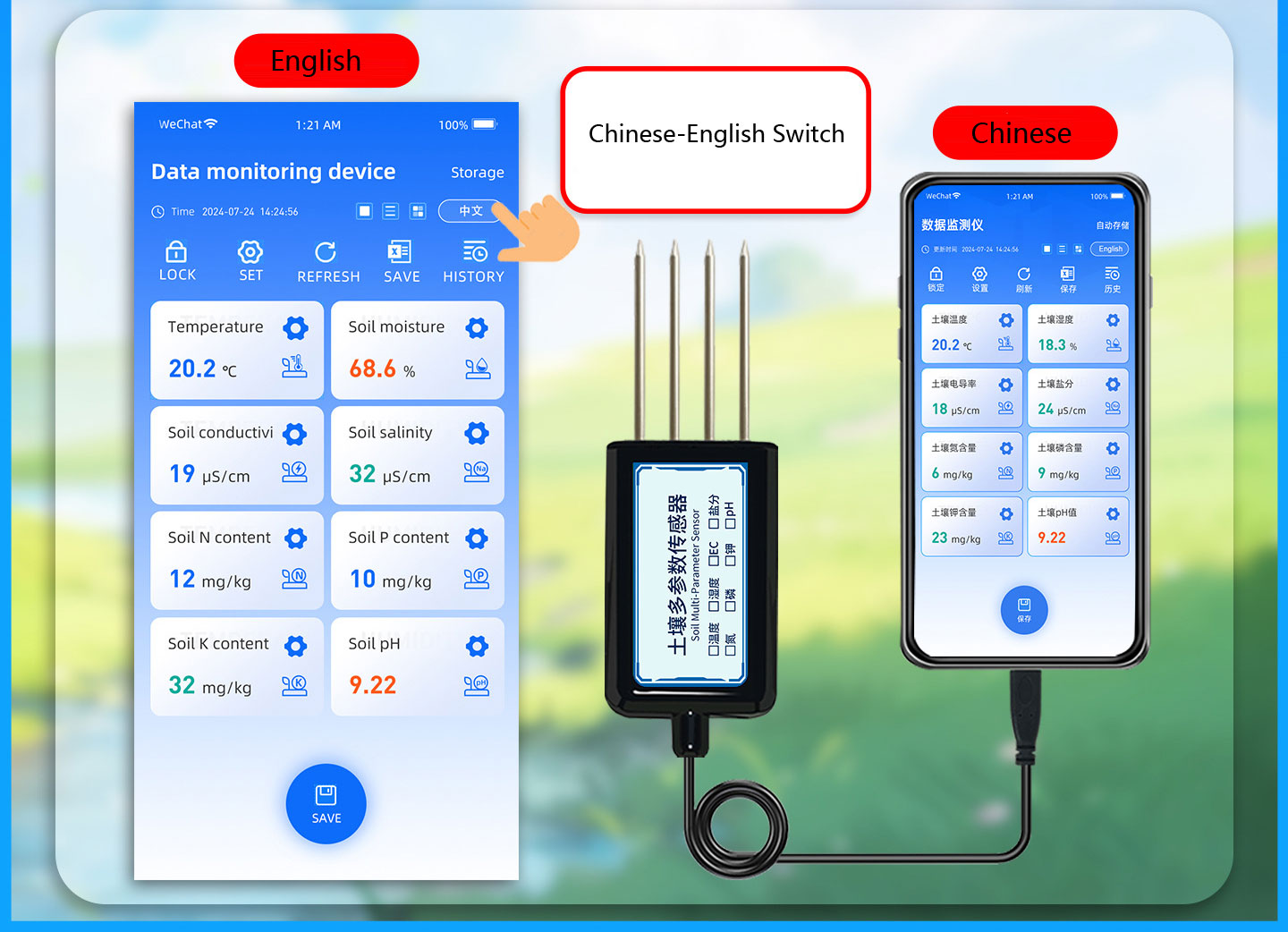
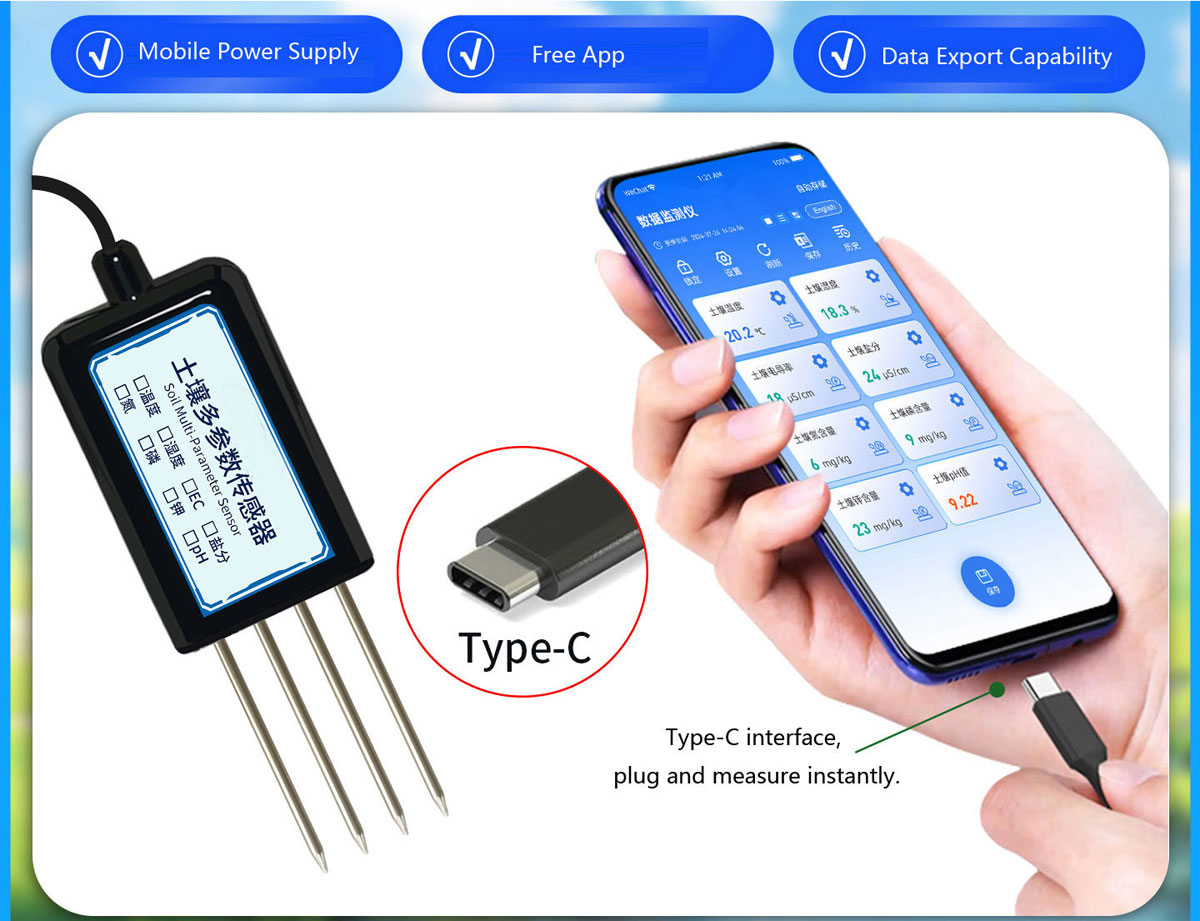
The NiuBoL Portable USB Type-C 7 In1 Soil Sensor is a portable device that integrates multiple soil parameter detection functions, designed specifically for modern agriculture and environmental practitioners. It uses a USB Type-C interface to connect directly to a phone's charging port, requiring no additional power supply or complex equipment, enabling rapid collection of soil data. The core of this soil tester lies in its 7-in-1 design, capable of simultaneously measuring soil temperature, moisture, electrical conductivity (EC), salinity, and the content of available nitrogen, phosphorus, and potassium—covering key indicators for soil health assessment.
Unlike traditional soil testing tools, this sensor emphasizes portability and user-friendliness. Users only need to install the free Android APP (compatible with Android and HarmonyOS 4.3 and below), and they can perform parameter settings, data correction, and historical record viewing through the phone interface. The APP also supports Chinese/English switching, data curve plotting, and Excel file export, facilitating subsequent analysis and report generation. If there is a software update, the APP will automatically prompt and upgrade, ensuring users always have the latest version.
In practical use, the sensor probe is exquisitely designed and can be fully inserted into the soil for measurement, with fast response speed and high stability. Manufacturer NiuBoL focuses on practicality, making the product suitable for various soil types, including field, greenhouse, and laboratory environments. By combining the sensor with a phone, it brings professional soil analysis into the daily work of ordinary users, greatly lowering the threshold for soil monitoring.
The measurement ranges and accuracies of this Portable USB Type-C 7 In1 Soil Sensor have been optimized to meet the needs of most agricultural and environmental applications. Below are the detailed specifications of its main parameters:
Soil Temperature: Measurement range -40~80℃, accuracy ±0.3℃, resolution 0.1℃. This indicator helps assess the impact of soil on crop growth, such as monitoring frost risk in cold regions.
Soil Moisture: Range 0~100% (m³/m³), accuracy ±2%, resolution 0.1% (m³/m³). Moisture data directly guides irrigation decisions, avoiding over- or under-watering.
Soil EC (Electrical Conductivity): 0~20000μS/cm, accuracy ±3%, resolution 1μS/cm. EC value reflects soil ion concentration and is closely related to salinity.
Soil Salinity: 0~20000mg/L, accuracy ±3%, resolution 1mg/L. High salinity may hinder crop growth; this parameter helps with saline-alkali land improvement.
Soil Available Nitrogen (Alkali Hydrolyzable Nitrogen): 0~1999mg/kg, accuracy ±3%, resolution 1mg/kg.
Soil Available Phosphorus (Effective Phosphorus): 0~1999mg/kg, accuracy ±3%, resolution 1mg/kg.
Soil Available Potassium (Effective Potassium): 0~1999mg/kg, accuracy ±3%, resolution 1mg/kg.
It should be noted that NPK (nitrogen, phosphorus, potassium) measurement is based on the soil electrical conductivity principle. The sensor actually detects the soil's conductivity value and then calculates the NPK values using manufacturer-preset conversion factors (referencing conventional soil nutrient content). This method provides empirical reference data, which may not be absolutely accurate on-site due to influences from soil type and environmental factors, but it is sufficient for preliminary assessment and trend analysis. In practical applications, users can perform data correction through the APP to improve accuracy.
These specifications ensure the sensor's reliability and practicality, especially excelling in daily monitoring where precision requirements are not extremely stringent.
The NiuBoL Portable USB Type-C 7 In1 Soil Sensor has a wide range of applications and is suitable for various fields that require rapid soil parameter assessment. It is particularly ideal for mobile operations, allowing users to carry it to the site for measurements at any time.
In water-saving agricultural irrigation, the sensor helps farmers monitor soil moisture in real time, avoiding blind watering. By combining temperature and EC data, users can optimize irrigation plans and reduce water waste. For example, in arid areas, monitoring moisture can prevent root dehydration, while salinity detection helps prevent soil salinization.
Meteorological monitoring and environmental monitoring are other key scenarios. Environmental workers can use it to assess soil pollution levels or the impact of climate change, such as measuring pH values and nutrient content in riverbanks or forest areas to support ecological restoration projects.
For greenhouse and flower/vegetable planting, the sensor provides precise nutrient management. NPK data guides fertilization timing, avoiding environmental issues caused by excessive fertilizer. In grassland and pasture management, it helps herders monitor soil health to ensure uniform grass growth.
Additionally, in rapid soil testing, plant cultivation, and scientific experiments, the device simplifies laboratory processes. Researchers can store historical data through the APP and plot curves to analyze long-term trends, such as studying the effects of different fertilizers on soil pH.
Overall, this soil tester is suitable for various users from small farms to large research institutions, emphasizing immediacy and portability to help improve production efficiency and sustainability.
IoT soil sensors typically refer to embedded devices that transmit data in real time to cloud platforms via wireless networks for remote monitoring. In contrast, the NiuBoL Portable USB Type-C 7 In1 Soil Sensor adopts a portable design with no need for fixed installation. The following comparison from multiple dimensions helps users make choices.
First, installation and portability. IoT sensors need to be buried in the soil and connected to power or solar panels; the installation process is complex and suitable for fixed locations such as large-field agriculture. Once deployed, they can monitor continuously but are not mobile. The portable sensor requires no installation and is used by directly plugging into the phone, suitable for scenarios with frequent measurement point changes, such as greenhouse inspections or field surveys.
Second, cost and maintenance. IoT systems have higher initial investment, including sensors, network equipment, and subscription services. In the long term, maintenance is more involved. The portable sensor is affordable, requires no additional network fees, and is simple to maintain—just clean the probe. Users with short-term projects or limited budgets prefer the latter.
Third, data acquisition and real-time performance. IoT sensors excel in automation and remote access, integrable into smart irrigation systems for 24/7 monitoring. However, they depend on network signals, which may be interrupted in remote areas. The portable sensor provides instant local data processed through the APP, with no network dependency, suitable for offline environments.
Fourth, measurement range and accuracy. Both have similar accuracy, but IoT sensors may be more stable due to fixed positions, while portable ones are flexible and allow multi-point sampling to reduce errors. NPK measurement in both is empirical and affected by soil variation.
Finally, scalability and functionality. IoT systems can be expanded to multi-sensor networks and support big data analysis, but the operation threshold is high. The portable sensor achieves data export and curve analysis through the APP, making it easy for individual use.
Overall, the portable sensor has advantages in flexibility and cost, while IoT is suitable for large-scale automated applications.

Based on the comparison, the advantages of the NiuBoL Portable USB Type-C 7 In1 Soil Sensor are evident. First is its portability and ease of use—it is lightweight and compact, easy to carry to any location for measurement, requiring no professional training. Second, multi-parameter integration reduces the number of devices needed—one device serves multiple purposes, improving efficiency. The free APP enhances data management capabilities, supporting Excel export for easy sharing and analysis.
In actual scenarios, its advantages are reflected in quick response. For example, farmers can instantly adjust fertilization in the field without waiting for IoT data transmission. Additionally, no network dependency avoids signal issues, suitable for remote farms. Although the accuracy is not laboratory-grade, errors within ±3% are sufficient to guide daily decisions.
Compared to IoT, it focuses more on user experience, avoiding complex configurations, and is suitable for beginners and small-scale operators.
Using this soil tester is simple and efficient. First, scan the product QR code to download the APP, compatible with Android and HarmonyOS 4.3 and below. During installation, if the system intercepts it, follow the prompts to disable pure mode or grant authorization (e.g., Huawei disable pure mode, Xiaomi grant once).
When connecting, insert the sensor into the phone's USB Type-C port. If there is no response, check and enable OTG function (search for OTG in settings). After successful connection, fully insert the probe into the soil, and the APP will display real-time data.
APP functions include parameter settings, data correction, storage, Excel export, historical curve viewing, and Chinese/English switching. Before measurement, ensure the soil is moist to improve accuracy, and clean the probe after use.
For detailed operations, scan the APP usage QR code to view.
Although operation is simple, please note a few points. NPK values are empirical estimates and affected by soil type; it is recommended to verify with laboratory testing. Apple iOS and HarmonyOS 5.0 and above are not supported at present. Avoid extreme environments during measurement, as excessively high temperatures may affect accuracy. When burying in soil for a long time, regularly check the probe for corrosion.

Q1. Can this sensor measure pH value?
The product specifications do not explicitly list pH, but application descriptions mention soil pH value. Based on the principle, it may indirectly estimate through EC; it is recommended to confirm the APP functions.
Q2. How does it differ from traditional soil testing kits?
Traditional kits mostly use chemical reagent methods, which are time-consuming and single-use. This sensor is electronic, reusable, and provides digitized data.
Q3. Can APP data be synced to the cloud?
The current version supports local storage and export, without cloud sync, but future updates may add this feature.
Q4. Which phone models is it suitable for?
Android and HarmonyOS 4.3 and below, models that support OTG. Confirm phone compatibility before testing.
Q5. How to correct measurement errors?
The APP provides a data correction function; users can input calibration values to adjust.
The NiuBoL Portable USB Type-C 7 In1 Soil Sensor, with its portable, multi-functional, and user-friendly design, has become a practical tool in the field of soil monitoring. It has broad application scenarios in agriculture, environment, and scientific research. The comparison with IoT sensors highlights its advantages in cost and flexibility. Through the powerful features of the free APP, users can easily manage data and achieve precise management. Whether for farmers or researchers, this soil tester provides reliable support and promotes the development of sustainable agriculture. Choosing it means choosing the combination of efficiency and convenience.
 8-in-1 Soil Sensor Portable Type-C/USB Soil Multi-Parameter Tester & Analyzer.pdf
Prev:Professional USB Soil Sensor Soil NPK/PH/EC Analyzer Moisture Nutrient Sensor for Agriculture
Next:Type-C Soil Sensor for Instant Results Ideal for Gardening & Agriculture
Related recommendations
Sensors & Weather Stations Catalog
 Agriculture Sensors and Weather Stations Catalog-NiuBoL.pdf
Weather Stations Catalog-NiuBoL.pdf
Agriculture Sensors Catalog-NiuBoL.pdf
Related products
 Combined air temperature and relative humidity sensor
 Soil Moisture Temperature sensor for irrigation
 Soil pH sensor RS485 soil Testing instrument soil ph meter for agriculture
 Wind Speed sensor Output Modbus/RS485/Analog/0-5V/4-20mA
 Tipping bucket rain gauge for weather monitoring auto rainfall sensor RS485/Outdoor/stainless steel
 Pyranometer Solar Radiation Sensor 4-20mA/RS485

Screenshot, WhatsApp to identify the QR code
WhatsApp number:+8615367865107
(Click on WhatsApp to copy and add friends)

