





— Download —
 Consumer hotline +8618073152920
WhatsApp:+8615367865107
Address:Room 102, District D, Houhu Industrial Park, Yuelu District, Changsha City, Hunan Province, China
All products
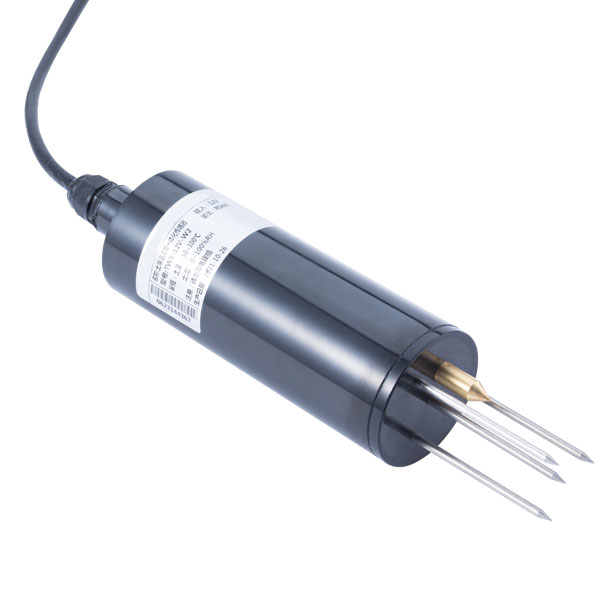
Soil moisture sensor for agriculture plays an important role in irrigation management, crop growth monitoring and resource conservation with the following roles and values:1. Precision irrigation: Soil moisture sensors can monitor the water content in the soil in real time, helping farmers to precisely control the amount and frequency of irrigation to avoid over- or under-irrigation, thus improving irrigation efficiency and saving water.2. Crop growth monitoring: By monitorin···
Tel/WhatsApp:+8615367865107
Email:Arvin@niubol.com +Nearly 100 partner companies in more than 75 countries. We are committed to providing high-quality, practical products to meet your needs and help you solve problems. Our products comply with international standards and are certified with ISO, CE and RoHS.Product Details
Choosing the right soil moisture sensor for agriculture involves more than selecting a measurement range. The sensor's electrical output must also be compatible with the irrigation controller, PLC, data logger or monitoring gateway used in the project.
The NiuBoL NBL-S-THR is a TDR soil moisture and temperature sensor designed for agricultural irrigation, greenhouse cultivation, field monitoring and environmental data acquisition. It measures volumetric soil water content and soil temperature, with RS485 Modbus RTU, 4–20mA and 0–5V output configurations available.
Each output type serves a different integration requirement. RS485 provides digital communication, while 4–20mA and 0–5V provide analog measurement signals. Understanding these differences helps system integrators select suitable sensors for agricultural monitoring and irrigation control systems.
Soil moisture monitoring provides information about water conditions around plant roots. By recording moisture measurements over time, agricultural operators can observe how soil responds to irrigation, rainfall and drying conditions.
Soil temperature measurements provide additional information about root-zone environmental conditions.
The NBL-S-THR combines both parameters in one sensor assembly, reducing the need for separate soil moisture and temperature probes at the same measurement point.
The sensor uses a sealed cylindrical housing with stainless steel sensing rods and can be installed for temporary field measurements or long-term buried monitoring.
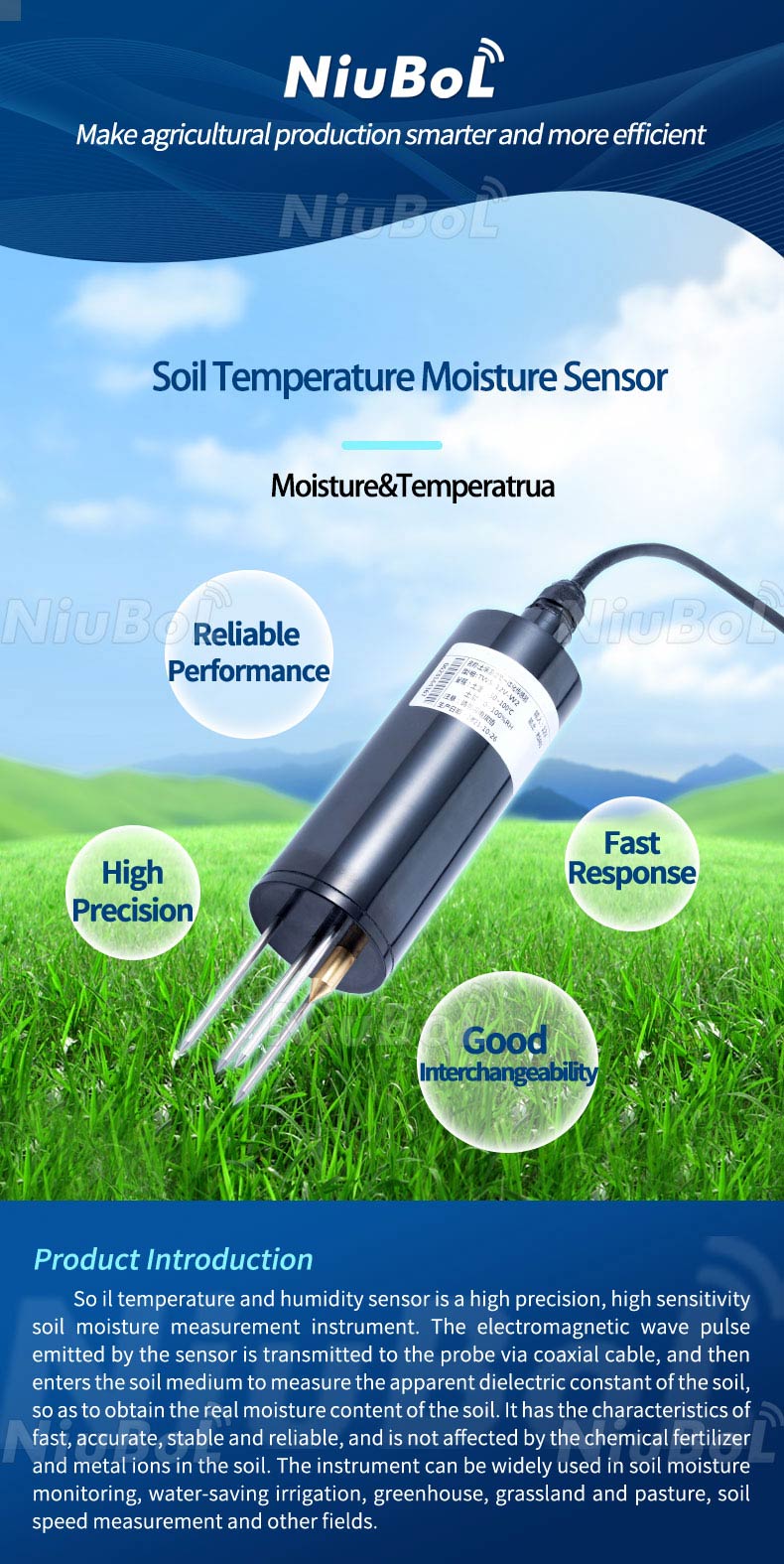
Different agricultural soil moisture sensors use different physical measurement principles. Common technologies include Time Domain Reflectometry (TDR), Frequency Domain Reflectometry (FDR), capacitance measurement and electrical resistance.
TDR sensors use an electromagnetic pulse and evaluate its response to the dielectric properties of the surrounding soil.
Water has a much higher dielectric permittivity than most dry soil minerals and air. Changes in soil water content therefore affect the measured electromagnetic response.
The NBL-S-THR uses TDR technology for soil moisture measurement.
FDR and capacitance sensors estimate soil moisture from frequency-dependent electrical or dielectric characteristics.
These methods are widely used in agricultural monitoring, greenhouses and multi-depth soil measurement systems.
Measurement performance depends on sensor design, calibration, soil texture, salinity and installation conditions.
Resistive sensors measure changes in electrical resistance or conductivity associated with moisture and dissolved ions in the soil.
Because soil salinity and fertilizer concentration can affect electrical conductivity, basic resistive measurements should not automatically be treated as calibrated volumetric water content measurements.
Some agricultural sensors measure moisture and temperature only, while other configurations include electrical conductivity or additional soil parameters.
Measurement channels should be selected according to the actual monitoring requirements. A two-parameter soil moisture and temperature sensor does not automatically measure electrical conductivity, salinity, pH or nutrients.
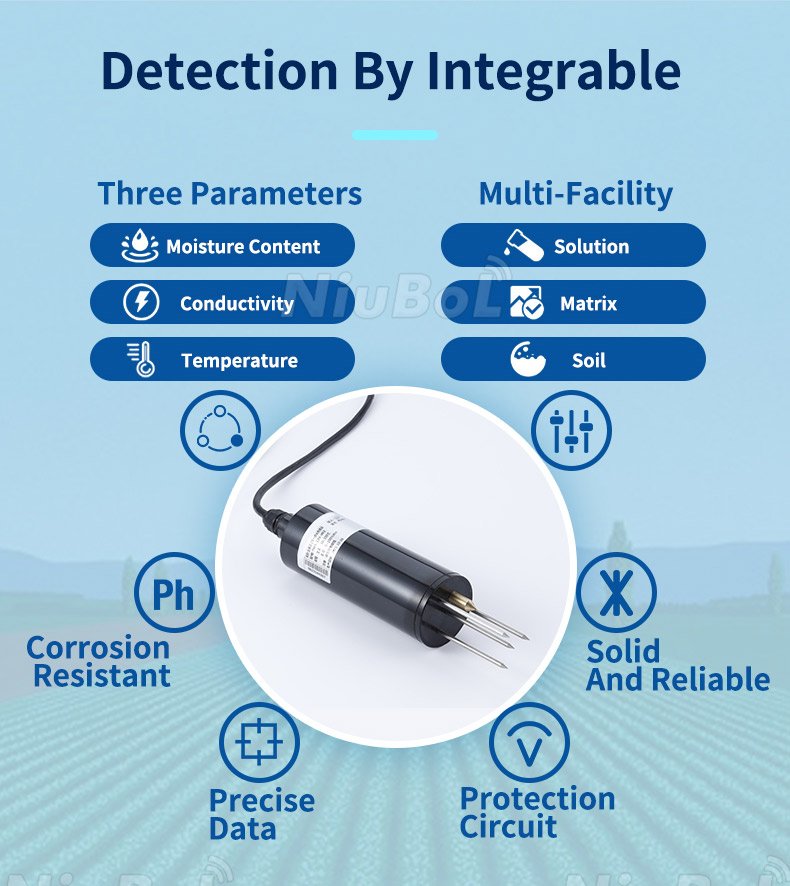
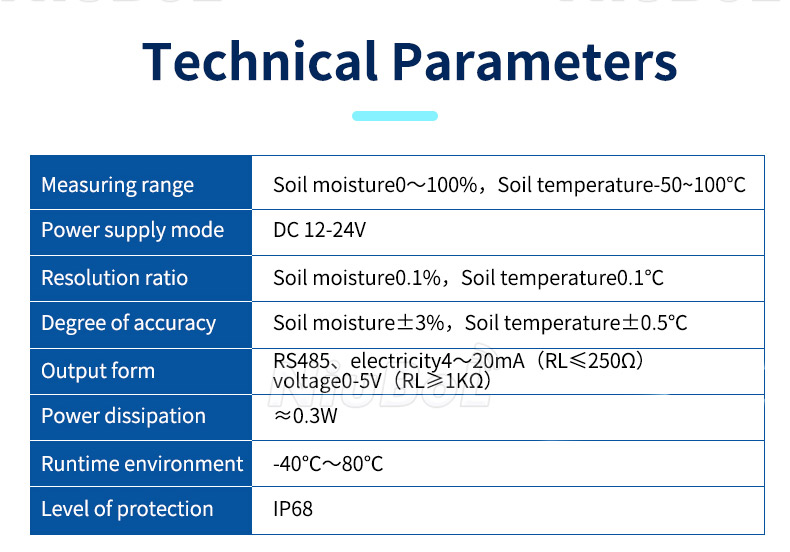
The NBL-S-THR provides simultaneous soil moisture and temperature measurements. Its electrical output can be selected to match the communication or analog input requirements of the receiving equipment.
| Parameter | Specification |
|---|---|
| Model | NBL-S-THR |
| Product Type | TDR Soil Moisture and Temperature Sensor |
| Measurement Principle | Time Domain Reflectometry (TDR) |
| Measured Parameters | Soil Moisture and Temperature |
| Soil Moisture Range | 0–100% |
| Moisture Accuracy | ±3% |
| Moisture Resolution | 0.1% |
| Soil Temperature Range | −50 to +100°C |
| Temperature Accuracy | ±0.5°C |
| Temperature Resolution | 0.1°C |
| Power Supply | DC 12–24V |
| Output Options | RS485 / 4–20mA / 0–5V |
| Digital Communication | Modbus RTU (RS485 Version) |
| RS485 Baud Rate | 9600 bps |
| Current Output Load | ≤250 Ω |
| Voltage Output Load | ≥1 kΩ |
| Power Consumption | Approximately 0.3W |
| Operating Temperature | −40 to +80°C |
| Protection Rating | IP68 |
The sensor's operating temperature range refers to the allowable conditions for the instrument. It is different from the measurement span of the soil temperature channel.
The required electrical output should be specified when ordering. RS485, current and voltage outputs are different configurations rather than simultaneous communication interfaces.
The output interface determines how the soil moisture sensor communicates with the receiving equipment.
For agricultural monitoring systems, RS485 is commonly selected for digital data acquisition, while 4–20mA and voltage outputs are suitable for compatible analog monitoring equipment.
| Feature | RS485 Modbus RTU | 4–20mA | 0–5V |
|---|---|---|---|
| Signal Type | Digital | Analog Current | Analog Voltage |
| Receiving Equipment | PLC, RTU, Logger, Gateway | Current Analog Input | Voltage Analog Input |
| Data Format | Digital Measurement Values | Current Converted by Input Scaling | Voltage Converted by Input Scaling |
| Multiple Sensors | Shared Bus with Unique Addresses | Separate Analog Channels | Separate Analog Channels |
| Main Consideration | Protocol and Address Configuration | Load and Current Input Compatibility | Voltage Input and Cable Effects |
The RS485 version provides digital measurements of soil moisture and temperature.
It is suitable for compatible data loggers, PLCs and agricultural monitoring gateways that support Modbus RTU communication.
In a properly designed RS485 network, several sensors can share one communication bus. Each device must use a unique communication address.
RS485 is useful when multiple agricultural monitoring points need to be integrated into one data acquisition system.
The 4–20mA version provides analog current signals for controllers equipped with compatible current inputs.
For the NBL-S-THR analog configuration, soil moisture and temperature are provided through separate measurement signal conductors.
The receiving equipment must have sufficient analog input channels and use the appropriate signal scaling for each parameter.
Current signals are commonly used in industrial monitoring systems because they are less affected by voltage drops than direct low-voltage measurement signals under suitable wiring conditions.
The 0–5V version provides analog voltage signals that can be measured by suitable data acquisition devices.
This output is useful for controllers or logging equipment equipped with compatible voltage inputs.
The receiving equipment must use the correct input range, signal scaling and wiring arrangement.
For longer cables, the influence of voltage drop, interference and grounding should be considered when designing the acquisition system.
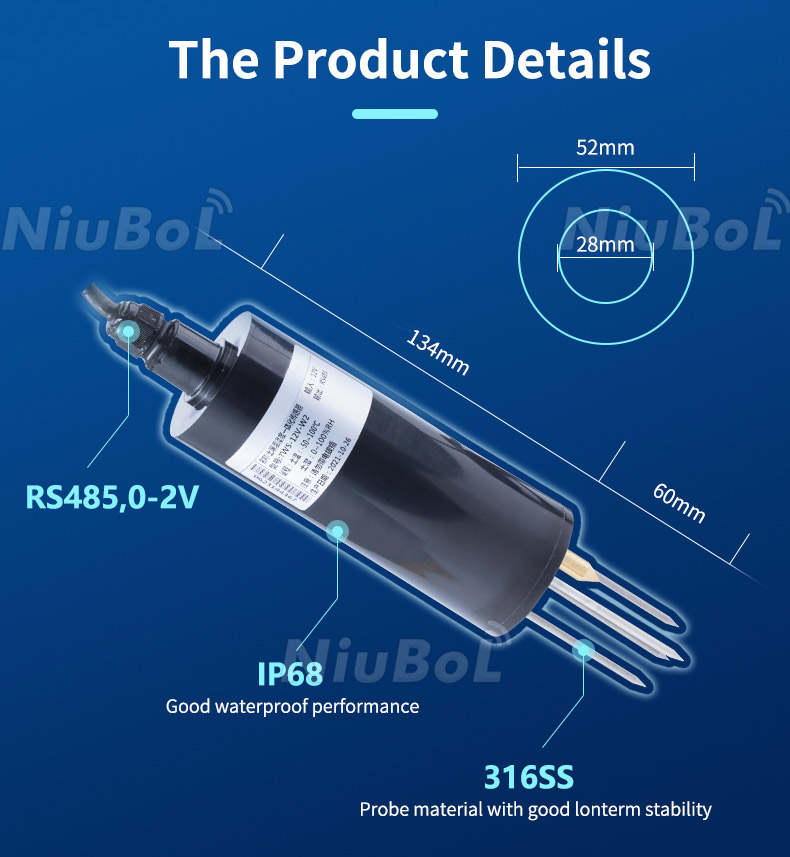
The NBL-S-THR uses a cylindrical sensor housing with stainless steel sensing rods.
The probe is inserted into soil so the sensing region maintains contact with the surrounding material.
The sealed housing supports long-term buried monitoring, while the external cable connects the sensor to the selected data acquisition equipment.
Proper protection of cable joints and external connectors is important for outdoor agricultural installations.
Correct wiring depends on the output configuration supplied with the sensor.
The RS485 configuration uses power supply conductors and an RS485 communication pair.
| Wire Color | RS485 Function |
|---|---|
| Red | Power Positive |
| Black / Green | Power Negative |
| Yellow | RS485 A |
| Blue | RS485 B |
Confirm the cable labels supplied with the sensor before connecting power. The receiving equipment must support Modbus RTU and use compatible serial communication settings.
The analog versions provide separate output signals for soil temperature and moisture.
| Wire Color | 4–20mA / 0–5V Function |
|---|---|
| Red | Power Positive |
| Black / Green | Power Negative |
| Yellow | Soil Temperature Signal |
| Blue | Soil Moisture Signal |
The analog receiving instrument should provide separate suitable input channels for the two measured parameters.
For the 4–20mA output configuration, the relationship between output current and the measured parameter is linear over the selected measurement range.
Soil Moisture (%) = (Current in mA − 4) / 16 × 100
Soil Temperature (°C) = (Current in mA − 4) / 16 × 150 − 50
For the 0–5V output configuration, the corresponding linear relationships are:
Soil Moisture (%) = Voltage / 5 × 100
Soil Temperature (°C) = Voltage / 5 × 150 − 50
Each formula applies to its specified output configuration. The receiving controller must use the correct channel and scaling to display the measurement accurately.
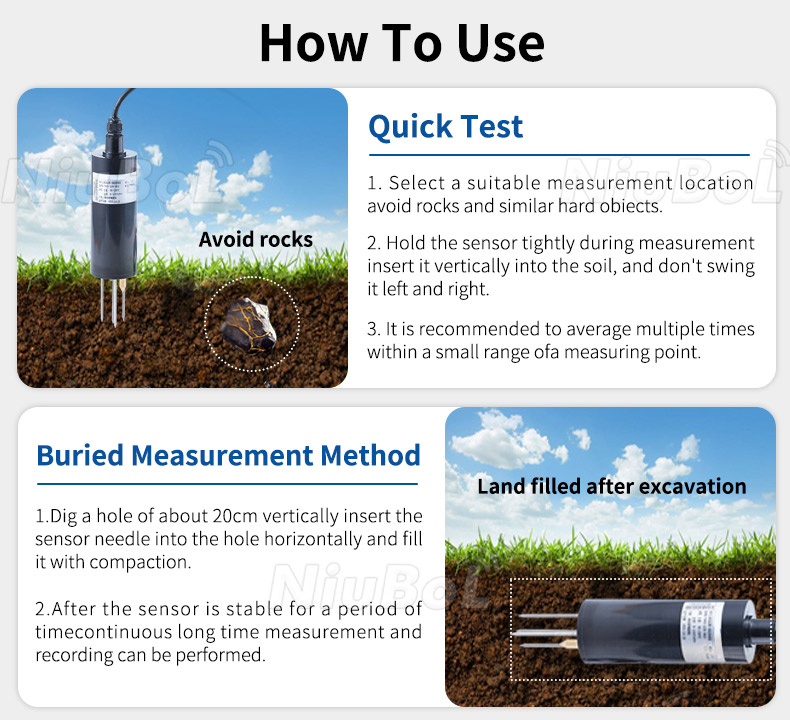
The NBL-S-THR can be used for temporary field testing or long-term soil monitoring at a selected depth.
Choose a representative monitoring location and avoid stones or hard objects that could damage the sensing rods.
Insert the probe into the soil carefully and maintain close contact between the sensing rods and surrounding soil.
Avoid moving the probe repeatedly after insertion because this can create air gaps and influence the reading.
For permanent installation, excavate to the desired monitoring depth and insert the sensing rods horizontally into undisturbed soil.
Ensure close contact with the surrounding soil and backfill the excavation carefully.
Protect the sensor cable from mechanical damage and record the measurement depth, monitoring location and installation conditions.
The installation depth should be selected according to crop rooting conditions, irrigation methods and the purpose of the measurement.
Shallow soil sensors can help observe water changes near the soil surface, while deeper sensors provide information about moisture conditions in lower root-zone layers.
For crops with deeper roots, monitoring at more than one depth may provide useful information about irrigation penetration and soil water distribution.
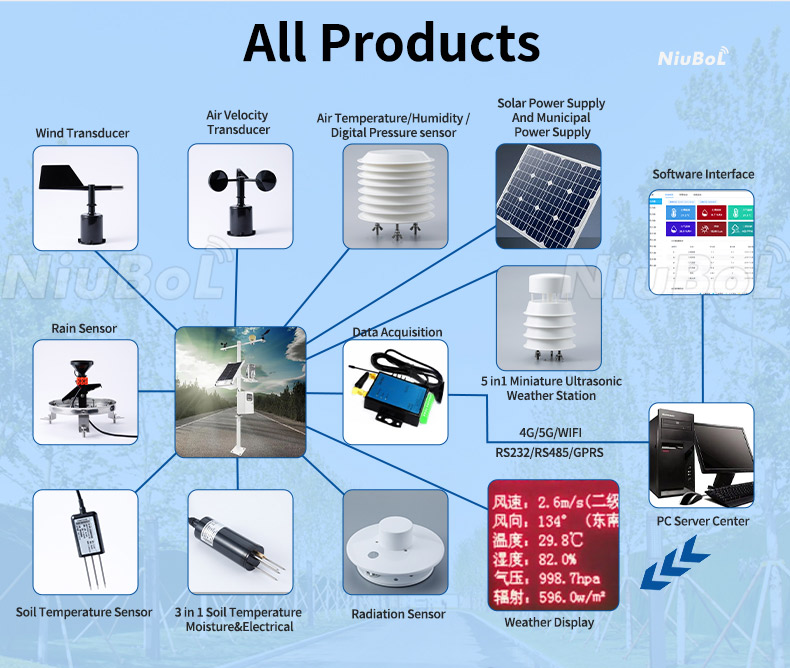
A complete agricultural monitoring system may combine soil moisture sensors with data loggers, communication gateways, automatic weather stations and suitable power equipment.
The required components depend on the monitoring area, number of sensors, installation location and data communication requirements.
The RS485 version of the NBL-S-THR can connect to compatible PLCs, data loggers, RTUs and agricultural monitoring gateways.
The connected gateway can collect soil moisture and temperature measurements and transmit them through its supported network interface to a compatible monitoring platform or private server.
The sensor itself does not include an independent cellular, Wi-Fi or Internet connection.
For irrigation and agricultural monitoring, soil measurements can be combined with air temperature, humidity, rainfall, wind and solar radiation data.
These measurements provide environmental context for interpreting soil moisture changes over time.
Weather sensors, soil sensors and communication devices should be selected according to the required monitoring parameters and system compatibility.
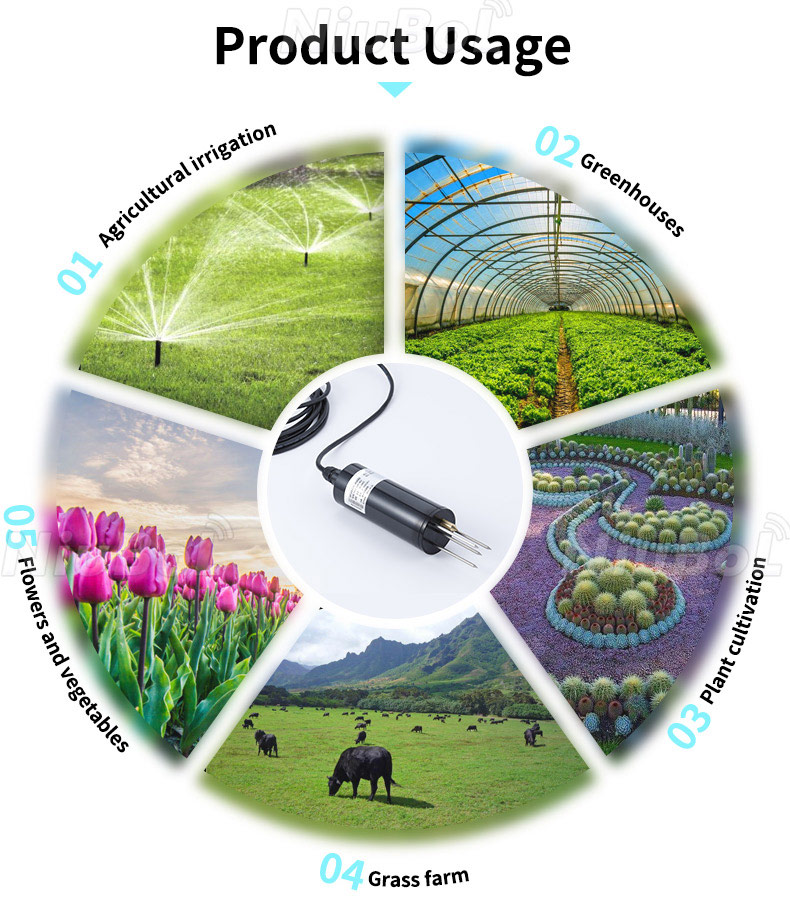
Soil moisture measurements provide useful information for agricultural irrigation planning and management.
Monitoring root-zone moisture before and after irrigation can help farmers evaluate irrigation response and observe whether soil water conditions are changing as expected.
A compatible irrigation controller can use soil moisture measurements as one input when determining whether irrigation equipment should operate.
Automatic irrigation requires additional components, including a controller, control logic, valves, pumps and suitable hydraulic equipment.
The soil sensor provides the measurement signal and does not directly operate the irrigation valve or pump.
Suitable irrigation thresholds depend on soil texture, crop requirements, rooting depth, irrigation method and the intended water management strategy.
A single volumetric soil moisture threshold is not appropriate for every soil type.
For example, sandy and clay-rich soils can have different plant-available water conditions at the same volumetric water content.
Large farms may contain different soil types, crops and irrigation arrangements.
Multiple monitoring points can provide information about these differences, helping operators evaluate conditions within separate management areas.
Monitoring zones and irrigation valve zones are not necessarily identical. Independent irrigation control requires a hydraulic system with appropriately separated control zones.
Soil moisture monitoring can help farmers observe water availability within the root zone and evaluate irrigation timing.
Sensor readings can be interpreted together with crop requirements, weather conditions and irrigation system information.
In soil-based greenhouses, moisture and temperature sensors can provide continuous observations of crop bed conditions.
These measurements can support greenhouse environmental monitoring and irrigation management.
In orchards, soil moisture sensors can be installed at selected depths to monitor water conditions around the active root zone.
The monitoring position should account for tree spacing, irrigation emitter location and soil variation.
Different vegetable crops and ornamental plants have different water requirements.
Soil moisture monitoring can help growers observe changing growing conditions and evaluate irrigation practices.
Soil moisture measurements can provide environmental observations for pastures, grassland monitoring and ecological research.
Soil moisture sensors can be used in research projects investigating water movement, irrigation response and soil environmental conditions.
Consistent installation, calibration and measurement procedures are important when comparing different monitoring locations.
Different agricultural monitoring requirements call for different sensor types.
A soil moisture and temperature sensor provides two environmental measurements. Other probes can measure electrical conductivity, pH, soil water tension or additional parameters.
For a monitoring project, select the measurements that are relevant to the intended agricultural decision.
NiuBoL supplies agricultural sensors with different measurement combinations and electrical interfaces.
For detailed information about the NBL-S-THR, see the TDR Soil Moisture and Temperature Sensor product page.
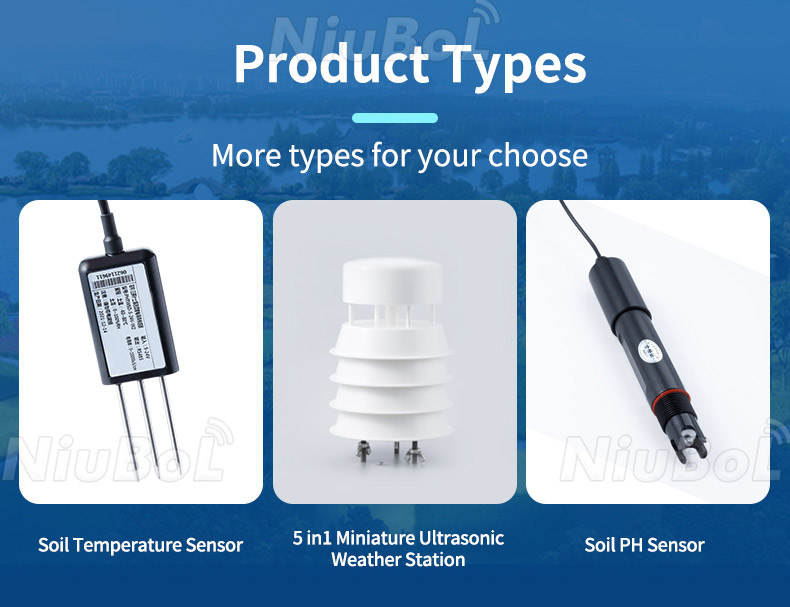
Sandy, clay-rich and organic soils have different physical and dielectric characteristics.
These properties can affect sensor response and the interpretation of volumetric soil moisture measurements.
Dissolved salts influence soil electrical properties. Their effect depends on the sensing technology, instrument design and calibration.
Air gaps and poor contact around the sensing rods can produce unrepresentative readings.
Careful installation is important for stable field measurements.
Soil moisture can vary significantly with depth, distance from irrigation emitters, slope and drainage conditions.
Monitoring points should be selected to represent the conditions relevant to the agricultural application.
For applications requiring high measurement confidence, soil-specific calibration or comparison with suitable reference measurements may be appropriate.
A1. The correct output depends on the receiving equipment. RS485 Modbus RTU is suitable for compatible digital data loggers and PLCs. 4–20mA and 0–5V are alternatives for systems equipped with appropriate analog inputs.
A2. RS485 provides digital communication using Modbus RTU, while 4–20mA provides an analog current signal. The receiving system must support the selected interface.
A3. Yes. Multiple compatible RS485 sensors can share a properly designed communication bus when each device has a unique address and the wiring and power supply are suitable.
A4. Yes. The NBL-S-THR analog configuration provides separate soil moisture and temperature signals. The receiving equipment requires suitable analog input channels.
A5. Yes. It can connect to a compatible PLC through the selected RS485, 4–20mA or 0–5V interface.
A6. The soil moisture measurement range is 0–100%, with a specified resolution of 0.1% and moisture accuracy of ±3%.
A7. The NBL-S-THR requires DC 12–24V and has a power consumption of approximately 0.3W.
A8. The NBL-S-THR has an IP68-rated sensor body and is suitable for properly installed long-term soil monitoring. External connections and cables require appropriate protection.
A9. The sensor supplies soil moisture and temperature measurements. Automatic irrigation requires a compatible external controller, control logic, pumps and valves.
A10. No. The NBL-S-THR is a wired instrument. Remote monitoring requires a compatible external gateway or data logger with a suitable network connection.
A11. No. The NBL-S-THR measures soil moisture and temperature. Soil EC measurement requires an appropriate additional or integrated sensor.
A12. Please specify the receiving equipment, available RS485 or analog inputs, required measurements, power supply, cable length, quantity and installation environment.
Download the NBL-S-THR user manual for technical specifications, output calculations, electrical connections, installation information and RS485 Modbus RTU communication details.
NBL-S-THR-Soil-temperature-and-moisture-sensors-Instruction-Manual-V4.0.pdf
The NBL-S-THR provides soil moisture and temperature measurements for agricultural monitoring, greenhouse cultivation and irrigation system integration.
For agricultural monitoring projects, the appropriate electrical output should match the receiving controller or data logger.
When requesting a quotation, please specify the required sensor quantity, output type, power supply, cable length, installation depth, soil conditions and data acquisition equipment.
For additional product information, visit the NBL-S-THR Soil Moisture and Temperature Sensor page.
To discuss equipment selection or system compatibility, contact NiuBoL with your application requirements.
NiuBoL supplies measurement instruments for agriculture, meteorology, environmental monitoring and related data acquisition applications.
The product range includes soil moisture and temperature sensors, soil EC probes, soil pH sensors, integrated agricultural sensors and weather station equipment.
Sensors & Weather Stations Catalog
 Agriculture Sensors and Weather Stations Catalog-NiuBoL.pdf
Weather Stations Catalog-NiuBoL.pdf
Agriculture Sensors Catalog-NiuBoL.pdf
Water Quality Sensor Catalog-NiuBoL.pdf
Related recommendations
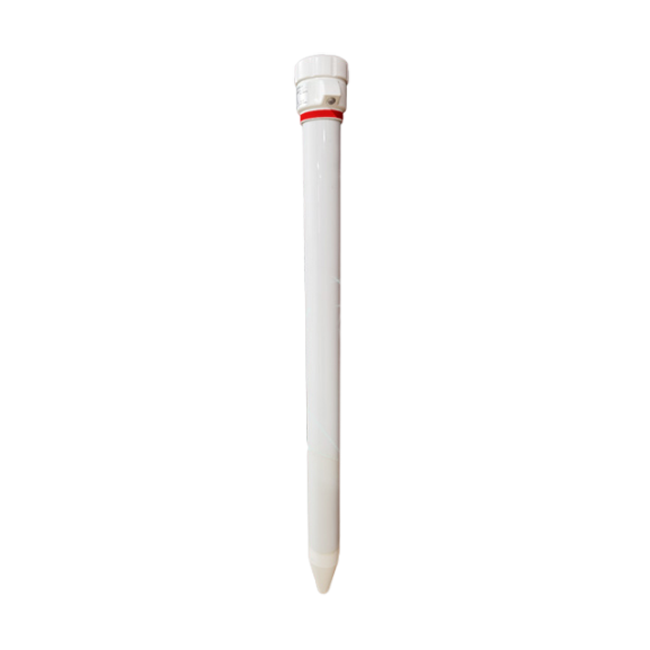 Multi-Depth Soil Sensor RS485
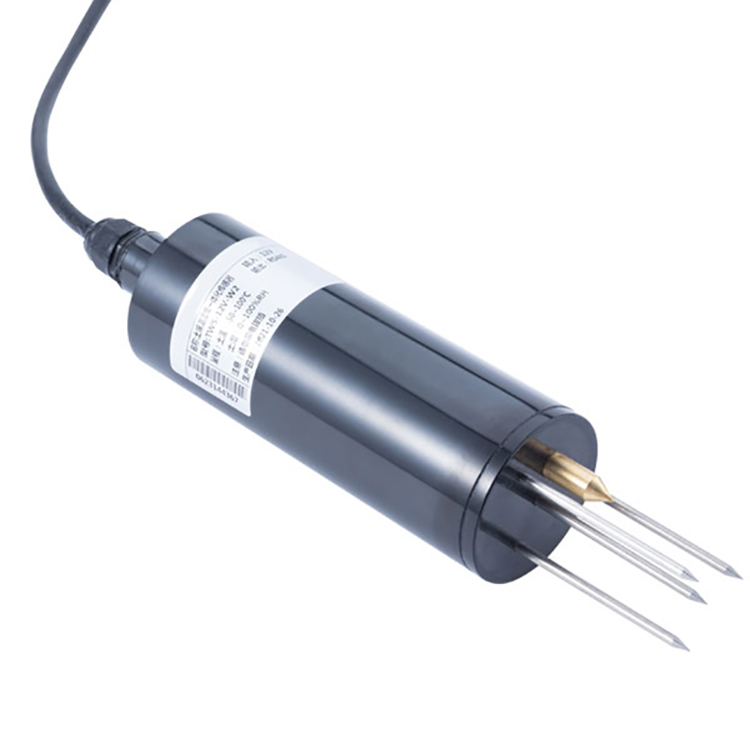 TDR Soil Moisture Sensor
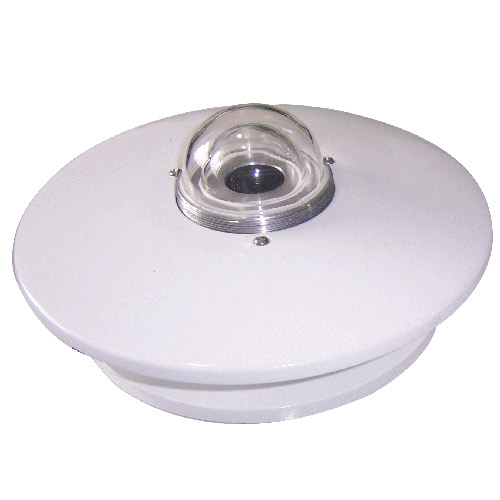 Pyranometer Solar Radiation Sensors
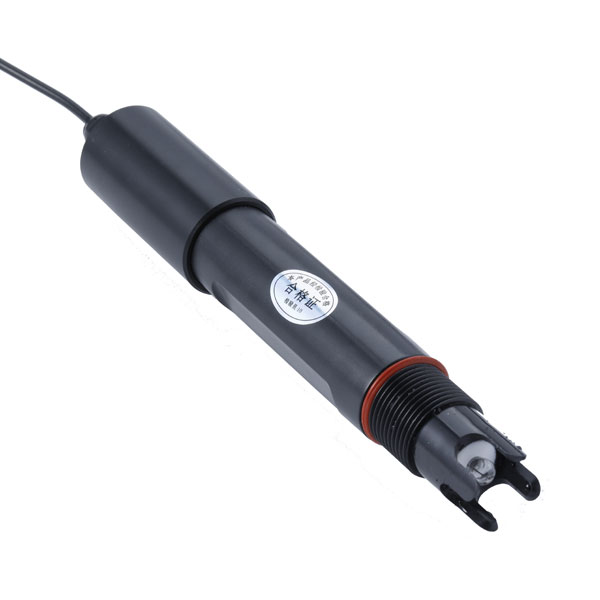 Soil ph sensor
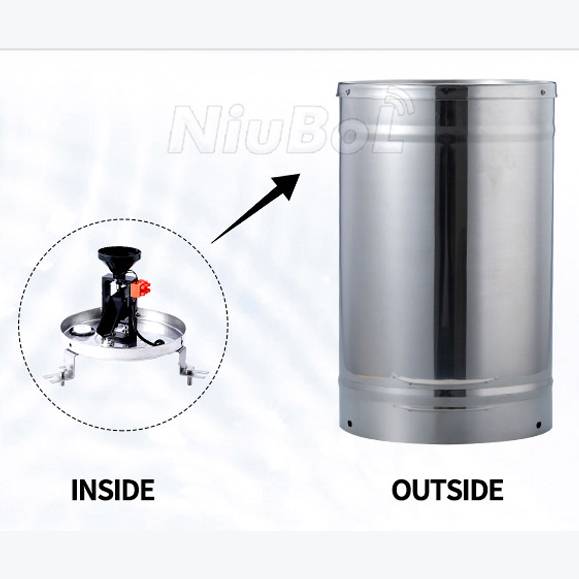 Tipping Bucket Rain Gauge - ABS and Stainless Steel
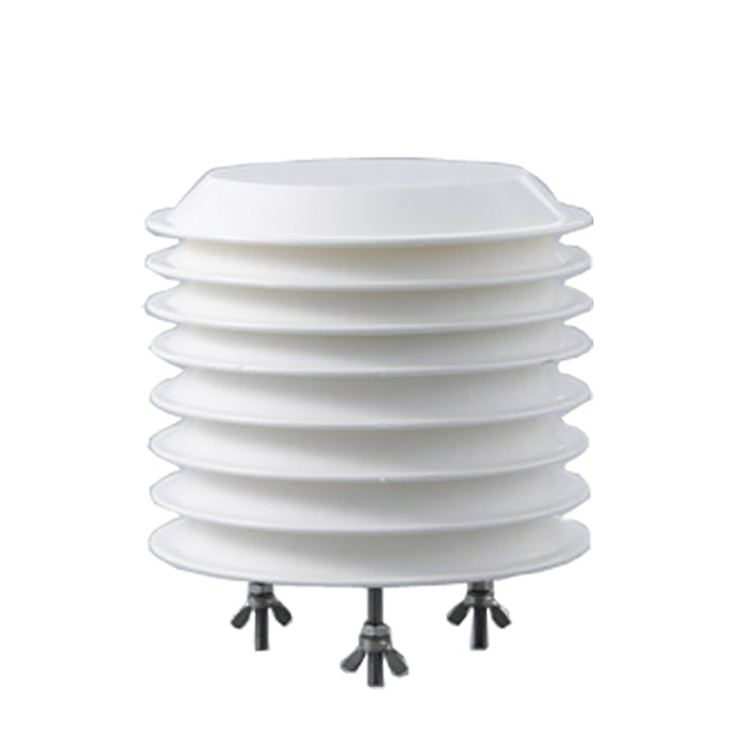 Air Temperature and Humidity Sensor


Screenshot, WhatsApp to identify the QR code
WhatsApp number:+8615367865107
(Click on WhatsApp to copy and add friends)

