

— Download —
 Consumer hotline +8618073152920
 WhatsApp:+8615367865107
Address:Room 102, District D, Houhu Industrial Park, Yuelu District, Changsha City, Hunan Province, China
All products
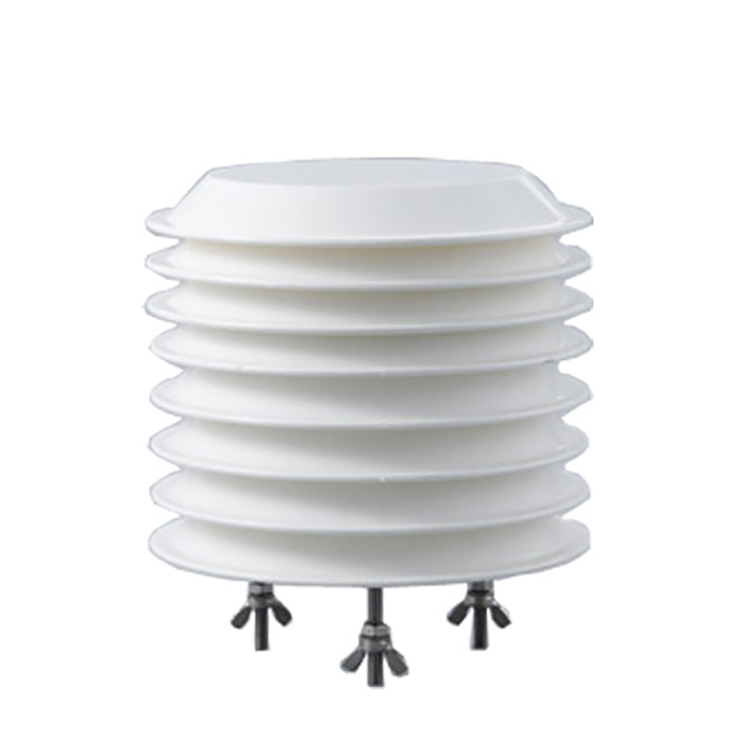
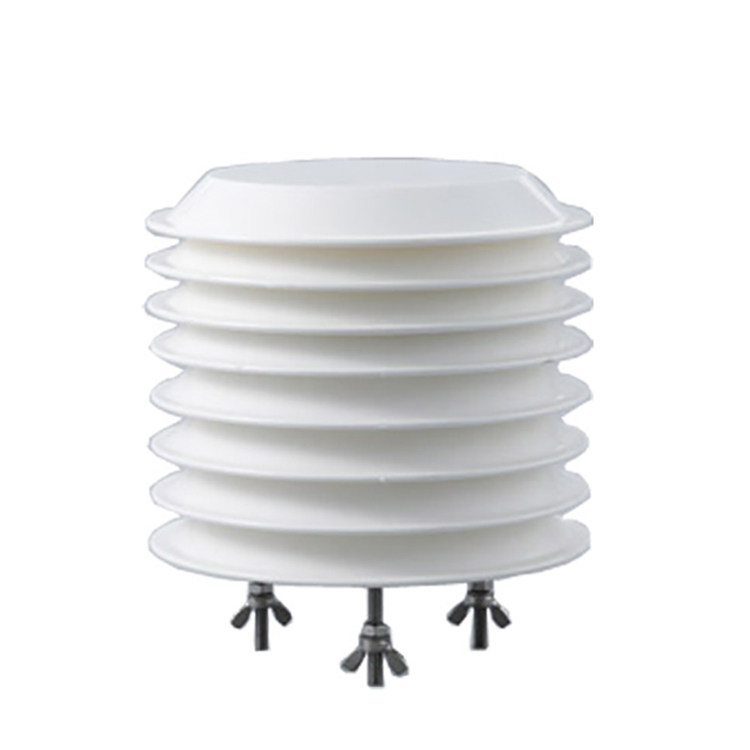
Integrate the NiuBoL NBL-W-LBTH temperature humidity pressure sensor into a weather station. Review radiation shielding, pressure units and RS485 setup for your project.
Tel/WhatsApp:+8615367865107
Email:Arvin@niubol.com +Nearly 100 partner companies in more than 75 countries. We are committed to providing high-quality, practical products to meet your needs and help you solve problems. Our products comply with international standards and are certified with ISO, CE and RoHS.Product Details
Quick Answer: The NiuBoL NBL-W-LBTH temperature humidity pressure sensor provides three atmospheric measurements in one louvered assembly. Its ranges are -40 to 80 degrees C, 0-100% RH and 10-1200 hPa, with 12-24 VDC supply and RS485 or 4-20mA output options. It is suitable when the three channels can share one representative air location. Radiation shielding, airflow and the pressure comparison method matter as much as connecting the logger.
| Item | Specification |
|---|---|
| Temperature | -40 to 80 degrees C; +/-0.5 degrees C; 0.1 degree C resolution |
| Relative humidity | 0-100% RH; +/-5% RH; 0.1% RH resolution |
| Pressure | 10-1200 hPa; +/-1.5 hPa; 0.1 hPa resolution |
| Supply | 12-24 VDC |
| Outputs | RS485 or 4-20mA depending on ordered configuration |
| Operating temperature | -40 to 80 degrees C |
| Operating humidity | 0-100% RH |
| Typical integration | Weather station, logger, PLC or RTU |
Combining the channels reduces separate mounting and acquisition work at an atmospheric monitoring point. In the RS485 configuration, a compatible PLC, RTU or data logger can acquire the temperature, humidity and pressure values over one addressed interface. Remote communication still requires the logger or gateway; the sensor is not a cellular weather station by itself.
A shared location is useful on a weather station mast or at a defined crop microclimate point. It is less suitable when the project needs temperature inside a process duct but atmospheric pressure outdoors, or humidity at several different canopy heights. In those cases, choose separate measurement points rather than forcing all three requirements into one convenient installation.
Check whether pressure is required at all. A project concerned only with local air temperature and humidity may use a two-channel instrument. Select NBL-W-LBTH when the pressure channel has a defined role, such as a meteorological record or another calculation that requires atmospheric pressure.
Avoid walls, roofs, exhausts, heaters and stagnant enclosures. Use the intended radiation protection and allow airflow around the sensing area. A convenient mounting point can still be meteorologically wrong.
The louvered radiation shield must remain around the sensing elements while allowing surrounding air to pass through it. Do not put the entire assembly in a sealed electrical cabinet and expect an outdoor ambient reading. The cabinet's heat and restricted exchange create a different measurement environment.
During a warm daytime comparison, inspect direct and reflected radiation, dark nearby surfaces and heat from equipment. An offset that grows with sunshine or low airflow is a reason to investigate exposure before changing the temperature calibration. Replacing the sensing element without correcting the location can leave the same error in place.
High humidity does not mean liquid water is harmless. Condensation, direct rain and blocked ventilation can delay or bias response. Mount and inspect the shield according to exposure.
Relative humidity also depends on air temperature. A local warm pocket can produce a different RH reading even without a corresponding change in water-vapor content. Keep temperature and humidity references together in comparable, well-ventilated conditions; holding a handheld meter nearby for a few seconds is not necessarily an equilibrated comparison.
For agricultural monitoring, choose the height from the required crop reference and inspect it as the canopy develops. A fixed bracket can become shaded, enclosed by foliage or exposed to irrigation spray later in the season. For industrial ambient monitoring, review exhausts, open doors and equipment operating states at the proposed location.
The pressure channel measures atmospheric pressure at the sensor's location. A weather service may display pressure reduced to sea level, which is a different reported quantity. At an elevated site, comparing those two numbers without checking their basis can create an apparent calibration error even when both systems are operating correctly.
Use a colocated reference at a comparable time and establish whether either system applies an elevation reduction or another correction. Document where any reduction is calculated. Applying a reduction in the logger and again on the server can produce a systematic discrepancy that should not be corrected at the sensor.
Keep units explicit. One hPa equals one mbar and 100 Pa; 1000 hPa is 100 kPa. A platform that receives a value in hPa but labels it as Pa or kPa can introduce a large numerical error. This check is independent of the sensor's +/-1.5 hPa specified accuracy.
The wide 10-1200 hPa measuring interval does not make this an industrial compressed-gas pressure transmitter. The assembly is an atmospheric sensor, not a process-pressure instrument with a pressure-rated connection. Select a suitable process transmitter when the measurement requires a sealed pipe connection or a pressurized medium.
The NBL-W-LBTH V4.0 sensor communicates over RS485 Modbus RTU with 9600 baud, 8 data bits, no parity and at least 1000 ms between communications. Match the delivered stop-bit setting and give devices on the installed bus distinct supported addresses.
The V4.0 channel order is temperature, humidity and pressure, with 0.1-unit resolution for each. Confirm the supplied protocol revision before programming. The same decimal conversion does not make the channels interchangeable: pressure belongs in hPa, humidity in % RH and temperature in the selected temperature unit.
For example, a decoded pressure count of 10112 represents 1011.2 hPa under the documented 0.1 hPa conversion. Check the value at the logger and at the final platform. Keep negative-temperature interpretation in the delivered data definition rather than copying an unsigned input template from another device.
For the 4-20mA option, request the actual channel wiring and assigned analog spans. Do not assume a single current loop contains all three measurements. Confirm the number of receiving inputs, signal returns and scaling before ordering; the choice affects the PLC input hardware as well as the sensor.
| Channel | Field check that answers a useful question |
|---|---|
| Temperature | Allow a suitable reference and sensor to equilibrate in comparable air exposure. Repeat if direct heating or airflow makes the comparison unstable. |
| Relative humidity | Compare in the same air volume after stabilization. Inspect condensation and reference temperature before assigning a humidity offset. |
| Pressure | Compare colocated values at a similar time, in matching units and on the same station-pressure or reduced-pressure basis. |
| Acquisition path | Check all three engineering values and their units at the logger and receiving platform. A valid serial response is not a three-channel acceptance result. |
Choose reference uncertainty and acceptance tolerances appropriate to the project. Display resolution is not a substitute for measurement accuracy. Avoid adding a software offset to make two instruments agree when their exposure or pressure basis has not been matched.
Record the shield and mounting position with the accepted values. After relocation, replacement or work on the mast, repeat the comparisons that the change can affect. This is especially important when a replacement sensor inherits an old channel correction that no longer applies.
If all three channels disappear at the same time, begin with shared supply, communication and receiving configuration. If only pressure disagrees while temperature and humidity remain plausible, check pressure units and reduction first. If temperature and RH diverge mainly in sunshine, inspect the shield, airflow and nearby heat sources.
Inspect the louver openings for blockage and follow the maintenance method for the delivered assembly. Do not direct a water jet or sharp cleaning tool into the sensing area. A 0-100% RH measuring range is not an immersion rating, and a closed enclosure prevents the air exchange needed for an ambient measurement.
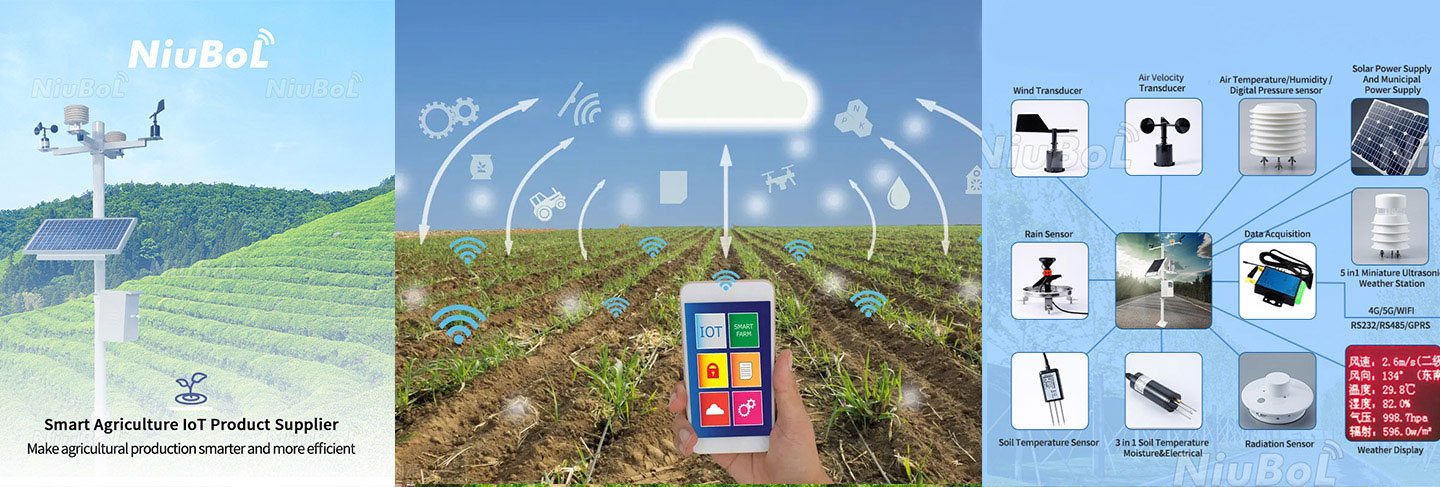
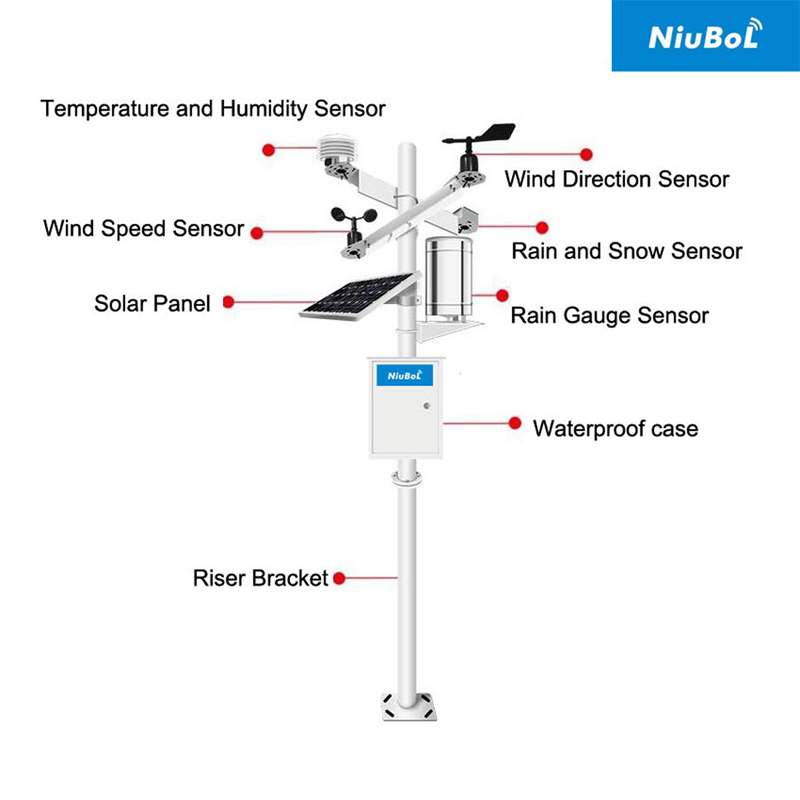
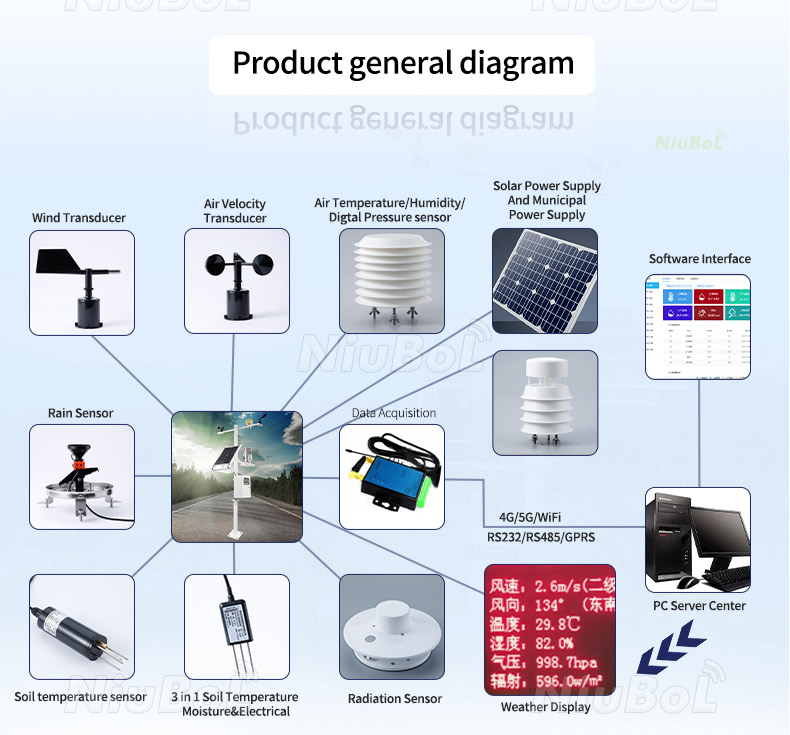
The system diagram below shows the acquisition and onward-transmission arrangement. Additional weather channels, power equipment and communications are separate configuration decisions. Include those items only when the monitoring point actually needs them.
First check whether the website gives sea-level-reduced pressure while the sensor reports pressure at its installation height. Then compare time, location and units. Do not apply a calibration offset until the quantities and reference conditions match.
Not for representative outdoor temperature and humidity. Keep the logger and power equipment in their cabinet while the atmospheric assembly samples the required air environment through its radiation shield. Cabinet air is a separate monitoring point.
No. It is an atmospheric measurement assembly, not a pressure-rated process transmitter. A pipeline application needs appropriate pressure connection, medium compatibility and pressure rating in addition to a measuring range.
Do not assume that from the 4-20mA option. Confirm the delivered channel arrangement and reserve the required inputs and signal returns. RS485 can provide separate digital values through one compatible bus connection.
Compare equilibrated references in the same air exposure, then check radiation, ventilation and nearby heat. An offset tied to sunshine is not automatically sensor calibration drift. Retain any deliberate correction with the sensor identity and installation record.
Provide required channels and tolerances, output, receiving equipment, mounting height, exposure and cable route. State whether shield, bracket, enclosure or remote communication is included. For pressure acceptance, identify the required station or reduced-pressure quantity.
NBL-W-LBTH combines three atmospheric channels, but each still needs the right exposure, units and comparison. Select it for a shared air-monitoring point, preserve ventilation around the shield and verify pressure on a matching basis. Send NiuBoL the location and logger requirements to review the assembly and interface.
Sensors & Weather Stations Catalog
 Agriculture Sensors and Weather Stations Catalog-NiuBoL.pdf
Weather Stations Catalog-NiuBoL.pdf
Agriculture Sensors Catalog-NiuBoL.pdf
Water Quality Sensor Catalog-NiuBoL.pdf
Related recommendations
 Multi-Depth Soil Sensor RS485
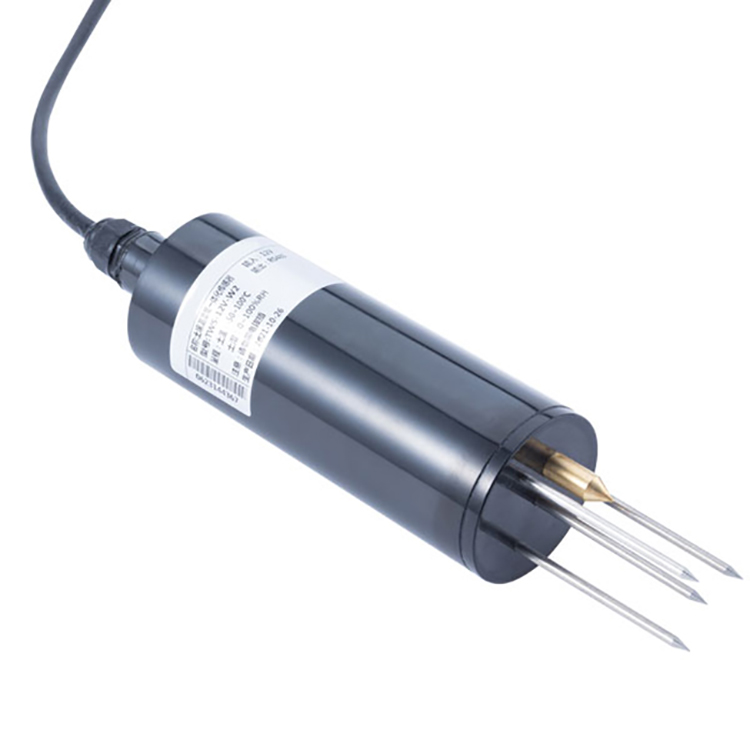 TDR Soil Moisture Sensor
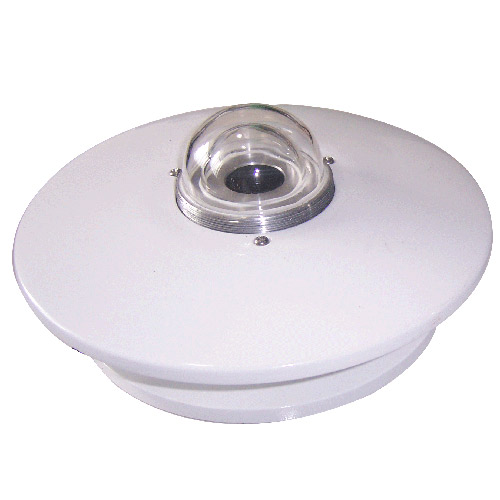 Pyranometer Solar Radiation Sensors
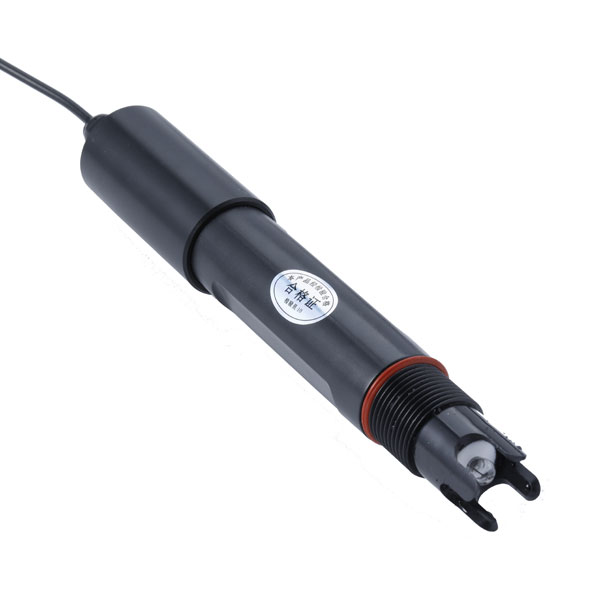 Soil ph sensor
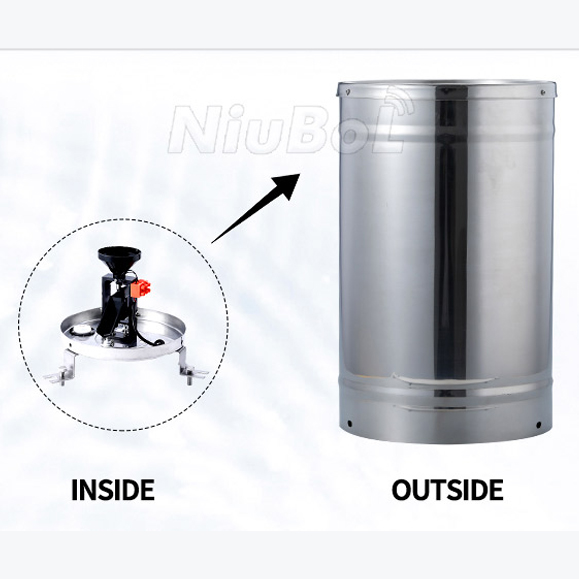 Tipping Bucket Rain Gauge
 Air Temperature and Humidity Sensor

Screenshot, WhatsApp to identify the QR code
WhatsApp number:+8615367865107
(Click on WhatsApp to copy and add friends)