





— Download —
 Consumer hotline +8618073152920
 WhatsApp:+8615367865107
Address:Room 102, District D, Houhu Industrial Park, Yuelu District, Changsha City, Hunan Province, China
All products
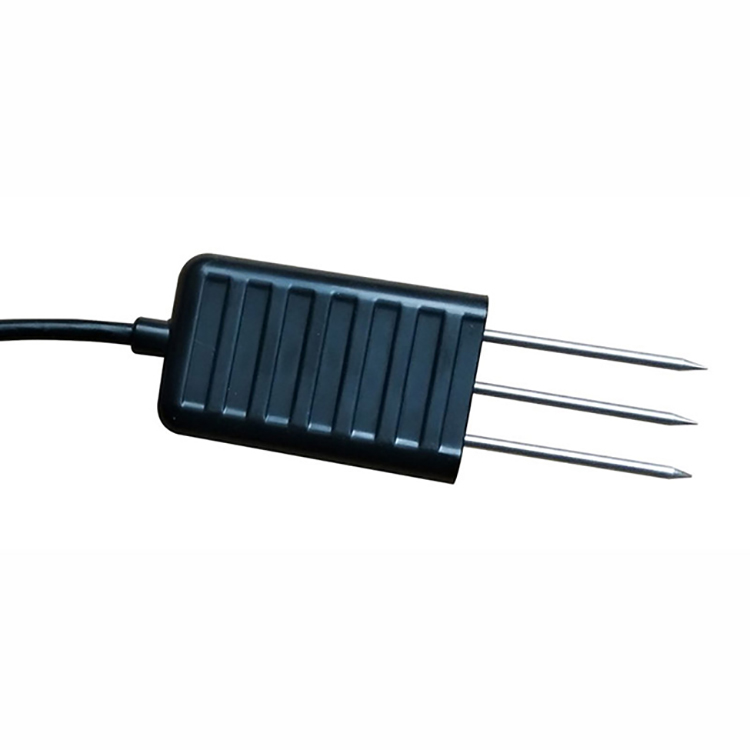
Soil nutrient detection sensors are devices used to measure the concentration of various nutrients in the soil, which is vital for plant growth and agricultural productivity. These sensors play a vital role in precision agriculture, helping farmers make informed decisions about fertiliser application, soil management and crop nutrition. Here are some key points about soil nutrient detection sensors:.
Tel/WhatsApp:+8615367865107
Email:Arvin@niubol.com +Nearly 100 partner companies in more than 75 countries. We are committed to providing high-quality, practical products to meet your needs and help you solve problems. Our products comply with international standards and are certified with ISO, CE and RoHS.Product Details
The NiuBoL NBL-S-NPK is an RS485 soil NPK sensor designed to provide field reference values for nitrogen (N), phosphorus (P) and potassium (K). It is suitable for smart agriculture, greenhouse monitoring, irrigation, soil research and IoT soil-monitoring projects.
The sensor outputs three parameters only: nitrogen, phosphorus and potassium. It does not provide separate EC or pH measurement channels.
The NPK values are generated from the probe's electrical response and empirical calibration/conversion model. Soil moisture, dissolved ions, salinity, fertilizer concentration, soil texture and probe contact can influence the sensor response. For this reason, the readings are most suitable for field comparison, trend monitoring and IoT data collection rather than as a replacement for laboratory chemical analysis.
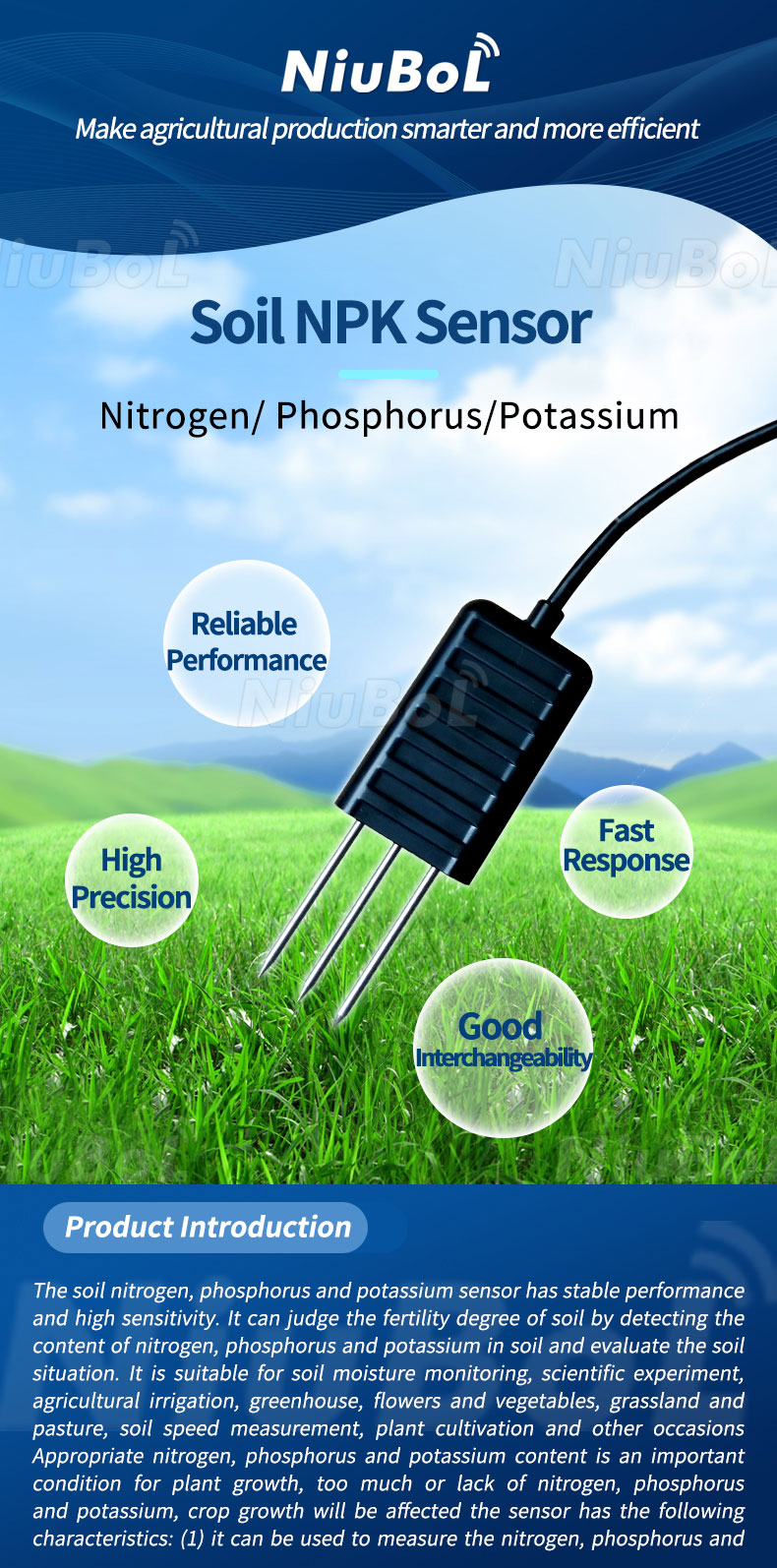
NPK refers to three major plant nutrients:
N – Nitrogen: involved in vegetative growth, chlorophyll formation and protein synthesis.
P – Phosphorus: important for energy transfer, root development and plant metabolism.
K – Potassium: involved in water regulation, enzyme activity and plant stress response.
The NBL-S-NPK provides separate digital output values for these three channels through RS485 Modbus RTU.
Important: The displayed N, P and K values are field reference values generated by the sensor model. They should not automatically be interpreted as laboratory-measured actual nutrient concentrations.
Three measurement channels: nitrogen, phosphorus and potassium
0–2000 mg/kg output range for each NPK channel
1 mg/kg resolution
RS485 Modbus RTU communication
12–24 V DC power supply
Configurable Modbus device address
Suitable for multi-sensor RS485 networks
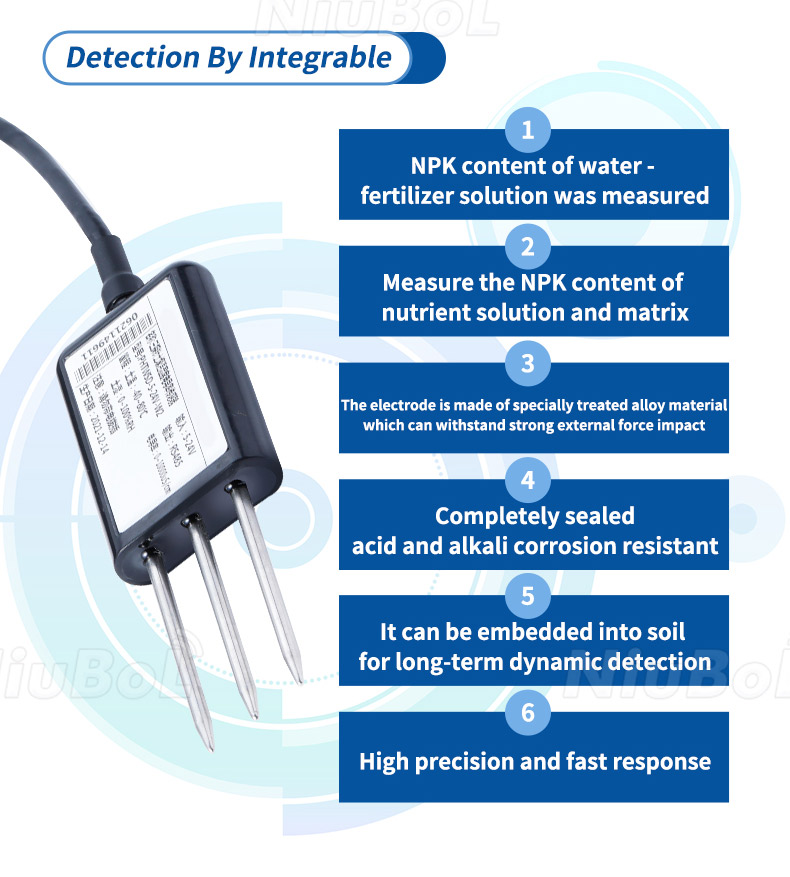
IP68 sealed probe structure
Suitable for long-term soil monitoring
Can connect to PLCs, RTUs, data loggers and IoT gateways
Suitable for agriculture, greenhouse, irrigation and research projects
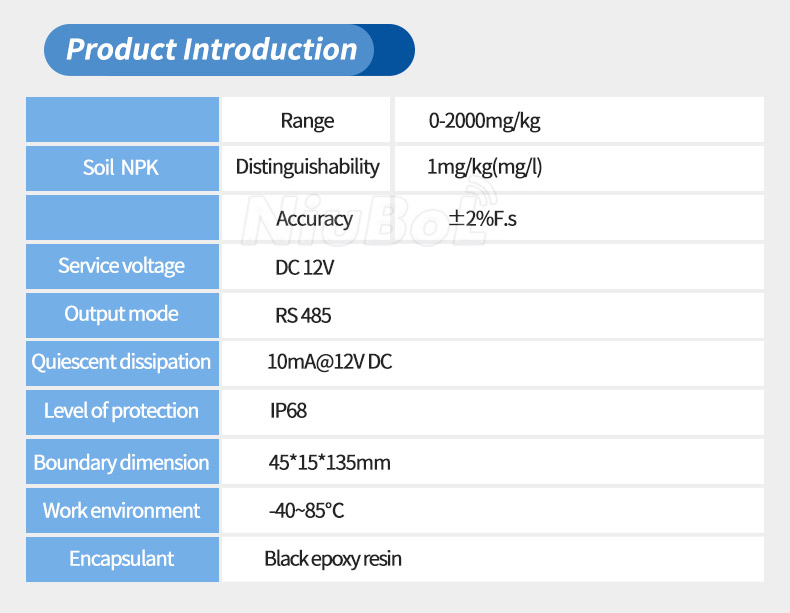
| Model | NBL-S-NPK |
| Measurement Channels | Nitrogen, Phosphorus, Potassium |
| Output Range | 0–2000 mg/kg |
| Resolution | 1 mg/kg |
| Specified Output Accuracy | ±2% F.S. under specified sensor test conditions |
| Communication | RS485 |
| Protocol | Modbus RTU |
| Power Supply | 12–24 V DC |
| Static Consumption | Approx. 10 mA @ 12 V DC |
| Protection | IP68 |
| Operating Environment | -40 to 85°C |
| Dimensions | 45 × 15 × 135 mm |
| Encapsulation | Black epoxy resin |
| Default Baud Rate | 9600 bps |
Note: The ±2% F.S. specification describes sensor output performance under defined test conditions. It does not mean ±2% agreement with laboratory-measured actual soil nitrogen, phosphorus and potassium concentrations.
The NBL-S-NPK uses the probe's electrical response together with an empirical calibration and conversion model to generate N, P and K reference values.
The sensor does not contain a separate EC measurement channel and does not output an EC value.
However, because the measurement is based on electrical response, factors such as soil moisture, dissolved ions, salinity, fertilizer concentration and soil texture can influence the NPK readings.
For this reason, the most useful application is to compare:
The same monitoring point over time
Different monitoring points under similar conditions
Changes before and after irrigation or fertilizer application
Relative nutrient-related trends in IoT monitoring projects
To avoid confusion during product selection, the NBL-S-NPK only outputs N, P and K.
| Parameter | NBL-S-NPK Output? |
|---|---|
| Nitrogen | Yes |
| Phosphorus | Yes |
| Potassium | Yes |
| Soil EC | No |
| Soil pH | No |
| Soil Moisture | No |
| Soil Temperature | No |
If these additional parameters are required, a separate sensor or a multi-parameter soil sensor should be selected.
| Comparison | NBL-S-NPK Field Sensor | Laboratory Analysis |
|---|---|---|
| Measurement Speed | Rapid / continuous | Requires sampling and analysis |
| Continuous Monitoring | Yes | Usually no |
| RS485 / IoT Integration | Yes | Usually not direct |
| Trend Monitoring | Suitable | Suitable but less frequent |
| Actual Nutrient Quantification | Reference / empirical output | Preferred method |
| Fertilizer Prescription | Should not be used alone | More appropriate with crop requirements |
Use the NBL-S-NPK when the goal is rapid field monitoring and trend comparison. Use laboratory analysis when accurate nutrient concentration is required for scientific analysis or fertilizer formulation.
Very dry soil can provide poor electrical contact with the probe. Changes in soil water content can also influence the electrical response used by the sensor.
Fertilizer application changes the concentration of dissolved ions in the soil and can therefore influence the probe's electrical response.
Higher salt concentration changes soil electrical properties and can influence the resulting NPK reference values.
Clay, sand, organic matter and other soil characteristics affect moisture retention and electrical behavior.
Soil conditions are not uniform. Measurements at different depths or positions can produce different readings.
Air gaps, stones and poor electrode contact can reduce measurement stability.
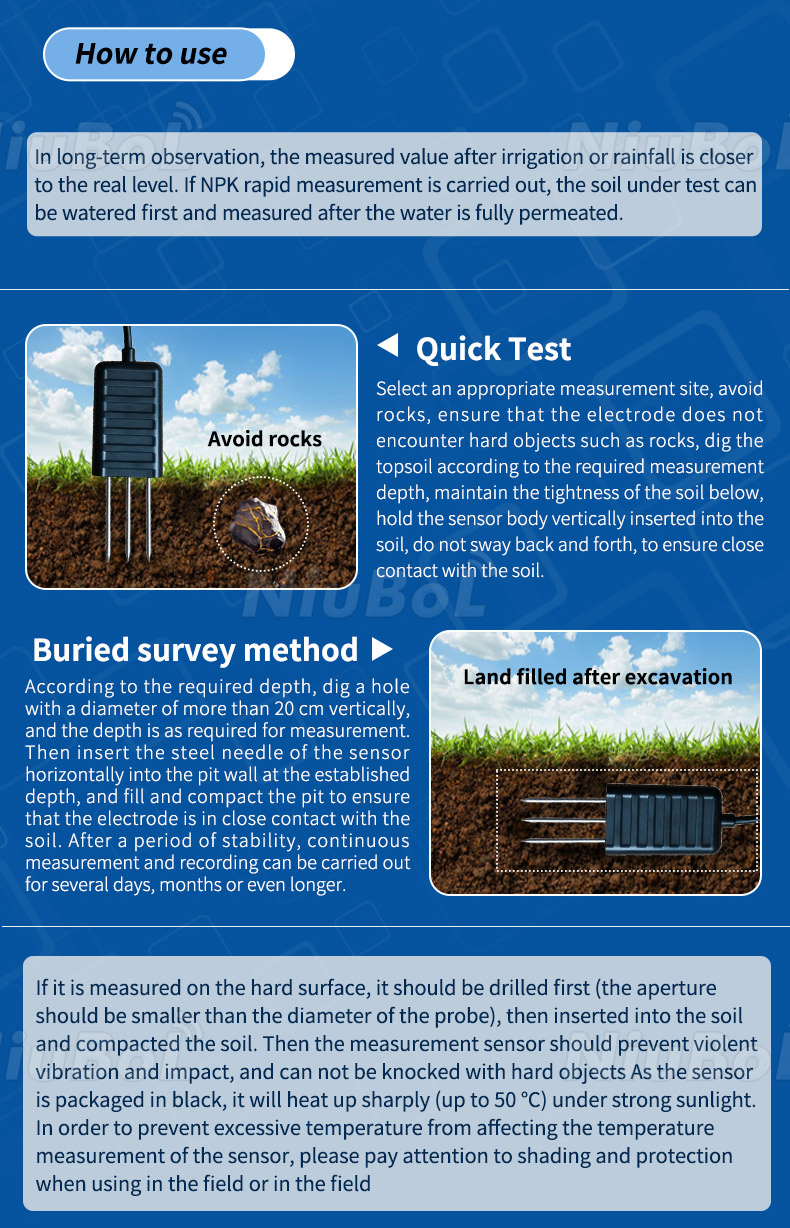
Choose a representative location and remove hard stones or other objects that could damage the probe.
Insert the probe vertically into the soil and make sure the electrodes have close contact with the surrounding soil.
Avoid repeatedly moving the probe from side to side, as this can create air gaps around the electrodes.
For comparative measurements, use similar insertion depth and soil-moisture conditions.
For permanent monitoring, dig a pit to the required depth and insert the probe horizontally into an undisturbed soil wall.
Backfill and compact the soil carefully to ensure close contact between the probe and surrounding soil.
The sensor can then remain connected to an RS485 data logger for continuous monitoring.
The NBL-S-NPK uses RS485 Modbus RTU and can connect to compatible PLCs, RTUs, data loggers and IoT gateways.
NBL-S-NPK → RS485 Modbus → PLC / Data Logger → 4G / Ethernet / LoRaWAN Gateway → MQTT / HTTP → Cloud or Private Server
| Protocol | Modbus RTU |
| Default Baud Rate | 9600 bps |
| Data Bits | 8 |
| Parity | None |
| Device Address | Configurable |
| Minimum Communication Interval | 1000 ms |
| Register | Parameter |
|---|---|
| 0000 | Nitrogen |
| 0001 | Phosphorus |
| 0002 | Potassium |
The sensor outputs only these NPK channels. There is no separate EC or pH register on the NBL-S-NPK model.
Multiple NBL-S-NPK sensors can share one RS485 communication bus when every sensor has a unique Modbus address.
Assign a unique address to each sensor.
Use twisted-pair cable for RS485 communication.
Prefer daisy-chain wiring where practical.
Use a suitable DC power supply.
Consider voltage drop on long cable runs.
Use termination where required for longer networks.
The RS485 sensor can be integrated with remote communication equipment when field data needs to be uploaded automatically.
NPK Sensor → RS485 → Data Logger / Gateway → 4G / Ethernet / LoRaWAN → MQTT / HTTP → Customer Server
For LoRaWAN projects, the NPK sensor normally connects to a compatible RS485-to-LoRaWAN node. The LoRaWAN node reads the N, P and K Modbus registers and packages them into a wireless payload.
For 4G projects, an RS485 data logger can read the sensor and send the measurements to a cloud platform or private MQTT / HTTP server.
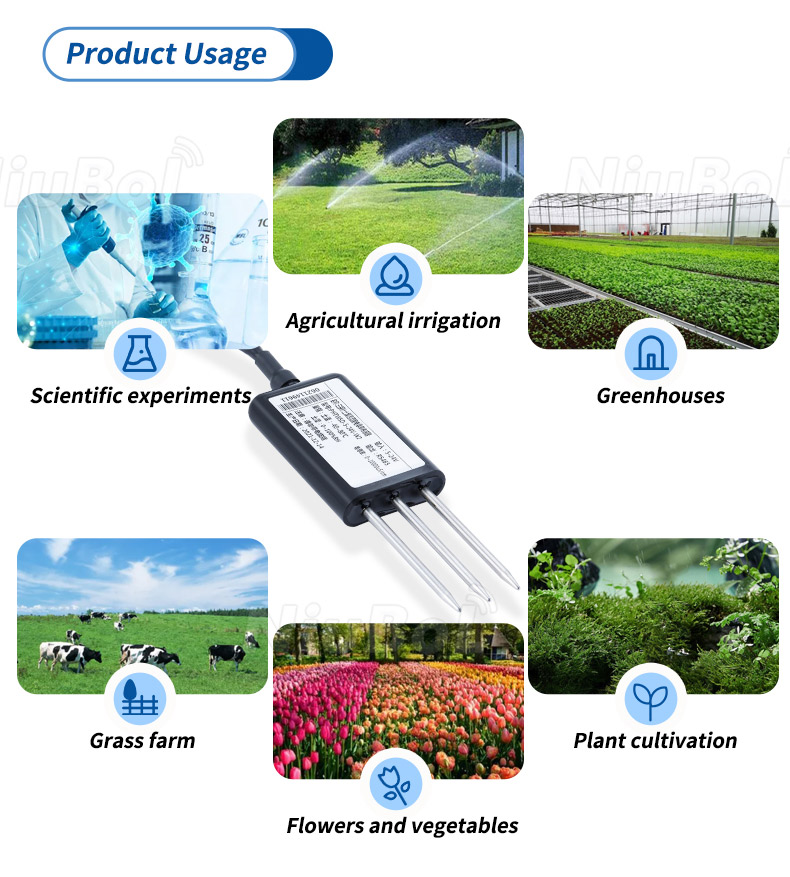
Precision agriculture
Greenhouse monitoring
Smart irrigation projects
Soil-condition trend monitoring
Research plots
Plant cultivation experiments
Grassland and pasture monitoring
Multi-point agricultural IoT systems
Choose the NBL-S-NPK when:
You specifically need N, P and K reference values.
You need RS485 Modbus output.
You need repeated or continuous field measurements.
You need several sensors connected to one monitoring network.
You need to upload field NPK trends to an IoT platform.
Do not choose this model if the project requires EC, pH, moisture or temperature output from the same sensor. In that case, select a dedicated sensor or multi-parameter model.
Assuming the sensor directly performs laboratory chemical analysis.
Assuming the sensor also measures EC.
Assuming the sensor also measures soil pH.
Using the reading as the only basis for fertilizer dosage.
Comparing measurements taken under very different soil-moisture conditions.
Installing the probe with poor soil contact.
Comparing one field sensor directly with a laboratory method without considering the different principles.
Using only one monitoring point in a large and highly variable field.
A1. It outputs three field reference values: nitrogen, phosphorus and potassium.
A2. No. The NBL-S-NPK does not provide an EC measurement or EC register.
A3. No. The standard NBL-S-NPK only provides N, P and K output.
A4. The sensor provides empirical field-reference values generated from its electrical response and calibration model. It is not equivalent to laboratory chemical nutrient analysis.
A5. No. Laboratory testing is recommended when accurate nutrient concentration or fertilizer formulation is required.
A6. Soil moisture affects electrical contact and the electrical properties of the soil environment. For comparison, measurements should be made under reasonably similar conditions.
A7. Yes. The IP68 probe can be installed for long-term field monitoring when the sensor is installed correctly and maintains good soil contact.
A8. Yes. The sensor supports RS485 Modbus RTU and can connect to compatible PLCs, RTUs and data loggers.
A9. Yes. Every sensor should use a unique Modbus address, and the RS485 wiring and power supply should be designed correctly.
A10. Yes. The sensor can connect to a compatible data logger or IoT gateway, which can send the NPK data through MQTT, HTTP or TCP depending on the system design.
A11. The values can support field trend observation but should not be used alone for fertilizer dosage. Crop requirements, laboratory soil analysis, growth stage and agronomic recommendations should also be considered.
1. NBL-S-NPK Soil NPK Sensor Instruction Manual
 NBL-S-NPK-Soil-NPK-Sensor-Instruction-Manual-4.0.pdf
For quotation and project selection, provide the required quantity, cable length, number of monitoring points, installation depth and whether the sensors will connect directly to a PLC, data logger, LoRaWAN node or 4G gateway.
For larger projects, also provide the approximate distance between monitoring points, available power supply, required upload interval and whether data must be sent to a cloud platform or private server.
Sensors & Weather Stations Catalog
 Agriculture Sensors and Weather Stations Catalog-NiuBoL.pdf
Weather Stations Catalog-NiuBoL.pdf
Agriculture Sensors Catalog-NiuBoL.pdf
Water Quality Sensor Catalog-NiuBoL.pdf
Related recommendations
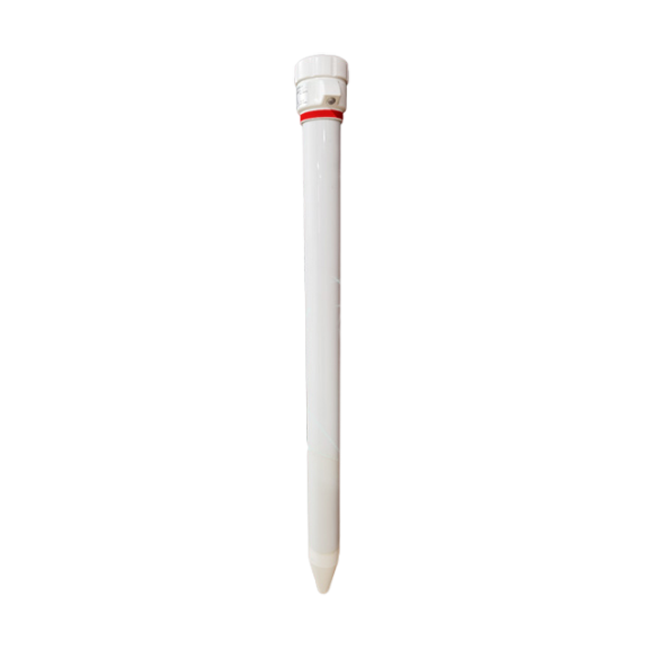 Multi-Depth Soil Sensor RS485
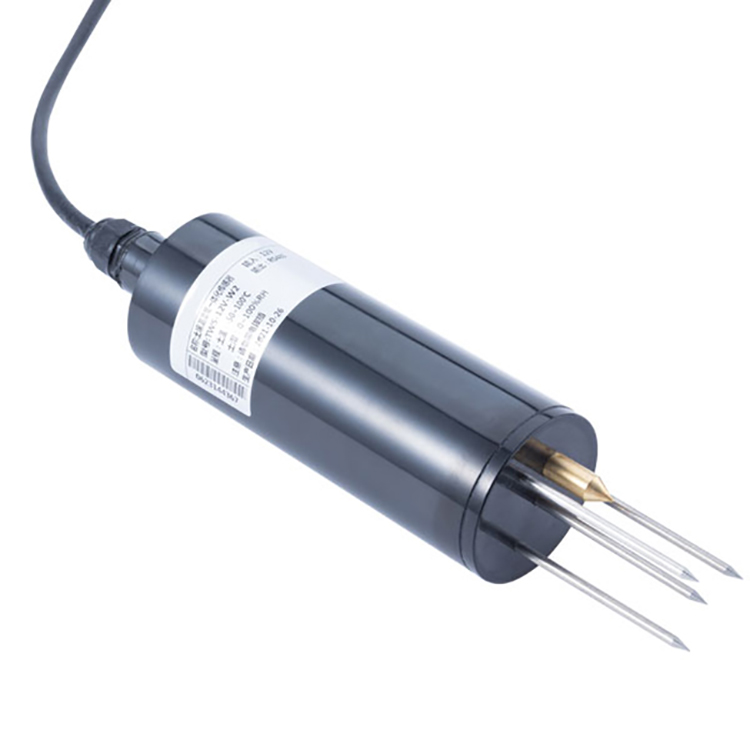 TDR Soil Moisture Sensor
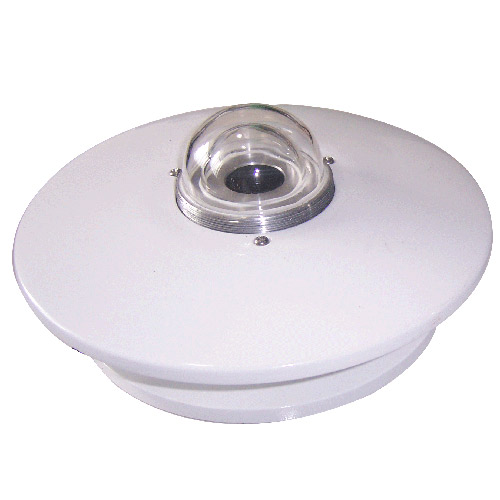 Pyranometer Solar Radiation Sensors
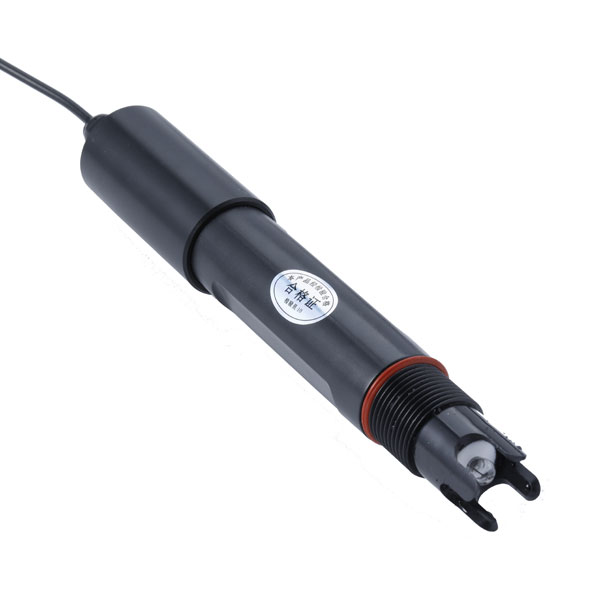 Soil ph sensor
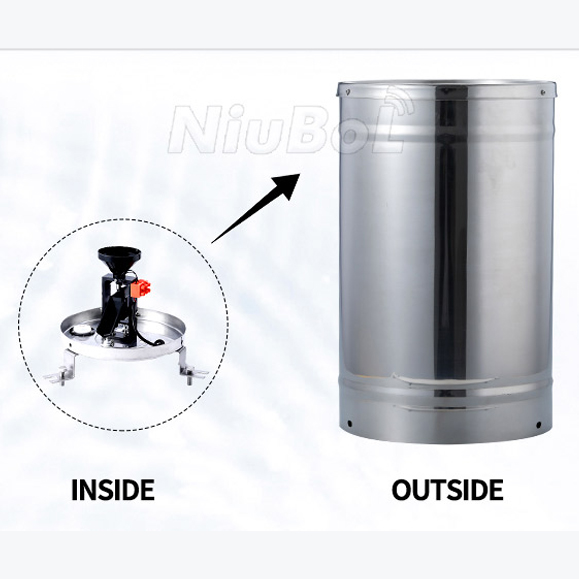 Tipping Bucket Rain Gauge
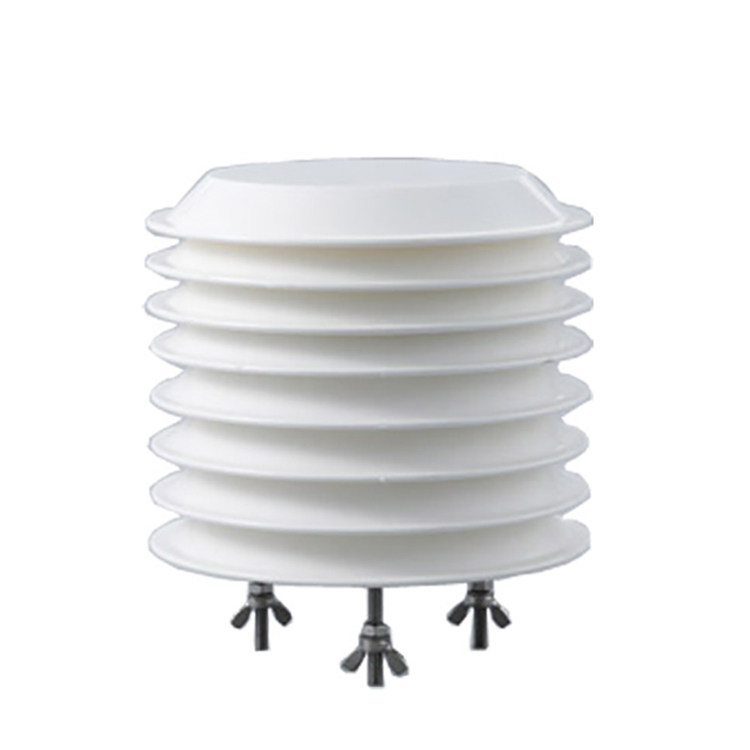 Air Temperature and Humidity Sensor

Screenshot, WhatsApp to identify the QR code
WhatsApp number:+8615367865107
(Click on WhatsApp to copy and add friends)

