





— Download —
 Consumer hotline +8618073152920
WhatsApp:+8615367865107
Address:Room 102, District D, Houhu Industrial Park, Yuelu District, Changsha City, Hunan Province, China
All products
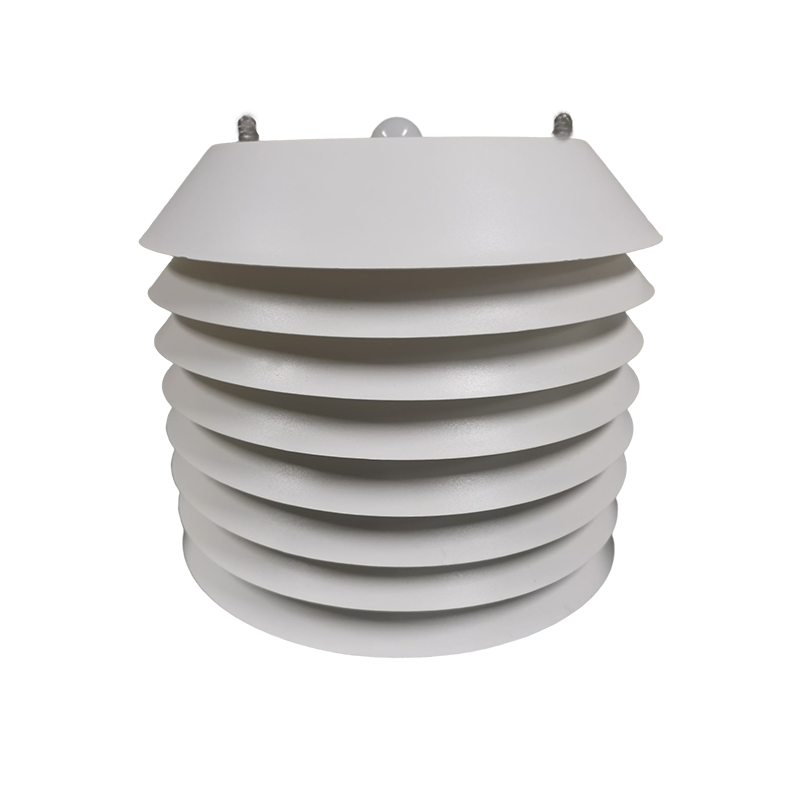
Integrate the NiuBoL 5-in-1 environmental sensor into a greenhouse or station. Check channel ranges, mounting tradeoffs and Modbus scaling before requesting a quotation.
Tel/WhatsApp:+8615367865107
Email:Arvin@niubol.com +Nearly 100 partner companies in more than 75 countries. We are committed to providing high-quality, practical products to meet your needs and help you solve problems. Our products comply with international standards and are certified with ISO, CE and RoHS.Product Details
Quick Answer: The NiuBoL 5-in-1 environmental sensor combines air temperature, relative humidity, barometric pressure, illuminance and CO2 through an RS485 interface. Select this arrangement when the five channels can share one suitable installation point. Its light value is Lux, not PAR or solar irradiance, and the 0-2000 ppm CO2 channel must cover the project's intended operating conditions. Each value needs its own unit and conversion in the receiving system.
| Channel or item | Specification |
|---|---|
| Temperature | -50 to 100 degrees C; +/-0.5 degree C accuracy; 0.1 degree C resolution |
| Relative humidity | 0-100% RH; +/-5% RH accuracy; 0.1% RH resolution |
| Barometric pressure | 10-1100 hPa; +/-0.3 hPa accuracy; 0.1 hPa resolution |
| Illuminance | 0-200000 Lux; +/-7% accuracy; 10 Lux resolution |
| CO2 | 0-2000 ppm; +/-(40 ppm + 2% full scale) accuracy; 1 ppm resolution |
| Supply options | 12 VDC or 24 VDC, as ordered |
| Interface | RS485 Modbus RTU |
| Operating environment | -50 to 80 degrees C; 0-100% RH |
Before replacing or adding an NBL-W-THPLC sensor, match its measuring ranges and resolution to the acquisition configuration. Do not inherit a pressure span or light conversion from a different revision merely because the housing looks the same.
The temperature measuring interval and the assembly's working environment are separate limits: the 100 degrees C measurement endpoint does not extend the specified 80 degrees C operating limit. Likewise, the humidity interval is not an immersion or direct-wetting rating.
Air channels need free ventilation away from walls, heaters, exhaust and dosing outlets. Illuminance needs a suitable light view. Survey both requirements before fixing the louver.
In a greenhouse, locate the air point in the intended mixed crop-zone air, away from a CO2 dosing outlet or ventilation jet. Then check the light view at that same point. A location appropriate for air monitoring may be shadowed by a crossarm or screen and may not represent the crop's light plane.
For a compact environmental station, one addressed assembly can reduce separate mounting and signal wiring. In a large atrium or divided greenhouse, however, one point may miss differences between levels or compartments. Use a site survey to decide the number of points rather than treating five channels as five spatial samples.
If crop-level light and representative air cannot share a position, use separate instruments at the required locations. The integrated sensor is useful where the measurements belong together; it does not remove the physical differences between canopy light, mixed air and a localized gas plume.
Radiant heating from walls, roofs or equipment can bias air temperature. Use the intended louver orientation and clearance and avoid stagnant cabinets.
Retain the intended radiation shield and airflow around the sensing elements. A sealed control box creates its own thermal and humidity environment, while nearby equipment can introduce heat even when the assembly remains shaded. Confirm the mounting clearance and cable strain relief for the supplied bracket.
Do not add an opaque cover that solves a mounting concern by obstructing the light view. Check the final arrangement with screens and ventilation in their normal operating states. After cleaning, pruning or work on a bracket, inspect whether the exposure has changed.
High humidity, dust and insects can affect louver airflow or optical response. Set inspection from the site and record cleaning or replacement.
Review a high-humidity disagreement with the actual wetting condition and air exchange. A blocked louver, local heater and condensation can produce different patterns. Treat an environmental symptom as a reason to inspect the installed point before applying a permanent software correction.
The RS485 configuration uses Modbus RTU, 9600 baud, 8 data bits and no parity, with at least 1000 ms between communications. Match the delivered stop-bit setting. Its channel sequence is temperature, humidity, pressure, illuminance and CO2; confirm that sequence against the supplied protocol revision.
| Channel | Illustrative decoded count | Engineering value |
|---|---|---|
| Temperature | 255 | 25.5 degrees C |
| Relative humidity | 655 | 65.5% RH |
| Pressure | 10245 | 1024.5 hPa |
| Illuminance | 86 | 860 Lux |
| CO2 | 980 | 980 ppm |
These examples illustrate the individual decimal conversions, not one captured response frame. The light channel uses a different multiplier from temperature, humidity and pressure, while CO2 uses ppm directly in this data definition. Check negative-temperature interpretation in the delivered documentation rather than using an unsigned template for every channel.
Bench-check one assembly and save the working configuration before installing a field bus. Give supported devices distinct addresses and map all five engineering values at the logger, then check them again after export or onward transmission. A correct temperature does not validate the other four conversions.
A logger or gateway provides storage and the selected remote communication path. Keep the difference between a new local reading and an old server record visible to the application. Reading five registers together does not, by itself, specify the internal timing of every sensing element.
For the stated 2000 ppm CO2 full scale, the accuracy expression is +/-80 ppm: 40 ppm plus 2% of 2000 ppm. The 1 ppm display increment is not a 1 ppm accuracy claim. Evaluate measurement accuracy, variation and process response separately when designing a controller's operating band.
Check expected peaks as well as the normal CO2 target. A system that can exceed 2000 ppm needs a suitable measurement range or another documented arrangement. A normal-looking endpoint or last valid value is not proof of the concentration after a channel has saturated or failed.
CO2 is not carbon monoxide or a general toxic-gas measurement. Use the appropriate purpose-built instruments when another gas or a safety duty is required. A combined environmental assembly should not be assigned unverified safety functions because it includes a gas concentration channel.
Illuminance is not solar irradiance or PAR. Use this channel for Lux-based monitoring and select other sensors when W/m2 or photon flux is required.
Use the Lux channel for a defined illuminance observation. A greenhouse project requiring PPFD or daily light integral needs a suitable photon measurement, and a PV station requiring irradiance needs a radiation sensor on the specified plane. An additional dedicated instrument can be more appropriate than converting the integrated light value with a fixed factor.
Compare temperature and humidity with suitable references in comparable, equilibrated air. Compare pressure in matching units and on the same station-pressure or reduced-pressure basis. Compare light in the same plane without introducing a temporary shadow. Check CO2 using the method and reference appropriate to the supplied configuration.
A casual outdoor CO2 observation is not a certified zero or an automatic calibration point. Likewise, a different weather service pressure or a light meter held at another angle is not sufficient evidence to alter a channel coefficient. Establish comparable conditions before interpreting a disagreement.
Test the receiving system's handling of unavailable data and recovery without substituting plausible values for missing channels. If one measurement is questionable, retain its status separately from the channels that remain valid. Agree the service procedure with the supplier rather than assuming that every internal element can be replaced independently in the field.
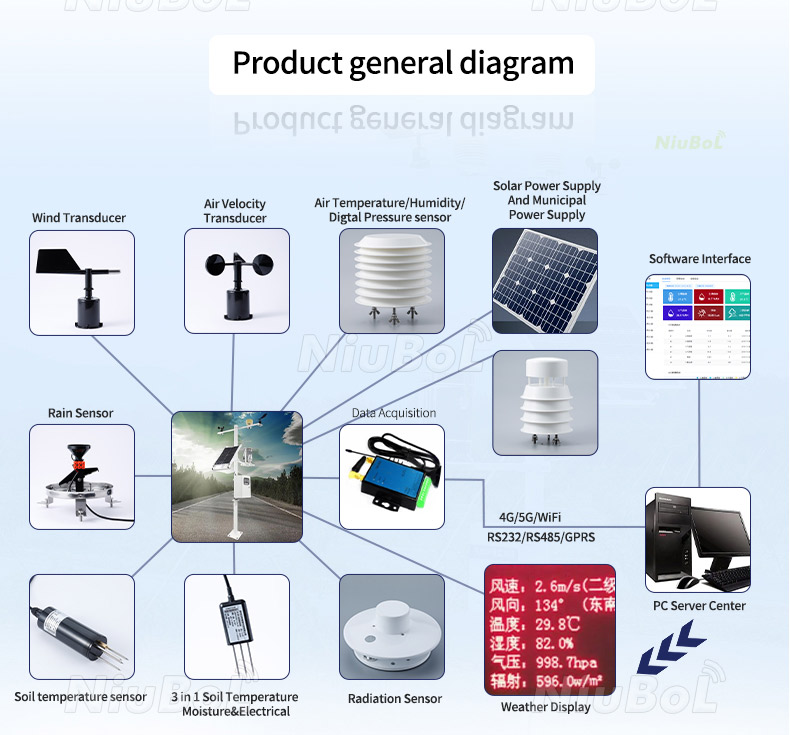
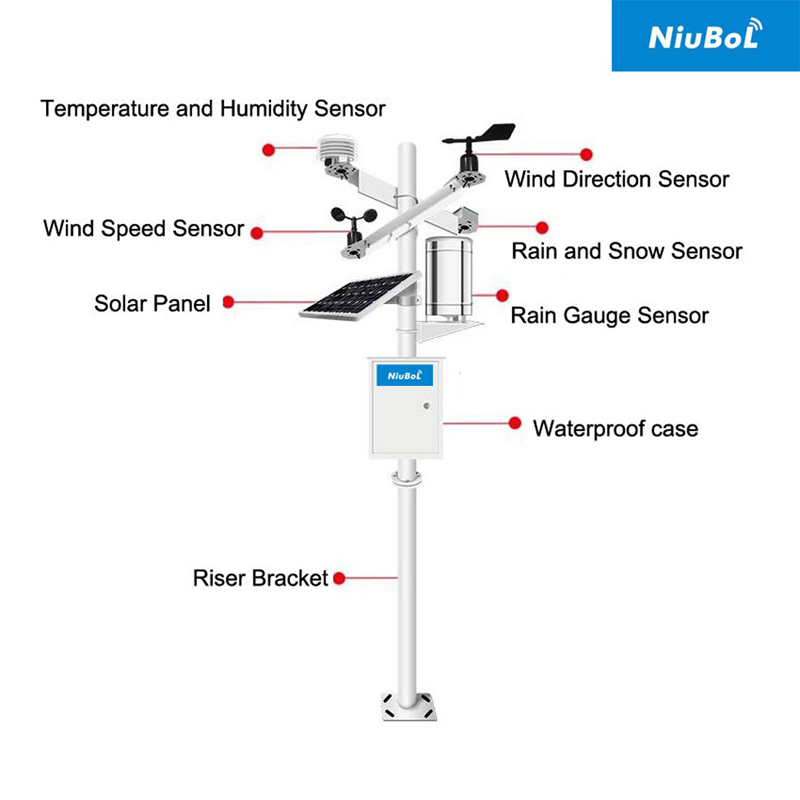
The modular station below shows how atmospheric measurements can be combined with separate wind and rainfall instruments. Those additional channels, the mast, power system and communications are separate equipment choices; they are not all included in a five-parameter sensor order.
When all five quantities can use the same suitable location and the receiver supports their digital definitions. Separate points are preferable when the required light plane, air sample or gas location differs. Compare installation suitability before counting saved ports.
The light channel has its own exposure and conversion. Check shadows, orientation and its documented multiplier. Correct air temperature neither establishes the light view nor validates that channel's scaling.
It gives +/-80 ppm from 40 ppm plus 2% of that full scale. This is different from a percentage-of-reading specification and from the 1 ppm output increment. Use the specification for the actual ordered range.
No. Lux, photon flux and irradiance are different quantities. Select a dedicated instrument for PPFD, daily photon integration or W/m2 rather than changing the integrated channel's unit label.
Not from that interface alone. A compatible logger, PLC, RTU or gateway acquires the local data and supplies the required onward connection. Specify storage, transport and platform requirements separately.
Confirm its supplied ranges, resolutions, address, serial format and protocol revision before transferring settings. Verify all five decoded channels and reconsider any previous software corrections. The same housing does not establish the same configuration.
Provide all five required ranges and tolerances, CO2 peaks, light purpose, installation drawing, supply and receiving equipment. Include cable, bracket, service access and any separate light or weather instruments so NiuBoL can review the complete point without assuming extra measurements.
Select the 5-in-1 environmental sensor where five channels can share an appropriate exposure. Match the ordered ranges to the controller, verify each conversion and use separate instruments when the measurement locations or quantities differ. Send NiuBoL the channel requirements and mounting layout for integration review.
Prev:Water level sensor For Agricultural Aquaculture analog 0-5v/4-20mA/rs485
Next:Ultrasonic wind speed and direction sensor RS485/MODBUS
Sensors & Weather Stations Catalog
 Agriculture Sensors and Weather Stations Catalog-NiuBoL.pdf
Weather Stations Catalog-NiuBoL.pdf
Agriculture Sensors Catalog-NiuBoL.pdf
Water Quality Sensor Catalog-NiuBoL.pdf
Related recommendations
 Multi-Depth Soil Sensor RS485
 TDR Soil Moisture Sensor
 Pyranometer Solar Radiation Sensors
 Soil ph sensor
 Tipping Bucket Rain Gauge
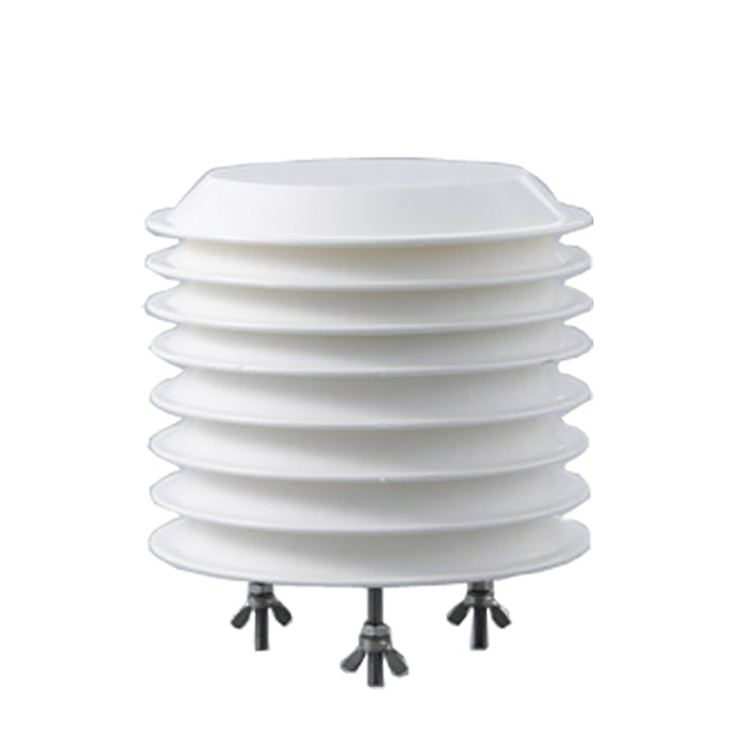 Air Temperature and Humidity Sensor


Screenshot, WhatsApp to identify the QR code
WhatsApp number:+8615367865107
(Click on WhatsApp to copy and add friends)

