





— Download —
 Consumer hotline +8618073152920
WhatsApp:+8615367865107
Address:Room 102, District D, Houhu Industrial Park, Yuelu District, Changsha City, Hunan Province, China
All products
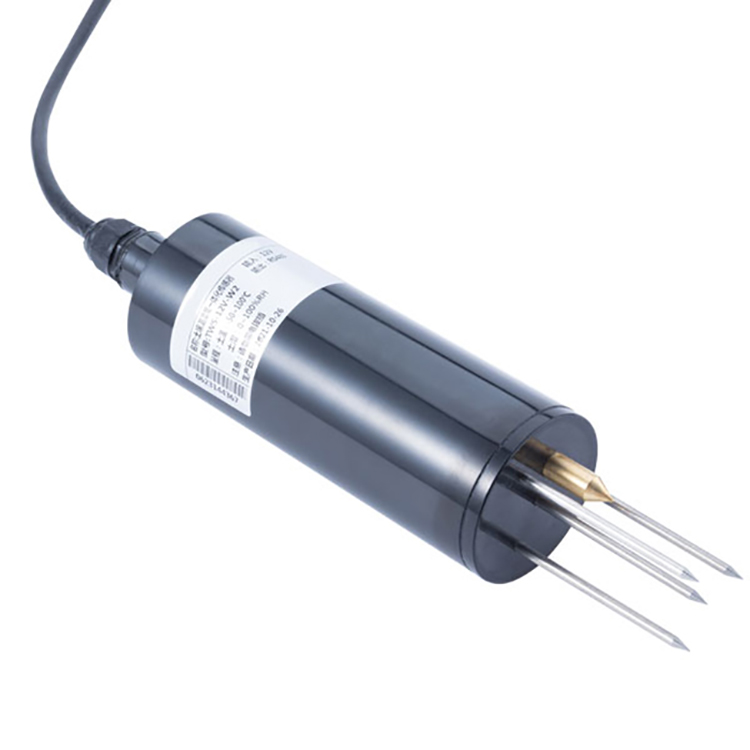
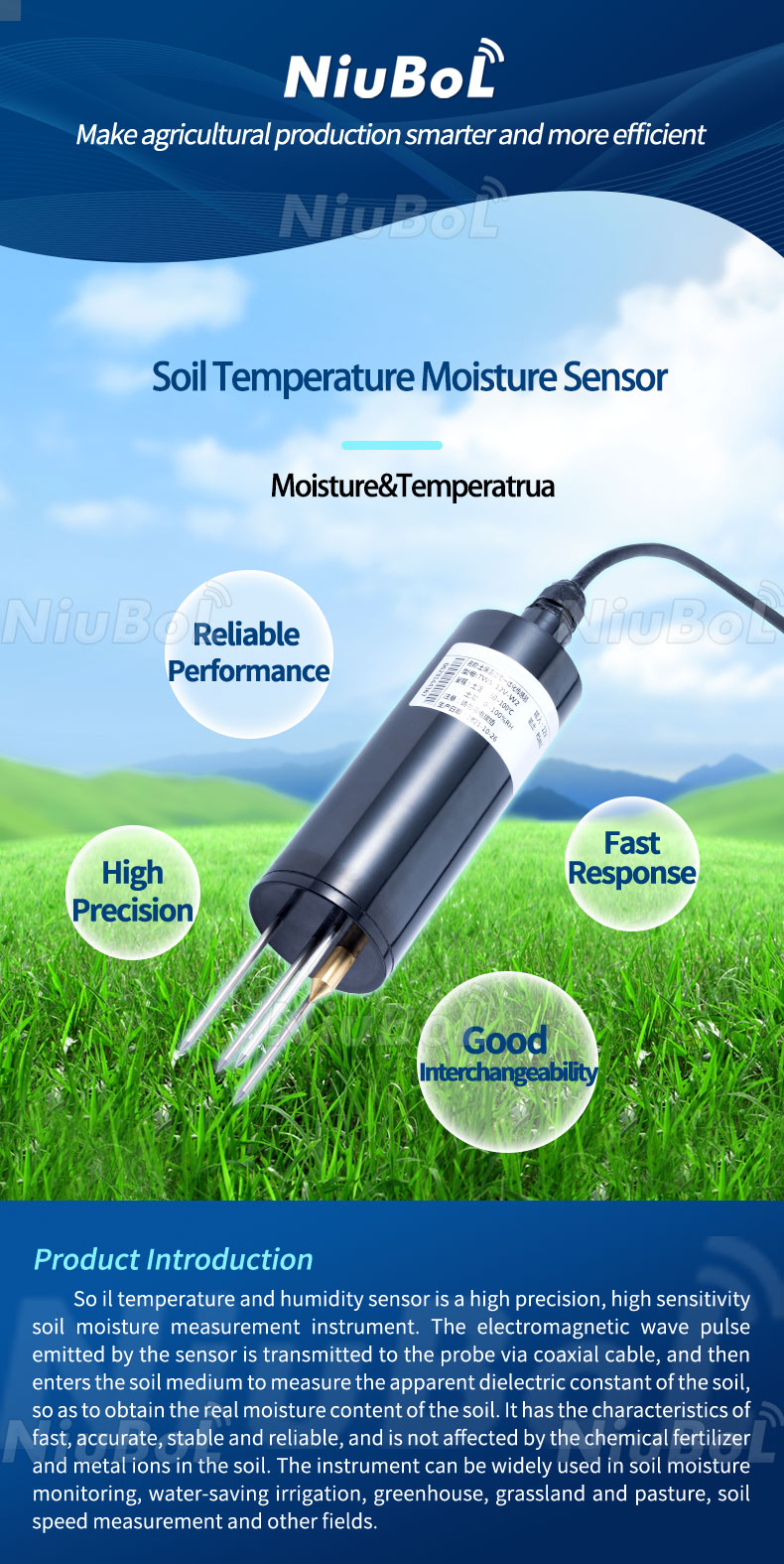
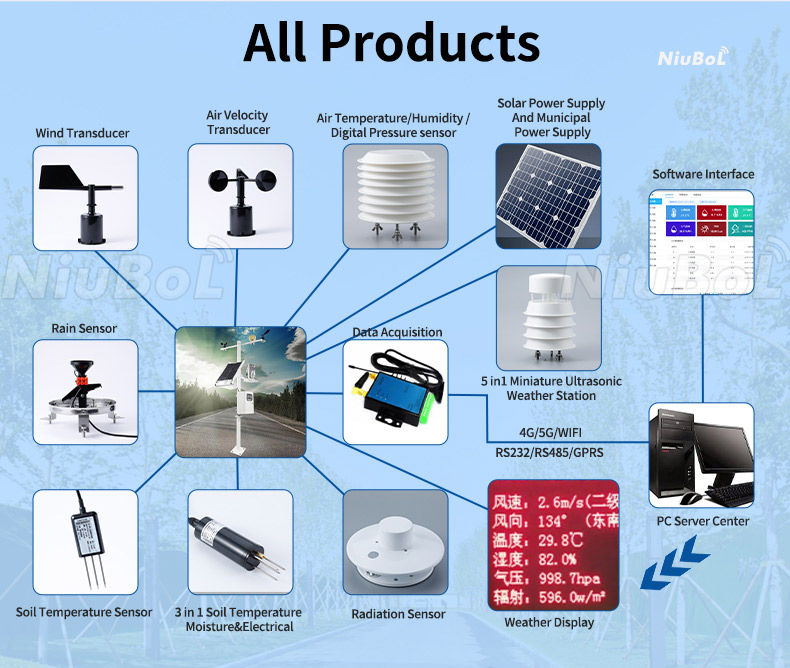
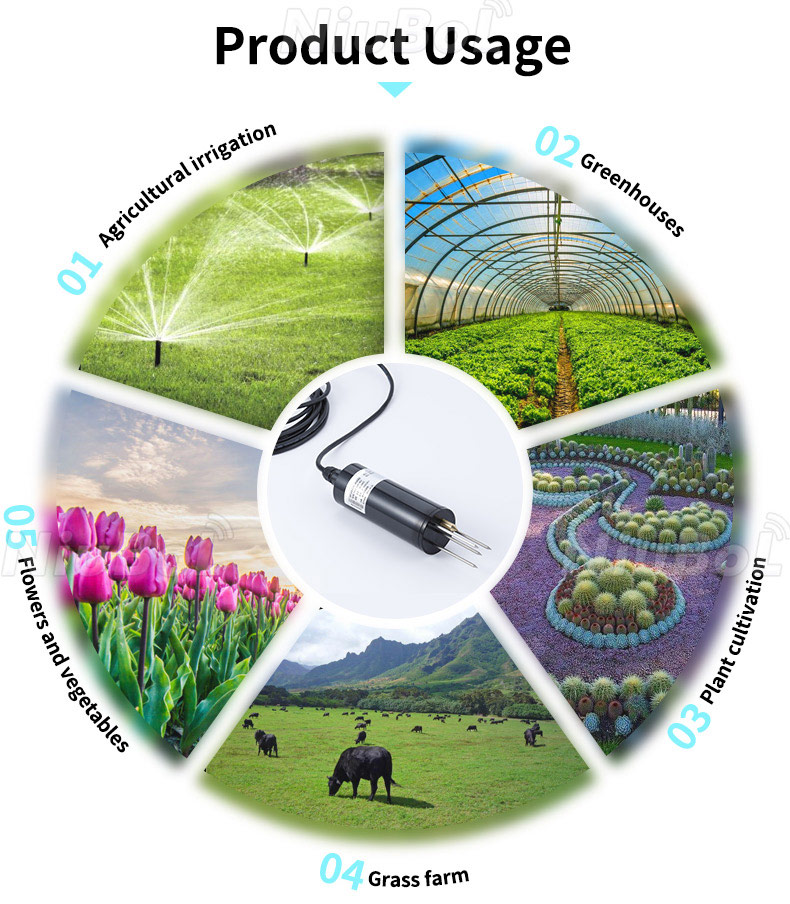
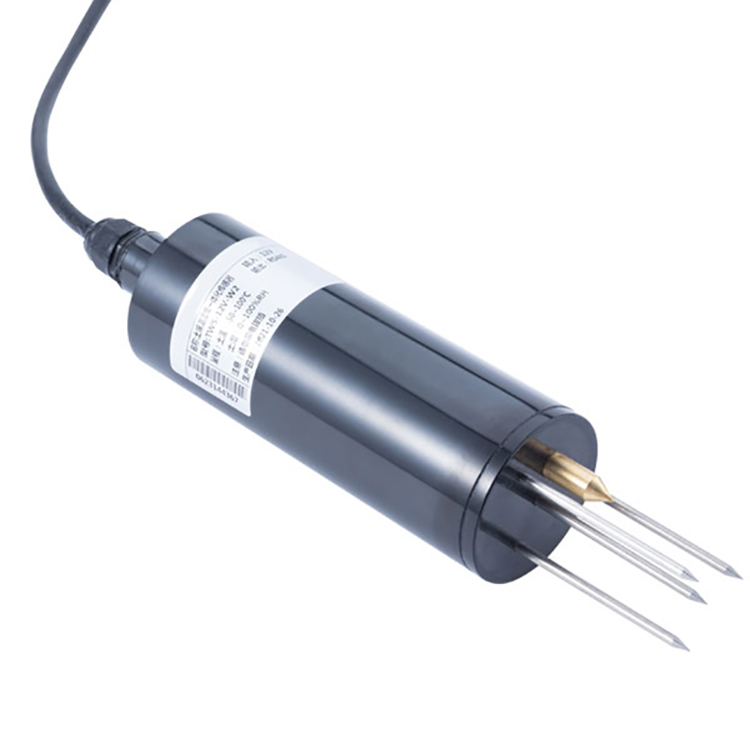
NBL-S-THR Soil Temperature and Moisture Sensor is a high-precision, high-sensitivity instrument for measuring soil moisture, suitable for various applications such as soil moisture monitoring, water-saving irrigation, greenhouses, grassland pastures, and soil speed measurement. This sensor supports RS485 output, allowing for easy connection to Arduino, providing users with great flexibility and convenience.
Tel/WhatsApp:+8615367865107
Email:Arvin@niubol.com +Nearly 100 partner companies in more than 75 countries. We are committed to providing high-quality, practical products to meet your needs and help you solve problems. Our products comply with international standards and are certified with ISO, CE and RoHS.Product Details
The NiuBoL NBL-S-THR is an industrial RS485 soil moisture sensor for Arduino, ESP32, PLCs and agricultural IoT monitoring systems. It measures soil moisture and temperature using Time Domain Reflectometry (TDR) technology and provides digital measurement data through Modbus RTU communication.
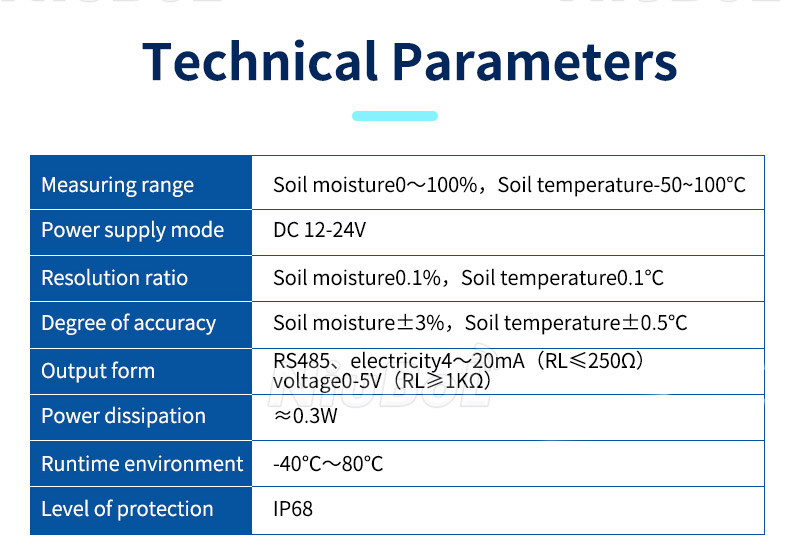
The sensor features a soil moisture range of 0–100%, a temperature range of -50 to +100°C, DC 12–24 V power supply and IP68 protection.
Unlike basic analog soil moisture probes commonly used in Arduino experiments, the NBL-S-THR provides an industrial communication interface suitable for agricultural monitoring, greenhouse cultivation, irrigation management and environmental research.
An appropriate UART-to-RS485 transceiver is required when connecting the sensor to an Arduino or ESP32 board.
| Parameter | Specification |
|---|---|
| Model | NBL-S-THR |
| Measured Parameters | Soil Moisture and Temperature |
| Measurement Principle | TDR (Time Domain Reflectometry) |
| Soil Moisture Range | 0–100% |
| Soil Moisture Accuracy | ±3% |
| Soil Moisture Resolution | 0.1% |
| Soil Temperature Range | -50 to +100°C |
| Soil Temperature Accuracy | ±0.5°C |
| Soil Temperature Resolution | 0.1°C |
| Power Supply | DC 12–24 V |
| Power Consumption | Approximately 0.3 W |
| Digital Output | RS485 Modbus RTU |
| Alternative Output Options | 4–20 mA (RL ≤ 250 Ω) or 0–5 V (RL ≥ 1 kΩ) |
| Operating Temperature | -40 to +80°C |
| Protection Rating | IP68 |
Technical Notes: RS485, 4–20 mA and 0–5 V are alternative ordering configurations. Select the RS485 version for the Modbus RTU communication examples on this page.
The temperature measurement range and operating temperature range are different specifications. Actual installation conditions must remain within the permitted operating limits.
Field measurement uncertainty can also be influenced by soil texture, salinity, probe contact and calibration conditions.
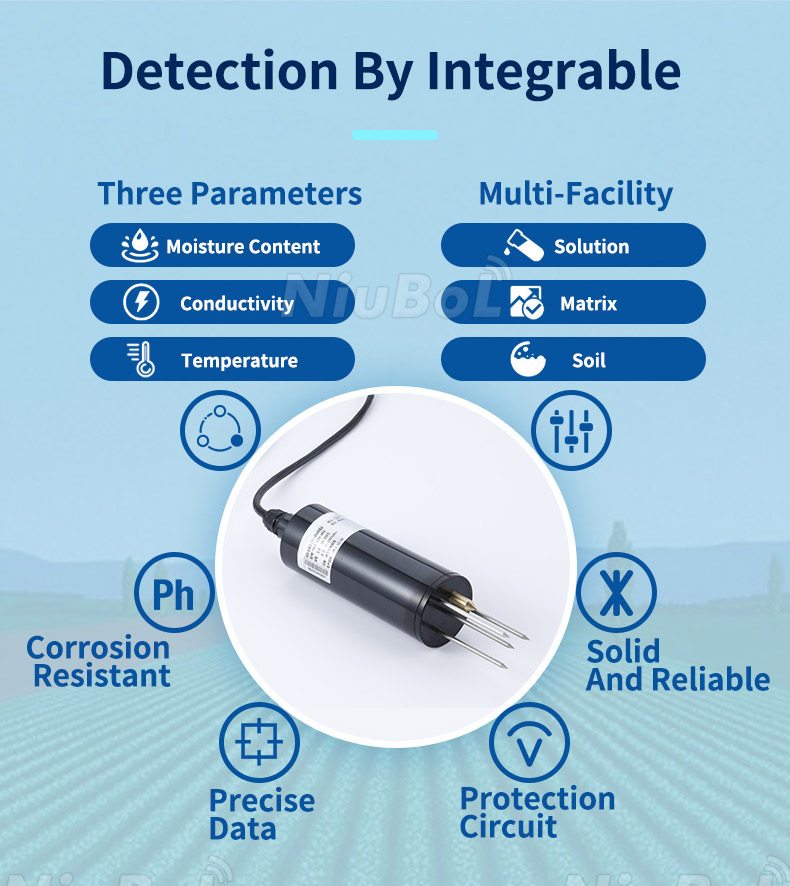
The NBL-S-THR uses electromagnetic pulse technology to evaluate the apparent dielectric properties of the soil surrounding its sensing probes.
Because water has a significantly higher dielectric permittivity than most dry mineral soil constituents, changes in soil water content influence the electromagnetic response of the measurement system.
TDR technology evaluates these propagation characteristics to estimate volumetric soil water content.
The sensor also measures soil temperature, allowing both parameters to be collected through the same device.
Good contact between the sensing probes and the surrounding soil is essential. Air gaps, stones, unusual soil composition and high salinity may affect measurement performance.
Digital measurement output: Soil temperature and moisture readings are transmitted through Modbus RTU.
Industrial communication: Differential RS485 signaling is suitable for many agricultural and industrial installations.
Multiple sensor integration: Compatible sensors can share an RS485 network when correctly addressed and configured.
Low power consumption: Approximately 0.3 W, suitable for appropriately configured remote monitoring systems.
IP68 protection: Suitable for soil monitoring within the specified operating conditions.
Flexible integration: Compatible with microcontrollers, PLCs, RTUs and industrial data loggers equipped with suitable interfaces.
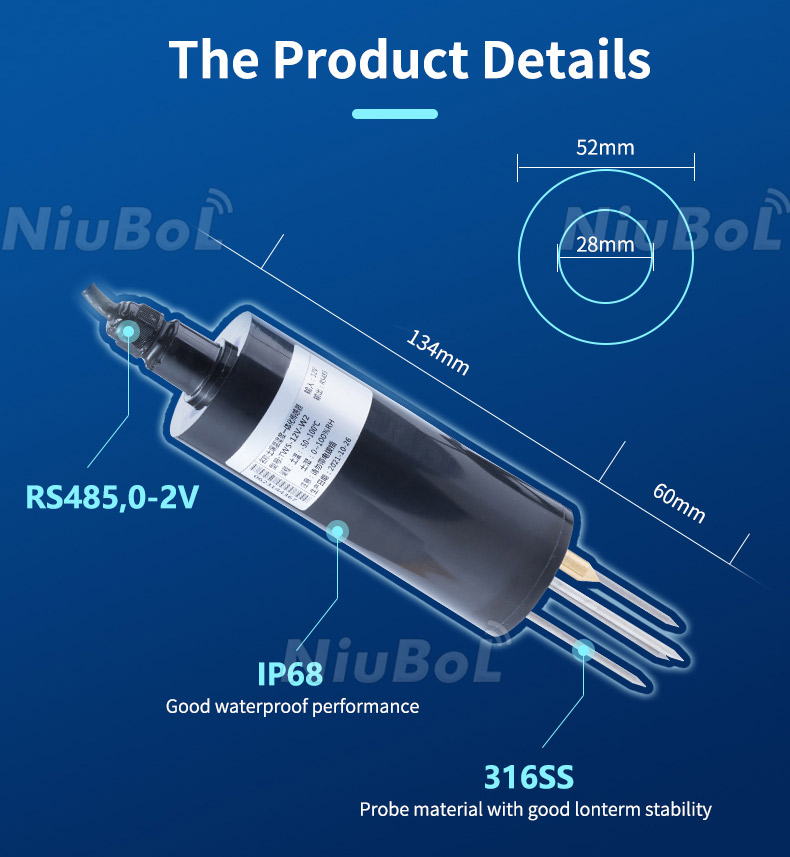
The NBL-S-THR RS485 version cannot be connected directly to the analog input or UART pins of an Arduino board. An RS485 transceiver is required to convert differential communication signals into compatible UART signals.
NiuBoL NBL-S-THR soil moisture sensor, RS485 version.
Arduino Mega 2560, Arduino Uno or another compatible microcontroller.
MAX485 or another suitable UART-to-RS485 transceiver module.
External DC 12–24 V power supply for the sensor.
Suitable power supply for the microcontroller and transceiver.
Connection cables and Modbus RTU software.
For 3.3 V microcontrollers such as ESP32, use a compatible 3.3 V RS485 transceiver, such as the MAX3485, or an appropriately designed level-shifting interface.
| Wire Color | Function | Connection |
|---|---|---|
| Red | Power Positive | DC 12–24 V Positive |
| Black (or Green) | Power Negative | DC Power Negative |
| Yellow | RS485 A | RS485 Transceiver A |
| Blue | RS485 B | RS485 Transceiver B |
Important: Verify the wiring definition supplied with the actual sensor before applying power. Do not connect the sensor's 12–24 V power supply directly to the Arduino 5 V or 3.3 V pins.
The following example uses the hardware Serial1 port of an Arduino Mega 2560 and a conventional MAX485 half-duplex transceiver.
| MAX485 Pin | Arduino Mega 2560 Connection |
|---|---|
| VCC | 5 V |
| GND | GND |
| RO | RX1 (Pin 19) |
| DI | TX1 (Pin 18) |
| DE and /RE | Digital Pin 2 (Connected Together) |
| A | Sensor RS485 A (Yellow) |
| B | Sensor RS485 B (Blue) |
For this non-isolated transceiver example, connect the sensor power negative and Arduino ground to provide a suitable common signal reference. For isolated RS485 interfaces, follow the isolation and grounding requirements of the selected hardware.
When DE and /RE are connected together, the direction control pin is set HIGH for transmission and LOW for reception.
For longer communication cables or multiple sensors, evaluate twisted-pair wiring, grounding, surge protection, termination and bus biasing according to the actual installation.
| Communication Parameter | Setting |
|---|---|
| Interface | RS485 |
| Protocol | Modbus RTU |
| Baud Rate | 9600 bps |
| Data Bits | 8 |
| Stop Bits | 1 or 2 |
| Parity | None |
| Communication Interval | Greater than 1000 ms |
| Read Function Code | 0x03 |
| CRC Byte Order | Low Byte First |
The communication examples below use device address 0x01 and serial configuration 9600, 8N1. Confirm the actual sensor address and serial settings before integration.
| Register Address | Parameter | Data Length | Conversion |
|---|---|---|---|
| 0x0000 | Soil Temperature | 16-bit | Raw Value ÷ 10 (°C) |
| 0x0001 | Soil Moisture | 16-bit | Raw Value ÷ 10 (%) |
The first register contains temperature data, and the second register contains moisture data. A returned value of 0x7FFF represents invalid or missing measurement data and should not be converted into a normal reading.
To read both measurement registers from a sensor configured with address 0x01, send the following hexadecimal request:
01 03 00 00 00 02 C4 0B
Example response:
01 03 04 00 B4 01 10 BA 49
| Response Field | Meaning |
|---|---|
| 01 | Device Address |
| 03 | Read Function Code |
| 04 | Four Data Bytes |
| 00 B4 | Soil Temperature Raw Data: 180 |
| 01 10 | Soil Moisture Raw Data: 272 |
| BA 49 | CRC Check Bytes |
Decoded Measurements:
Soil temperature: 180 ÷ 10 = 18.0°C.
Soil moisture: 272 ÷ 10 = 27.2%.
These values illustrate the documented communication format and are not live measurements from an installed sensor.
The following integration example uses an Arduino Mega 2560, a MAX485 transceiver and the ModbusMaster library.
Install the ModbusMaster library through the Arduino IDE Library Manager before compiling the program.
The example reads two holding registers starting at address 0x0000 and displays the converted measurements through the Serial Monitor.
#include <ModbusMaster.h>

const uint8_t RS485_DE_RE = 2;
const uint8_t SENSOR_ADDRESS = 1;

ModbusMaster node;

void preTransmission()
{
  digitalWrite(RS485_DE_RE, HIGH);
}

void postTransmission()
{
  digitalWrite(RS485_DE_RE, LOW);
}

void setup()
{
  pinMode(RS485_DE_RE, OUTPUT);
  digitalWrite(RS485_DE_RE, LOW);

  Serial.begin(115200);
  Serial1.begin(9600, SERIAL_8N1);

  node.begin(SENSOR_ADDRESS, Serial1);

  node.preTransmission(preTransmission);
  node.postTransmission(postTransmission);

  delay(2000);

  Serial.println("NBL-S-THR Modbus RTU Example");
}

void loop()
{
  uint8_t result =
    node.readHoldingRegisters(0x0000, 2);

  if (result == node.ku8MBSuccess)
  {
    uint16_t rawTemperature =
      node.getResponseBuffer(0);

    uint16_t rawMoisture =
      node.getResponseBuffer(1);

    if (rawTemperature != 0x7FFF)
    {
      // Assumes signed 16-bit temperature encoding.
      // Confirm negative-temperature encoding
      // for the actual sensor firmware.
      float temperature =
        (int16_t)rawTemperature / 10.0f;

      Serial.print("Soil Temperature: ");
      Serial.print(temperature, 1);
      Serial.println(" C");
    }
    else
    {
      Serial.println("Temperature data invalid");
    }

    if (rawMoisture != 0x7FFF)
    {
      float moisture = rawMoisture / 10.0f;

      if (moisture <= 100.0f)
      {
        Serial.print("Soil Moisture: ");
        Serial.print(moisture, 1);
        Serial.println(" %");
      }
      else
      {
        Serial.println("Moisture data out of range");
      }
    }
    else
    {
      Serial.println("Moisture data invalid");
    }
  }
  else
  {
    Serial.print("Modbus Error: 0x");
    Serial.println(result, HEX);
  }

  Serial.println("--------------------");

  delay(2000);
}
Using the documented example response, the Serial Monitor output would be:
Soil Temperature: 18.0 C
Soil Moisture: 27.2 %
--------------------
Integration Note: This is an illustrative Arduino implementation rather than a factory-validated software package. Adjust the device address, serial settings and RS485 direction-control pins according to the actual hardware. Negative-temperature encoding should be verified against the delivered sensor before using sub-zero measurements in production software.
The same Modbus register addresses and conversion factors apply when the sensor is integrated with compatible ESP32, PLC or RTU systems.
For ESP32 applications, use a suitable 3.3 V RS485 transceiver, configure the selected hardware UART and assign the appropriate transmit and receive pins.
The sensor still requires an independent DC 12–24 V power supply. Changing the microcontroller does not change the sensor's power requirements.
For remote agricultural monitoring, measurements can also be collected through compatible IoT gateways and data acquisition equipment.
When multiple sensors share an RS485 network, each sensor must have a unique device address.
The NBL-S-THR instruction manual includes device-specific address-reading and address-setting commands.
Address-reading request:
00 20 00 68
Example response for device address 0x01:
00 20 01 A9 C0
Example request to set the device address to 0x01:
00 10 01 BD C0
Expected response:
00 10 00 7C
These are manufacturer-specific address configuration frames rather than standard Modbus holding-register write requests. Use the appropriate serial communication tool to send them.
Connect only one sensor when reading or changing its address through these commands to avoid response conflicts or unintended address changes on a shared network.
| Problem | Possible Cause | Recommended Check |
|---|---|---|
| No Response | Power supply, wiring or device address error | Check DC power, A/B connections and sensor address. |
| Communication Timeout | Incorrect serial settings or direction control | Verify baud rate, stop bits, parity and DE/RE operation. |
| Unexpected Values | Incorrect register order or scaling | Read temperature first, moisture second, and divide valid values by 10. |
| Intermittent Communication | Electrical interference or incorrect bus configuration | Check wiring, grounding, termination and polling interval. |
| Invalid Register Value | Missing or invalid measurement | Check for 0x7FFF and investigate the sensor condition. |
Before integrating the sensor with Arduino or ESP32, it is often useful to verify basic Modbus communication on a computer using a USB-to-RS485 converter and suitable serial communication software.
Soil moisture measurements provide data for irrigation scheduling and root-zone water monitoring. A compatible controller can evaluate moisture thresholds and operate pumps or valves through suitable control equipment.
For system design considerations, see Soil Moisture Sensor for Automatic Irrigation Systems.
Combined soil moisture and temperature measurements help greenhouse operators observe root-zone conditions and evaluate irrigation performance.
Arduino, ESP32 and industrial data loggers can collect measurements for local storage or transmission through compatible communication modules.
Multiple sensors can be installed at representative locations or selected soil depths to investigate moisture variation, temperature conditions and water infiltration.
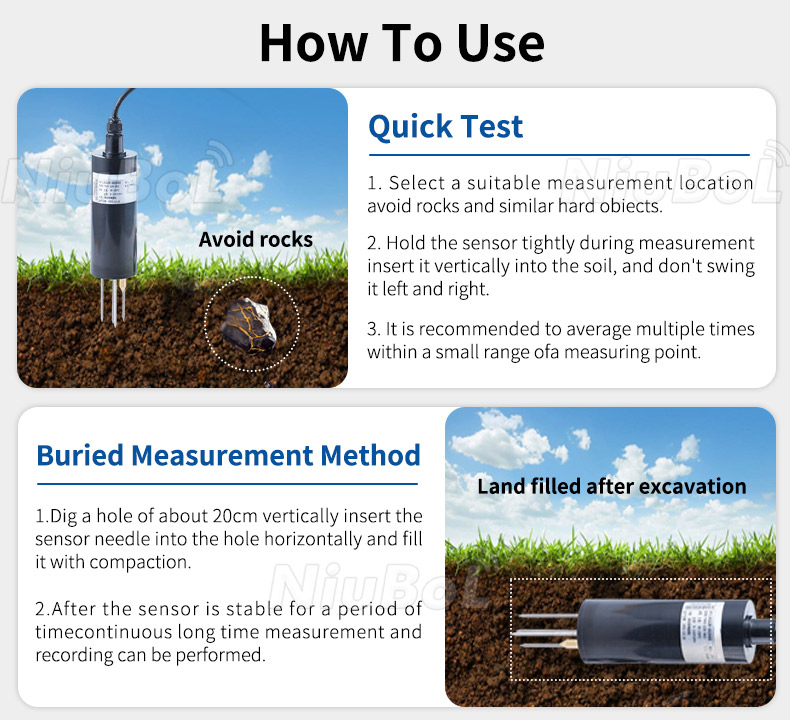
Select representative monitoring locations and depths.
Insert the probes into the soil with adequate contact along the sensing area.
Avoid stones, air gaps and excessive disturbance of the soil.
Do not force the sensing probes into hard objects.
Disconnect power before installing or changing electrical connections.
Protect cable joints and external electronic equipment from environmental exposure.
Use representative field measurements to establish irrigation thresholds.
A single NBL-S-THR measures the soil surrounding its sensing probes. Monitoring several depths requires multiple sensors or a suitable multi-depth soil monitoring instrument.

No. The RS485 version requires a suitable UART-to-RS485 transceiver and an external DC 12–24 V sensor power supply.
Yes. Use a compatible 3.3 V RS485 transceiver and configure the ESP32 UART for the sensor's Modbus RTU communication settings.
Soil temperature is located at register 0x0000, and soil moisture is located at register 0x0001. Valid raw measurement values are divided by 10.
The NBL-S-THR requires DC 12–24 V. A 5 V Arduino power supply is not sufficient to power the sensor directly.
Yes. Multiple compatible RS485 sensors can share one communication bus when each device has a unique address and the network is correctly configured.
RS485, 4–20 mA and 0–5 V are alternative output configurations. Specify the required output interface when ordering.
No. It provides measurement data. An Arduino, PLC or compatible irrigation controller must evaluate the data and operate the pump through suitable switching and protection equipment.
It indicates invalid or missing measurement data. Software should detect this value before converting it into temperature or moisture readings.
The NBL-S-THR has an IP68 protection rating and is intended for suitable soil monitoring installations. Cable connections, power supplies and external communication equipment must also be appropriately protected.

NiuBoL supplies industrial soil moisture and temperature sensors for agricultural monitoring, automatic irrigation, greenhouse cultivation and custom IoT equipment integration.
In addition to the NBL-S-THR, NiuBoL offers multi-parameter soil probes, multi-depth soil monitoring sensors and compatible data acquisition equipment for different project requirements.
For product selection and quotation, please specify the required measurement parameters, output interface, cable length, sensor quantity and receiving controller or microcontroller.

Developing an Arduino, ESP32 or industrial agricultural monitoring system? Contact NiuBoL for suitable RS485 soil sensor configurations, Modbus RTU integration support, technical documentation and product quotations.
 NBL-S-THR-Soil-temperature-and-moisture-sensors-Instruction-Manual-V4.0.pdf
Prev:Multi-depth Soil Moisture and Temperature Sensor 60cm
Next:3-in-1 Soil EC & Moisture Sensor for Irrigation | NBL-S-TMC
Sensors & Weather Stations Catalog
 Agriculture Sensors and Weather Stations Catalog-NiuBoL.pdf
Weather Stations Catalog-NiuBoL.pdf
Agriculture Sensors Catalog-NiuBoL.pdf
Water Quality Sensor Catalog-NiuBoL.pdf
Related recommendations
 Multi-Depth Soil Sensor RS485
 TDR Soil Moisture Sensor
 Pyranometer Solar Radiation Sensors
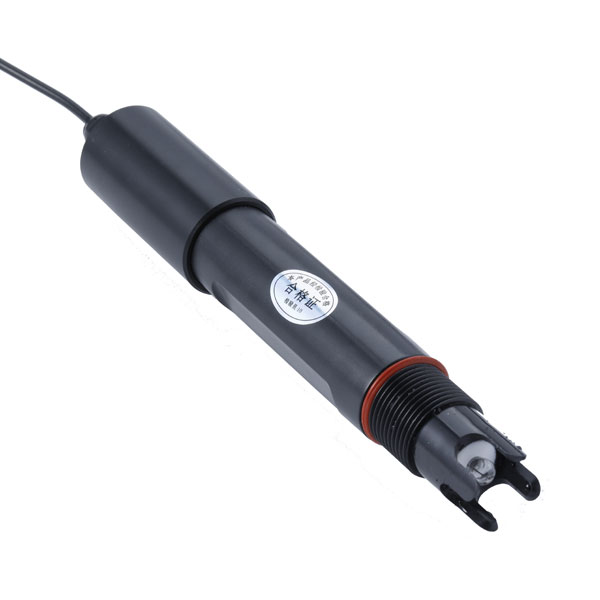 Soil ph sensor
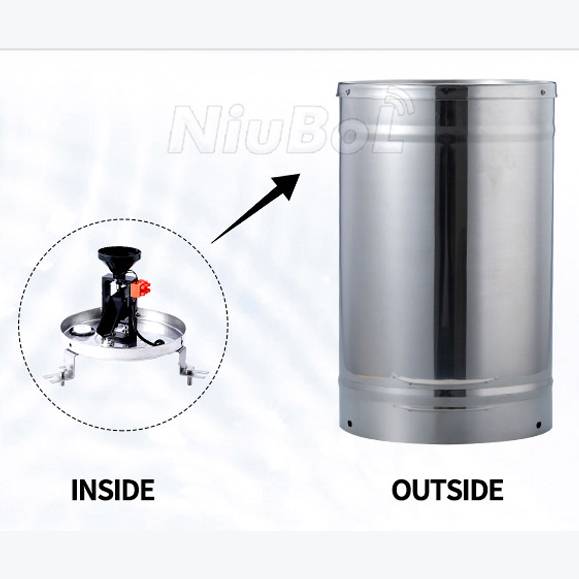 Tipping Bucket Rain Gauge - ABS and Stainless Steel
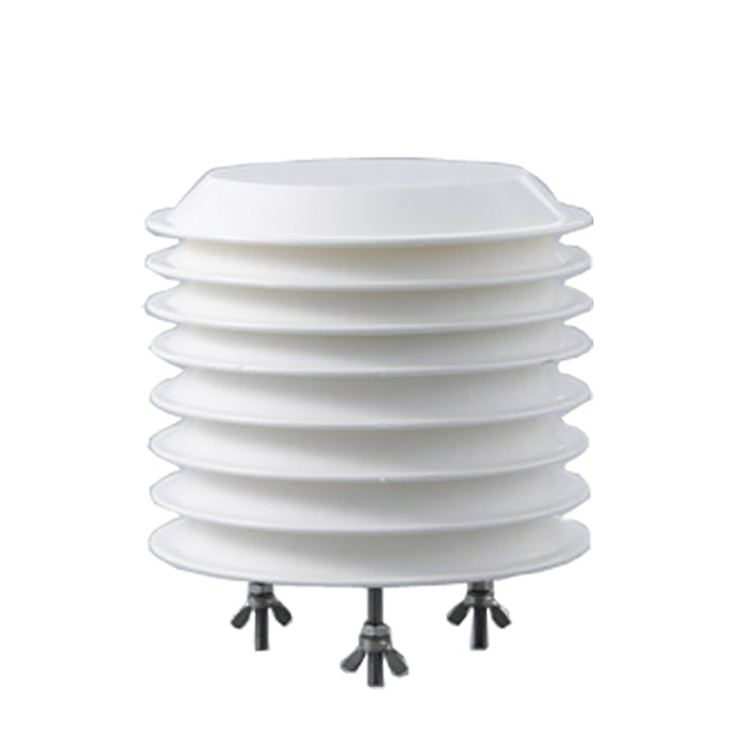 Air Temperature and Humidity Sensor


Screenshot, WhatsApp to identify the QR code
WhatsApp number:+8615367865107
(Click on WhatsApp to copy and add friends)

