





— Download —
 Consumer hotline +8618073152920
WhatsApp:+8615367865107
Address:Room 102, District D, Houhu Industrial Park, Yuelu District, Changsha City, Hunan Province, China
All products
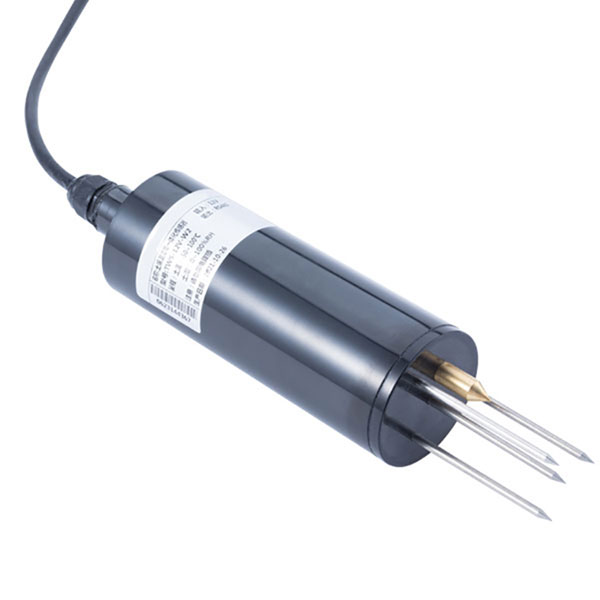
VWC (Volumetric Water Content) sensor is a professional device for measuring the volume content of water in soil. By measuring the soil's dielectric constant, it reflects the volumetric proportion of water in the soil, providing accurate data support for agricultural irrigation, plant growth research, environmental monitoring, etc. VWC sensors are essential for precision agriculture, water resource management, scientific research and environmental monitoring.
Tel/WhatsApp:+8615367865107
Email:Arvin@niubol.com +Nearly 100 partner companies in more than 75 countries. We are committed to providing high-quality, practical products to meet your needs and help you solve problems. Our products comply with international standards and are certified with ISO, CE and RoHS.Product Details
The NiuBoL VWC Soil Moisture Sensor is designed to measure volumetric water content (VWC) in soil for agricultural irrigation, greenhouse cultivation, environmental monitoring and soil research.
Volumetric water content represents the volume of water within a given bulk volume of soil. It is an important parameter for understanding soil water conditions, monitoring the root zone and evaluating irrigation performance.
The NiuBoL NBL-S-THR combines TDR soil moisture measurement with a soil temperature sensing channel. It is available with RS485 Modbus RTU, 4–20mA or 0–5V output configurations for integration with compatible monitoring equipment.
The sensor operates from DC 12–24V and features an IP68-rated sensing body for suitable long-term soil installation.
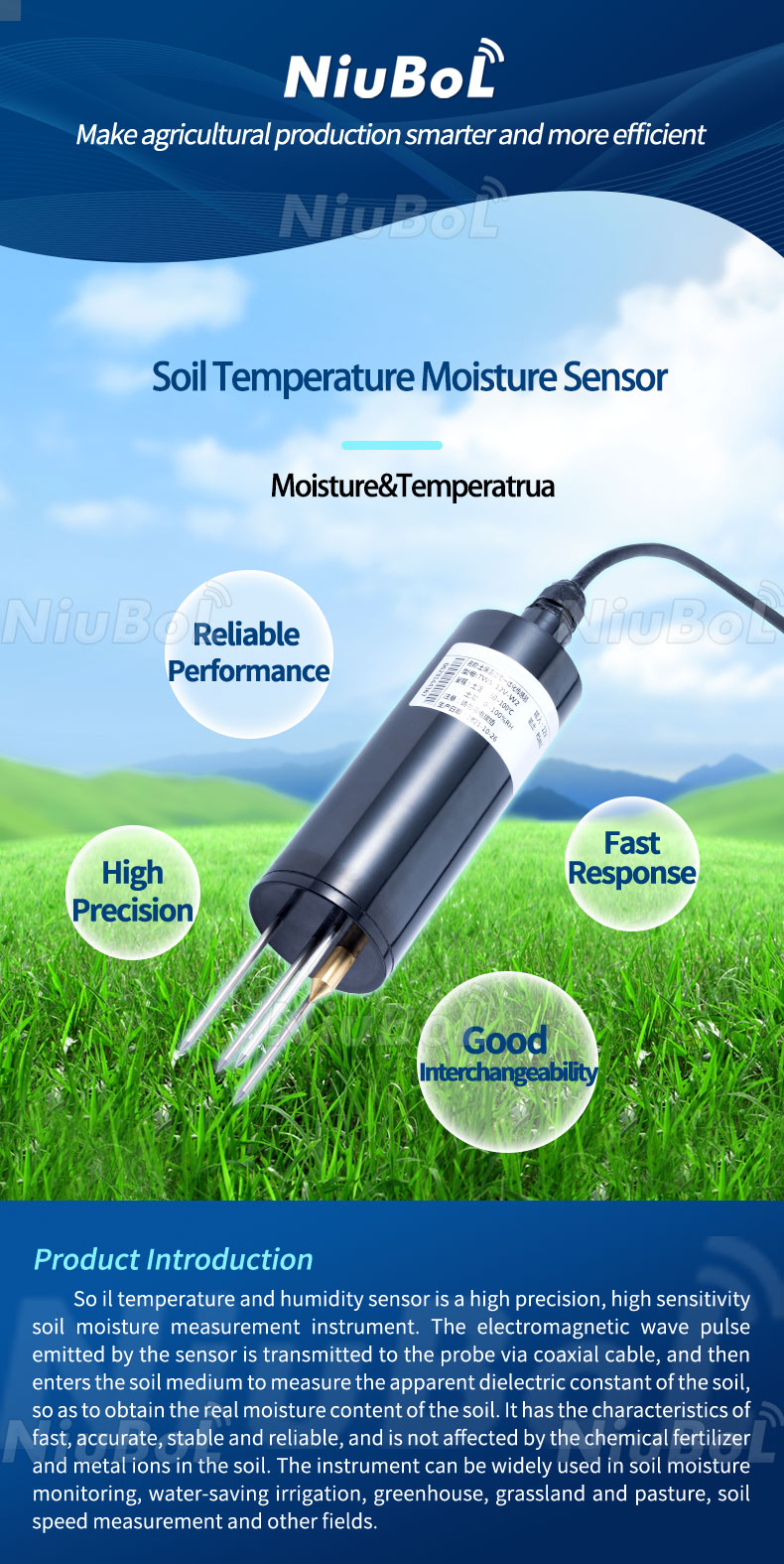
Volumetric Water Content (VWC) describes the volume of water in soil divided by the total bulk volume of the soil sample.
VWC is commonly expressed as a percentage (%) or as a volumetric ratio in cubic meters of water per cubic meter of soil (m³/m³).
VWC (%) = (Volume of Water / Total Bulk Soil Volume) × 100
For example, a soil moisture measurement of 30% VWC means that water occupies approximately 30% of the total bulk volume of the measured soil.
A VWC value does not directly indicate how much plant-available water remains. Soil texture and water retention characteristics influence how easily plants can extract water from the soil.
Volumetric soil moisture and relative humidity are different physical measurements.
Relative humidity (%RH) describes the amount of water vapor in air relative to saturation at a given temperature. Volumetric water content describes the proportion of liquid water within a bulk soil volume.
A soil moisture sensor reporting VWC should use % VWC or m³/m³ rather than %RH.
| Measurement | Meaning | Unit |
|---|---|---|
| Soil VWC | Volume of water relative to total bulk soil volume | % VWC or m³/m³ |
| Soil Temperature | Thermal condition of soil | °C |
| Air Relative Humidity | Water vapor relative to saturation in air | %RH |
| Soil Water Tension | Energy-related condition of water held in soil | kPa or other pressure units |
Many electronic VWC sensors estimate soil moisture by measuring electrical characteristics associated with the dielectric properties of soil.
Water has a substantially higher relative dielectric permittivity than most dry soil minerals and air. As soil water content increases or decreases, the dielectric response of the surrounding soil also changes.
Sensor electronics use a calibration relationship between the measured electrical response and soil water content to estimate VWC.
Time Domain Reflectometry (TDR) uses an electromagnetic pulse to measure the electrical response associated with the apparent dielectric permittivity of soil.
The NBL-S-THR uses this measurement principle to estimate volumetric soil moisture.
TDR measurement can support continuous agricultural monitoring when the sensor is properly installed and its calibration is suitable for the soil conditions.
Frequency Domain Reflectometry (FDR) and capacitance-based sensors use frequency-dependent electrical responses to estimate the dielectric properties of soil.
Both TDR and FDR methods are used in agricultural moisture monitoring. Their measurement performance depends on sensor design, soil properties, calibration and installation quality.
Different soil monitoring instruments offer different parameter combinations. A two-parameter sensor measures soil moisture and temperature, while other configurations may also include electrical conductivity.
Electrical conductivity provides information about soil electrical conditions and dissolved ions. It is not automatically included in every VWC sensor.
The NBL-S-THR provides soil moisture and temperature measurements. For projects requiring soil EC, select an appropriately configured additional or multi-parameter sensor.
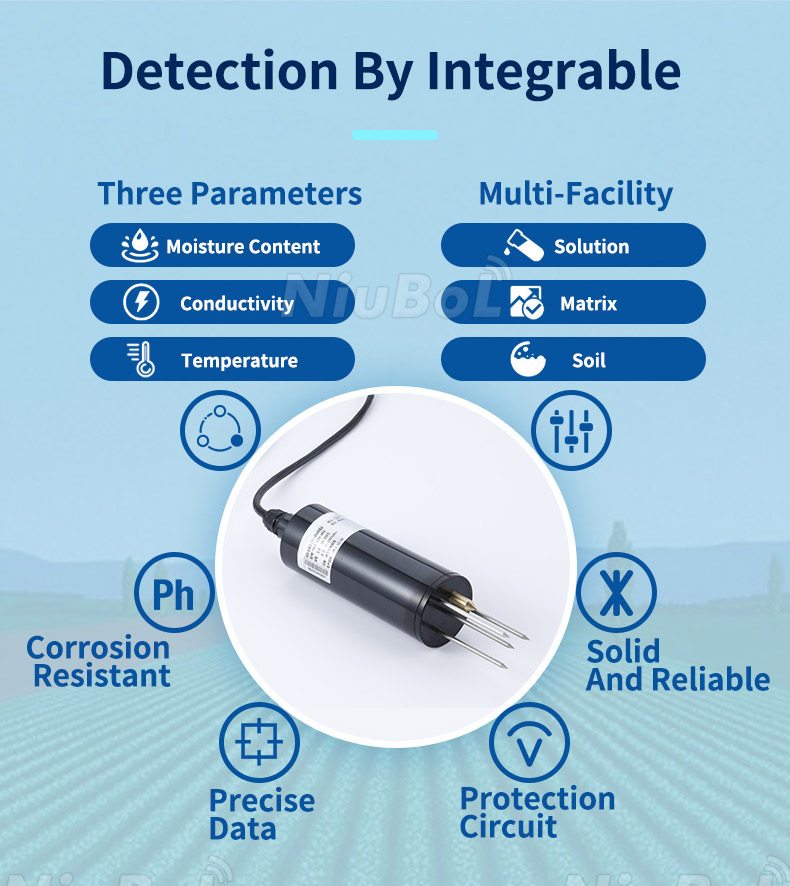
The NiuBoL NBL-S-THR measures soil volumetric water content and soil temperature for agricultural field monitoring, irrigation applications and environmental observation.
| Parameter | Specification |
|---|---|
| Model | NBL-S-THR |
| Product Type | TDR Soil Moisture and Temperature Sensor |
| Moisture Measurement Principle | Time Domain Reflectometry (TDR) |
| Measured Parameters | Soil Moisture (VWC) and Temperature |
| Soil Moisture Range | 0–100% VWC |
| Moisture Accuracy | ±3% |
| Moisture Resolution | 0.1% |
| Soil Temperature Range | −50 to +100°C |
| Temperature Accuracy | ±0.5°C |
| Temperature Resolution | 0.1°C |
| Power Supply | DC 12–24V |
| Output Options | RS485 / 4–20mA / 0–5V |
| Digital Protocol | Modbus RTU (RS485 Version) |
| RS485 Baud Rate | 9600 bps |
| Current Output Load | ≤250 Ω |
| Voltage Output Load | ≥1 kΩ |
| Power Consumption | Approximately 0.3W |
| Operating Temperature | −40 to +80°C |
| Protection Rating | IP68 |
The moisture measurement range and the temperature measurement range describe different parameters. The sensor's operating temperature range refers to the environmental conditions permitted for the complete instrument.
RS485, current and voltage outputs are alternative configurations. The selected version must match the receiving controller or data logger.
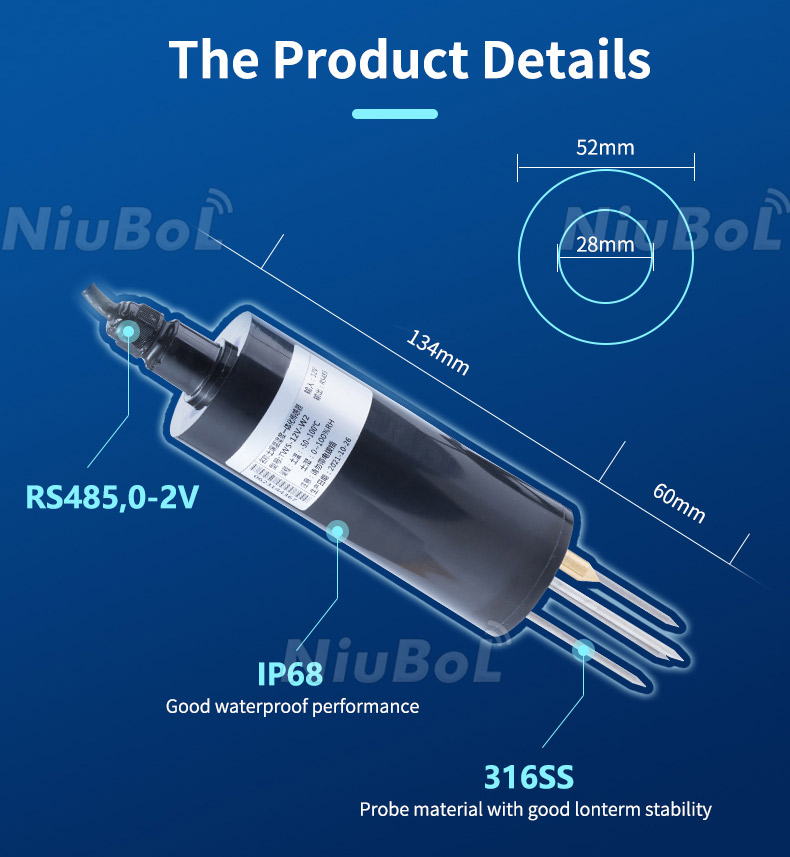
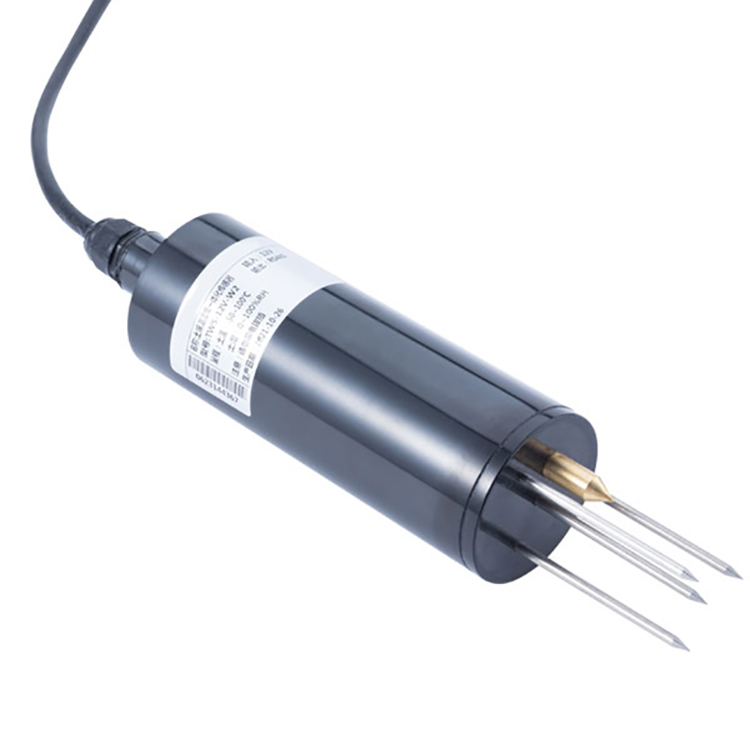
The NBL-S-THR uses a cylindrical housing with stainless steel sensing rods. The rods are inserted into soil to measure water content within the surrounding sensing region.
The sealed sensor body has an IP68 protection rating, making it suitable for appropriately installed buried soil monitoring.
For field installations, consider the probe dimensions, insertion depth, protection of the cable and accessibility of the external data acquisition equipment.
The sensing rods should maintain close contact with the soil. Air gaps or loose soil around the probe can affect measurement quality.
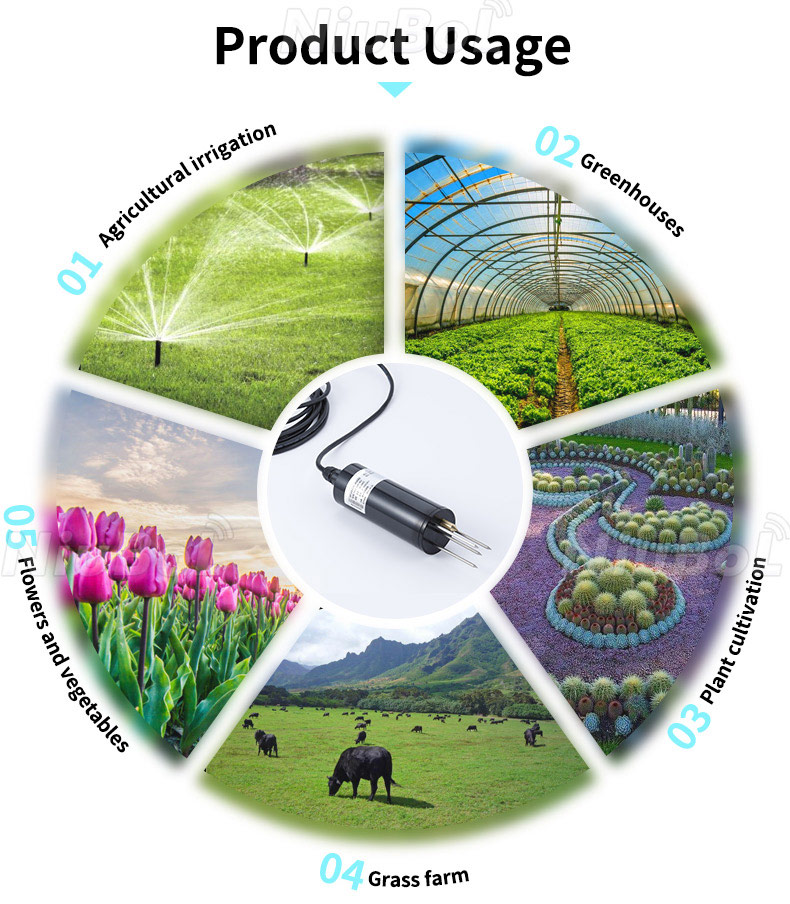
VWC measurements provide information about soil water conditions before and after irrigation.
Continuous soil moisture observation can help farmers identify changes in the root zone and evaluate whether irrigation water is reaching the selected monitoring depth.
Moisture readings should be interpreted according to crop requirements, soil properties and the irrigation method.
In soil-based greenhouses, a VWC sensor can be installed in selected growing beds to monitor moisture and temperature conditions.
These measurements can be combined with air temperature, relative humidity, light and other environmental data in a compatible greenhouse monitoring system.
In orchards and horticultural growing areas, soil moisture sensors can monitor conditions around the active root zone.
Installation depth and distance from irrigation emitters should be selected according to the crop and irrigation layout.
VWC sensors can be used to observe seasonal soil moisture variation in pastures and grasslands.
The measurements may also support environmental research into rainfall infiltration, soil water storage and vegetation conditions.
Soil VWC measurements are useful for investigating soil-water movement, infiltration, moisture variation and relationships between soil and weather conditions.
For research projects, consistent installation and appropriate calibration are important for comparing measurements across locations.
Correct installation is essential for obtaining representative volumetric soil moisture measurements.
The probe should be installed at a location and depth that reflect the monitoring objective. Soil texture, irrigation distribution and rooting depth should be considered when selecting the measurement point.
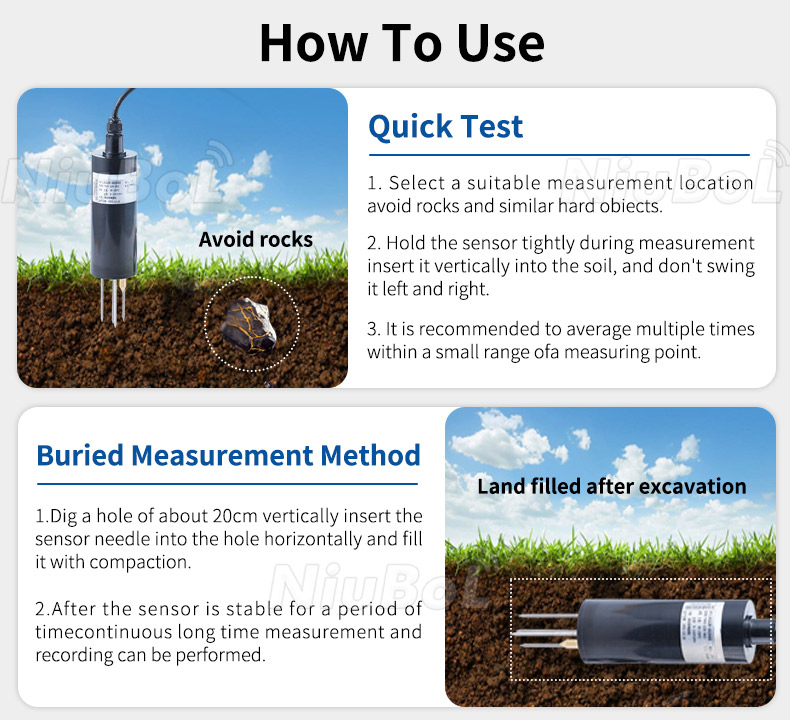
Select a representative location and remove stones or other hard objects that may damage the sensing rods.
Insert the probe carefully into the soil at the required depth. Avoid moving the sensor repeatedly from side to side after insertion.
Maintain close contact between the sensing rods and the surrounding soil. Allow the reading to stabilize before recording the measurement.
For continuous monitoring, excavate a small soil pit to the required depth and insert the sensing rods horizontally into undisturbed soil at the side of the excavation.
Ensure that the sensing rods are surrounded by soil without significant air gaps. Carefully backfill the excavation and protect the cable against mechanical damage.
Record the installation location and depth to support consistent data interpretation and future maintenance.
Installation depth depends on crop rooting conditions, irrigation method and the objective of the measurement.
Shallow sensors may be used to observe moisture variation near the soil surface. Deeper sensors can help monitor water movement within lower root-zone layers.
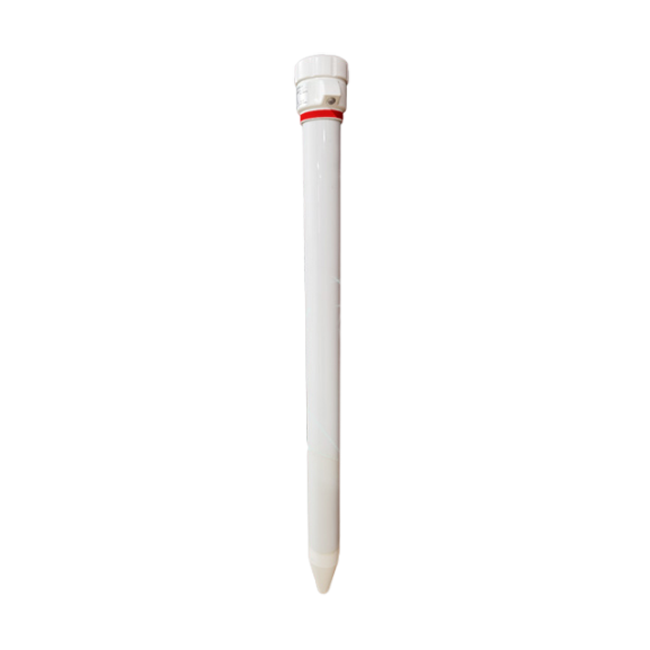
For projects requiring several measurement depths, multiple probes or a suitable multi-depth soil sensor may be installed.
The NBL-S-THR is available with RS485 Modbus RTU communication for connection to compatible PLCs, RTUs, data loggers and agricultural monitoring gateways.
The RS485 version provides digital measurements of soil temperature and moisture. Compatible receiving equipment can collect both parameters through the sensor's communication interface.
For applications using analog controllers, 4–20mA and 0–5V output versions are also available.
| Output Type | Compatible Equipment | Application |
|---|---|---|
| RS485 Modbus RTU | PLC, RTU, Data Logger and RS485 Gateway | Digital soil monitoring |
| 4–20mA | Industrial Analog Current Input | Industrial control and analog data acquisition |
| 0–5V | Compatible Analog Voltage Input | Local environmental monitoring controllers |
A compatible data logger or communication gateway can collect soil moisture measurements and transfer them to a remote monitoring platform or private server.
The network connection may use cellular, Ethernet or Wi-Fi communication, depending on the external gateway configuration.
The NBL-S-THR itself is a wired measuring instrument. Independent cloud communication requires suitable external networking equipment.
Soil moisture measurements can be used as an input to a compatible irrigation controller.
A properly designed control system may evaluate moisture readings together with selected irrigation conditions to operate connected valves and pumps.
Automatic irrigation requires external controllers, actuators, control logic and suitable hydraulic equipment. The VWC sensor supplies measurement data rather than directly operating irrigation hardware.
Sandy, clay-rich and organic soils have different physical and dielectric properties. These differences can influence the relationship between sensor response and actual soil water content.
Dissolved salts influence soil electrical properties. Their effect on a dielectric-based moisture sensor depends on the sensing method, instrument design and calibration.
Air gaps and loose soil around the sensing rods can produce readings that do not represent the surrounding soil accurately.
Good probe contact is important for reliable measurements.
Soil moisture can vary with depth, distance from irrigation emitters, soil compaction, slope and drainage conditions.
Choose monitoring points that represent the soil conditions relevant to the agricultural or environmental application.
The sensor is supplied with a factory measurement configuration. For applications requiring higher measurement confidence, soil-specific calibration or comparison with suitable reference measurements may be useful.
Measurement uncertainty should be evaluated according to the monitoring objective and actual soil conditions.
A1. VWC means Volumetric Water Content. It is the volume of water divided by the total bulk volume of soil, commonly expressed as a percentage or m³/m³.
A2. A reading of 25% VWC means that water occupies approximately 25% of the total bulk soil volume in the measurement region. It does not mean that 25% of plant-available water remains.
A3. No. VWC measures volumetric water content in soil. Relative humidity measures water vapor in air relative to saturation. They use different definitions and measurement methods.
A4. The NBL-S-THR provides a 0–100% soil moisture measurement range with 0.1% resolution and a specified moisture accuracy of ±3%.
A5. Yes. It includes a soil temperature measurement channel with a range of −50 to +100°C, resolution of 0.1°C and specified accuracy of ±0.5°C.
A6. TDR uses a time-domain electromagnetic response, while FDR measures a frequency-domain electrical response. Both can estimate soil water content from dielectric properties, but their calibration and measurement performance depend on the sensor and soil conditions.
A7. Yes. The NBL-S-THR RS485 version supports Modbus RTU communication with compatible PLCs, data loggers and monitoring gateways.
A8. Yes. Soil moisture measurements can be provided to a compatible irrigation controller. Automatic operation of valves and pumps requires external control equipment.
A9. The NBL-S-THR has an IP68-rated sensor body suitable for properly installed buried soil monitoring. External cable joints and data acquisition equipment require appropriate protection.
A10. No. The NBL-S-THR provides soil moisture and temperature measurements. Electrical conductivity and salinity monitoring require additional sensing functions.
A11. The installation depth depends on crop rooting depth, irrigation method, soil conditions and the monitoring objective. Multiple depths may be useful for observing root-zone water movement.
A12. Please specify the application, sensor quantity, soil conditions, measurement depth, required output interface, power supply, cable length and compatible data acquisition equipment.
Download the NBL-S-THR soil moisture and temperature sensor instruction manual for technical specifications, wiring, output scaling, installation and RS485 Modbus RTU communication information.
NBL-S-THR-Soil-temperature-and-moisture-sensors-Instruction-Manual-V4.0.pdf
The NiuBoL NBL-S-THR provides VWC and soil temperature measurements for agricultural irrigation, greenhouse cultivation and environmental monitoring.
For a suitable sensor configuration, consider the measurement requirements, installation depth, soil conditions, power supply and communication interface.
For detailed product specifications, visit the NBL-S-THR TDR Soil Moisture and Temperature Sensor product page.
For agricultural deployment planning, see Soil Moisture Sensor for Agriculture and Irrigation Control.
To request pricing or technical information, contact NiuBoL with your project requirements.
Sensors & Weather Stations Catalog
 Agriculture Sensors and Weather Stations Catalog-NiuBoL.pdf
Weather Stations Catalog-NiuBoL.pdf
Agriculture Sensors Catalog-NiuBoL.pdf
Water Quality Sensor Catalog-NiuBoL.pdf
Related recommendations
 Multi-Depth Soil Sensor RS485
 TDR Soil Moisture Sensor
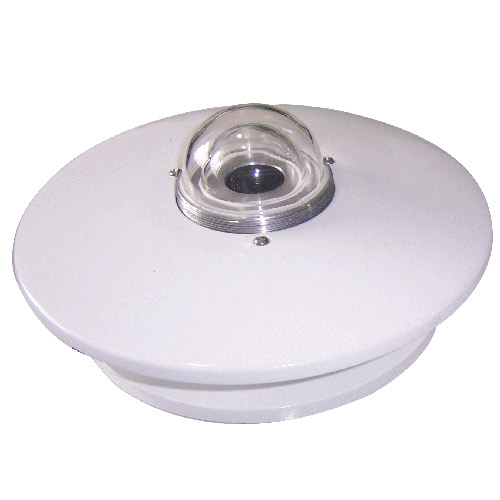 Pyranometer Solar Radiation Sensors
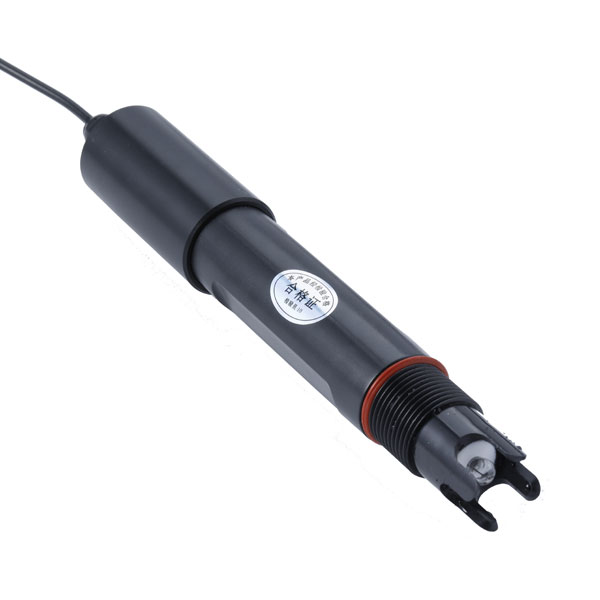 Soil ph sensor
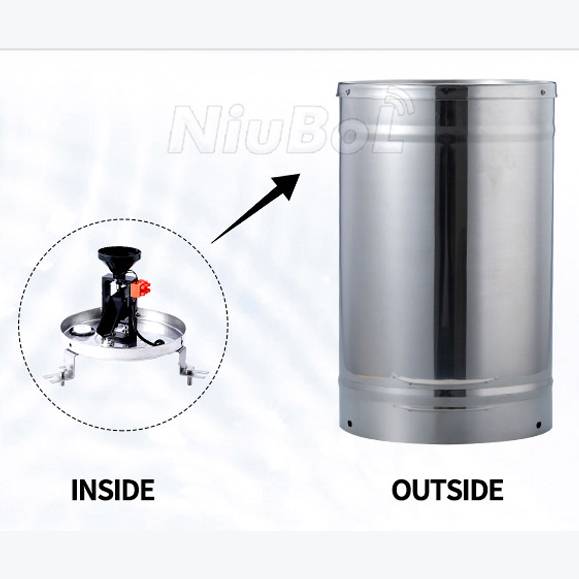 Tipping Bucket Rain Gauge - ABS and Stainless Steel
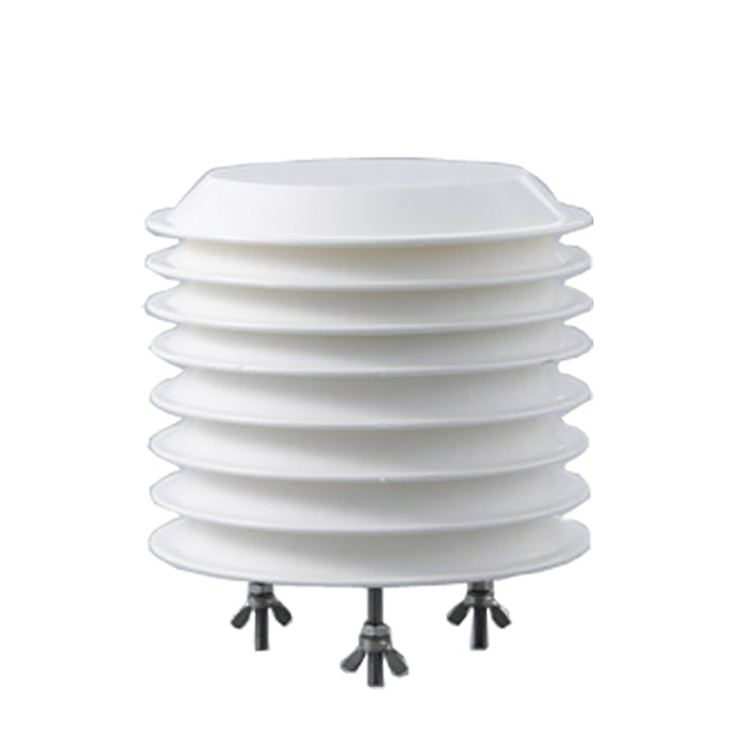 Air Temperature and Humidity Sensor


Screenshot, WhatsApp to identify the QR code
WhatsApp number:+8615367865107
(Click on WhatsApp to copy and add friends)

