





— Blogs —
—Products—
 Consumer hotline +8618073152920
 WhatsApp:+8615367865107
Address:Room 102, District D, Houhu Industrial Park, Yuelu District, Changsha City, Hunan Province, China
Product knowledge
Time:2026-06-16 14:17:52 Popularity:192
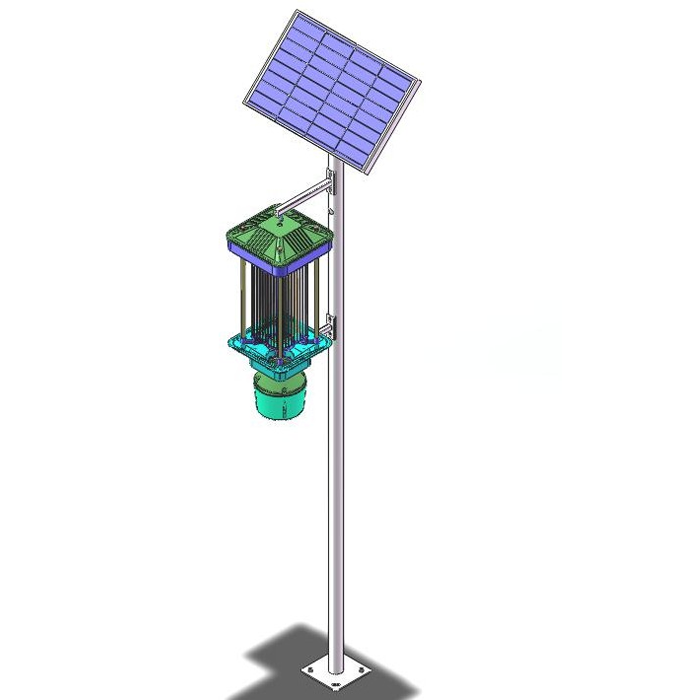
Solar insect killer lamp density is a project design issue, not only an installation habit. For farms, orchards, forestry zones and vegetable bases, spacing affects pest attraction coverage, operating cost, maintenance workload and the real effect of green pest control.
A frequency vibration solar insect trap uses the phototaxis, wave preference and activity pattern of target pests to attract adult insects and interrupt the breeding chain. If lamps are too sparse, uncovered areas remain between attraction zones. If they are too dense, equipment cost and maintenance workload increase without proportional improvement.
A practical engineering reference is that effective radius should be no less than about 120 m in open farmland and no less than about 80 m in forestry areas. These values should be adjusted according to crop height, terrain, pest species, light obstruction, local wind direction and field boundary shape.
Lamp height affects how far the light is visible and whether the attraction field is blocked by crops or trees. In greenhouses, the lamp should be higher than the crop canopy. For short crops such as peanuts and vegetables, about 0.7 m can be suitable. In fruit tree areas, installation near two-thirds of tree height is often more practical.
System integrators should not quote only a unit price. A useful proposal includes a layout map, lamp spacing, pole height, power mode, maintenance route and expected coverage area. This makes acceptance easier because the buyer can see whether the installed lamps match the design basis.
For large farms, density planning can be connected with block management. High-risk plots, field edges near forest belts, vegetable zones and fruit orchards may require different spacing. GIS-based maps or simple field grids can help maintenance teams locate each lamp and record cleaning status.
A good density plan also reduces pesticide overuse. When insect trap lamps are placed correctly, operators can monitor pest pressure and time chemical intervention more precisely instead of spraying uniformly without field evidence.
| Item | Engineering Reference |
|---|---|
| Device type | Frequency vibration solar insect trap for physical pest control |
| Applicable standard | GB/T 24689.2-2017 plant protection machinery insecticidal lamp reference |
| Solar panel | Monocrystalline silicon panel, >=40 Wp, conversion efficiency >=21% |
| Battery | Solar lithium iron phosphate battery, 12 Ah, DC 12.8 V |
| Grid voltage | >=4000 V high-voltage grid |
| Lamp wavelength | 320 to 680 nm, main wavelength around 365 nm depending on target pest |
| Lamp power | <=20 W |
| Control area | About 30 to 50 mu depending on terrain, crop and pest pressure |
| Protection rating | IP65 |
| Control functions | Light control, time control, rain protection, temperature protection |
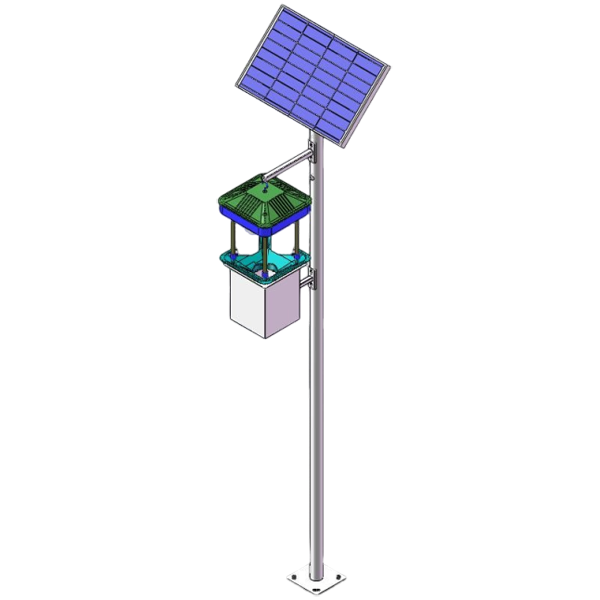
| Pole | Galvanized pipe, diameter 60 mm, wall thickness 2.0 mm, full height about 3 m |
| Safety note | High-voltage grid short-circuit current not exceeding 10 mA |
Site environment challenge: Short crops and frequent pest pressure require clear coverage without crop canopy obstruction.
System integration scheme: Use frequency vibration solar insect traps at planned intervals, with height around crop canopy and field layout recorded.
User value delivered: Growers reduce blind spraying and improve physical pest control coverage.
Site environment challenge: Tree canopy may block light and create uneven attraction zones.
System integration scheme: Place lamps near two-thirds of tree height and adjust density around borders and high-risk rows.
User value delivered: The operator gains more stable adult pest suppression with manageable maintenance.
Site environment challenge: Complex terrain and vegetation shorten effective attraction radius.
System integration scheme: Use smaller effective radius assumptions and check line-of-sight between lamps.
User value delivered: The buyer avoids under-designed systems that look cheaper but leave coverage gaps.
Site environment challenge: Managers need equipment status and pest control records across multiple plots.
System integration scheme: Combine lamp layout with IoT platform records, maintenance schedules and pest occurrence notes.
User value delivered: The park can compare lamp operation with pest pressure and chemical reduction results.
Buyers should compare proposals by coverage logic, not only by lamp quantity. A lower quotation may simply use wider spacing and leave untreated areas. The specification should state coverage assumptions, lamp height, solar power configuration and maintenance method.
For distributors, the useful sales document is a layout-based proposal. It shows that the project is designed for pest control performance, not only for equipment delivery.
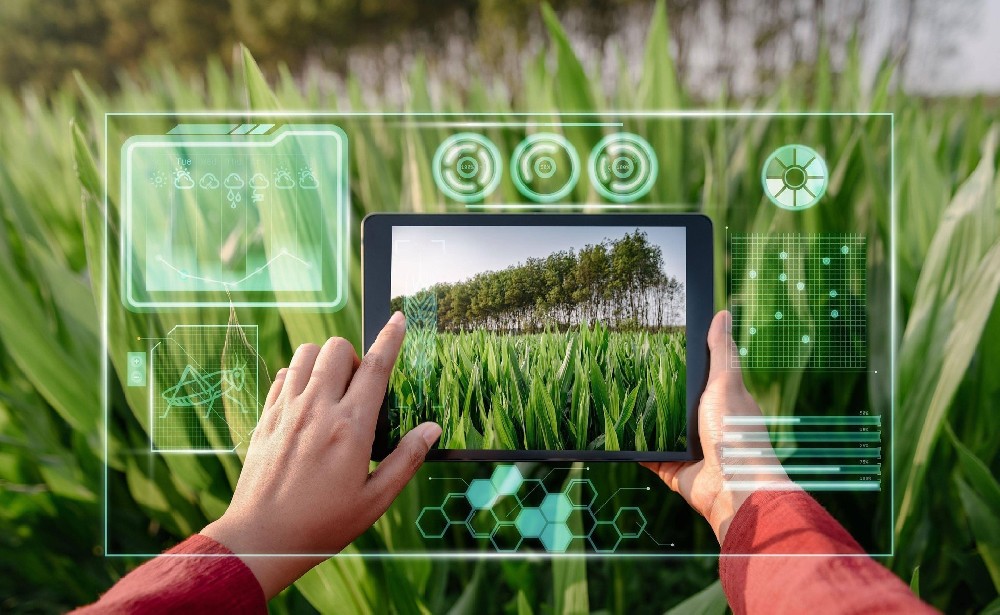
The quantity should be calculated from effective coverage radius, field shape, crop height and pest pressure. A practical reference is about 120 m radius in open farmland and about 80 m in forestry areas.
Tree height, canopy density, row spacing, terrain and competing light sources can reduce attraction coverage, so orchard spacing often needs closer review than open fields.
Acceptance should check lamp spacing, installation height, solar panel direction, rain-control response, collection-box access and whether coverage gaps remain between lamps.
Standard spacing may not fit fields with dense trees, tall crops, strong artificial lighting, steep terrain, irregular boundaries or severe localized pest pressure.
Short crops may use about 0.7 m height, greenhouses should place lamps above crop canopy, and orchards often place lamps near two-thirds of tree height.
Compare coverage assumptions, lamp quantity, pole height, solar configuration, control functions, maintenance plan and safety design, not only unit price.
Farms should record cleaning date, collection-box condition, lamp working status, battery condition, pest pressure and any abnormal weather or device fault.
They can support pesticide reduction as part of integrated pest management, but they should be combined with field monitoring and other control methods when pest pressure is high.
The main risk is under-design: using too few lamps or installing them at the wrong height, which leaves untreated areas and weakens pest control effect.
Provide field size, crop type, tree or crop height, target pest, terrain, power preference, expected operating season and whether platform management is required.
For a B2B project, documentation is part of the product value. The buyer should keep the product model, installation point, wiring record, communication settings, calibration or inspection method, maintenance interval and acceptance screenshots in one project file.
This documentation helps distributors, system integrators and end users discuss the same technical facts when troubleshooting or expanding the system. It also makes later procurement easier because the original design assumptions are visible.
A quotation should be compared by application fit, not only unit price. Buyers should check whether the supplier has considered the site environment, power supply, communication method, platform requirements, maintenance path and expected service life.
When two proposals use similar product names, the better proposal is usually the one that explains installation, data use and acceptance more clearly. That is the difference between buying a device and buying a usable monitoring point.
Before the agricultural insect trap spacing project is accepted, the commissioning team should test power supply, equipment start-up, communication, platform display, alarm response and data storage. If the system includes solar power, battery voltage and working schedule should be checked under real field conditions.
Acceptance should include photos of the installation point, screenshots of platform data, a simple fault simulation and confirmation that the end user knows how to clean, inspect or restart the equipment. These small steps reduce later disputes between supplier, contractor and owner.
Monitoring data should be reviewed on a schedule. Daily values help operators see abnormal events, weekly trends help managers evaluate field operation, and seasonal records help the buyer decide whether more monitoring points or control devices are required.
For IoT projects, the platform should not be treated as only a display screen. It should support historical query, data export, alarm review and equipment management so the buyer can convert field measurements into practical decisions.
Every outdoor monitoring or field-control device needs a named maintenance responsibility. The owner should define who checks cables, who cleans the collection or sensing area, who reviews alarm messages and who contacts the supplier when communication fails.
For distributors and project contractors, providing a maintenance schedule improves customer trust because it shows that the system is designed for long-term operation rather than a one-time installation.
Many insect control projects begin with one demonstration block, then expand after the buyer confirms lamp coverage, maintenance workload and pest reduction effect. The initial design should therefore keep a clear numbering rule for additional lamps, platform users and future field blocks.
A scalable design is especially useful for agricultural parks, construction groups, scenic areas and municipal platforms because they often start with one pilot area and later copy the configuration to other sites. Clear wiring, naming and data rules make this expansion easier.
Outdoor devices are affected by rain, dust, insects, vibration, sunlight, corrosion, human interference and unstable power. The supplier should explain how the selected equipment handles these conditions, and the buyer should check whether the installation method matches the actual site.
If the monitoring point is remote, the project should also define how faults are reported and how quickly maintenance can arrive. A technically suitable product still needs an operating plan that fits the service distance.
Agricultural insect trap density should be designed from coverage radius, crop height, terrain and target pest behavior. NiuBoL solar insect trap products support field-level green pest control when spacing and maintenance are planned as part of the project.
Related recommendations
Sensors & Weather Stations Catalog
 Agriculture Sensors and Weather Stations Catalog-NiuBoL.pdf
Weather Stations Catalog-NiuBoL.pdf
Agriculture Sensors Catalog-NiuBoL.pdf
Water Quality Sensor Catalog-NiuBoL.pdf
Related products
 Combined air temperature and relative humidity sensor
 Soil Moisture Temperature sensor for irrigation|NBL-S-THR
 Soil pH sensor RS485 soil Testing instrument soil ph meter for agriculture |NBL-S-PH
 Wind Speed sensor Output Modbus/RS485/Analog/0-5V/4-20mA
 Tipping bucket rain gauge for weather monitoring auto rainfall sensor RS485/Outdoor/stainless steel
 Pyranometer Solar Radiation Sensor 4-20mA/RS485

Screenshot, WhatsApp to identify the QR code
WhatsApp number:+8615367865107
(Click on WhatsApp to copy and add friends)

