





— Blogs —
—Products—
 Consumer hotline +8618073152920
 WhatsApp:+8615367865107
Address:Room 102, District D, Houhu Industrial Park, Yuelu District, Changsha City, Hunan Province, China
Product knowledge
Time:2024-11-02 15:59:36 Popularity:1733
In modern agriculture, precise management of soil moisture is the key to improving crop yield and optimizing resource utilization. As an important part of intelligent agriculture, agricultural soil moisture sensor is leading the change of agricultural production with its advantages of high precision, real-time monitoring and intelligent management. In this paper, we will discuss in depth the functions, types, characteristics of agricultural soil moisture sensors and their great application value in agricultural production.
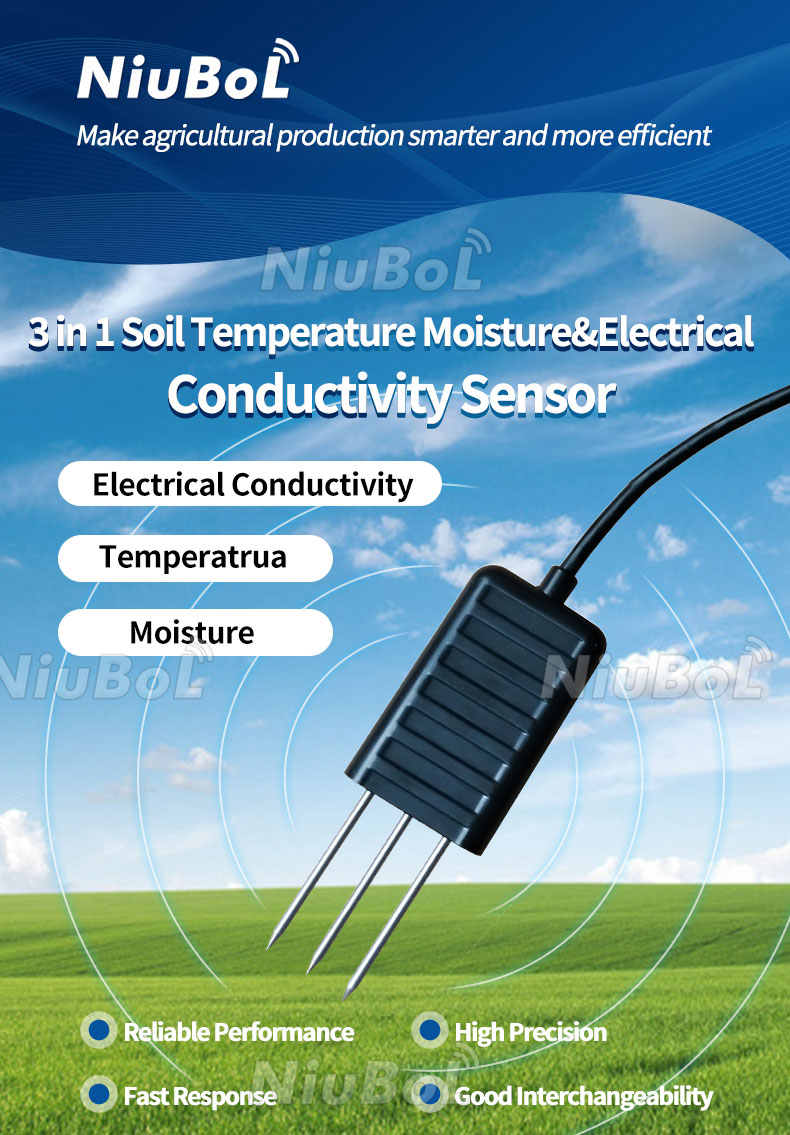
Agricultural soil moisture sensor is mainly used for real-time monitoring of the moisture content in the soil, providing key data support for agricultural production. Its core functions include:
1. accurate measurement: by measuring the dielectric constant or resistivity of the soil, the sensor is able to accurately calculate the moisture content of the soil, with a low error rate, providing a scientific basis for irrigation decisions.
2. Real-time monitoring: the sensor can continuously monitor soil moisture changes, and transmit the data to the central control system in real time to realize remote monitoring and management.
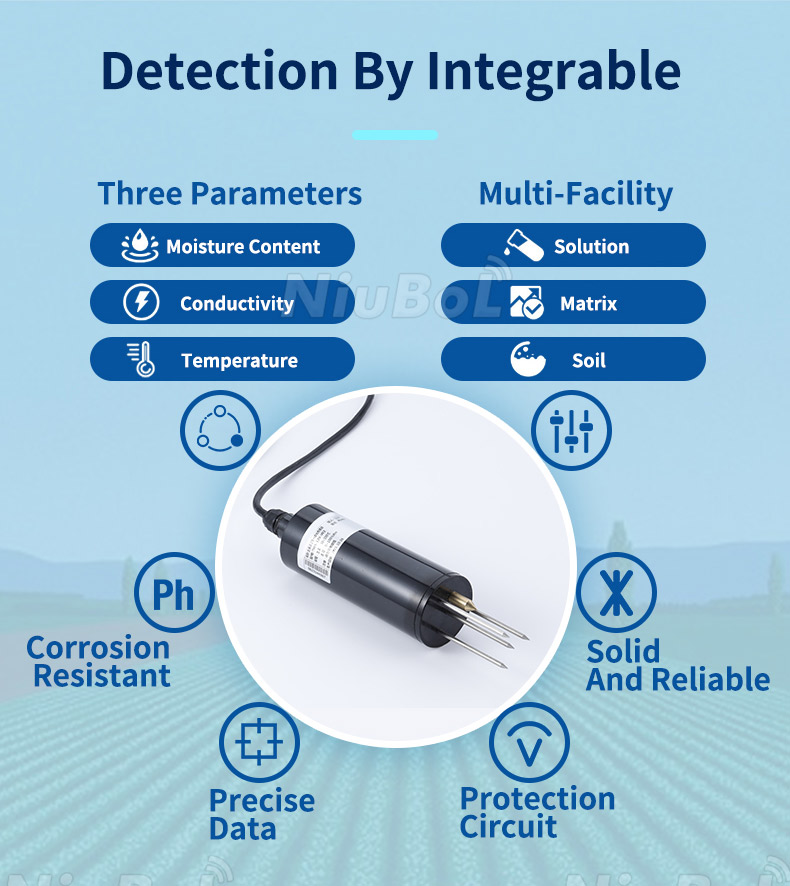
3. multi-parameter monitoring: some advanced sensors can also monitor the soil temperature, pH value and other parameters, to provide comprehensive soil environment information for agricultural production.
4. Intelligent early warning: when the soil moisture content is lower or higher than the set threshold, the sensor can automatically trigger the early warning system to remind farmers to take timely irrigation or drainage measures.
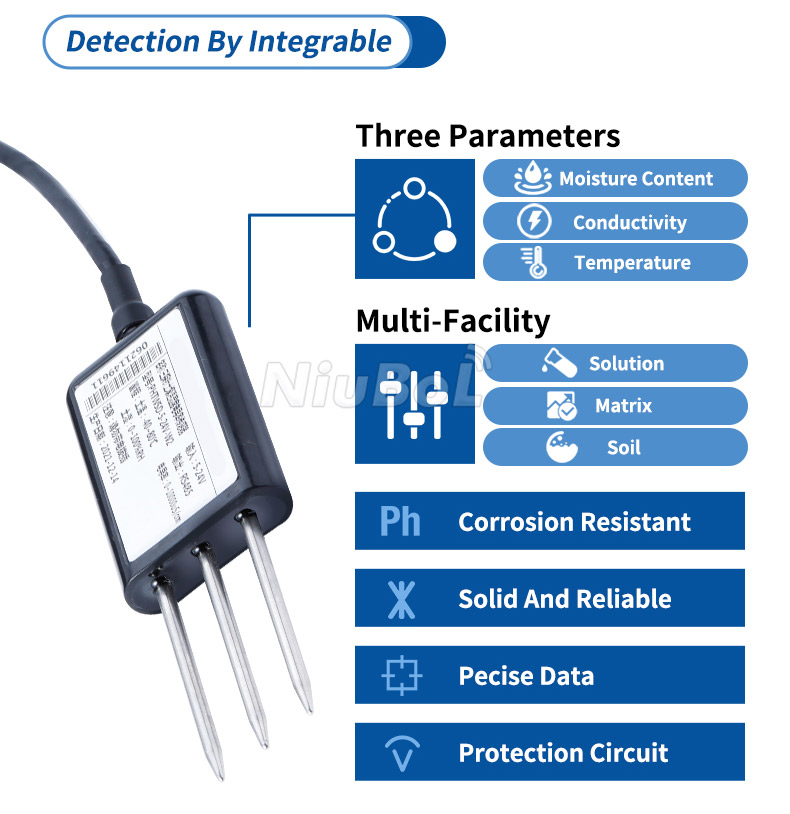
According to the principle of measurement and different ways of working, agricultural soil moisture sensor can be divided into a variety of types, including:
- Principle: by measuring the resistivity of the soil to deduce the moisture content.
- Characteristics: simple structure, low cost, but accuracy and stability may be affected by soil salinity and temperature.
- Principle: Measure the moisture content by utilizing the change of soil dielectric constant.
- Characteristics: High measurement accuracy, good stability, applicable to various soil types.
- Principle: Estimates moisture content by measuring the propagation speed of electromagnetic waves through the soil.
- Characteristics: Wide measurement range, not affected by soil salinity, applicable to a wide range of soil conditions.
- Principle: Determines moisture content by measuring the propagation speed of electromagnetic waves through the soil.
- Characteristics: Provides very high accuracy, but is costly and complex to install.
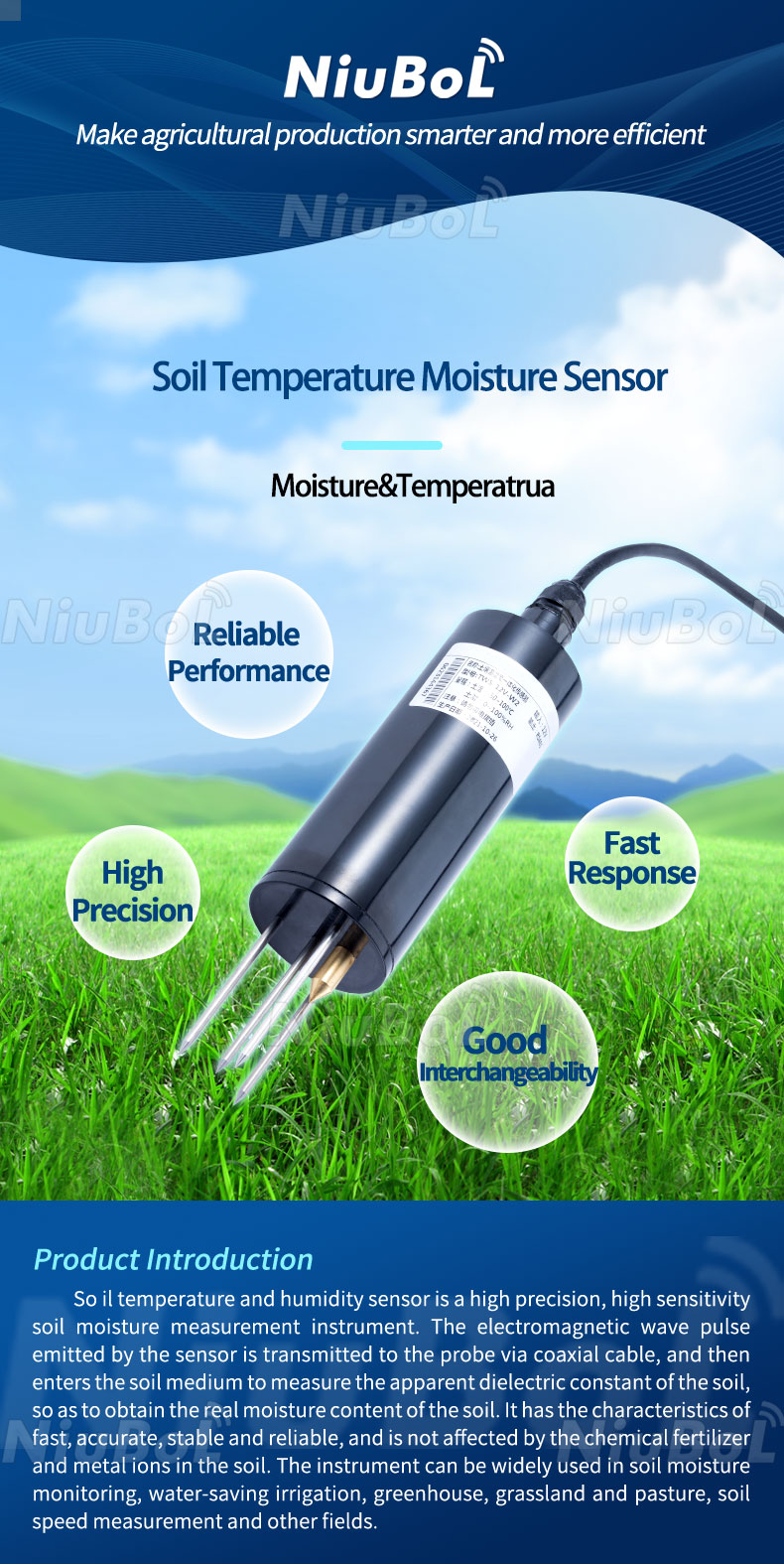
1. High accuracy: the sensor adopts advanced measurement technology and materials to ensure the accuracy and reliability of the measurement results.
2. High stability: the sensor can operate stably in a variety of harsh environments, without interference from soil type, salt content and other factors.
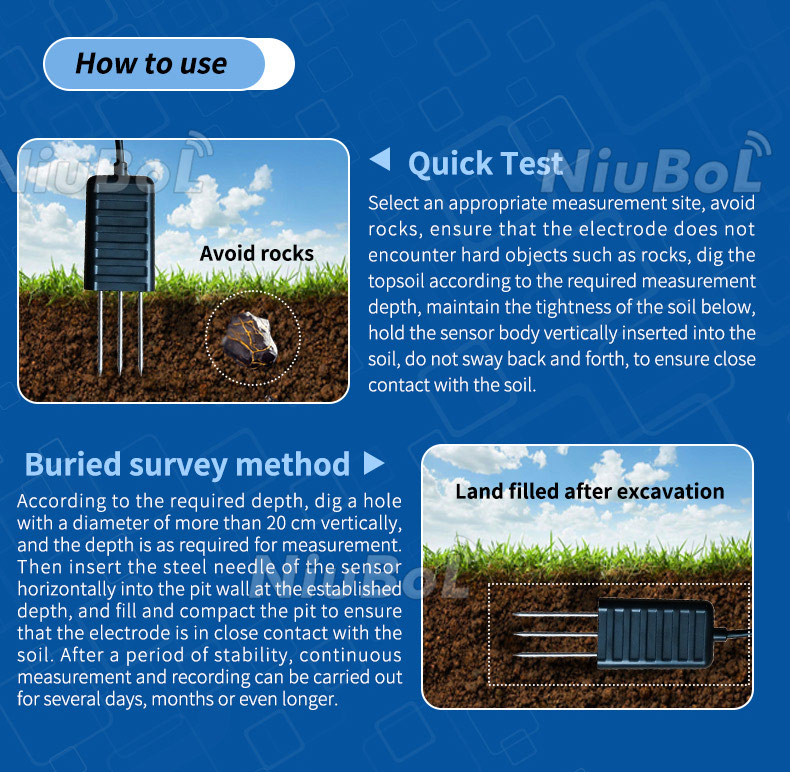
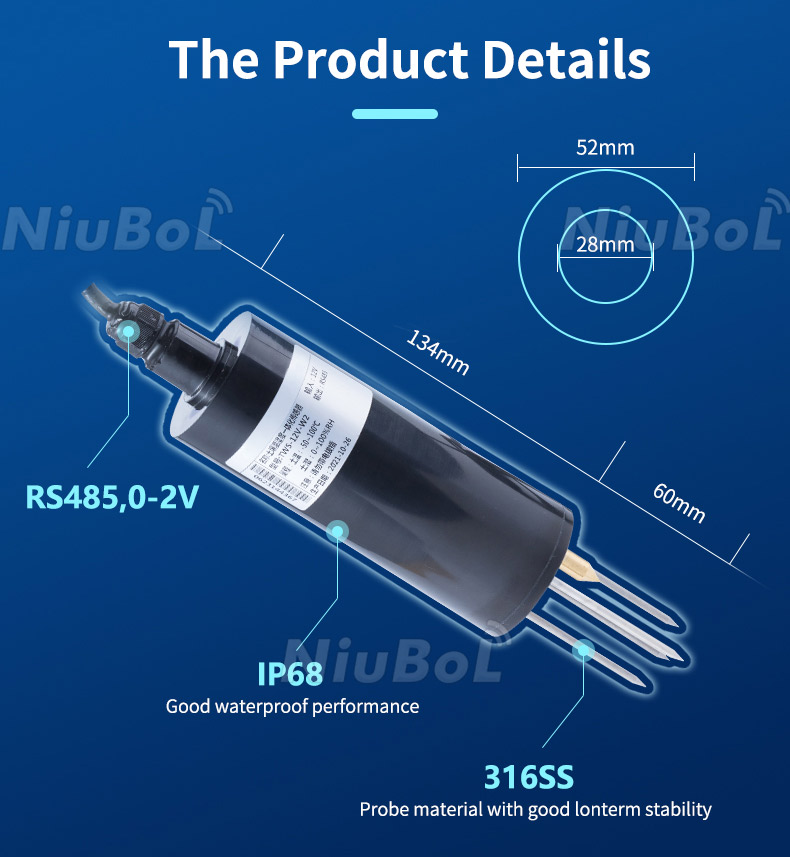
3. easy to install: the sensor is compact and easy to install, suitable for a variety of agricultural and horticultural sites.
4. Low power consumption: the sensor adopts low power consumption design, which can run stably for a long time and reduce energy consumption.
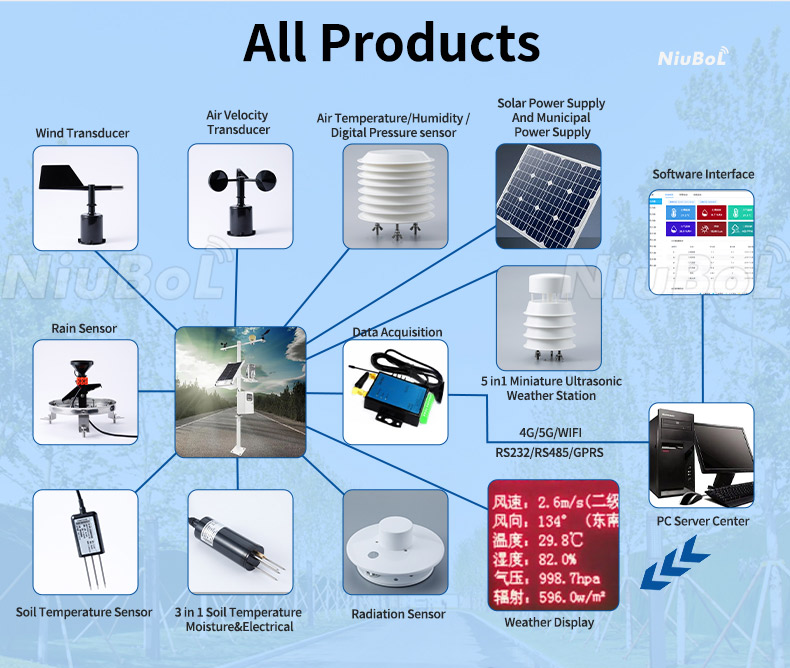
5. Intelligent management: the sensor can be integrated with intelligent irrigation systems, agricultural Internet of Things, etc., to achieve remote monitoring and intelligent management.
1. Improve irrigation efficiency: through real-time monitoring of soil moisture content, the sensor can guide farmers to scientific irrigation, to avoid excessive irrigation and drought on the impact of crops, improve irrigation efficiency and water utilization.
2. Optimize the crop growing environment: the sensor can monitor soil temperature, pH and other parameters, providing farmers with comprehensive information on the soil environment, helping farmers to optimize the crop growing environment, improve crop yield and quality.
3. Reduce production costs: through intelligent management, the sensor can reduce human input and the use of fertilizers and pesticides, reduce production costs and improve agricultural production efficiency.
4. Promote the development of intelligent agriculture: sensors as an important part of intelligent agriculture, can promote the digitalization of agricultural production, intelligence and precision, to provide strong support for the sustainable development of agriculture.
1. Integration and multifunctionality: future sensors may not be limited to measuring soil moisture and temperature, but also will be integrated into the measurement of soil pH, conductivity, nutrient content NPK and other parameters of the function of agricultural production to provide more comprehensive information on the soil environment.
2. Wireless transmission and remote monitoring: with the development of Internet of Things technology, the sensor will be more wireless transmission to achieve remote monitoring and management of data, improve the efficiency and accuracy of data transmission.
3. Intelligent decision support: future sensors will be integrated with intelligent irrigation systems and agricultural big data analysis platforms to form an intelligent agricultural management system. Through data analysis and model prediction, the system can provide farmers with scientific irrigation decision-making suggestions, optimize the agricultural production process, and improve yield and quality.
4. Low power consumption and long life: in order to meet the demand for long-term monitoring, the sensor will pay more attention to low-power design, the use of energy-saving materials and technologies to extend the service life of the sensor. At the same time, the sensor will also have self-diagnostic and maintenance functions to reduce downtime due to failure and improve system stability and reliability.
Although agricultural soil moisture sensors play an important role in agricultural production, they still face some challenges. For example, the problem of measurement accuracy under different soil types and climatic conditions, the cost of sensors, and the problem of data security and privacy protection. To address these challenges, we can take the following measures:
1. Strengthen technological R&D and innovation: Increase investment in technological R&D of agricultural soil moisture sensors to improve the measurement accuracy and stability of sensors. At the same time, actively explore new measurement principles and technologies to adapt to the needs of different soil types and climatic conditions.
2. Reduce cost and improve price-performance ratio: reduce the production cost of sensors by optimizing the production process and supply chain management. At the same time, improve the price-performance ratio of the sensor, so that more farmers can afford and use this advanced agricultural management tool.
3. Enhance data security and privacy protection: Establish a comprehensive data security and privacy protection mechanism to ensure that farmers' soil moisture data will not be leaked or misused. At the same time, strengthen the development and implementation of relevant laws and regulations to provide strong legal protection for the application of agricultural soil moisture sensors.
In addition to the above mentioned application scenarios, agricultural soil moisture sensors can also play an important role in the following areas:
1. forestry management: monitoring forest soil moisture to help prevent forest fires and assess tree growth.
2. Geological disaster early warning: In areas prone to landslides and mudslides, monitoring soil moisture changes to provide data support for disaster early warning.
3. ecological environment restoration: in ecologically fragile areas, by monitoring soil moisture, guide vegetation restoration and ecological construction.
1. Reducing chemical pollution: Reduce the excessive use of chemical fertilizers and pesticides through precise irrigation and fertilization, and reduce the pollution of soil and groundwater.
2. Protecting biodiversity: Reasonable regulation of soil moisture helps to maintain the balance of soil microbial communities and protect biodiversity.
3. Responding to climate change: through monitoring and optimizing soil moisture, it improves agriculture's ability to adapt to climate change and reduces the impact of extreme weather events on agricultural production.
IX. User-friendliness enhancement
1. Ease of use: Design a more user-friendly operation interface, so that non-professionals can also use it easily.
2. Easy Maintenance: Sensor design takes long-term stability into account, reducing the frequency and difficulty of maintenance.
3. Data Interpretation: Provide data interpretation services to help users better understand the sensor data and make scientific decisions.
Summarize
Agricultural soil moisture sensor with its high precision, real-time monitoring and intelligent management advantages, is becoming an indispensable and important tool for modern agriculture. With the continuous progress of technology and the continuous expansion of application fields, agricultural soil moisture sensors will play a more important role in promoting the green development of agriculture, improving agricultural production efficiency and promoting farmers' income. Through technological innovation and to meet the challenges, we can look forward to this tool in the future for agricultural production to provide a more comprehensive, smarter and more accurate management services.
1.NBL-S-THR Soil Temperature Moisture Sensor datasheet
 NBL-S-THR-Soil-temperature-and-moisture-sensors-Instruction-Manual-V4.0.pdf
2. NBL-S-TMC Soil Temperature Moisture EC Sensor datasheet
NBL-S-TMC-Soil-temperature-and-moisture-conductivity-sensor.pdf
3. NBL-S-TM Soil Temperature Moisture Sensor datasheet
NBL-S-TM-Soil-temperature-and-moisture-sensor-Instruction-Manual-4.0.pdf
4. NBL-S-TMCS Soil Temperature, Moisture, Conductivity and Salinity Integrated Sensor
NBL-S-TMCS-Soil-Temperature-Humidity-Conductivity-and-Salinity-Sensor.pdf
5. NBL-S-TMCS-7 Soil Temperature, Moisture, NPK, Conductivity and pH Integrated Sensor
7-in-1-Soil-Composite-Sensor-Manual.pdf
4. NBL-S-TMCS-8 Soil Temperature, Moisture, NPK, pH, Conductivity and Salinity Integrated Sensor
Related recommendations
Sensors & Weather Stations Catalog
 Agriculture Sensors and Weather Stations Catalog-NiuBoL.pdf
Weather Stations Catalog-NiuBoL.pdf
Agriculture Sensors Catalog-NiuBoL.pdf
Water Quality Sensor Catalog-NiuBoL.pdf
Related products
 Combined air temperature and relative humidity sensor
 TDR Soil Moisture & Temperature Sensor for irrigation| RS485 |4-20mA| NBL-S-THR
 Soil pH sensor RS485 soil Testing instrument soil ph meter for agriculture |NBL-S-PH
 Wind Speed sensor Output Modbus/RS485/Analog/0-5V/4-20mA
 Tipping bucket rain gauge for weather monitoring auto rainfall sensor RS485/Outdoor/stainless steel
 Pyranometer Solar Radiation Sensor 4-20mA/RS485

Screenshot, WhatsApp to identify the QR code
WhatsApp number:+8615367865107
(Click on WhatsApp to copy and add friends)

