





— Blogs —
—Products—
 Consumer hotline +8618073152920
WhatsApp:+8615367865107
Address:Room 102, District D, Houhu Industrial Park, Yuelu District, Changsha City, Hunan Province, China
Product knowledge
Time:2026-09-26 10:00:00 Popularity:227
Quick Answer: Semiconductor water quality monitoring must distinguish plant utilities and pretreatment from critical ultrapure-water (UPW) measurements. A conductivity range starting at zero does not establish adequate accuracy near an ultrapure-water limit. UV-derived COD, turbidity and conductivity also answer different questions; they cannot collectively replace qualified TOC, particle, ionic or other measurements required by the process.
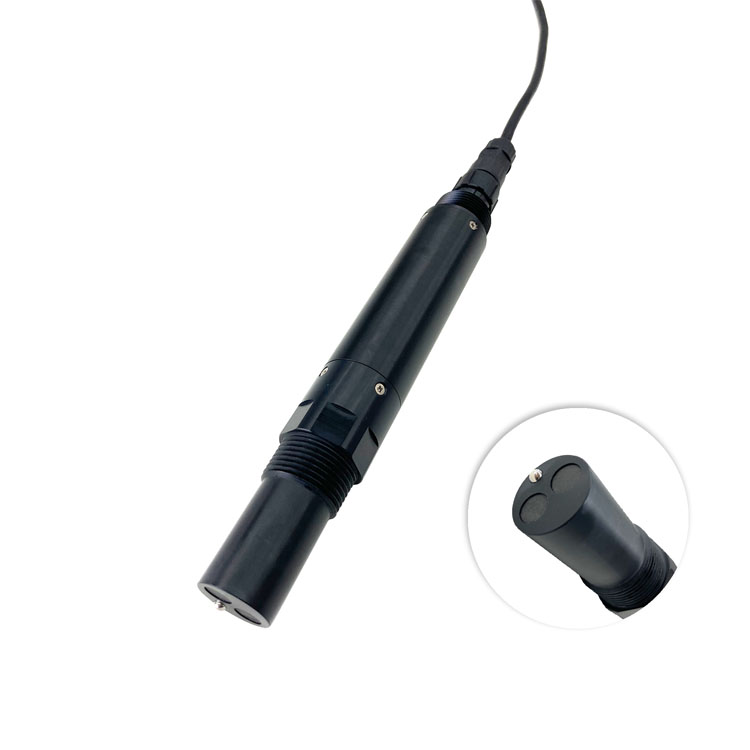
An electronics or semiconductor site may operate incoming-water treatment, cooling utilities, cleaning and rinsing lines, reclaimed-water systems and a high-purity distribution loop. Sharing one facility does not give those circuits the same water specification. A sensor suitable for a utility return can be unsuitable for product-contact rinse-water release.
The useful distinction is the decision attached to the point. A pretreatment conductivity trend may trigger investigation of a treatment stage. A critical rinse-water measurement may determine whether a process is permitted to operate. The latter needs demonstrated performance at the required level, appropriate materials and a qualified installation, not merely an industrial enclosure and a digital output.
| Water circuit | Possible monitoring task | Selection boundary |
|---|---|---|
| Incoming water and pretreatment | Observe source changes and treatment-stage trends | Select ranges and methods for the actual feed water |
| Cooling and general utilities | Observe conductivity, pH or particle-related changes for the treatment program | Utility instrumentation does not automatically qualify a process rinse |
| Recovered water before reuse | Check the properties relevant to the intended reuse destination | A release decision may require analyses beyond installed online channels |
| High-purity generation and distribution | Verify specified purity at defined process points | Require performance, sampling and materials suitable for the high-purity task |
| Tool or final rinse point | Confirm the water condition required by the specific manufacturing step | Use the process owner's qualification requirements, not a generic plant-wide limit |
The NiuBoL NBL-WQ-EC has separate conductivity range configurations. Their full-scale accuracy makes range selection important. A small display increment should not be mistaken for sufficient accuracy at a much smaller process limit.
| NBL-WQ-EC configuration | Resolution | Implication of +/-1% full-scale accuracy |
|---|---|---|
| 0-20.00 uS/cm | 0.01 uS/cm | +/-0.20 uS/cm |
| 0-200.0 uS/cm | 0.1 uS/cm | +/-2.0 uS/cm |
For illustration, if a process requires a decision at 0.10 uS/cm, a specified error of +/-0.20 uS/cm cannot by itself demonstrate the required discrimination. The example is not a universal semiconductor-water specification. It shows why choosing the smallest listed range is not enough to qualify an instrument for a critical high-purity point.
Conductivity and resistivity are reciprocal quantities when compared at the same temperature and reporting conditions. In the common units used here, resistivity in megohm-centimeters equals 1 divided by conductivity in microsiemens per centimeter. Thus 0.10 uS/cm corresponds to 10 megohm-centimeters. Converting the display does not improve the underlying measurement performance.
Establish whether the required result is actual-temperature conductivity, a normalized value or resistivity under a defined temperature convention. A compensation setting copied from ordinary process water should not be assumed appropriate for high-purity water. The sensing cell, temperature channel and calculation must be assessed together.
A sample taken into an open container can change through contamination and contact with air. The USGS discussion of water chemistry and conductance explains that atmospheric carbon dioxide can change the conductivity of exposed distilled water. An open beaker comparison therefore does not automatically represent the condition in a clean flowing process line.
Use a suitable controlled sample path for the intended high-purity measurement, with its materials, cleanliness and flow assessed for the application. A repeatable value in a contaminated sample line is not proof that the original water meets the process requirement.
Conductivity responds to ionic conduction; it does not quantify all organic contamination. A low conductivity result cannot establish a low total organic carbon concentration, and a satisfactory TOC result does not establish that every ionic or particle requirement has been met.
The NiuBoL NBL-WQ-COD uses ultraviolet absorption to provide an organic-load-related measurement in suitable water. Its COD or correlated output should not be presented as a dedicated high-purity TOC analysis. UV response depends on the compounds present, and an empirical relationship developed on one water matrix does not become a universal carbon measurement.
Turbidity is another separate optical quantity. An NTU probe is not a particle counter that reports the number of particles above a specified size. For a process requiring particle counts, trace organics or specific ionic contaminants, select an appropriate dedicated method and verify its performance at the required level.
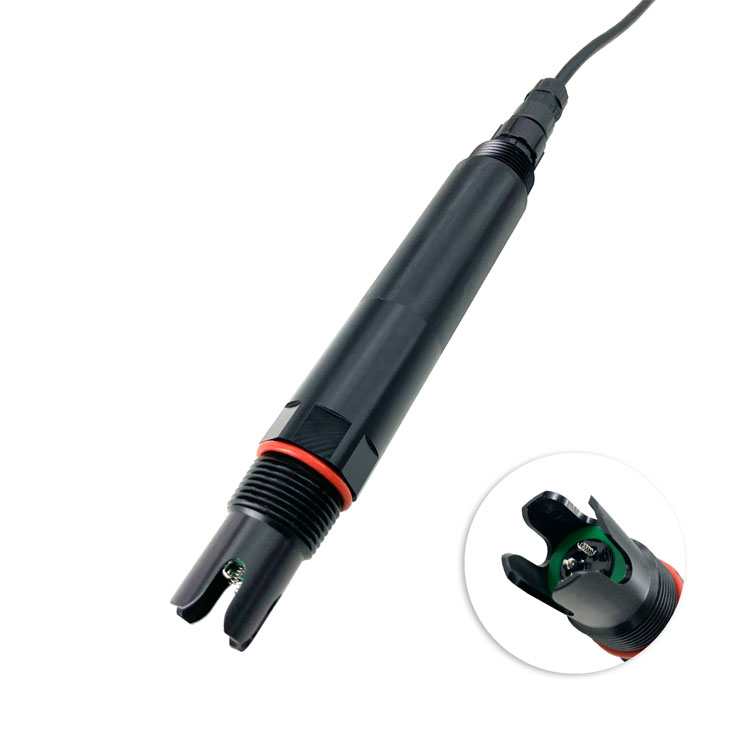
The pictured NBL-WQ-CL is a residual-chlorine probe, not a COD or TOC sensor. A chlorine measurement can have a separate role at an appropriate treated utility-water point, but it does not verify organic purity in an ultrapure-water loop.
The NiuBoL NBL-WQ-EC can be considered for suitable pretreatment, utility or recovered-water points where its range, accuracy and construction match the required decision. Its digital interface is useful for collecting trends, but the interface is not evidence of high-purity qualification.
| Technical item | NBL-WQ-EC configuration | What remains application-specific |
|---|---|---|
| Working conditions | 0-50 degrees C; pressure below 0.6 MPa | Actual sample and process connection conditions |
| Supply and power | 12-24 V DC +/-10%; 0.2 W at 12 V | Controller and auxiliary power requirements |
| Communication | RS485 Modbus RTU | Register interpretation, unit and temperature-reporting mode |
| Installation | 3/4 NPT; standard 5 m cable; IP68 probe | Complete flow arrangement, connection protection and maintenance access |
| Materials | ABS, stainless-steel or PVC configurations as applicable | Exact wetted construction, seals, cleanliness and suitability for the selected circuit |
An IP68 rating does not establish low extractables, cleanroom suitability, sanitary design or acceptance for a particular semiconductor process. Request those properties explicitly when relevant. If the required evidence or performance is unavailable, do not treat a general-purpose probe as an equivalent replacement.
For a NiuBoL inquiry, identify whether the point is a utility, pretreatment, reuse or critical high-purity application. Provide the required measurement level and method, sample conditions and material requirements. That information allows a suitability assessment without suggesting that a standard industrial probe covers every water circuit in the facility.
No. Compare accuracy and low-level performance with the actual decision limit. For the NBL-WQ-EC range discussed here, +/-1% full scale corresponds to +/-0.20 uS/cm. Range coverage alone cannot demonstrate a much tighter purity decision.
No. It changes the numerical representation of the same measurement. Use matching temperature and reporting conditions, and assess the original instrument performance before relying on the converted value.
Not without a justified measurement basis, and it should not be represented as the same analytical method. A UV organic-load trend and a dedicated carbon analysis have different responses and limitations. Critical TOC requirements need an appropriate qualified measurement.
No. Turbidity describes an optical response rather than the number of particles in defined size categories. Use a suitable particle-counting method where that is the required quantity.
Sample handling, air contact, temperature and container contamination can change the water. Verify that both methods observe equivalent water under suitable conditions before altering the installed instrument's calibration.
No. It describes data communication. Measurement performance, wetted materials, cleanliness and process qualification remain separate requirements, even when a PLC can read the device correctly.
Provide the circuit's role, existing instrument definition, required range and accuracy, temperature convention and material requirements. Include the acceptance method and host interface. A matching thread and output protocol are not enough to establish equivalence.
Semiconductor water quality monitoring requires a clear boundary between industrial utility observation and critical high-purity qualification. Use NiuBoL probes where their actual performance and construction fit the task. Where trace ionic, organic or particle requirements exceed that basis, specify a suitable dedicated measurement instead of inferring capability from range or protocol alone.
Prev:Outdoor Water Quality Monitoring in Heat and Humidity
Next:Electroplating Wastewater Monitoring: ORP, pH and Treatment Control
Related recommendations
Sensors & Weather Stations Catalog
 Agriculture Sensors and Weather Stations Catalog-NiuBoL.pdf
Weather Stations Catalog-NiuBoL.pdf
Agriculture Sensors Catalog-NiuBoL.pdf
Water Quality Sensor Catalog-NiuBoL.pdf
Related products
 Combined air temperature and relative humidity sensor
 TDR Soil Moisture & Temperature Sensor for irrigation| RS485 |4-20mA| NBL-S-THR
 Soil pH sensor RS485 soil Testing instrument soil ph meter for agriculture |NBL-S-PH
 Wind Speed sensor Output Modbus/RS485/Analog/0-5V/4-20mA
 Tipping bucket rain gauge for weather monitoring auto rainfall sensor RS485/Outdoor/stainless steel
 Pyranometer Solar Radiation Sensor 4-20mA/RS485


Screenshot, WhatsApp to identify the QR code
WhatsApp number:+8615367865107
(Click on WhatsApp to copy and add friends)

