





— Blogs —
—Products—
 Consumer hotline +8618073152920
 WhatsApp:+8615367865107
Address:Room 102, District D, Houhu Industrial Park, Yuelu District, Changsha City, Hunan Province, China
Product knowledge
Time:2026-03-05 22:14:08 Popularity:542
Quick Answer: Air pollution sources and online monitoring should be linked through a specific measurement question: which pollutant may reach which location, under what operating and weather conditions? Ambient sensors measure conditions at their inlets. They do not automatically identify a responsible source or measure its emissions rate. Start with the source type, then select particle or gas channels, comparison locations and reference checks that can answer the project's question.
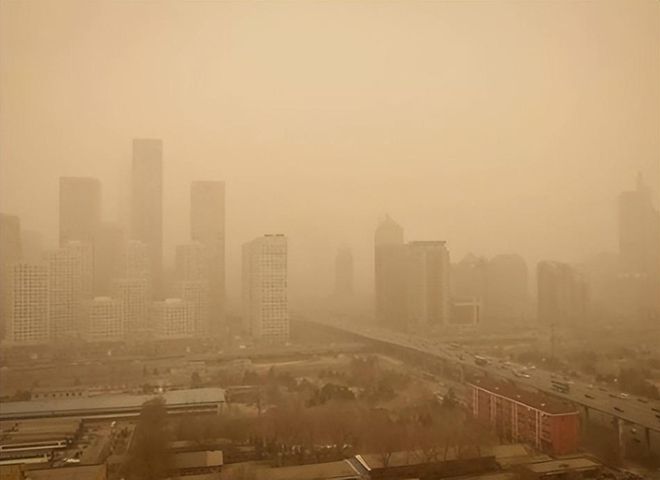
A factory stack, a stockpile and a road may all influence the same boundary station, but they require different investigation methods. A stack is a defined discharge point. A stockpile releases dust over an area, often intermittently. Traffic combines moving exhaust sources with disturbed road dust. Calling all three "air pollution" does not make one general-purpose sensor equally informative for every release.
| Source type | Examples and likely measurements | Monitoring decision |
|---|---|---|
| Combustion and process discharge | Boilers, engines and production vents; pollutants depend on fuel and process | Distinguish an ambient boundary observation from a stack measurement |
| Fugitive dust | Excavation, crushing, stockpiles and vehicle movement; particle fractions of interest | Compare activity periods and wind sectors, with suitable background observations |
| Traffic corridor | Exhaust gases and resuspended particles | Choose inlet positions for the intended roadside or community exposure |
| Agricultural release | Ammonia from relevant activities, field dust or combustion smoke | Select the actual analyte; a particle channel does not measure ammonia |
| Natural event | Windblown dust, wildfire smoke, sea spray or volcanic releases | Include regional and weather context before assigning a local industrial cause |
Pollutants can also form after release. Ozone and secondary particles involve atmospheric chemistry, so the highest concentration need not occur immediately beside an emitting activity. The distinction between directly emitted and secondary pollutants changes the network layout and interpretation. It also explains why measuring one gas cannot establish the full mixture affecting a site.
A PM2.5 and PM10 sensor reports particle concentration estimates for defined size fractions. PM2.5 is included within the broader PM10 fraction; these are not independent quantities to add together. Neither channel is automatically a total suspended particulate, or TSP, measurement. If a contract specifies TSP, select a method and instrument intended for that quantity instead of relabeling PM10.
Optical particle instruments infer a mass-related concentration from scattered light and their calibration response. Particle composition, size distribution and moisture can affect that relationship. A reading produced in mineral dust should not be assumed equivalent in every detail to one produced in smoke or wet aerosol. A visual haze photograph also cannot identify the pollutant or establish the concentration.
Gas channels are analyte-specific. Check each selected module's range, interference response and environmental limits. An SO2 module does not quantify all sulfur compounds, and NO2 is not a measurement of every nitrogen oxide. Where industrial air monitoring includes unusual vapors, review the process inventory rather than assuming a standard multi-gas package includes them.
A boundary station measures concentration in the air reaching that point, commonly expressed as ug/m3 for particles. An emissions rate describes a mass released per unit time, such as kg/h. These quantities are not interchangeable. A taller plume, a wind change or an unrelated regional event can alter the boundary value without a corresponding change in the source's actual mass release.
Source attribution usually needs more than a single concentration trace. Compare source operating periods, wind direction and speed, other nearby activities and an appropriate background record. Where the decision requires chemical identification or a defensible emissions estimate, additional analysis or modeling may be necessary. A camera can provide activity context, but an image recorded at the same time does not by itself prove causation.
An outdoor ambient sensor should not be installed directly in a hot process duct merely because the pollutant name is familiar. Stack monitoring involves different sample conditions, presentation, calibration and project requirements. Similarly, a general environmental station is not automatically a personal exposure monitor or a certified hazardous-gas alarm system.
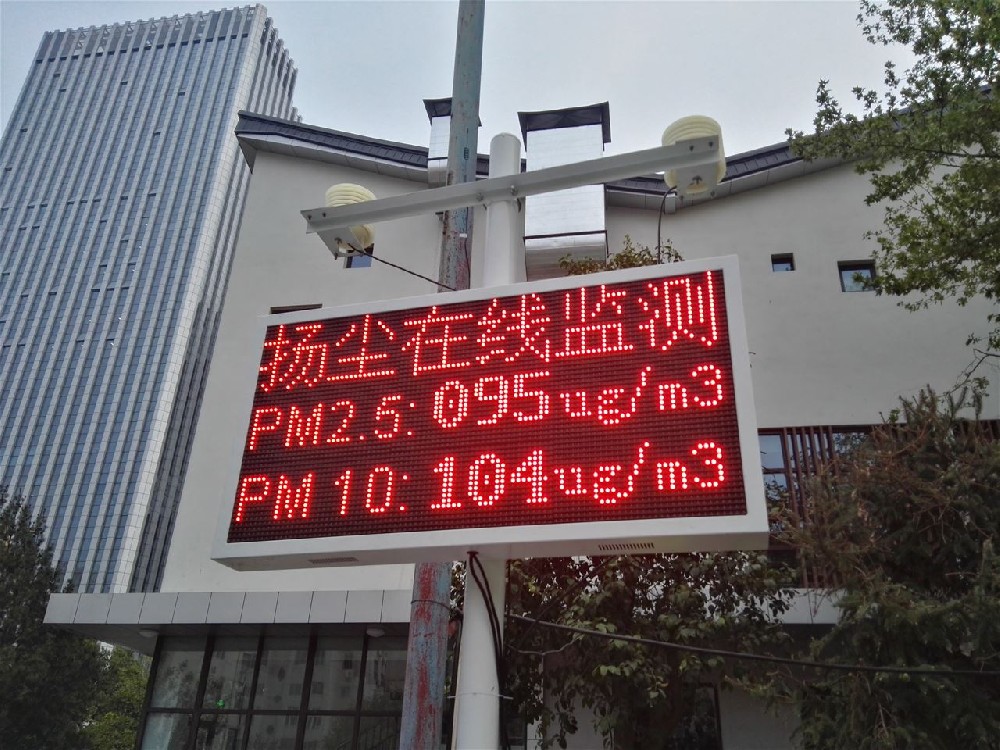
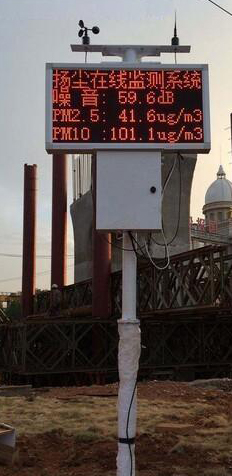
For a construction site, identify earthworks, haul routes, material handling and nearby occupied locations. Position inlets to observe the intended area without hiding them behind a display panel or enclosing them in still cabinet air. Record nearby obstructions and local sources such as a generator; otherwise a small installation detail may dominate the data presented as the whole site's condition.
A fixed point is not always downwind. Wind direction changes, so a pair of stations may exchange their upwind and downwind roles. Use the weather record to classify comparison periods. Do not simply subtract every value at station A from station B and call the difference the construction site's contribution. Both stations may be affected by different local sources or delayed transport.
For an industrial boundary, select locations around the release paths and nearby receptors of interest. Review whether buildings channel airflow or recirculate exhaust. At a roadside site, separate a deliberately near-road observation from a neighborhood-background observation. An ambient monitoring network is more useful when each station has a defined role than when every point is described as a general area average.
The NiuBoL NBL-W-PM integrated sensor provides PM2.5 and PM10 channels using laser scattering with a built-in fan. It can form the particle-measurement part of a station connected to a logger and optional weather instruments. Its particle specifications must not be transferred to separately selected gas modules or to the complete monitoring enclosure.
| Parameter | NBL-W-PM configuration | Effect on project selection |
|---|---|---|
| PM2.5 range | 0-1000 ug/m3 | Check expected events as well as routine background levels |
| PM10 range | 0-2000 ug/m3 | Do not substitute this result for TSP |
| Concentration error terms | +/-15% and +/-10 ug/m3 at 25 degrees C and 50% RH | Establish the applicable combined-limit interpretation and field comparison criteria before acceptance |
| Minimum detectable particle diameter | 0.3 um | This is not a claim to count every particle below 0.3 um |
| Supply and power consumption | DC 12-24 V; 350 mW | Size the logger, modem, display and any conditioning equipment separately |
| Digital output | RS485 Modbus RTU | Confirm data layout and serial settings in the receiving controller |
| Operating environment | -20 to +60 degrees C; 0-99% RH | Evaluate condensation and inlet exposure, not only the humidity number |
| Standard cable length | 2.5 m; other lengths by configuration | Specify jacket material, exposed routing and connection protection for the site |
A sensor specification under stated temperature and humidity conditions is not a guarantee of the same error throughout every outdoor aerosol event. Do not describe a 1 ug/m3 display increment as proof of 1 ug/m3 accuracy. For observations near an important decision level, evaluate agreement with an appropriate reference over the expected concentration and weather conditions.
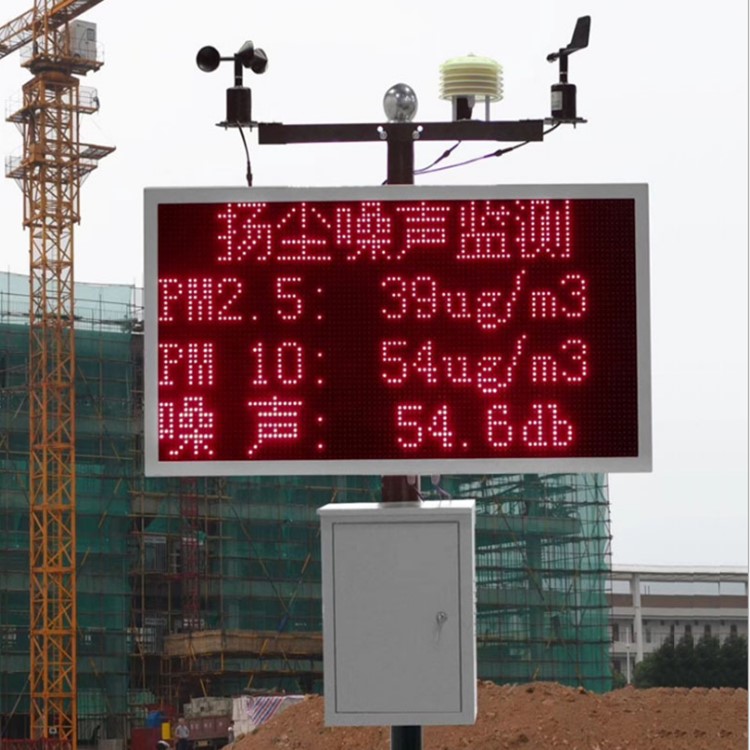
Construction dust monitoring can help a supervisor compare dust events with vehicle movements and handling activities. Use timestamps that allow those records to be aligned. A short event that occurs during a logger or camera time error may be assigned to the wrong operation. Record when dust suppression begins so the monitoring team can review what changed afterward.
Place an inlet where it measures the intended ambient condition, not directly inside spray intended to suppress dust. Droplets can affect an optical measurement. A pump or spray command should therefore follow tested site logic with suitable operating constraints, not an unexamined loop in which wetting the sensor produces an apparent improvement. Process confirmation and safe operation remain separate from concentration reporting.
At industrial and urban sites, channel combinations should follow the question. Particles plus weather may be sufficient for an initial dust investigation. A combustion-related task may need selected gases as well. Noise is another independent channel: it can support activity interpretation, but it is not a surrogate for dust concentration or gas emissions.
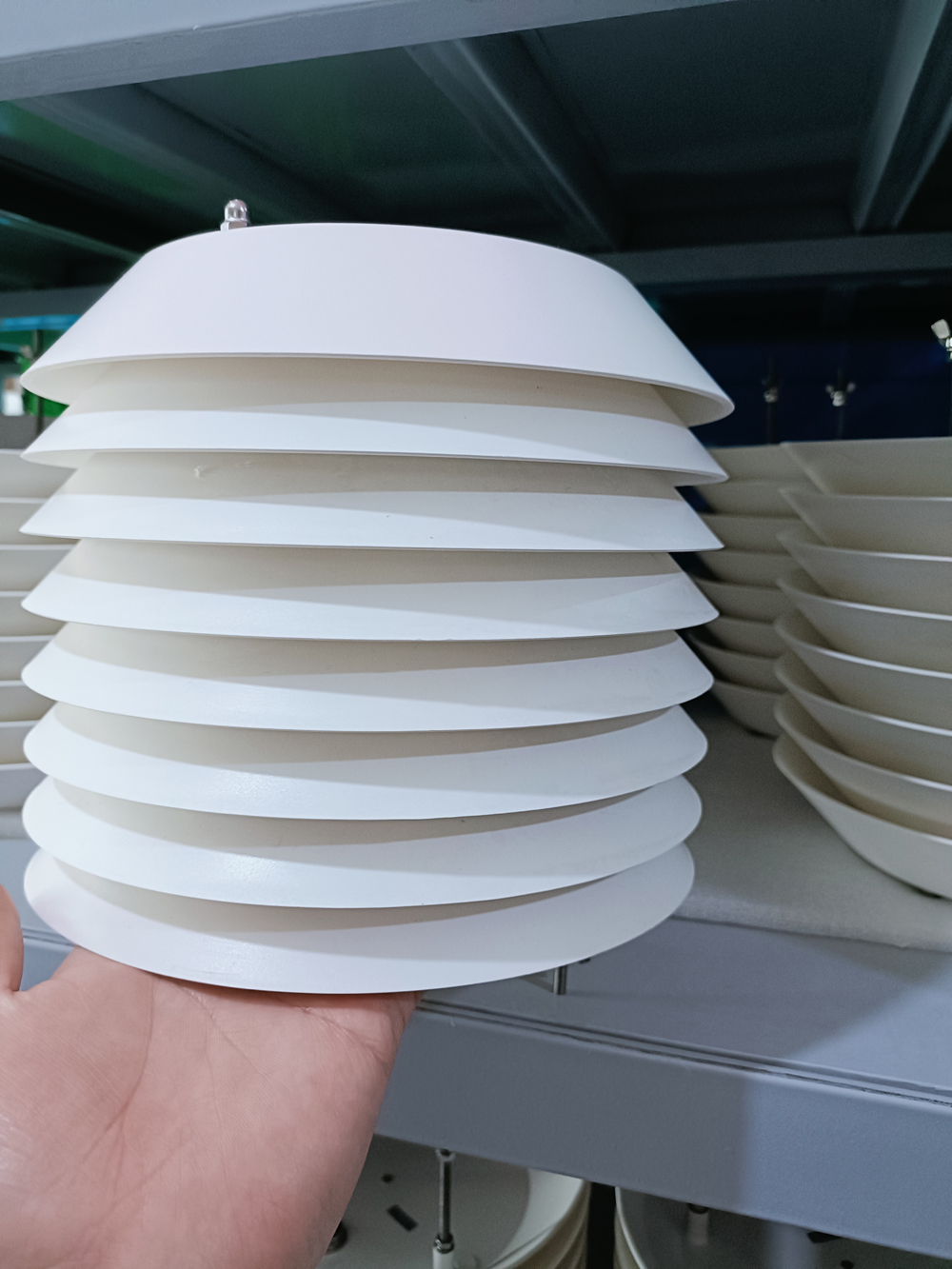
Check instrument response alongside a suitable reference when the project requires quantitative comparability. The EPA air-sensor collocation guide describes comparison at the same place and time. Include the local operating conditions in that evaluation; agreement during one dry afternoon does not describe behavior across an entire season.
Separate scheduled cleaning, inlet blockage, sensor faults and communications loss from valid environmental observations. Keep acquisition time and status with the value. After a network interruption, old packets should retain their original times. A missing concentration must not become zero in daily calculations, and a stale number must not remain marked as a new event on a public screen.
During RS485 Modbus RTU integration, read the correct concentration words and verify the units. Configure addresses without issuing setup commands repeatedly during normal polling. Outdoor cabinet protection, surge arrangements and a clear cable route are installation requirements; they do not remove the need to maintain the sampling path.
For a NiuBoL proposal, identify the source activities, intended observations, site plan and required reporting interval. State whether the project needs supplemental investigation or a particular regulated monitoring task. Then list the necessary particle, gas and weather channels, together with the reference comparison and integration work. This avoids buying more channels while leaving the central monitoring question unanswered.
Not reliably by itself. Source attribution needs the station's location and response, wind and operating records, background influences and sometimes further analysis. A concentration peak is an observation requiring investigation, not automatic identification of a responsible operator.
No. They refer to different particle fractions and measurement arrangements. A contract requiring TSP should specify a suitable TSP instrument and method; the PM10 channel must retain its correct name.
No. PM2.5 falls within the broader PM10 fraction. Adding the two double counts the overlapping fraction and does not create a valid TSP result or a complete measure of airborne particle number.
Moisture, droplets and changes in particle properties can affect optical response. Check inlet conditions, reference compatibility and time alignment before applying a correction. A correction developed under one set of conditions needs evaluation before use elsewhere.
No automatic substitution is justified. Stack and ambient monitoring use different sampling conditions and project criteria. Select the instrument and method for the actual discharge or exposure location.
No. Successful data transfer demonstrates an interface connection. Method acceptance, siting, calibration and other requirements for the particular reporting task must also be met.
Define the selected analytes, station count, mounting, inlet arrangement, power, communications, display, field comparison and servicing responsibilities. Quote these against the site plan rather than comparing sensor-only prices with complete installations.
Air pollution sources and online monitoring are connected by a measurement plan, not by a generic list of pollutants. Select the release and observation task, keep particle fractions and gas species distinct, and interpret field readings with weather and activity records. The result is a station network that supports specific investigations without overstating source attribution or compliance.
Prev:Highway Meteorological Monitoring Station: RWIS Data Integration Before V2X
Next:Water Quality Monitoring Buoy: Compare Online Readings with Laboratory Samples
Related recommendations
Sensors & Weather Stations Catalog
 Agriculture Sensors and Weather Stations Catalog-NiuBoL.pdf
Weather Stations Catalog-NiuBoL.pdf
Agriculture Sensors Catalog-NiuBoL.pdf
Water Quality Sensor Catalog-NiuBoL.pdf
Related products
 Combined air temperature and relative humidity sensor
 TDR Soil Moisture & Temperature Sensor for irrigation| RS485 |4-20mA| NBL-S-THR
 Soil pH sensor RS485 soil Testing instrument soil ph meter for agriculture |NBL-S-PH
 Wind Speed sensor Output Modbus/RS485/Analog/0-5V/4-20mA
 Tipping bucket rain gauge for weather monitoring auto rainfall sensor RS485/Outdoor/stainless steel
 Pyranometer Solar Radiation Sensor 4-20mA/RS485

Screenshot, WhatsApp to identify the QR code
WhatsApp number:+8615367865107
(Click on WhatsApp to copy and add friends)

