





— Blogs —
—Products—
 Consumer hotline +8618073152920
 WhatsApp:+8615367865107
Address:Room 102, District D, Houhu Industrial Park, Yuelu District, Changsha City, Hunan Province, China
Product knowledge
Time:2026-03-05 22:08:06 Popularity:521
A highway meteorological monitoring station supplies observations to a road-weather information system; it is not, by itself, a connected-vehicle warning system. A contractor must connect the field sensors, data logger and communications link to the road operator's receiving software, then validate how that software uses each observation. Treat any downstream sign, roadside unit or vehicle message as an additional integration responsibility.
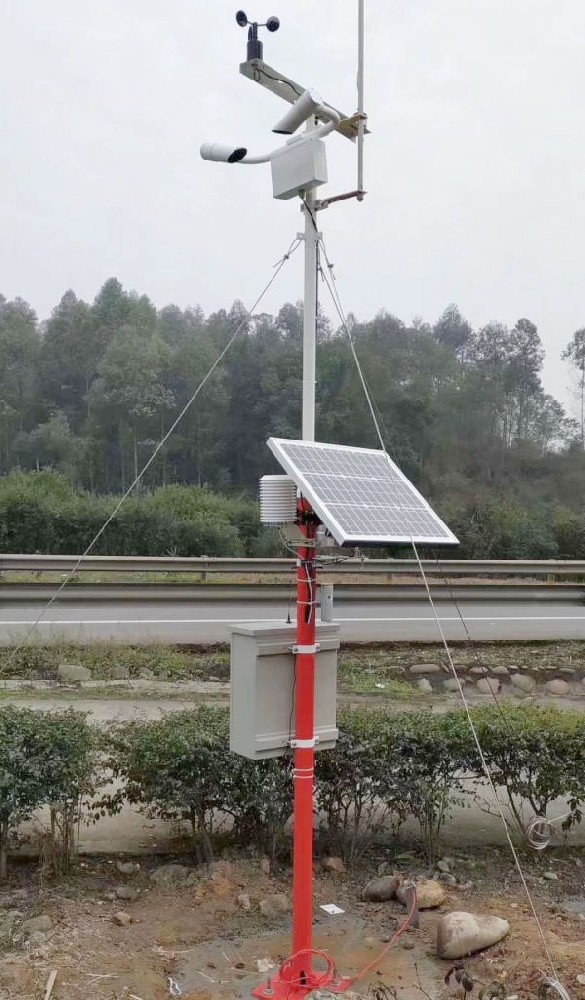
A Road Weather Information System, or RWIS, combines field environmental sensor stations, communications and central processing. This distinction follows the FHWA explanation of RWIS. A cabinet displaying wind and humidity locally is only part of that chain. Its data must reach the operator with the correct meaning, location and observation time.
A practical arrangement is: roadside instruments, local acquisition, communications, an RWIS or traffic management centre, and then the operator's selected information channels. In a connected-vehicle project, a separate interface may transfer information to roadside ITS equipment. RS485 Modbus RTU describes a field-device exchange; it does not establish V2X messaging, security credentials or interoperability with vehicles.
| Component | Principal role | Interface to establish |
|---|---|---|
| Weather and road sensors | Measure specific atmospheric or pavement quantities | Electrical output, units, sampling basis and fault indications |
| Data logger or RTU | Acquire and identify observations | Channel mapping, timing, local retention and output record |
| Communications equipment | Carry records to the receiving system | Network access, addressing, transport and recovery |
| RWIS or traffic management software | Combine observations for operational use | Station identity, quality rules, display and application processing |
| Signs or connected-vehicle services | Disseminate approved information | Separate application requirements and end-to-end tests |
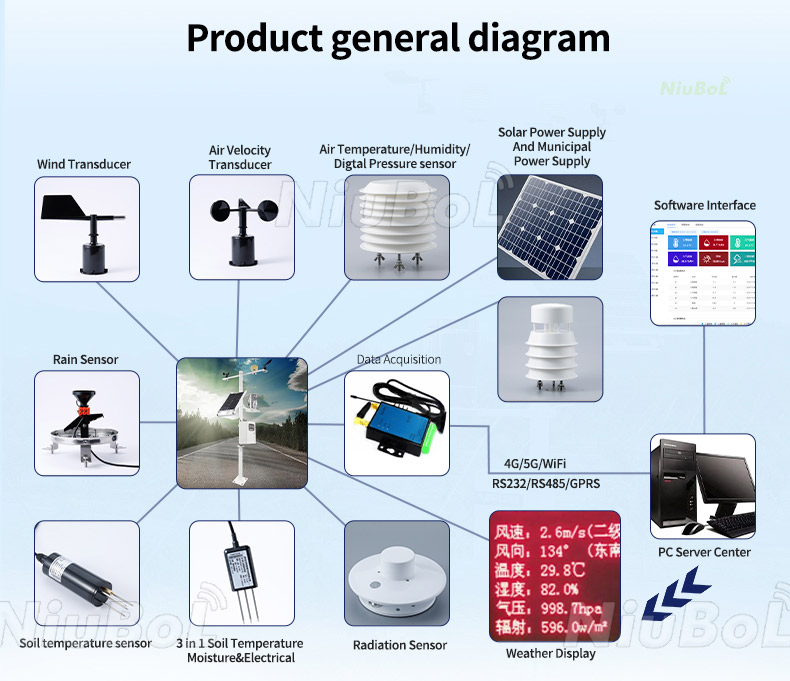
A crosswind observation project may need wind speed, direction and the relationship between the instrument and road alignment. A fog-monitoring project requires a suitable visibility measurement rather than an estimate made from relative humidity. Winter maintenance may require pavement observations in addition to atmospheric temperature. None of those requirements is satisfied simply by ordering a station with more generic channels.
NiuBoL modular weather configurations can combine atmospheric, wind and rainfall instruments with a compatible logger. The NBL-W-LBTH measures temperature, relative humidity and pressure. Separate NBL-W-SS wind speed and NBL-W-DS wind direction sensors have IP65 protection. Choose their outputs to match the ordered acquisition hardware.
| Component or quantity | Relevant specification or requirement | Road-project limitation |
|---|---|---|
| NBL-W-LBTH temperature | -40 to 80 C; +/-0.5 C | Air temperature is not pavement temperature |
| NBL-W-LBTH humidity and pressure | 0-100% RH, +/-5% RH; 10-1200 hPa, +/-1.5 hPa | Neither channel measures road friction or visibility distance |
| NBL-W-LBTH electrical connection | 12-24 VDC; RS485 Modbus RTU or separate 4-20 mA version | Output version must match the receiving input |
| NBL-W-RS liquid rainfall | 0.2 mm resolution; 0-4 mm/min; operation 0-50 C | Not evidence of unheated snow measurement or precipitation classification |
| Wind channels | NBL-W-SS and NBL-W-DS; IP65; ordered output to be specified | Gust processing and site exposure need separate definition |
| Power, cable and enclosure | Size for the actual logger, sensors, network equipment and site conditions | No single station-wide load, cable material or autonomy value applies to every configuration |
For a visibility instrument, obtain its range, operating limits and installation requirements as a separate line item. For a pavement sensor, establish whether it measures temperature, reports a surface classification or estimates another condition. Do not describe a calculated category as a direct friction measurement without evidence for that exact instrument and method.
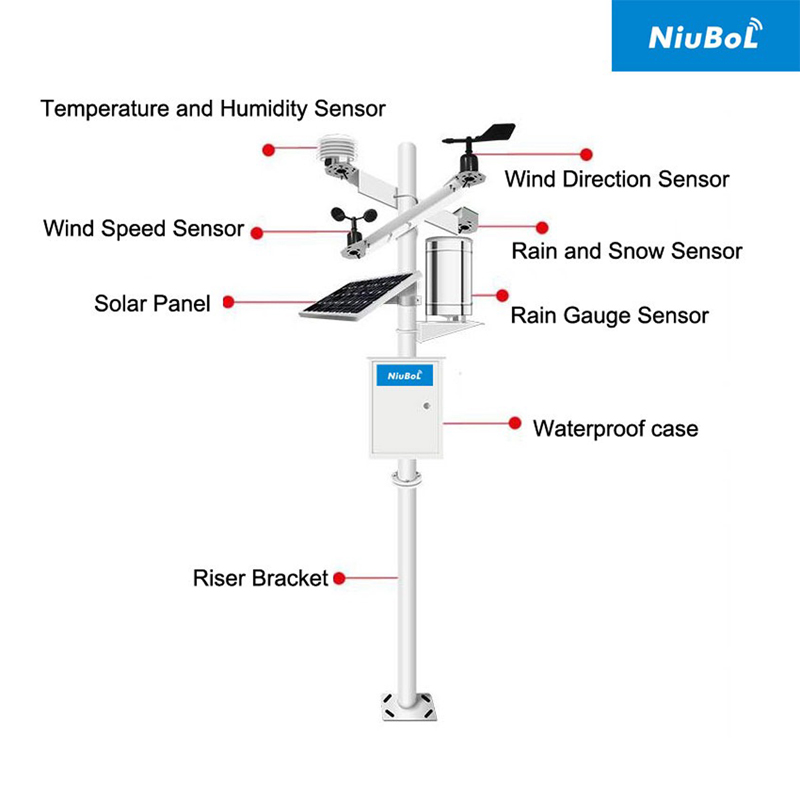
A weather station identifier should resolve to coordinates and a documented road section. Some quantities describe ambient conditions near a mast; others describe a particular pavement spot or lane. Keep those locations distinct. A surface sensor aimed at a shaded bridge deck should not be presented as though it represents every lane along an entire corridor.
For wind, retain the geographic direction convention and instrument alignment. If software derives a crosswind component, it also needs the relevant road bearing and a defined calculation. A copied compass number without those definitions can reverse an interpretation or associate a reading with the wrong carriageway.
Maintain the relationship when equipment moves. A replacement cabinet at the same station may leave the measurement positions unchanged; moving a pavement target or raising the wind head does not. Record the effective date of the change so historical comparisons do not silently combine observations from different exposures.
Ask the traffic management system supplier for its actual input contract: endpoint, transport, authentication, field names, units and quality values. A generic claim of platform compatibility is not enough. A logger supporting cellular transmission may still need application-specific mapping or a separate adapter before the central system accepts its records.
For each channel, carry a station and sensor identifier, engineering value, unit, observation timestamp and available quality or fault indication. Add a period when the value is an average, maximum or accumulation. If the instrument cannot provide a quality code, establish which acquisition failures the logger can detect and avoid inventing sensor diagnostics.
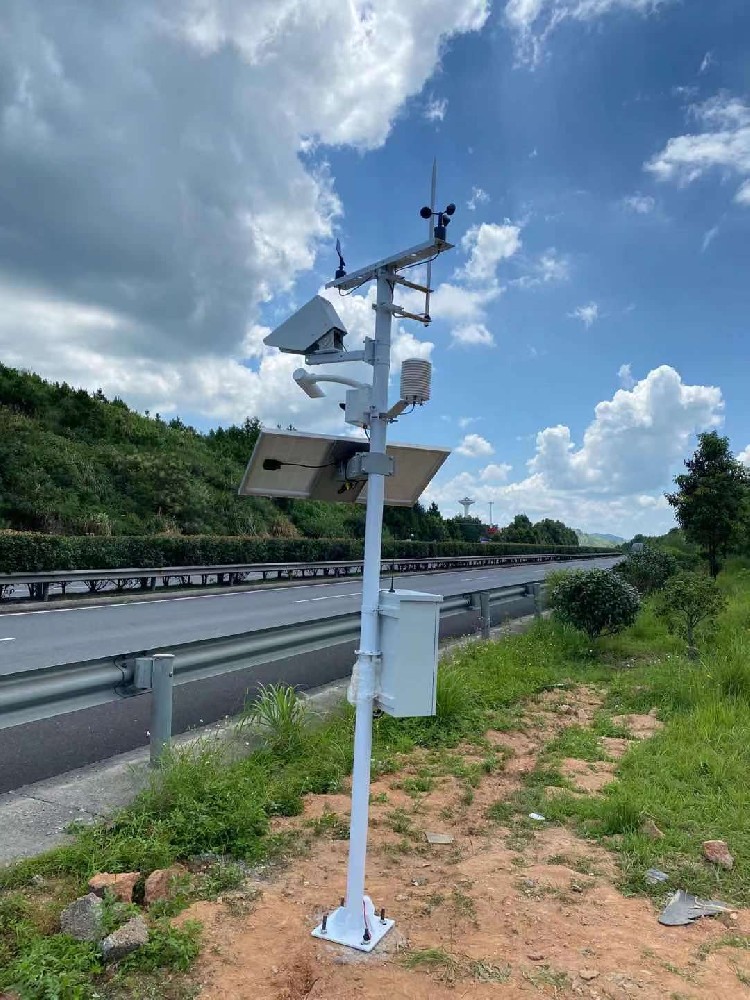
Roadside networks can fail while sensors continue working. If the specified logger retains data, reconnection may deliver older observations in a batch. The RWIS must preserve their observation times and distinguish them from the current reading. Server receipt time is useful for diagnosing transport, but it cannot replace the event's measurement time.
As an acceptance example, acquire a known test sequence at 09:00, interrupt the uplink and restore it at 09:15. Inspect whether recovered records appear in their historical positions, whether duplicates are handled according to the receiving system's rules, and whether the latest valid observation is clearly identified. These are test conditions, not a promised retention or recovery feature of every NiuBoL logger.
Check each failure separately: loss of one sensor, loss of the serial bus, loss of the modem and loss of cabinet power. A healthy network connection does not prove healthy measurements. Equally, a missing upload does not prove that the rain gauge stopped counting. Diagnostic separation reduces unnecessary roadside visits and helps identify which contractor must investigate.
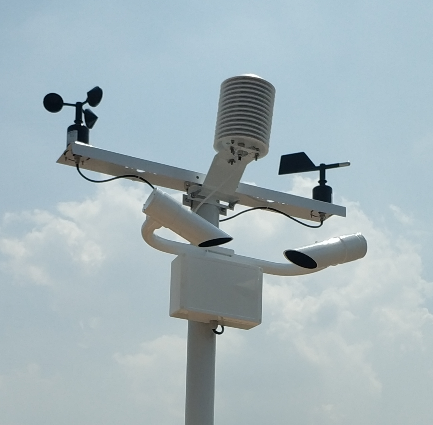
First show that the central system receives correctly scaled and timed values from the supplied station. Then test the separate application that interprets or disseminates those values. For signs, this includes the operator's display and approval workflow. For connected vehicles, it includes the selected roadside equipment and message implementation; weather sensors alone cannot establish that interoperability.
The FHWA environmental sensor station guidance separates collection, transmission, processing and dissemination within an RWIS. For project acceptance, acquired weather data, interpreted conditions and issued messages should likewise be checked as different outputs. Successful sensor polling alone does not demonstrate the final information service.
Do not accept a demonstration in which a technician changes a dashboard number and a warning appears as proof of the complete field chain. Exercise an identifiable field input or approved simulator through the actual logger and receiving interface. Separately test invalid or stale inputs so downstream software does not treat them as fresh normal conditions.
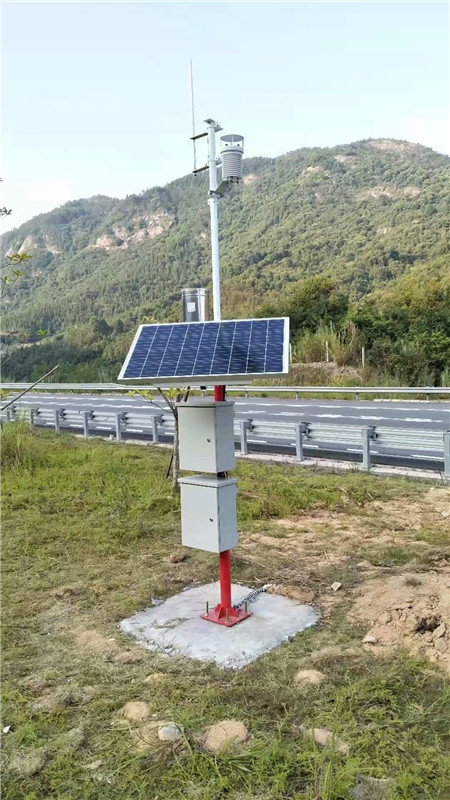
No. The station is a field observation component. An RWIS also needs communications and central processing or display, with interfaces that preserve the meaning and timing of the measurements.
No. Modbus RTU can transfer sensor data to a compatible logger. Vehicle-facing messaging requires separate equipment, application mapping and interoperability tests for the chosen implementation.
Not where the requirement is direct pavement temperature or a specific surface condition. Atmospheric readings provide context but do not establish the pavement's measured condition.
Provide the required quantities, road locations, existing receiving interface, power and network availability, access constraints and operating temperature conditions. Identify optional visibility and pavement measurements explicitly.
Exchange the receiving schema and a sample decoded record, then test the actual logger through the target interface. Verify units, time basis, identifiers and invalid-data handling rather than relying on the names of the communication protocols.
Use separate sensor, acquisition and uplink diagnostics to establish the likely failure location. Physical inspection remains necessary for contamination, damage or changed exposure; a working modem cannot verify those conditions.
Not across different sensor sets, civil works and receiving systems. Request an itemised scope separating instruments, mounting, power, communications, interface work and commissioning so bids cover the same road-weather task.
A highway meteorological monitoring station needs a defined path from each roadside observation to the road operator's software. NiuBoL equipment selection should begin with the required quantities and receiving interface, followed by tests of location, units, timestamps and failure behaviour. Keep downstream V2X or sign applications separate until the field-to-RWIS data path has been accepted.
Related recommendations
Sensors & Weather Stations Catalog
 Agriculture Sensors and Weather Stations Catalog-NiuBoL.pdf
Weather Stations Catalog-NiuBoL.pdf
Agriculture Sensors Catalog-NiuBoL.pdf
Water Quality Sensor Catalog-NiuBoL.pdf
Related products
 Combined air temperature and relative humidity sensor
 TDR Soil Moisture & Temperature Sensor for irrigation| RS485 |4-20mA| NBL-S-THR
 Soil pH sensor RS485 soil Testing instrument soil ph meter for agriculture |NBL-S-PH
 Wind Speed sensor Output Modbus/RS485/Analog/0-5V/4-20mA
 Tipping bucket rain gauge for weather monitoring auto rainfall sensor RS485/Outdoor/stainless steel
 Pyranometer Solar Radiation Sensor 4-20mA/RS485

Screenshot, WhatsApp to identify the QR code
WhatsApp number:+8615367865107
(Click on WhatsApp to copy and add friends)

