





— Blogs —
—Products—
 Consumer hotline +8618073152920
 WhatsApp:+8615367865107
Address:Room 102, District D, Houhu Industrial Park, Yuelu District, Changsha City, Hunan Province, China
Product knowledge
Time:2023-12-03 16:10:30 Popularity:6185
The working principle of temperature and humidity sensors can vary depending on the technology and type of sensor used, here are some common working principles of temperature and humidity sensors:
1. Capacitive Sensors: Capacitive temperature and humidity sensors use a capacitive element to measure the humidity in the air. As the humidity in the air changes, the capacitance value of the capacitive element changes. The circuitry in the sensor measures this change and converts it into a corresponding humidity reading.
2. Resistive Sensors: Resistive temperature and humidity sensors use a special material, such as a polymer or ceramic, as the sensitive resistance element. These materials are very sensitive to changes in humidity, and their resistance changes as the humidity changes. By measuring the change in resistance, the sensor can determine the level of humidity in the air.
3. Thermoconductive Sensors: Thermoconductive temperature and humidity sensors use a thermistor or thermistor to measure humidity. The circuitry in the sensor heats up a portion of the sensor and measures the difference in temperature between the sensor and its surroundings. Changes in humidity affect the ability of the surroundings to dissipate heat, which changes the temperature difference. By measuring the temperature difference, the sensor can determine the level of humidity in the air.
These sensors are usually connected to a microcontroller or data logger, which converts the temperature and humidity data into a digital signal and outputs it to the monitoring system for processing and logging. Some advanced temperature and humidity sensors can also provide compensation to correct temperature and humidity readings to ensure accuracy and stability.
It should be noted that different types of temperature and humidity sensors may vary in terms of accuracy, response time and range of application. Selection of the right sensor should be evaluated and chosen based on specific application requirements and environmental conditions.
Soil temperature and humidity sensors and atmospheric temperature and humidity sensors are two different types of sensors used to monitor temperature and humidity under different environmental conditions.
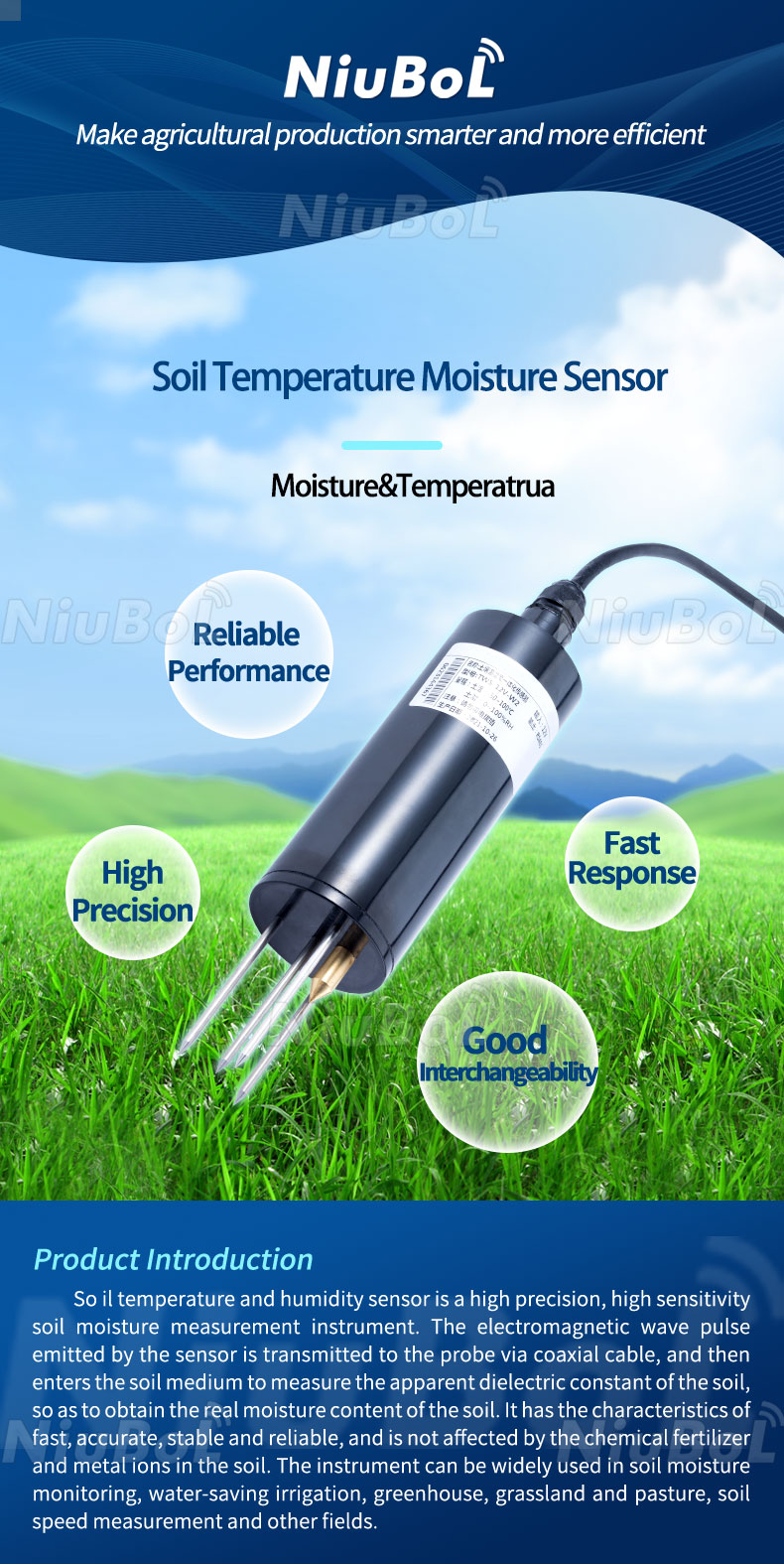
1. Soil temperature and humidity sensors:
- Soil temperature and humidity sensors are commonly used in agriculture, horticulture and soil science to monitor the temperature and humidity in the soil. These sensors help farmers and researchers understand the biological activity of the soil, plant growth conditions, and irrigation needs.
- Soil temperature and moisture sensors typically include a temperature sensor and a moisture sensor that are buried in the soil to measure the soil's temperature and moisture levels. These sensors are usually waterproof to ensure that they work properly in wet environments.
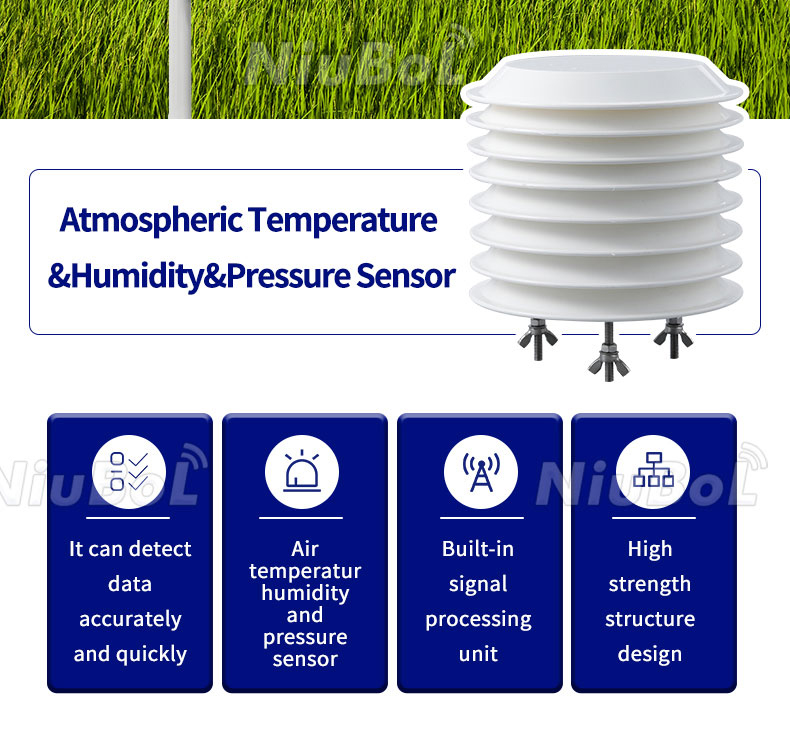
2. Atmospheric temperature and humidity sensors:
- Atmospheric temperature and humidity sensors are used to measure the temperature and relative humidity in the atmosphere. These sensors are commonly used in applications such as meteorological observations, environmental monitoring and indoor and outdoor climate control.
- Atmospheric temperature and humidity sensors measure the temperature and humidity levels in the air and convert this data into an electronic signal output. Sensors are often designed with corrosion and contamination resistance in mind to ensure consistent performance over time.
These two types of sensors differ in principle and application, but both are key environmental monitoring tools that can be used to optimise agricultural production, weather forecasting, environmental protection and other related areas. When selecting and using these sensors, factors such as their accuracy, stability, range of application and compatibility with monitoring systems need to be considered.
Related recommendations
Sensors & Weather Stations Catalog
 Agriculture Sensors and Weather Stations Catalog-NiuBoL.pdf
Weather Stations Catalog-NiuBoL.pdf
Agriculture Sensors Catalog-NiuBoL.pdf
Water Quality Sensor Catalog-NiuBoL.pdf
Related products
 Combined air temperature and relative humidity sensor
 TDR Soil Moisture & Temperature Sensor for irrigation| RS485 |4-20mA| NBL-S-THR
 Soil pH sensor RS485 soil Testing instrument soil ph meter for agriculture |NBL-S-PH
 Wind Speed sensor Output Modbus/RS485/Analog/0-5V/4-20mA
 Tipping bucket rain gauge for weather monitoring auto rainfall sensor RS485/Outdoor/stainless steel
 Pyranometer Solar Radiation Sensor 4-20mA/RS485

Screenshot, WhatsApp to identify the QR code
WhatsApp number:+8615367865107
(Click on WhatsApp to copy and add friends)


