





— Blogs —
—Products—
 Consumer hotline +8618073152920
 WhatsApp:+8615367865107
Address:Room 102, District D, Houhu Industrial Park, Yuelu District, Changsha City, Hunan Province, China
Product knowledge
Time:2026-06-14 18:56:38 Popularity:271
An ultrasonic weather station is a compact, multi-parameter monitoring node for projects that require long-term outdoor data without the maintenance burden of mechanical wind sensors. For system integrators, it is especially useful in unattended stations where wind, rainfall, air quality, radiation, and atmospheric data must be transmitted to a central platform.
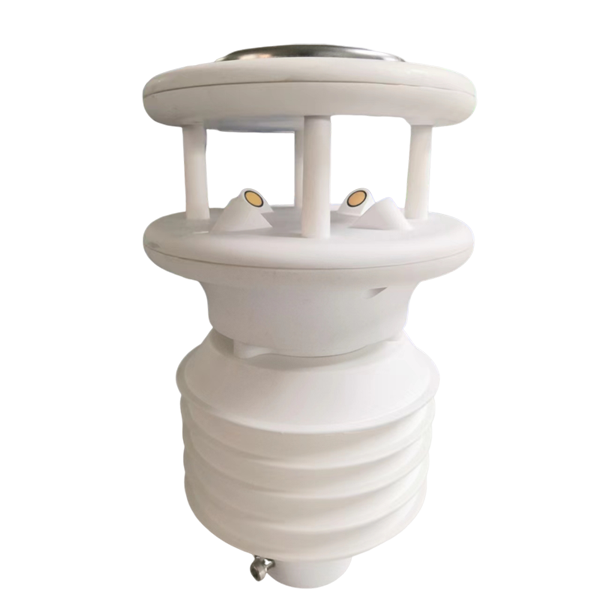
NiuBoL ultrasonic weather stations combine digital sensing, integrated structure, low power operation, and flexible communication. The station can be deployed in meteorological, environmental, airport, port, laboratory, traffic, agricultural, industrial, and energy projects where data continuity and easy installation are important.
Compared with discrete sensor assemblies, an all-in-one ultrasonic station reduces bracket complexity, wiring workload, installation time, and maintenance tasks. It also simplifies spare parts planning for contractors managing multiple monitoring locations.
A complete station can include wind speed, wind direction, temperature, humidity, atmospheric pressure, PM2.5, PM10, noise, rainfall, and solar radiation or illuminance. Data can be transmitted through RS485, 4G, or RS485-to-USB depending on the system design. PC software, cloud platform access, and mobile viewing can be adopted for project management.
For IoT providers, RS485 MODBUS remains an important advantage because it connects cleanly with RTUs, industrial gateways, data loggers, and edge computers. This allows the weather station to become a standard environmental input in SCADA, smart farm, road weather, photovoltaic, and environmental compliance platforms.
| Item | Specification | Integration Meaning |
|---|---|---|
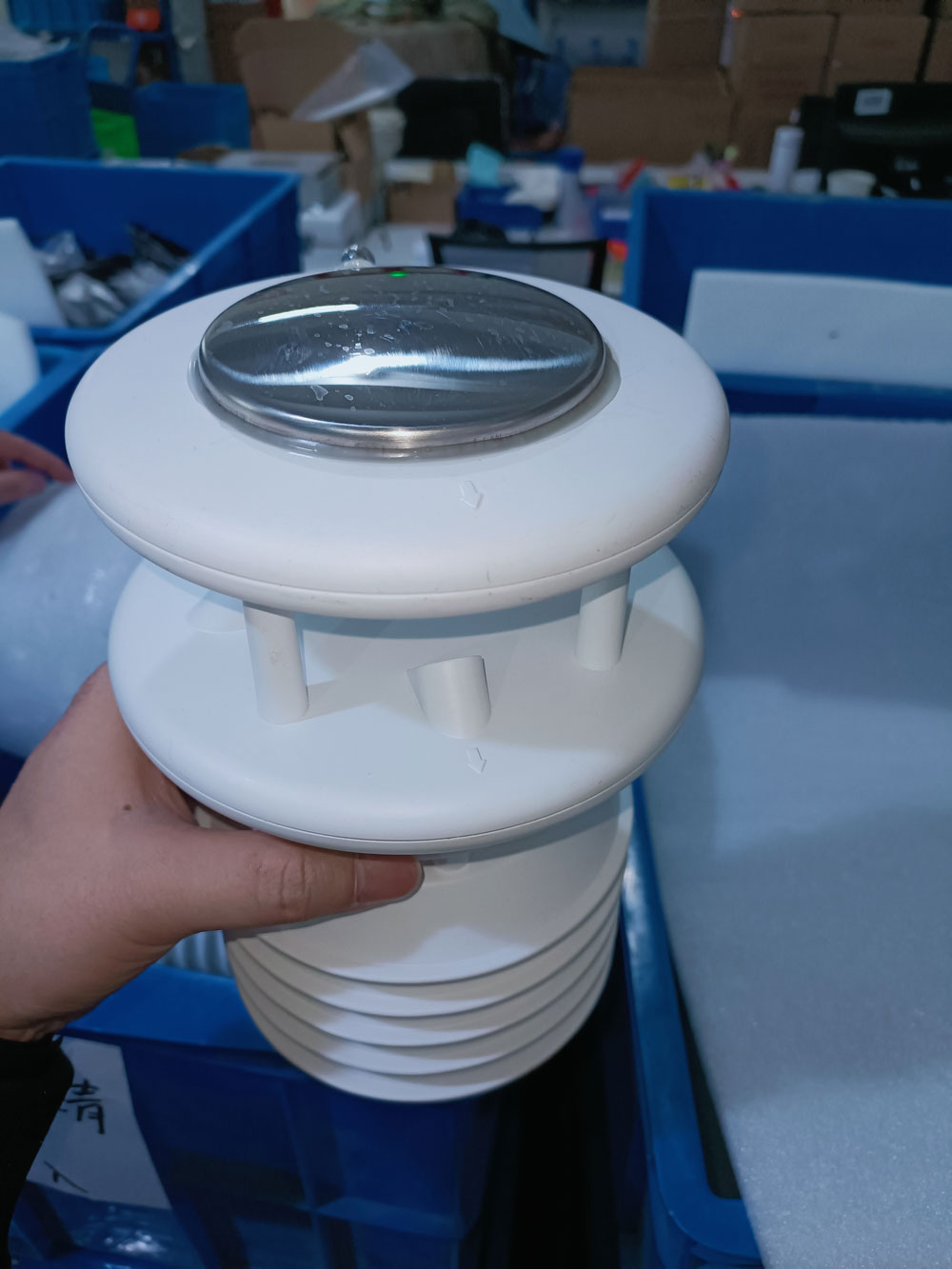
| Model | NBL-W-10GUWS ultrasonic weather station | Integrated ultrasonic weather station model for multi-parameter project deployment |
| Supply Voltage | DC 9-24V | Compatible with solar and industrial DC power |
| Signal Output | RS485 | Standard wired field communication |
| Communication Protocol | MODBUS protocol | PLC, RTU, gateway, and SCADA compatibility |
| Baud Rate | 9600 bps | Common industrial default setting |
| Average Power Consumption | 0.4W without dust sensor / 1W with dust sensor | Supports low-power remote station design |
| Working Temperature | -40 to 80℃ | Suitable for harsh outdoor deployment |
| Protection Class | IP65 | Outdoor dust and water resistance |
| Parameter | Range | Accuracy / Resolution |
|---|---|---|
| Wind Speed | 0-60m/s | ±0.3 + 3%FS / 0.01m/s |
| Wind Direction | 0-359° | ±3° / 1° |
| Temperature | -40 to 80℃ | ±0.5℃ / 0.1℃ |
| Humidity | 0-100%RH | ±5%RH / 0.1%RH |
| Atmospheric Pressure | 10-1100hPa | ±1.5hPa / 0.1hPa |
| PM2.5 | 0-1000µg/m³ | ±10% / 1µg/m³ |
| PM10 | 0-2000µg/m³ | ±10% / 1µg/m³ |
| Noise | 30-130dB | ±5dB / 0.1dB |
| Illuminance | 0-200000Lux | ±7% / 10Lux |
| Rainfall | 0-8mm/min | ±10% / 0.01mm |
| Solar Radiation | 0-1500W/m² | ±10% / 1W/m² |
In agriculture, ultrasonic weather stations can support irrigation scheduling, disease-risk analysis, greenhouse-perimeter monitoring, field operation warnings, and local climate archives. In environmental projects, the station can combine weather and particulate data for air-quality interpretation and boundary monitoring.
In transport and industrial projects, wind, rainfall, pressure, noise, and visibility-related environmental data can support road safety, port operations, construction site management, and energy facility operation. For research projects, a multi-parameter station creates a consistent dataset for field experiments.
Choose the parameter set according to the project objective. A basic weather station may require wind, temperature, humidity, pressure, and rainfall. A more comprehensive station may add PM2.5, PM10, noise, illuminance, or solar radiation. For photovoltaic and agricultural evapotranspiration projects, solar radiation can be more important than a simple light value.
Before procurement, confirm the installation environment, mast height, power supply, communication method, sensor output, cable length, mounting diameter, IP rating, wind exposure, and expected data platform. For remote locations, solar power design and communication signal strength should be checked during the survey stage.
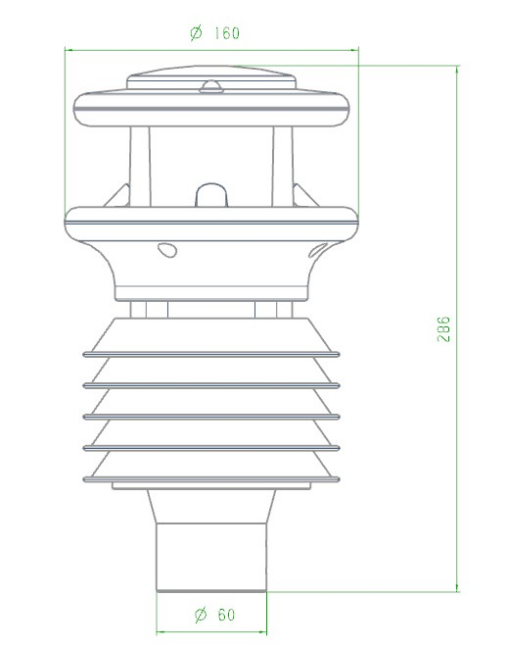
Install the station on a vertical pole in an open area. Keep it away from radar, radio transmitters, engines, vibration sources, buildings, trees, utility poles, and structures that create turbulence. Maintain required distance from radar scanning equipment and align the north reference correctly for wind direction.
For system integration, verify power polarity, RS485 A/B wiring, MODBUS address, baud rate, register mapping, sampling interval, alarm thresholds, and data unit conversion. Commissioning should include live data verification, platform display check, communication stability test, and acceptance record generation.
An ultrasonic weather station project is usually judged by data continuity, communication reliability, and maintenance workload. The NBL-W-10GUWS ultrasonic weather station should be configured as a long-term monitoring node with stable power, correct wind exposure, and a defined data path from sensor to platform.
For unattended sites, the system design should include power budget, surge protection, pole stability, gateway signal, local data backup, and offline alarm logic. These details are especially important for photovoltaic sites, ports, highways, environmental stations, and remote agricultural areas.
The station can be integrated into a larger platform by standardizing device ID, MODBUS polling, unit conversion, alarm thresholds, and dashboard layout. Once standardized, the same station profile can be reused across multiple monitoring sites.
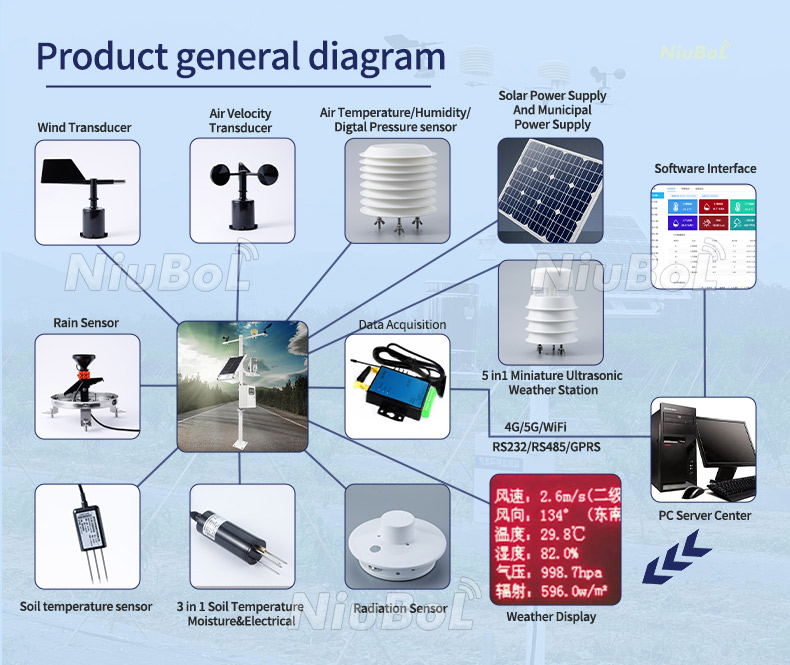
Maintenance planning should cover sensor surface inspection, connector sealing, cable aging, solar panel cleaning, battery condition, pole verticality, and platform data review. Abnormal flat lines, sudden spikes, and long data gaps should trigger a site inspection or remote diagnosis.
For contractors, the goal is to deliver a weather station that remains useful after acceptance. Clear installation photos, wiring records, register maps, and maintenance intervals help the owner keep the station operating across seasons.
A remote ultrasonic weather station project can be designed as a sensor layer, acquisition layer, communication layer, and platform layer. The NBL-W-10GUWS ultrasonic weather station provides multi-parameter data, the data logger or gateway handles polling, the communication module uploads records, and the platform stores alarms, curves, and reports.
For remote sites, power design deserves early attention. Solar panel size, battery capacity, station power consumption, communication interval, and local weather conditions all influence whether the station can operate continuously. A stable data path is as important as the sensor itself.
When multiple stations are deployed, a common station template should be used. Device ID, parameter names, units, alarm thresholds, and maintenance records should follow the same logic across each site.
Wind data can support safety warnings, transport operations, and photovoltaic maintenance. Rainfall data can support drainage and environmental interpretation. PM2.5, PM10, and noise data can support site environmental monitoring. Solar radiation or illuminance can support agricultural, energy, and research applications.
A multi-parameter station is valuable when the owner needs to understand the relationship between different conditions. For example, particulate readings may be interpreted differently during rain, strong wind, or dry weather. A single station that records several parameters at the same timestamp makes this comparison easier.
Commissioning should include physical inspection, power test, MODBUS communication test, platform display verification, alarm test, and sample data export. For wind direction, north alignment should be confirmed on site. For rainfall, the platform field should be checked so the owner understands the displayed unit.
Long-term reliability depends on installation quality and maintenance discipline. The operator should check pole stability, connector sealing, solar panel condition, battery status, and data continuity. If the station is installed in a harsh site, the inspection interval should be shortened.
A well-documented station is easier to maintain. Installation photos, cable labels, register maps, gateway settings, and spare-part records help future technicians resolve issues without rebuilding the system from the beginning.
For photovoltaic, highway, port, or industrial infrastructure projects, the NBL-W-10GUWS ultrasonic weather station can provide a compact environmental data source for the operation platform. Wind, rainfall, radiation, particulate, and noise data can support maintenance planning, safety alerts, and environmental records.
The station should be installed where the data reflects the operating area rather than the convenience of the equipment cabinet. For example, wind data should not be blocked by nearby structures, and solar radiation data should not be shaded by poles or buildings during critical observation periods.
For remote sites, communication recovery rules should be defined. If the 4G signal drops, the system should identify whether data can be buffered locally, how offline alarms are displayed, and how the missing period is handled after reconnection.
Unattended stations require stronger front-end planning because technicians are not present every day. The project should consider lightning protection, cable protection, mounting foundation, anti-loosening measures, waterproof connectors, and enough power reserve for poor weather periods.
A remote platform should show station health indicators in addition to measurement data. Battery voltage, communication status, last upload time, and abnormal data flags help operators distinguish weather events from equipment issues.
For long-term contracts, spare parts and inspection intervals should be agreed during project delivery. This reduces downtime when a cable, connector, battery, or gateway module needs replacement.
If the station is part of a regulatory or operational reporting system, the owner should also define data retention time, export frequency, user permissions, and alarm acknowledgement records during the project design stage.
NBL-W-10GUWS ultrasonic weather station acts as a multi-parameter environmental data node for remote sites. It can provide wind, temperature, humidity, pressure, rainfall, particulate, noise, illuminance, or radiation data depending on configuration. The station is suitable for projects where long-term data continuity and low maintenance are important.
A common architecture is sensor to RS485 bus, RS485 bus to data logger or gateway, and gateway to the platform through 4G, Ethernet, or another project communication method. The platform should define device ID, parameter names, units, polling interval, alarm rules, and data storage policy.
The project team should evaluate wind exposure, pole stability, power supply, solar charging condition, communication signal, lightning protection, cable routing, and maintenance access. A convenient installation point is not always a representative monitoring point, so site selection should match the operational objective.
Photovoltaic sites, road weather systems, ports, industrial parks, agricultural bases, environmental monitoring stations, and research sites can benefit when they need multiple environmental variables from one compact station. The station is especially useful where separate sensors would increase wiring and maintenance workload.
Weather and environmental variables often influence each other. For example, particulate readings may change during wind or rainfall, and solar radiation data may explain energy or crop conditions. Recording multiple parameters with the same timestamp makes the data more useful for platform analysis and operation reports.
Commissioning should include power test, communication test, MODBUS register verification, wind direction alignment, platform display check, alarm test, and sample data export. If the station includes rainfall, radiation, noise, or particulate parameters, those fields should also be checked against the project configuration.
Maintenance should include checking mounting stability, connector sealing, cable aging, solar panel cleanliness, battery health, sensor surface condition, and data continuity. The platform should also show station health indicators such as last upload time and communication status.
Integrators should request the datasheet, parameter configuration, wiring definition, MODBUS register map, power requirements, installation guidance, and recommended accessories. If the project has platform integration requirements, those should be discussed before ordering.
A NiuBoL ultrasonic weather station is a practical platform component for unattended meteorological and industrial IoT projects. Its integrated structure, RS485 MODBUS output, optional 4G transmission, low power design, and multi-parameter sensing help contractors build reliable weather monitoring systems with clear procurement, installation, and maintenance logic.
Related recommendations
Sensors & Weather Stations Catalog
 Agriculture Sensors and Weather Stations Catalog-NiuBoL.pdf
Weather Stations Catalog-NiuBoL.pdf
Agriculture Sensors Catalog-NiuBoL.pdf
Water Quality Sensor Catalog-NiuBoL.pdf
Related products
 Combined air temperature and relative humidity sensor
 Soil Moisture Temperature sensor for irrigation|NBL-S-THR
 Soil pH sensor RS485 soil Testing instrument soil ph meter for agriculture |NBL-S-PH
 Wind Speed sensor Output Modbus/RS485/Analog/0-5V/4-20mA
 Tipping bucket rain gauge for weather monitoring auto rainfall sensor RS485/Outdoor/stainless steel
 Pyranometer Solar Radiation Sensor 4-20mA/RS485

Screenshot, WhatsApp to identify the QR code
WhatsApp number:+8615367865107
(Click on WhatsApp to copy and add friends)

