





— Blogs —
—Products—
 Consumer hotline +8618073152920
WhatsApp:+8615367865107
Address:Room 102, District D, Houhu Industrial Park, Yuelu District, Changsha City, Hunan Province, China
Product knowledge
Time:2025-12-26 11:42:18 Popularity:870
Quick answer: A small agricultural weather station configuration should specify the farm decision, individual instruments, compatible acquisition inputs, power system and data service. Air temperature, rainfall, soil water and radiation answer different questions. Assemble the required observations first; add automatic control or forecasting only when the necessary controller, method and safeguards are included.
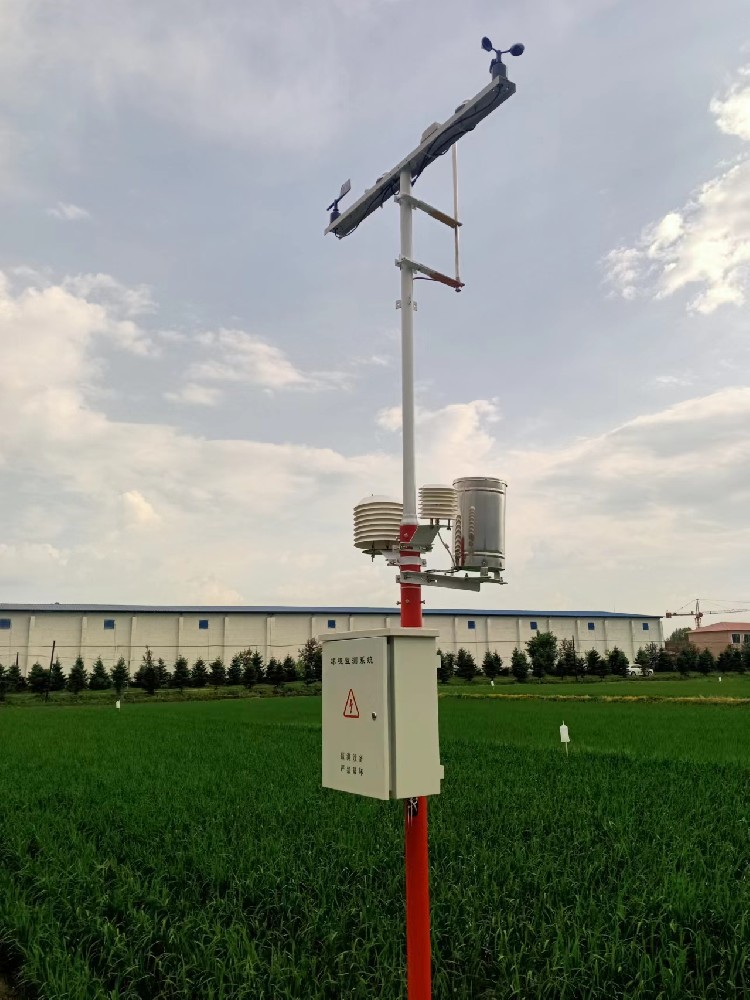
A farm weather monitoring system can support fieldwork planning, irrigation review, greenhouse observations or crop trials. These uses do not require identical packages. A station sold with many channels can still omit the measurement that determines the decision, while a smaller package may be sufficient for a clearly defined task.
Write the expected result in operational terms. For example, a farm may need a rainfall record for reviewing irrigation, while a greenhouse manager needs representative air conditions and feedback from ventilation equipment. Recording atmospheric conditions alone does not calculate root-zone water storage or operate a fan.
| Farm task | Measurements to consider | Additional requirement |
|---|---|---|
| Review irrigation delivery and crop water condition | Rainfall, representative soil moisture and temperature; flow where needed | Zone layout, rooting depth and an agronomic interpretation |
| Record conditions during crop trials | Defined air, rainfall, radiation or soil channels | Comparable exposure, timing and records of instrument changes |
| Support spraying decisions | Representative wind and air conditions | Applicable operating restrictions and a suitable observation location |
| Review greenhouse ventilation and shading | Representative indoor air and the relevant light measurement | Separate actuator control, feedback and protected operating logic |
NiuBoL modular equipment allows the observation package to be selected around those tasks. The instrument list and acquisition plan should describe what is included now and what additional hardware would be required for a later control function.
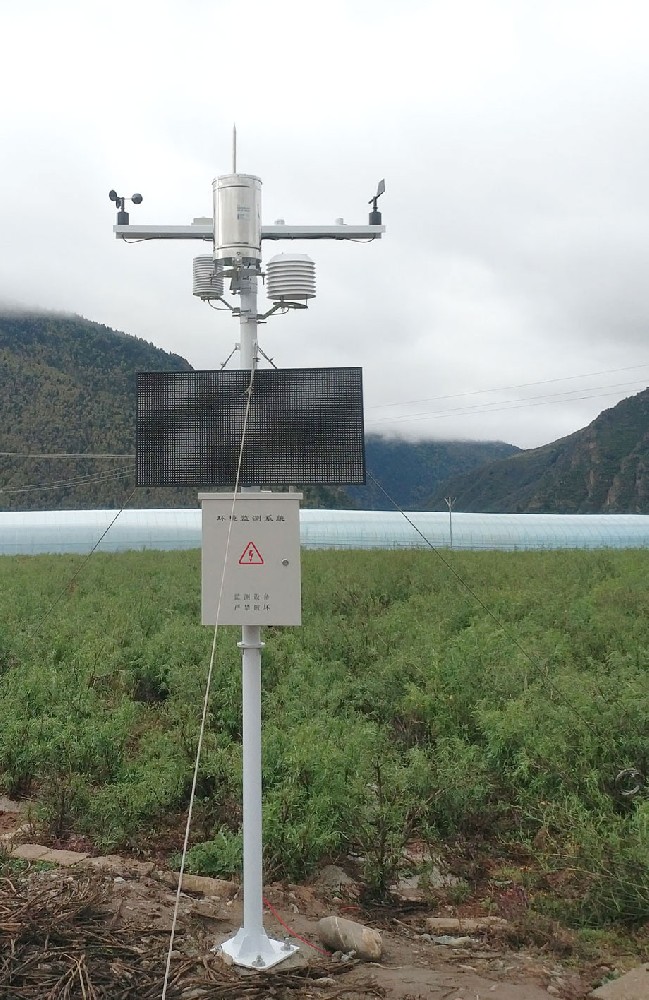
One air sensor may report temperature, humidity and pressure through a digital connection. A pulse rain gauge needs a counter. Analog versions need the correct voltage or current inputs. Counting four sensor housings is therefore not enough to specify a collector with four inputs.
For an illustrative interface plan, a digital air sensor and digital soil probe share an RS485 bus if their settings and polling requirements are compatible; a pulse rain gauge uses a separate counter input; an analog radiation transmitter uses an appropriate analog channel. This describes an architecture, not a statement that every logger supports all three interfaces.
| Ordered signal | Collector requirement | Acceptance check |
|---|---|---|
| RS485 Modbus RTU | Supported serial format, addresses and register decoding | Confirm channel identity, sign, decimal scale and unit |
| Rain-gauge contact pulses | Compatible counting input and contact handling | Apply known counts and verify accumulation and reset behavior |
| 4-20 mA | Compatible active/passive input arrangement and loading | Test low, middle and high signal values against assigned endpoints |
| Voltage output | Correct input span, impedance and reference connection | Compare the signal at the transmitter and receiving terminal |
Keep the input plan with the quotation. Changing a sensor from a pulse to a digital version may change supply requirements and configuration work even if its measurement name remains rainfall.
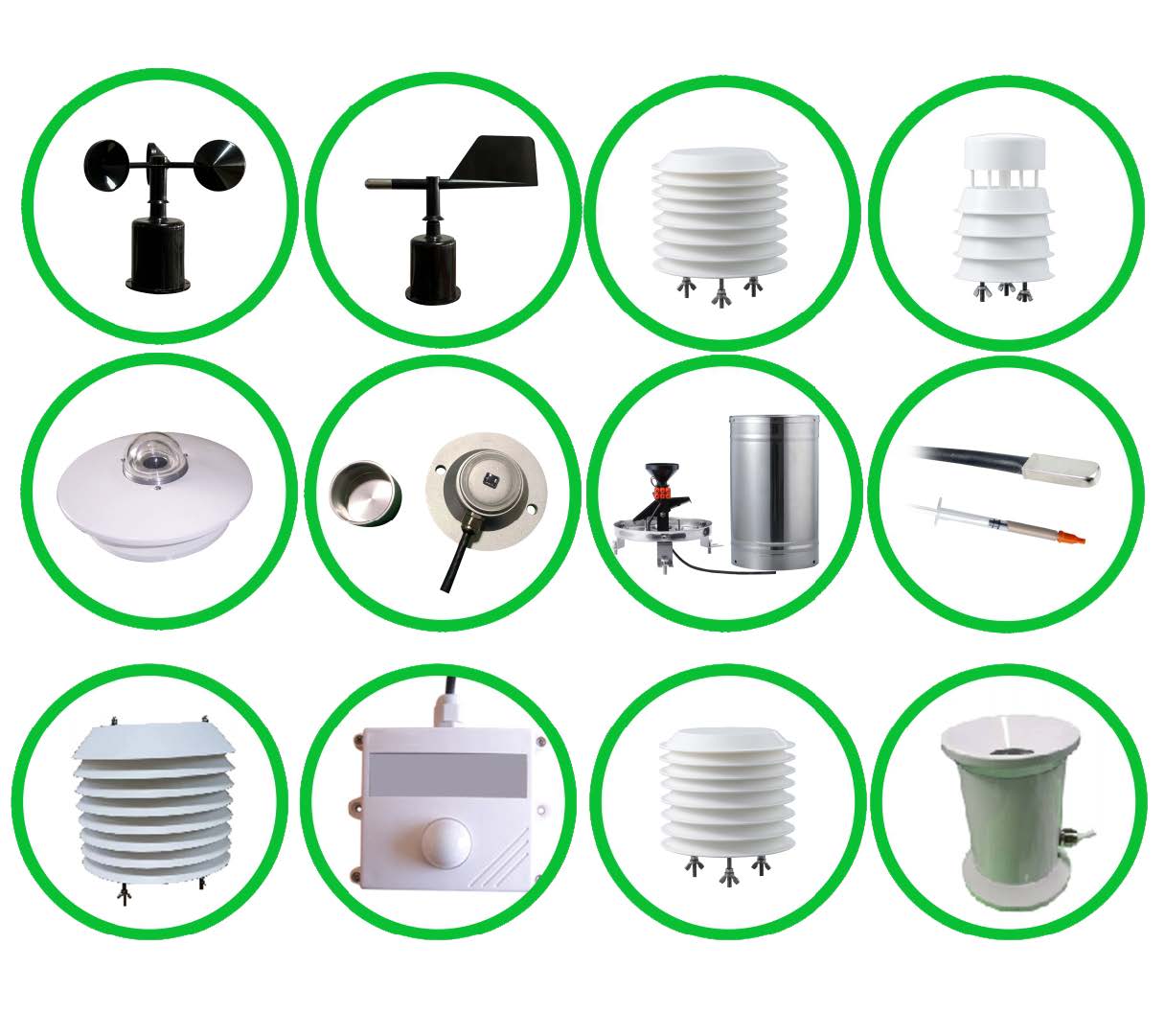
Soil water content is not air humidity. Illuminance in lux, total solar irradiance in W/m2 and photosynthetically active radiation are also different quantities. A channel called light does not establish which measurement the crop model or lighting controller will receive.
The following examples show component specifications relevant to selecting the acquisition equipment. They do not establish one accuracy or temperature rating for the whole agricultural station.
| Example component | Technical selection details |
|---|---|
| NBL-W-LBTH air temperature, humidity and pressure | -40 to 80 C, +/-0.5 C; 0-100% RH, +/-5% RH; 10-1200 hPa, +/-1.5 hPa. Supply 12-24 VDC; select RS485 or 4-20 mA version |
| NBL-W-RS, 0.2 mm liquid-rainfall configuration | 0.2 mm per tip; 0-4 mm/min intensity; +/-4% indoor static test at 2 mm/min. Working 0-50 C; selected pulse, voltage or RS485 output; standard cable 5 m |
| NBL-W-HPRS pyranometer | 0-2000 W/m2; spectral range 0.3-3 micrometers; thermopile response at 99% within 35 s. Select 12 V or 24 V supply and 4-20 mA, 0-5 V or RS485 output; standard cable 2.5 m |
| NBL-W-SS and NBL-W-DS | Wind speed and direction are separate channels; select ranges and outputs. Sensor housings IP65; standard cable 2.5 m |
| Complete assembly | Specify actual power consumption, enclosure rating, cable jacket materials and operating limits for the ordered package |
A ground frost investigation may need a deliberately located near-crop temperature point in addition to the general air observation. Soil or leaf-level measurements cannot be created by relabelling the station's shielded air channel. Likewise, pressure trends alone do not justify a fixed twelve- or twenty-four-hour weather forecast.
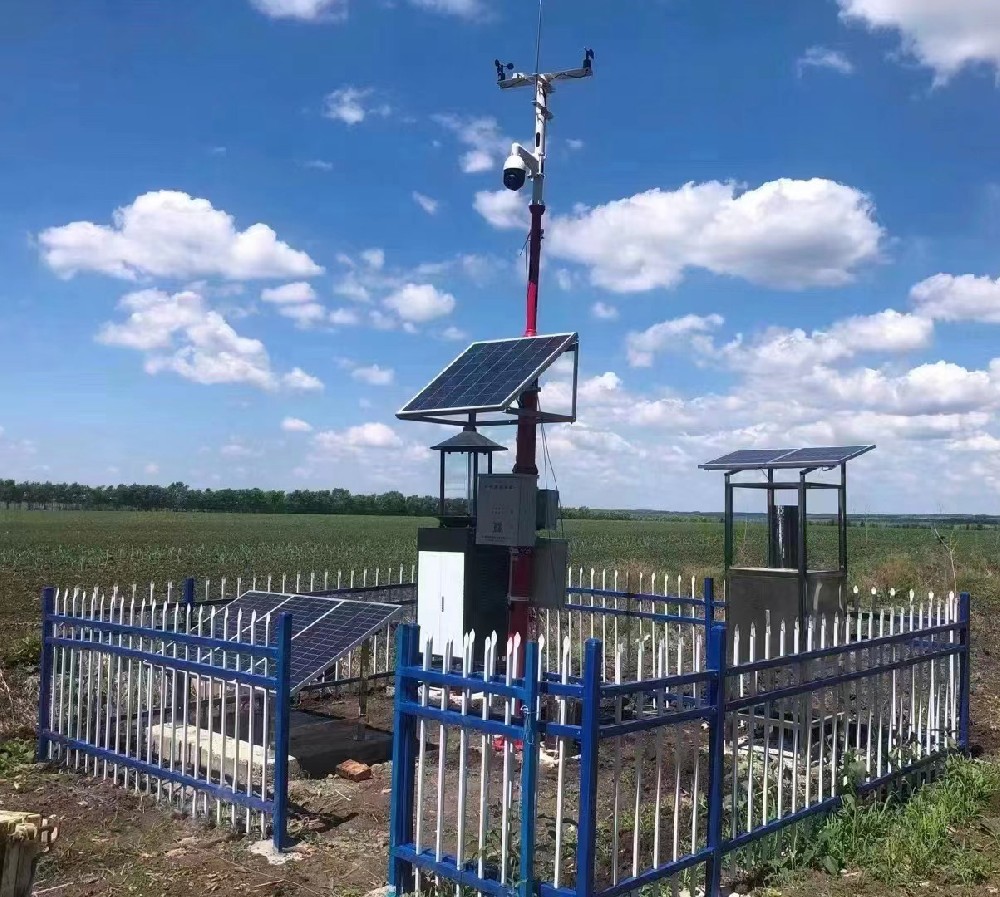
Weather station power supply selection starts with every connected load: sensors, logger, modem, display and any auxiliary equipment. Record continuous demand, sleep modes, transmission peaks and startup behavior. The solar panel rating alone does not describe available stored energy or operation through poor weather.
Mains-powered arrangement: Suitable where a properly protected supply is available and the cable route is practical. Establish what happens during a power interruption. A battery backup is a specified component, not an automatic feature of a mains connection.
Solar-powered arrangement: Size generation and usable storage for site conditions and the acquisition schedule. Consider shading, temperature and the installed battery's allowed operating limits. If the logger switches sensor power, verify stabilization before readings are accepted.
Hybrid arrangement: Confirm charging, source isolation, transfer behavior and recovery after either source fails. Combining two supplies without a compatible power design is not a backup system. Include the resulting status indications in commissioning tests.
Do not power pumps, heaters or spray equipment from the measurement supply unless a separately rated design explicitly includes those loads. Monitoring and actuator power have different current, protection and failure requirements.
A logger collects and timestamps observations. A gateway or modem transports data. A hosted platform displays or processes it. Each function needs a defined configuration. RS485 is not an internet connection, and MQTT or another uplink protocol should only be specified when the selected gateway and destination support it.
For irrigation monitoring inputs, retain the difference between rainfall increments, running totals and local-day totals. For wind, agree the statistic needed by the operation. Identify timezone, stored interval and the handling of delayed uploads before the customer compares stations or field operations.
Confirm local storage, export format, user access and service charges with the chosen data package. Free access, indefinite history, an API and remote-control permissions should not be assumed. A customer using its own platform needs the supported data interface, not merely a screenshot of the supplier's dashboard.
Control functions require an appropriate controller, rated outputs and actuator feedback. Test missing sensor data and stale values before enabling commands. Follow the farm's approved operating procedures; a station threshold must not bypass equipment protection or restrictions on an agricultural operation.
Place the air shield, wind instruments, rain collector and radiation sensor according to their observation needs. Leave access for cleaning and inspection. A shared pole can simplify installation, but brackets, panels and crops can obstruct another instrument. Foundations, surge protection and bonding need an appropriate site design; a lightning rod does not make the equipment immune to damage.
At handover, demonstrate a known rainfall count, correctly decoded digital values, an interrupted connection and a controlled power restart. Check that the final export contains the required units and observation times. For automatic actions, test with a protected commissioning procedure before connecting the farm's normal operating sequence.
Send NiuBoL the farm task, site layout, required channels, existing inputs, power availability and destination system. Ask for a configuration-specific list of sensors, collector, communication service, power parts, mounting and commissioning work. This makes small agricultural weather station configuration quotations comparable without relying on a generic equipment count.
It depends on the decision. A rainfall record requires a suitable collector and acquisition path; root-zone irrigation assessment also needs representative soil observations or a validated water-balance method. Define the required output before adding channels.
No. They represent different spectral quantities and reporting units. Select the measurement the crop, research method or lighting controller actually requires. Do not use a channel called light without defining its quantity.
Not by default. Digital devices may share a properly designed bus, while contact pulses and analog signals need compatible channels and wiring. Confirm supply, pin assignments and interface capacity for the ordered instruments.
Confirm the actual service terms, retention, account access and export functions in the quotation. Hardware communication capability does not establish a hosted service entitlement or a third-party API.
No supply choice alone guarantees continuity. Evaluate usable energy, local solar conditions, all loads, storage and recovery behavior. Demonstrate the required outage scenarios for the selected package.
Only if a suitable control arrangement is explicitly supplied and commissioned. Sensors provide inputs; controllers, outputs, interlocks and delivery feedback are separate functions. Establish permissions and behavior during faults before enabling automatic operation.
It may omit the necessary signal inputs, a radiation instrument, local records, battery capacity or installation work. Compare the same measurement and service scope, with actual model versions, rather than the label agricultural weather station.
A useful farm configuration joins the required observations to compatible acquisition, suitable power and clearly defined data services. NiuBoL can select modular equipment around those requirements. Keep control and forecasting capabilities explicit so the delivered system supports the farm's task without unsupported assumptions about software, accuracy or autonomy.
Prev:Agricultural Weather Station Sensor Compatibility: Mixed Inputs and Units
Next:Micro Weather Station Storm Readiness: Power, Icing and Data Availability
Related recommendations
Sensors & Weather Stations Catalog
 Agriculture Sensors and Weather Stations Catalog-NiuBoL.pdf
Weather Stations Catalog-NiuBoL.pdf
Agriculture Sensors Catalog-NiuBoL.pdf
Water Quality Sensor Catalog-NiuBoL.pdf
Related products
 Combined air temperature and relative humidity sensor
 TDR Soil Moisture & Temperature Sensor for irrigation| RS485 |4-20mA| NBL-S-THR
 Soil pH sensor RS485 soil Testing instrument soil ph meter for agriculture |NBL-S-PH
 Wind Speed sensor Output Modbus/RS485/Analog/0-5V/4-20mA
 0.2mm Tipping Bucket Rain Gauge for Weather & Hydrology | NiuBoL
 Pyranometer Solar Radiation Sensor 4-20mA/RS485


Screenshot, WhatsApp to identify the QR code
WhatsApp number:+8615367865107
(Click on WhatsApp to copy and add friends)

