





— Blogs —
—Products—
 Consumer hotline +8618073152920
 WhatsApp:+8615367865107
Address:Room 102, District D, Houhu Industrial Park, Yuelu District, Changsha City, Hunan Province, China
Product knowledge
Time:2024-01-31 11:36:18 Popularity:39887
A rain gauge is an instrument used to measure precipitation at a specific location. Rainfall is normally reported as a depth in millimeters (mm), where 1 mm of rainfall is equivalent to 1 liter of water falling on each square meter of horizontal area.
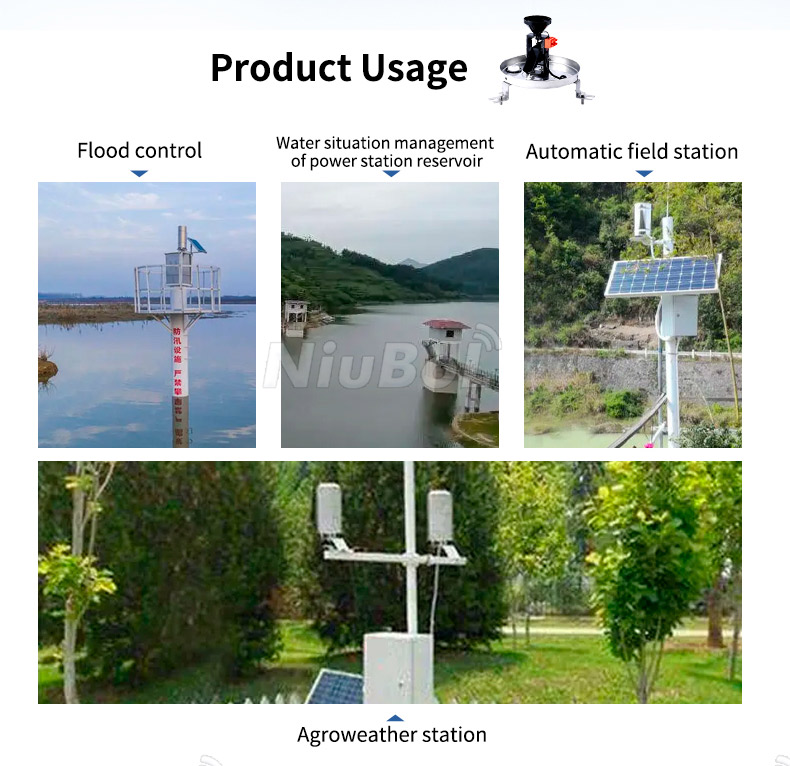
Rain gauges are used not only in weather stations but also in agriculture, hydrology, flood monitoring, reservoir management, urban drainage, climate research and environmental studies.
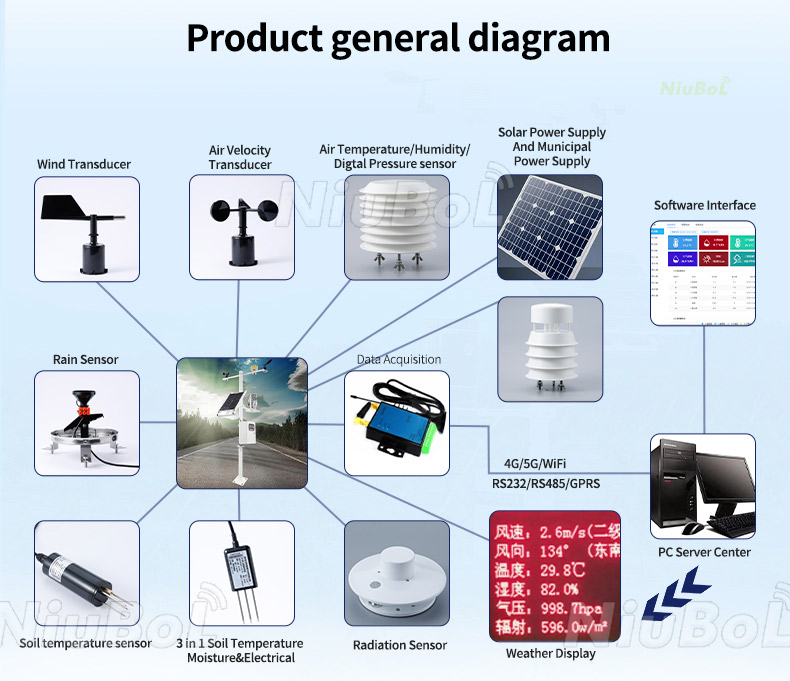
Modern automatic rain gauges can provide pulse or RS485 Modbus output, allowing rainfall data to be collected continuously and transmitted to data loggers, IoT gateways, cloud platforms or private servers.
| Use | Why Rainfall Data Is Important |
|---|---|
| 1. Weather Monitoring | Records rainfall amount, duration and intensity |
| 2. Flood Warning | Provides real-time rainfall input for flood-risk assessment |
| 3. Agriculture | Supports irrigation and crop water management |
| 4. Irrigation Management | Helps determine natural water input before irrigation |
| 5. Hydrology | Supports watershed, river and runoff analysis |
| 6. Reservoir Management | Provides rainfall data for catchment and inflow analysis |
| 7. Urban Drainage | Supports stormwater and drainage-system monitoring |
| 8. Climate Research | Creates long-term precipitation records |
| 9. Environmental Research | Provides precipitation context for ecological studies |
| 10. Emergency Management | Provides rainfall information during severe-weather events |
The most basic use of a rain gauge is to measure rainfall at a specific location. Meteorological stations use rainfall data together with temperature, humidity, pressure and wind measurements to describe local weather conditions.
Automatic rain gauges can provide:
Accumulated rainfall
Rainfall start and stop time
Rainfall duration
Rainfall intensity
Rainfall totals over hourly, daily or longer periods
For automatic weather stations, tipping bucket rain gauges are widely used because they can produce an electrical signal for automatic recording.
Real-time rainfall is an important input for flood-monitoring and warning systems. High rainfall intensity or large accumulated rainfall can increase runoff and river levels, particularly in steep or highly urbanized catchments.
A rain gauge does not predict floods by itself. Flood assessment normally combines rainfall with other information such as:
River or stream water level
Catchment characteristics
Soil saturation
Previous rainfall
Reservoir level
Runoff models
Rain Gauge + Water Level Sensor + Hydrological Model → Flood Monitoring / Warning
Rainfall is one of the main natural water inputs for crops. Farmers can use rain-gauge data to understand how much precipitation has reached the field and whether additional irrigation may be required.
Rainfall information is particularly useful when combined with:
Soil moisture
Air temperature
Relative humidity
Solar radiation
Crop growth stage
Evapotranspiration estimates
Rainfall alone should not be used as the only irrigation-control parameter because actual root-zone water conditions also depend on soil type, drainage and crop water use.
Rain gauges can be integrated into smart irrigation systems so that recent rainfall is considered before irrigation starts.
For example, an irrigation controller may use rainfall together with soil-moisture measurements to delay or reduce irrigation after a significant rain event.
Rain Gauge + Soil Moisture Sensor → Controller → Irrigation Decision
The actual control logic should be configured according to crop requirements, soil conditions and irrigation strategy rather than using one universal rainfall threshold.
Hydrologists use rainfall data to understand how precipitation affects rivers, streams, groundwater and catchment runoff.
Typical hydrological monitoring systems may combine:
River-level sensors
Reservoir-level sensors
Surface-velocity sensors
Flow meters
Soil-moisture sensors
Rainfall data is particularly important when analysing the relationship between precipitation and changes in river discharge.
Rainfall over a reservoir catchment influences inflow, storage and water-resource availability. Rain gauges installed across the catchment can provide localized precipitation data for reservoir management.
When combined with reservoir level and inflow measurements, rainfall data can support:
Water-balance analysis
Reservoir operation
Drought monitoring
Flood-control planning
Water-supply assessment
Cities use rainfall measurements to monitor storm events and understand the load placed on drainage systems.
Real-time rainfall data can be combined with:
Drainage water levels
Urban river levels
Pump-station status
Stormwater models
Road flooding sensors
This information can support urban flood monitoring and drainage-system operation during heavy rainfall.
Long-term rain-gauge records are used to study precipitation patterns and variability over months, years and decades.
Researchers may analyse:
Annual rainfall totals
Seasonal rainfall distribution
Frequency of heavy rainfall events
Dry periods
Changes in rainfall intensity
Regional precipitation variability
For climate research, long-term data consistency, site stability, instrument maintenance and measurement methods are particularly important.
Rainfall influences soil moisture, vegetation, groundwater recharge, erosion and ecosystem conditions, so rain gauges are frequently used in environmental and ecological studies.
A rain gauge itself does not measure pollutants in rainwater. If the goal is to analyse chemical pollutants, nutrients, acidity or contaminants in rainfall, a separate precipitation sample must be collected and analysed with appropriate laboratory or water-quality methods.
The rain gauge provides the rainfall amount and timing that can be used together with those environmental measurements.
During typhoons, tropical storms, monsoon rainfall or other severe-weather events, real-time rainfall measurements help emergency teams understand how precipitation is developing at specific locations.
Rainfall information can support:
Flood-response planning
Landslide-risk assessment when combined with geological and soil data
Road-closure decisions
Reservoir and dam monitoring
Emergency resource deployment
Rain gauges provide measurement data; disaster prediction and warning require additional models, thresholds and monitoring information.
For automatic rainfall monitoring, NiuBoL provides tipping bucket rain gauges with pulse and RS485 communication options for weather, agricultural and hydrological applications.
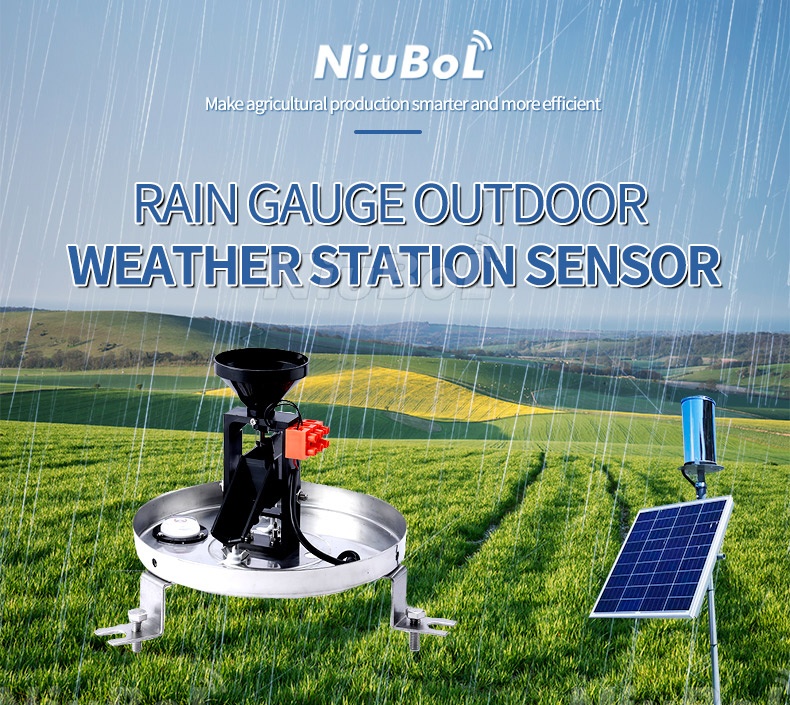
NBL-W-RS Tipping Bucket Rain Gauge
Suitable for automatic weather stations, agriculture, hydrology, reservoirs and remote rainfall-monitoring systems. Depending on configuration, pulse, voltage and RS485 Modbus outputs are available.
View NBL-W-RS Rain Gauge →
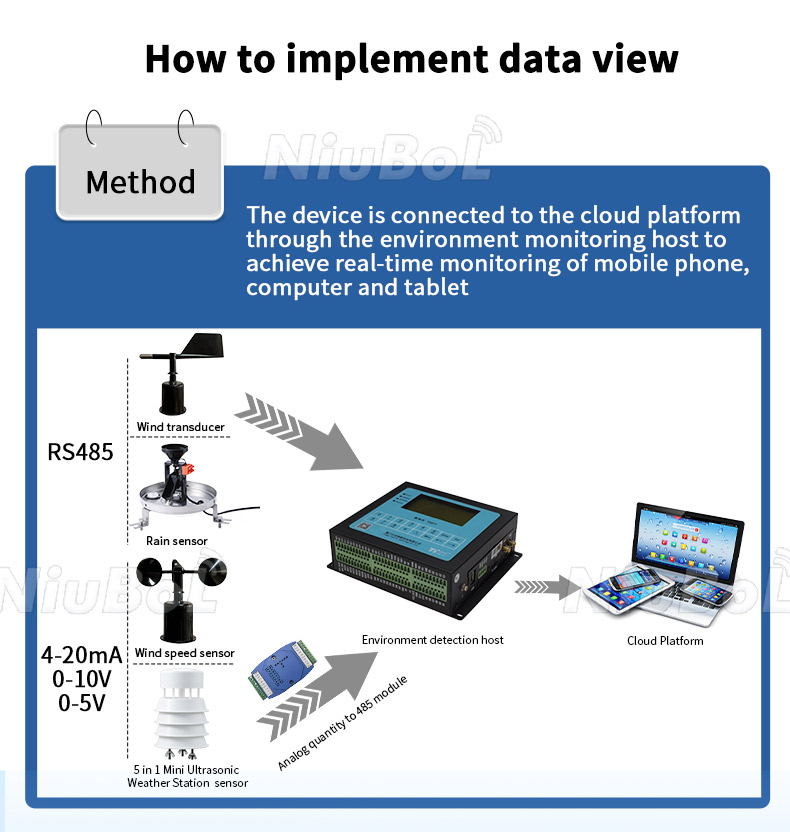
For remote monitoring, the rain gauge can connect to a data logger or IoT gateway.
Rain Gauge → Pulse / RS485 → Data Logger → 4G / Ethernet → MQTT / HTTP → Cloud or Private Server
This allows rainfall measurements to be recorded continuously without requiring an operator to visit the site after every rainfall event.
| Application | Typical Choice |
|---|---|
| Manual Rainfall Observation | Standard manual rain gauge |
| Automatic Weather Station | Tipping bucket rain gauge |
| Agricultural IoT | RS485 or pulse tipping bucket gauge |
| Flood / Hydrology | Automatic tipping bucket or project-specific precipitation gauge |
| Rain + Snow | Suitable heated / weighing precipitation gauge |
A1. Its main function is to measure the amount of precipitation falling at a specific location.
A2. Rainfall data helps farmers understand natural water input and can be combined with soil-moisture and weather data for irrigation management.
A3. Not by itself. It provides rainfall measurements that can be combined with river level, soil conditions, catchment data and hydrological models for flood-risk assessment and warning.
A4. No. A rain gauge measures rainfall and is not a lightning-detection instrument. Lightning monitoring requires dedicated lightning-detection equipment or meteorological systems.
A5. No. A rain gauge measures precipitation amount. Chemical pollutants in rainwater require separate sample collection and laboratory or water-quality analysis.
A6. Yes. Rainfall data can be combined with soil-moisture and crop information to reduce unnecessary irrigation after rainfall.
A7. Rainfall over a catchment influences runoff, inflow and reservoir levels. Rain gauges provide local precipitation data for hydrological analysis.
A8. Real-time rainfall measurements support urban drainage, stormwater management and flood monitoring.
A9. Yes. Pulse or RS485 rain gauges can connect to data loggers and gateways for 4G, Ethernet or other remote communication.
A10. Yes. Outdoor rain gauges should be inspected periodically for leaves, insects, dust, mud, blocked funnels, cable problems and incorrect leveling.
1. NBL-W-ARS Tipping Bucket Rain Gauge Instruction Manual
 NBL-W-ARS-Tipping-bucket-rain-gauge-instruction-manual.pdf
2. NBL-W-RS Rain Sensor Instruction Manual
NBL-W-RS-Rain-sensors-instruction-manual-V4.0.pdf
3. NBL-W-PRS Piezoelectric Rain Sensor Manual
NBL-W-PRS-Piezoelectric-Rain-Sensor-Operator's-Manual.pdf
NiuBoL provides tipping bucket rain gauges, piezoelectric rain sensors, automatic weather stations and IoT data-acquisition equipment for agriculture, meteorology, hydrology, flood monitoring and environmental projects.
For product selection, provide the required rainfall resolution, output signal, quantity, cable length, installation environment and whether the project requires a data logger, 4G communication, solar power or private-server integration.
Related recommendations
Sensors & Weather Stations Catalog
 Agriculture Sensors and Weather Stations Catalog-NiuBoL.pdf
Weather Stations Catalog-NiuBoL.pdf
Agriculture Sensors Catalog-NiuBoL.pdf
Water Quality Sensor Catalog-NiuBoL.pdf
Related products
 Combined air temperature and relative humidity sensor
 TDR Soil Moisture & Temperature Sensor for irrigation| RS485 |4-20mA| NBL-S-THR
 Soil pH sensor RS485 soil Testing instrument soil ph meter for agriculture |NBL-S-PH
 Wind Speed sensor Output Modbus/RS485/Analog/0-5V/4-20mA
 Tipping bucket rain gauge for weather monitoring auto rainfall sensor RS485/Outdoor/stainless steel
 Pyranometer Solar Radiation Sensor 4-20mA/RS485

Screenshot, WhatsApp to identify the QR code
WhatsApp number:+8615367865107
(Click on WhatsApp to copy and add friends)

