





— Blogs —
—Products—
 Consumer hotline +8618073152920
 WhatsApp:+8615367865107
Address:Room 102, District D, Houhu Industrial Park, Yuelu District, Changsha City, Hunan Province, China
Product knowledge
Time:2026-09-07 16:00:00 Popularity:226
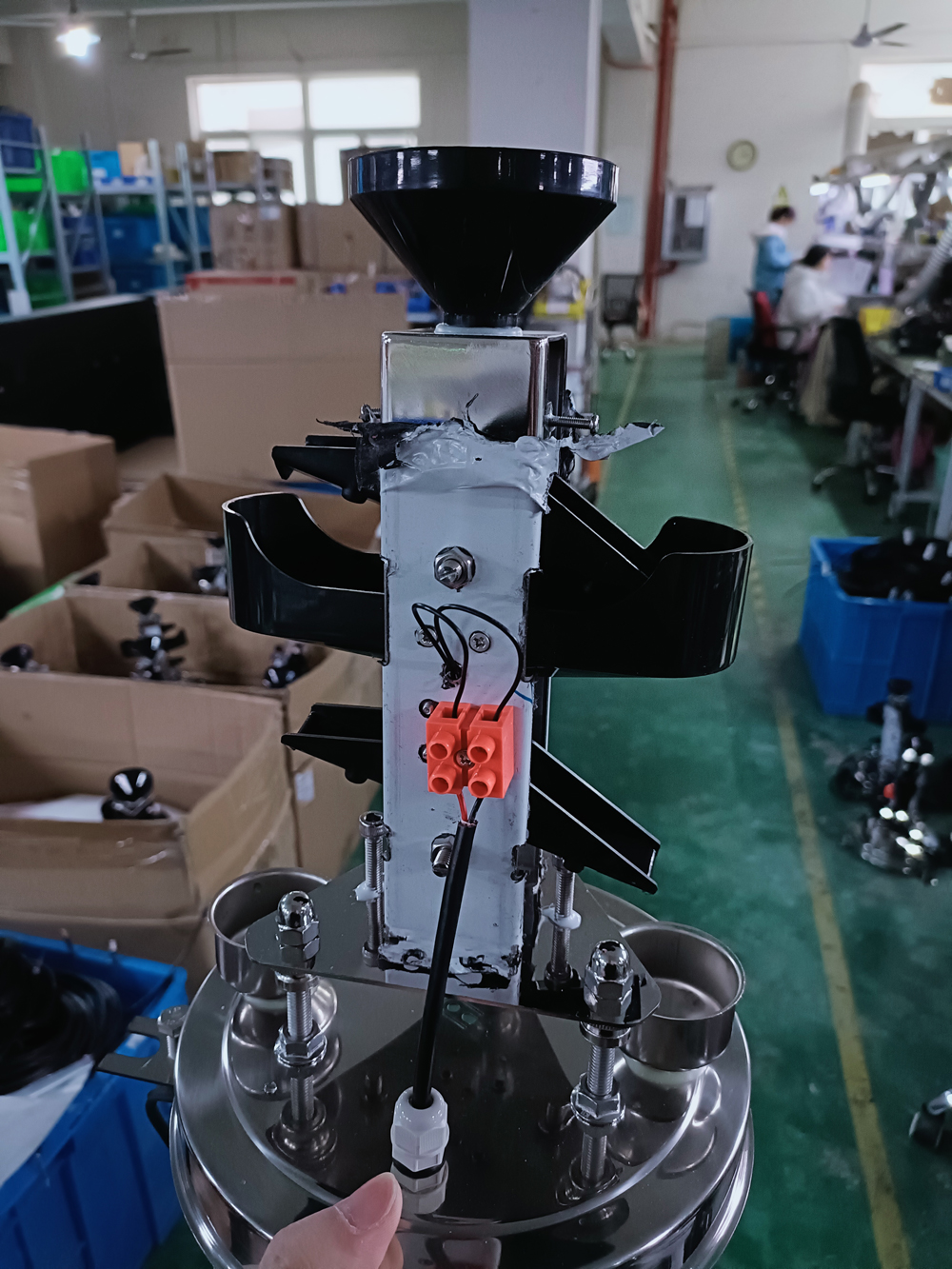
Tipping bucket rain gauge maintenance should check the complete measuring chain: collector, funnel, bucket movement, level, pulse transmission and logger scaling. Record the as-found condition before cleaning or adjustment. A bucket that tips by hand proves movement, not rainfall accuracy. Use a controlled water test and an end-to-end count check to distinguish a hydraulic problem from an electrical or data-processing fault.
A zero result during a storm can arise from a blocked funnel, a restrained mechanism, a broken pulse path or a failed logger input. Excess rainfall can come from duplicate counts, incorrect scaling or test water included in the operating record. Save the event and recent service history before changing anything.
Check whether the problem is missing rainfall, a constant factor error, isolated spikes or an unexpected reset. A consistent factor difference after a logger replacement is a reason to inspect millimetres per pulse. A delayed burst after a shower is a reason to inspect the water path. These patterns guide the inspection; they are not sufficient by themselves to identify the cause.
Mark maintenance start and finish times. Water poured during a test must remain distinguishable from natural rainfall. Deleting the test from a presentation copy may be appropriate, but keep the original record and the reason for exclusion so the daily total can be reconstructed.
Record what was removed and whether cleaning changed the result. If a blockage released stored water, the resulting tips belong to an uncertain accumulation period. They should not automatically be assigned to the time at which the blockage cleared.
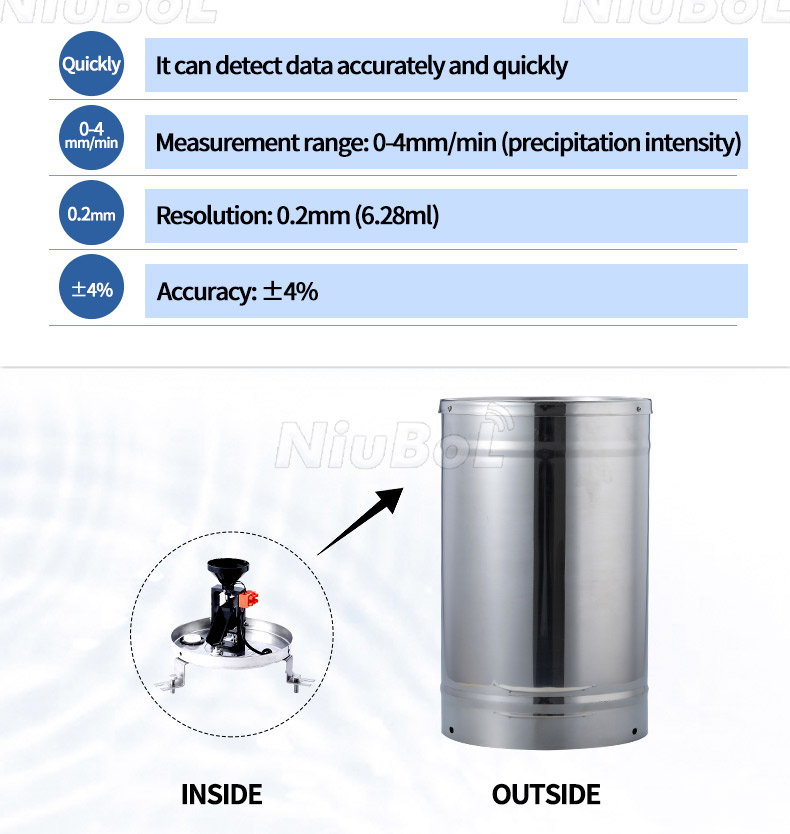
The NiuBoL NBL-W-RS is available in different output and resolution configurations. The following specifications apply to the 0.2 mm arrangement. Do not copy its scaling into a separately supplied 0.5 mm gauge or another tipping-bucket model.
| Item | NBL-W-RS 0.2 mm configuration | Maintenance significance |
|---|---|---|
| Collector diameter | 200 +/-0.6 mm | The collection area determines the water-depth conversion |
| Resolution | 0.2 mm per tip; approximately 6.28 mL | Verify the logger's millimetres-per-pulse setting |
| Intensity range | 0-4 mm/min | Do not establish high-rate performance from a slow hand test alone |
| Stated accuracy | +/-4% under the specified indoor test condition at 2 mm/min | Keep that condition distinct from total field uncertainty |
| Output selections | Reed-switch pulse, 0-2.5 V, 0-5 V or RS485 as ordered | Inspect and test the actual supplied signal path |
| Supply selections | 5 VDC or 12-24 VDC version, according to configuration | Do not assume one delivered unit accepts every ordering option |
| Working temperature | 0-50 deg C | This is not an unheated all-season snow measurement specification |
| Standard cable | 5 m | Inspect extensions, junctions and the receiving input separately |
Keep the model, resolution and output version in the service record. A pulse input and an RS485 transmitter need different checks, even when the outdoor collectors look similar.
For a nominal 200 mm collector, area is approximately 31416 mm2. Rainfall depth in millimetres equals water volume in mL multiplied by 1000 and divided by collector area in mm2. Thus approximately 31.4 mL represents 1 mm, and 628 mL represents 20 mm or 100 nominal 0.2 mm tips.
Those calculations define an expected quantity, not a complete calibration procedure. The delivery rate, reference volume accuracy, starting bucket condition and water remaining in the mechanism affect the test. Pouring the whole volume rapidly can overflow or exercise the mechanism outside the intended condition.
Use the suitable controlled delivery arrangement and agreed procedure for a quantitative check. Record delivered volume, rate, duration, starting condition and final count. For a small test, the unfinished water left before the next tip can be a significant part of the result; do not infer an adjustment from that result without accounting for it.
A hand-tip test is still useful for electrical continuity. Count a known number of deliberate tips and compare the logger count. Keep that result separate from the controlled-water result so a technician can identify which part of the chain passed.
At a pulse input, check wiring, the intended contact arrangement and the input's filtering or debounce settings. Too little filtering can permit duplicate counts from contact behaviour or electrical disturbance; excessive filtering can miss valid tips. Use settings appropriate to the actual gauge and test them rather than choosing a universal delay.
For the configured RS485 Modbus RTU version, compare the decoded rainfall with the field transmitter's expected quantity. One NBL-W-RS example returns data word 0x001A, decimal 26, representing 2.6 mm after division by ten. That is a scaled rainfall value, not necessarily 26 tips. Use the correct interpretation for the supplied version.
Check accumulation boundaries after a power interruption or communications outage. Determine whether the device retains a cumulative total, reports an interval amount or resets under a defined command. A historian that repeatedly adds the same cumulative value will overstate rainfall even when the transmitter is correct.
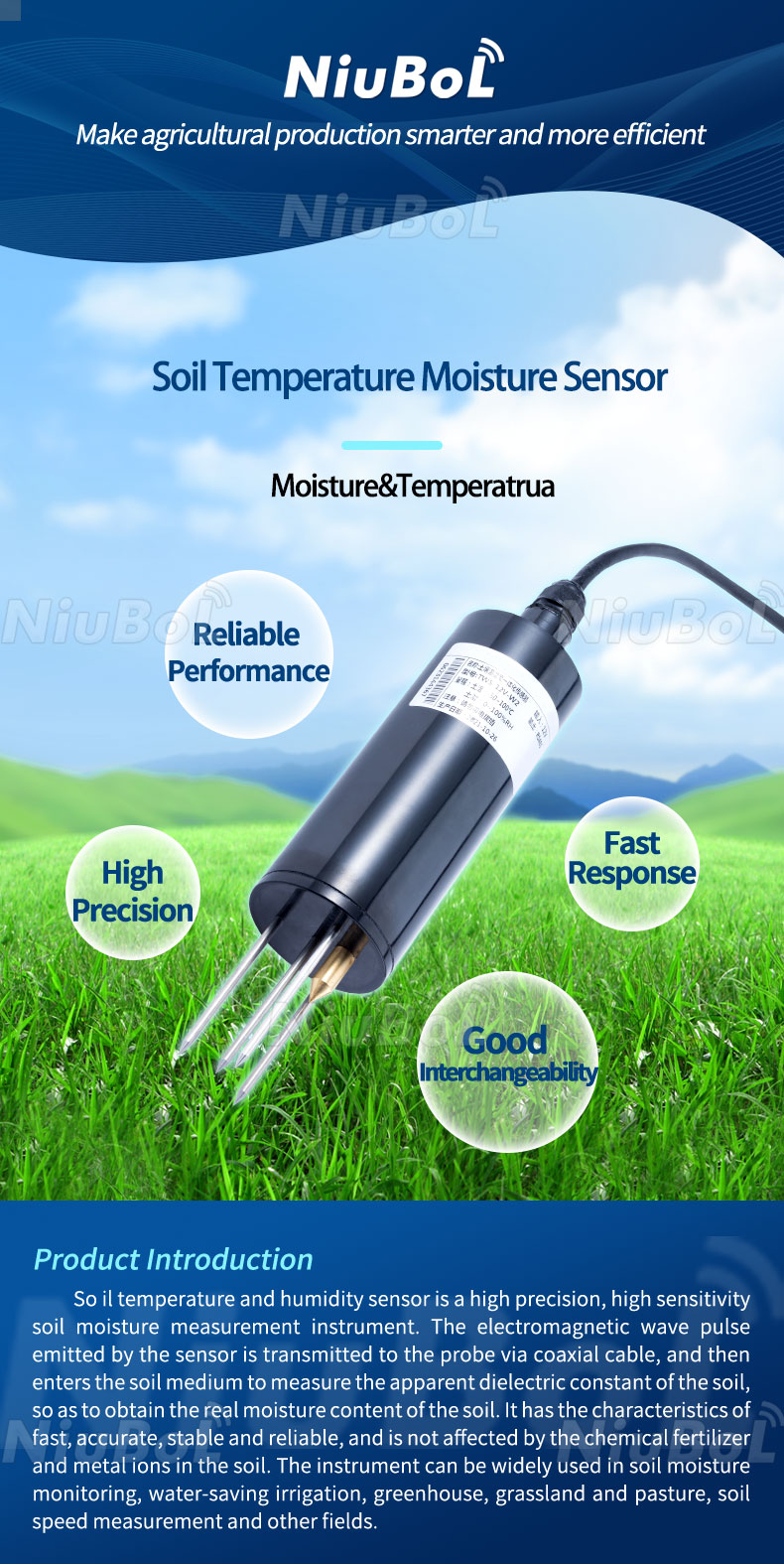
At an agricultural station, a soil-moisture channel can help interpret what happened after rain. It cannot calibrate the rain gauge. Irrigation, interception, runoff, soil texture and measurement depth can all change the soil response independently of the collected rainfall.
If the rain channel reports an event with little soil change, inspect the rain record and the field conditions rather than forcing one channel to agree with the other. The soil sensor and rain gauge perform different measurements and need separate maintenance checks.
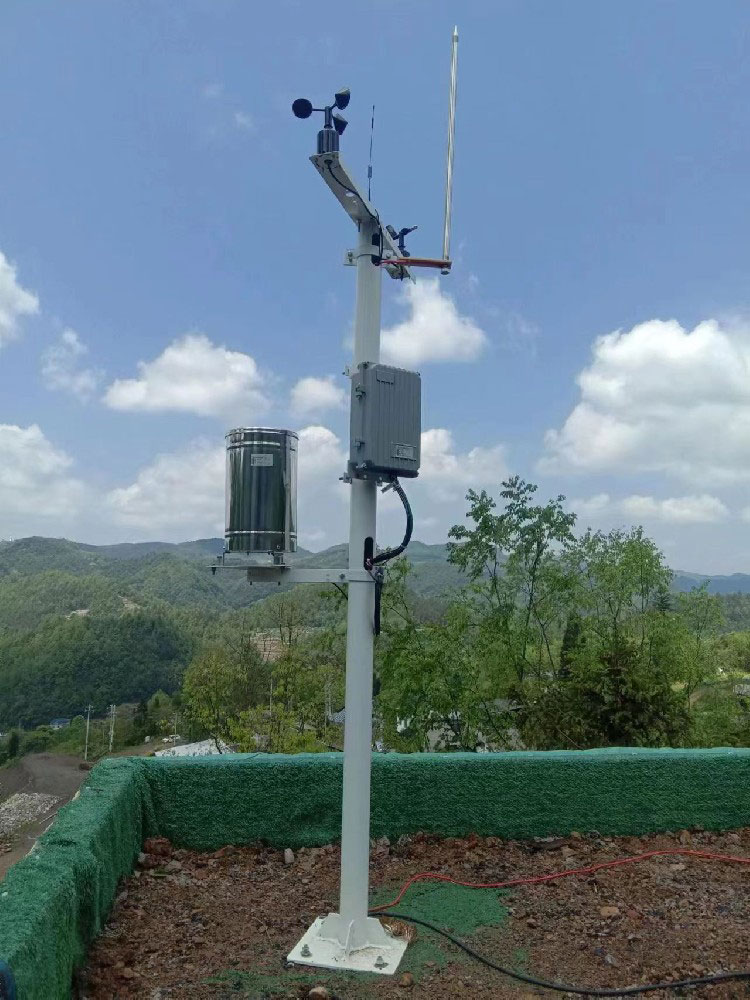
After the check, confirm the collector is assembled, level and unobstructed, with test accessories removed. Verify that valid tips reach the correct station tag and that test water is identified. Retain the as-found and as-left observations instead of recording only that maintenance was completed.
Set inspection frequency from actual debris, insect activity, vegetation and access conditions. Check again after work that could move the mounting or alter exposure. A clean and calibrated collector can still differ from a nearby gauge because of location, wind and splash; do not adjust its mechanism merely to make two different sites match.
Where freezing precipitation is part of the duty, review a suitable heated or alternative measurement arrangement and its power requirements. Do not claim snow-water-equivalent coverage from the unheated NBL-W-RS temperature specification. Mark periods when the installed method cannot supply the required precipitation measurement.
No. It can demonstrate bucket movement and pulse registration. A quantitative rainfall check also needs a suitable reference volume, controlled delivery and an agreed starting and ending condition.
Check the installed resolution and receiving-system scale first. Using a different millimetres-per-pulse value, or treating a digital rainfall value as a pulse count, can create a constant error without a mechanical fault.
Only when a suitable quantitative test establishes the need and the authorised procedure permits it. Cleaning and levelling may restore operation without changing calibration. Record every adjustment and repeat the test afterwards.
Investigate maintenance water, manual tips, wiring disturbance, input filtering, resets and historian calculations. Check the original count and event times before removing the spike from the operating record.
Provide the exact model and resolution, output version, logger settings, event export, installation photographs and separate hand-tip and controlled-water results. This helps distinguish a replacement-part requirement from a wiring, scaling or exposure problem.
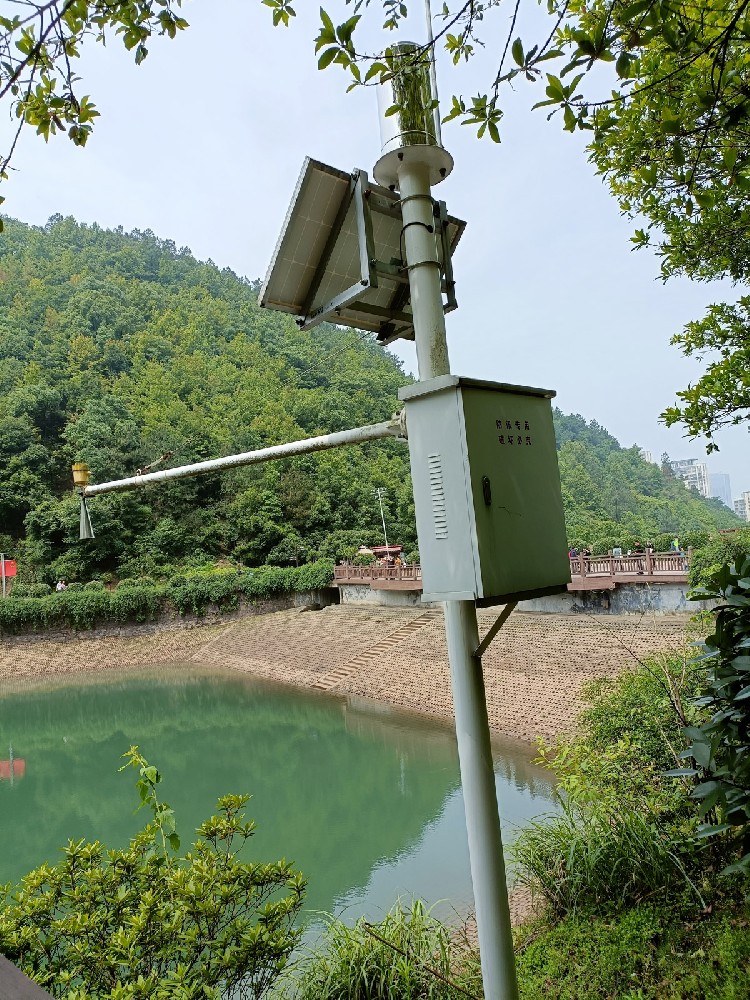
Effective tipping bucket rain gauge maintenance separates water collection, mechanism performance, signal counting and rainfall calculation. Preserve the original evidence, clean and level carefully, then verify the complete chain under a suitable test. Request NiuBoL support with the installed configuration and measured test results rather than adjusting the gauge to match an unexplained total.
Related recommendations
Sensors & Weather Stations Catalog
 Agriculture Sensors and Weather Stations Catalog-NiuBoL.pdf
Weather Stations Catalog-NiuBoL.pdf
Agriculture Sensors Catalog-NiuBoL.pdf
Water Quality Sensor Catalog-NiuBoL.pdf
Related products
 Combined air temperature and relative humidity sensor
 TDR Soil Moisture & Temperature Sensor for irrigation| RS485 |4-20mA| NBL-S-THR
 Soil pH sensor RS485 soil Testing instrument soil ph meter for agriculture |NBL-S-PH
 Wind Speed sensor Output Modbus/RS485/Analog/0-5V/4-20mA
 Tipping bucket rain gauge for weather monitoring auto rainfall sensor RS485/Outdoor/stainless steel
 Pyranometer Solar Radiation Sensor 4-20mA/RS485

Screenshot, WhatsApp to identify the QR code
WhatsApp number:+8615367865107
(Click on WhatsApp to copy and add friends)

