





— Blogs —
—Products—
 Consumer hotline +8618073152920
 WhatsApp:+8615367865107
Address:Room 102, District D, Houhu Industrial Park, Yuelu District, Changsha City, Hunan Province, China
Product knowledge
Time:2026-09-07 15:00:00 Popularity:174
A multi-layer tube soil moisture monitoring system needs continuous soil contact, a fixed depth datum and verified channel-to-layer mapping. For the NBL-S-TMSMS integrated tube, prepare a suitable vertical borehole and install using the approved soil-contact procedure; do not hammer the housing into hard ground. Check each depth in the logger before interpreting a moisture profile. A plausible graph can still be wrong if air gaps or swapped layer labels remain.
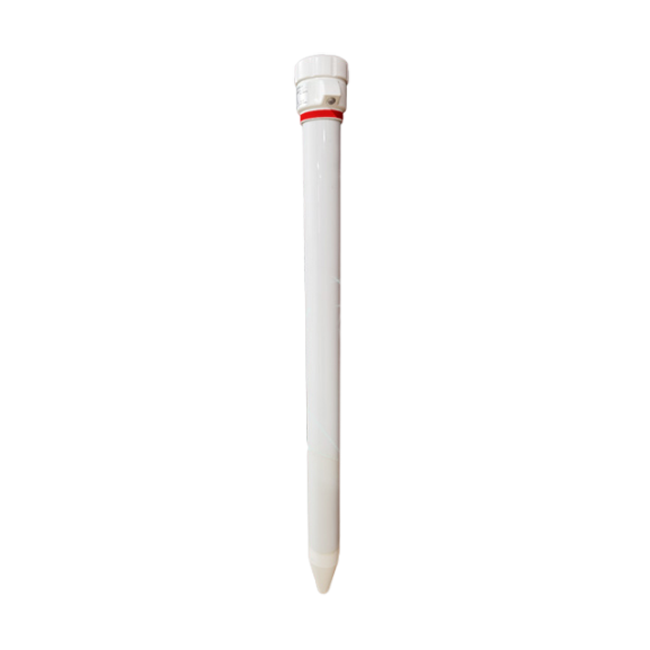
The NiuBoL NBL-S-TMSMS combines moisture and temperature sensing at specified depths in an integrated tubular assembly. Do not assume that it is a removable probe lowered into a separately installed access tube. Construction determines the borehole, contact treatment and future retrieval procedure.
Obtain a drawing identifying the zero mark and sensing-node centres. Standard arrangements include 10, 20, 30 and 40 cm nodes, with other configurations available. The ordered layout controls the installation; the overall tube length is not a substitute for the depth schedule.
Record the intended soil-surface datum before drilling. Later cultivation, erosion or a mound around the head can change the apparent surface level. Keep a stable reference and note any change rather than relabelling the historical channels as though the sensor had never moved.
Classify the soil and management zone before choosing the point. Texture, compaction, slope and irrigation pattern can differ within one field. A wet depression or a compacted vehicle track may be important to investigate, but it should not automatically represent the whole crop area.
Record the distance and orientation relative to a drip emitter, crop row or irrigation line. Two correctly functioning tubes can produce different profiles if one observes the wetted zone and the other sits outside it. The installation drawing should make that difference intentional.
Consider whether a single-point soil probe is enough for the task. It can measure a selected location, but moving it between depths does not provide the same simultaneous profile as a fixed multi-layer tube. Select the arrangement from the question rather than calling both devices equivalent.
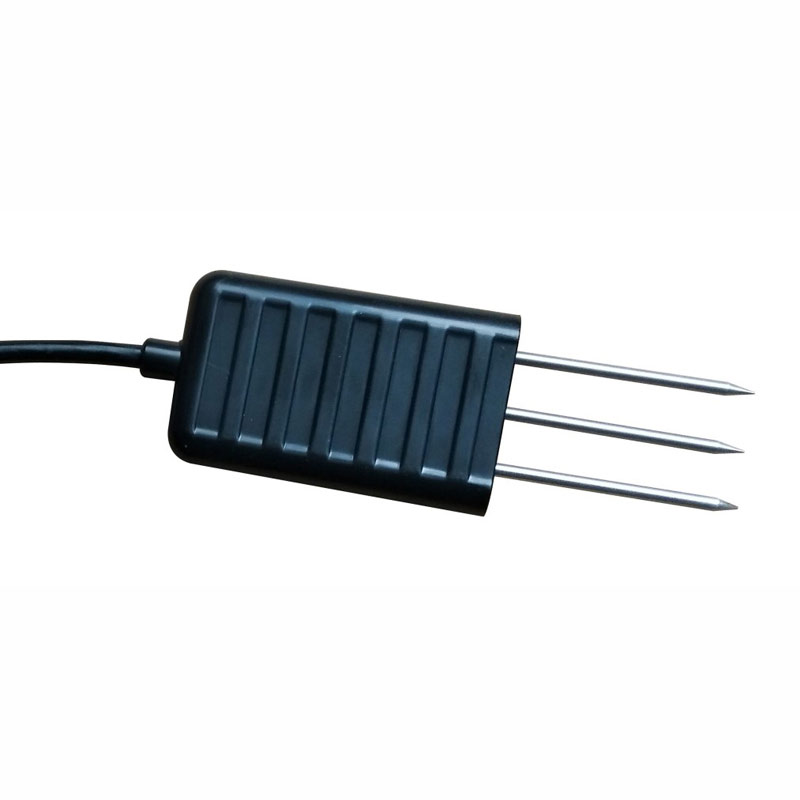
The contact treatment changes conditions immediately around the sensor. Record the installation date, added material and any water used. Initial readings can reflect that disturbance; do not call them the undisturbed field baseline simply because the instrument has powered up.
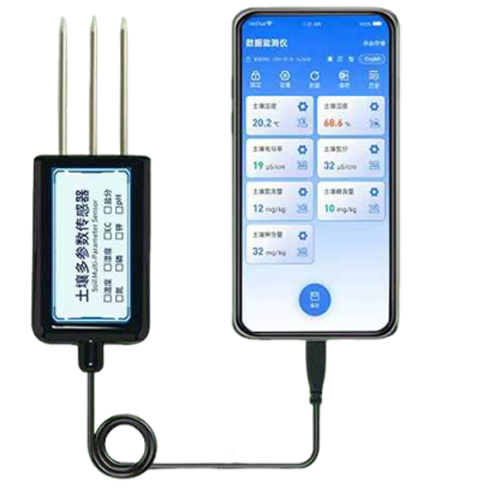
A phone-connected soil meter can be useful for a separate survey or a local comparison. Its insertion geometry and sampled volume differ from those of the installed tube. Agreement at one surface point does not verify the deeper nodes, and disagreement need not prove that either instrument is defective.
Where a comparison is required, define the depth, method and soil condition. Avoid excavating immediately beside the tube in a way that destroys the very contact being evaluated. Keep destructive reference sampling far enough from the assembly to preserve it, while documenting the remaining spatial difference.
| Item | NBL-S-TMSMS specification | Installation consequence |
|---|---|---|
| Moisture principle and range | FDR dielectric measurement; dry to moisture-saturated soil | Assess the actual soil response rather than assuming texture-independent accuracy |
| Moisture accuracy and resolution | Stated +/-3% under laboratory conditions; 0.1% resolution | Clarify the error basis and establish field comparisons separately |
| Temperature | -40 to 80 deg C; +/-0.5 deg C; 0.1 deg C resolution | Store each temperature channel against its physical depth |
| Nodes | Standard 10/20/30/40 cm arrangement; custom configurations up to 10 layers | Verify the ordered node schedule before drilling |
| Supply | 12 VDC or the configured solar-powered arrangement | Confirm the exact supplied version; solar operation requires a complete power system |
| Current | Below 1 mA during sleep; below 70 mA during sampling | Budget the sampling duty and separate logger or communications loads |
| Digital output | RS485, Modbus RTU | Use the exact node count, channel order and scaling |
| Housing and protection | Plastic tube with epoxy sealing; above-ground IP67, underground IP68 | Protect the head and joints as well as the buried portion |
| Dimensions | 63 mm diameter; length varies with configuration, approximately 1000 mm standard | Use the actual dimensional drawing for auger and installation planning |
Do not transfer specifications from a different tube or multi-point probe carrying a similar name. Cable construction, extensions and connector arrangement should be confirmed for the ordered unit; the nominal tube diameter does not define those electrical details.
At the digital interface, compare the raw response with the logger's engineering values. One documented three-layer example begins with supply voltage, followed by moisture and temperature pairs for successive layers. Verify the actual configuration before adopting that layout for a different node count.
In that example, voltage word 0x2EE0 is decimal 12000 and represents 12.000 V. Moisture word 0x00EA is 234 and represents 23.4%; temperature word 0x011A is 282 and represents 28.2 deg C. These are decoding examples, not field observations or an acceptance target. Confirm the negative-temperature encoding separately where required.
Use the specified serial settings and allow the required interval between requests. The documented arrangement uses 9600 baud and at least 1000 ms between communications. Keep addresses unique and distinguish a missed reply from a new moisture value. A disconnected layer must not become a valid zero in the profile.
Retain the installation record and observe a suitable rain or irrigation event under the site's approved operating plan. Review depth-specific changes alongside the event time and applied-water information. Do not require every layer to respond together; delayed or absent deep response can be a real soil condition.
If all depths change abruptly and identically, check mapping and software processing. If one depth remains implausibly fixed, review its channel and installation contact. If changes appear immediately after work around the head, inspect whether surface water has found an unintended path along the tube. These patterns guide inspection; none establishes a fault without further evidence.
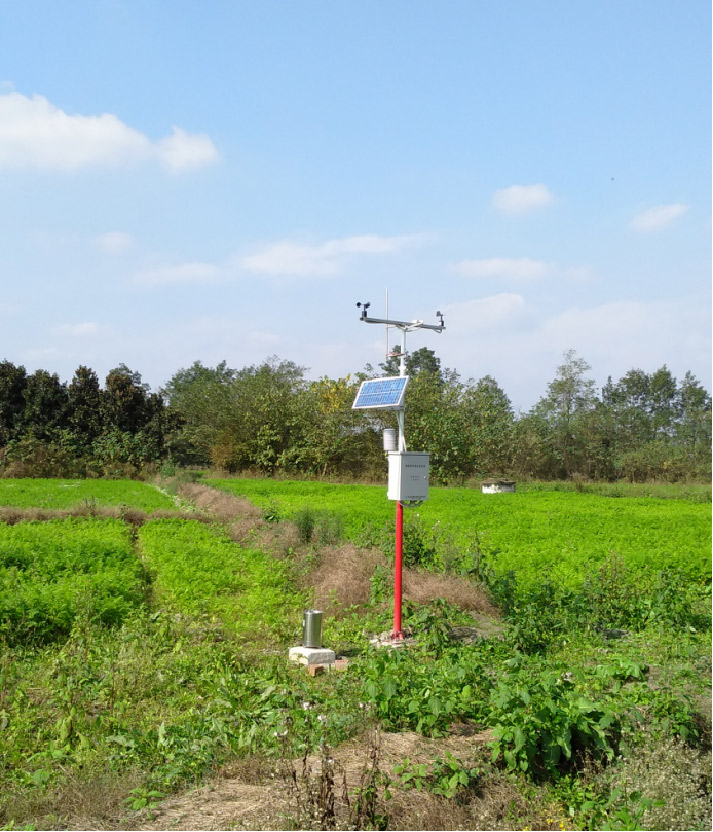
A nearby agricultural weather station can help document rainfall and atmospheric conditions, but it does not validate buried sensing nodes. Keep its timestamps coordinated with the soil logger and retain the distance between the two installations. An air temperature or humidity sensor provides separate context, not another soil layer.
Mark the head and cable route so cultivation equipment and maintenance crews can avoid them. Provide strain relief and appropriate protection at above-ground connections. Do not lift or reposition the tube by its cable.
For greenhouse rows, document any changes to emitters or planting arrangement around the sensor. For open fields, record soil-surface changes and work that could disturb contact. A mechanically sound installation can become less representative when the surrounding management changes.
No. Prepare a suitable vertical borehole and establish contact using the approved procedure. Impact can damage the assembly and does not demonstrate uniform soil contact.
It defines the physical depths assigned to the channels. Installing the tube too high or low shifts the whole profile. Record the final datum and preserve that information after surface changes.
No. Soil properties, contact, disturbance and spatial variability also affect field interpretation. Keep laboratory specifications separate from the site's comparison and commissioning evidence.
Not necessarily. Applied water may not reach the deeper nodes during that event. Review the irrigation pattern and soil conditions before calling an unchanged layer faulty.
Send NiuBoL the soil profile, crop and irrigation arrangement, required node depths, obstruction risks, cable route, power and receiving logger. Request the exact depth drawing and electrical information needed before augering begins.
A multi-layer tube soil moisture monitoring system produces a useful profile when the physical depths, soil contact and digital channel mapping agree. Install without impact, document the disturbed starting condition and review layer behaviour through real field events. NiuBoL can review the tube configuration and installation requirements before the point is committed to the ground.
Prev:Multiparameter Soil Meter for Research: Repeatable Experiments
Next:Tipping Bucket Rain Gauge Maintenance: Water Tests and Count Checks
Related recommendations
Sensors & Weather Stations Catalog
 Agriculture Sensors and Weather Stations Catalog-NiuBoL.pdf
Weather Stations Catalog-NiuBoL.pdf
Agriculture Sensors Catalog-NiuBoL.pdf
Water Quality Sensor Catalog-NiuBoL.pdf
Related products
 Combined air temperature and relative humidity sensor
 TDR Soil Moisture & Temperature Sensor for irrigation| RS485 |4-20mA| NBL-S-THR
 Soil pH sensor RS485 soil Testing instrument soil ph meter for agriculture |NBL-S-PH
 Wind Speed sensor Output Modbus/RS485/Analog/0-5V/4-20mA
 Tipping bucket rain gauge for weather monitoring auto rainfall sensor RS485/Outdoor/stainless steel
 Pyranometer Solar Radiation Sensor 4-20mA/RS485

Screenshot, WhatsApp to identify the QR code
WhatsApp number:+8615367865107
(Click on WhatsApp to copy and add friends)

