





— Blogs —
—Products—
 Consumer hotline +8618073152920
 WhatsApp:+8615367865107
Address:Room 102, District D, Houhu Industrial Park, Yuelu District, Changsha City, Hunan Province, China
Product knowledge
Time:2023-10-15 16:30:35 Popularity:1934
The application advantages of solar radiation sensors, in addition to high-precision measurement, good stability, fast response speed and diversified measurement ranges, are as follows:
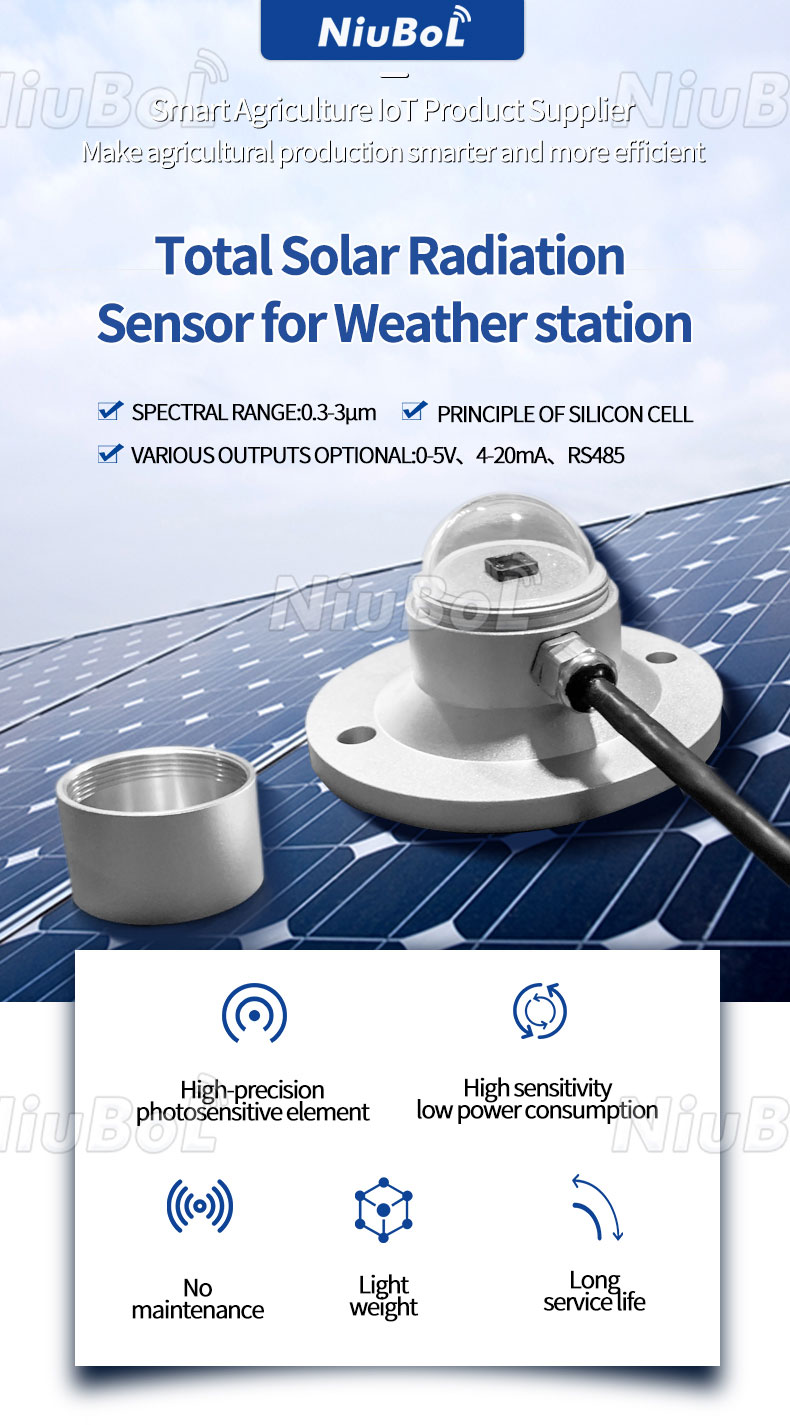
Strong environmental adaptability: the solar radiation sensor generally adopts stainless steel shell, waterproof, dustproof, and able to work stably in a variety of harsh environments. This makes it possible to make accurate measurements of solar energy resources under various climatic conditions, providing us with stable and reliable data.
Automatic tracking of the sun: in order to better receive solar energy, many solar radiation sensors have the function of automatic tracking of the sun. Through the built-in solar tracking system, it can monitor the position of the sun in real time and adjust its own angle, so that the sensor is always aligned with the sun, thus improving the accuracy and stability of the measurement data.
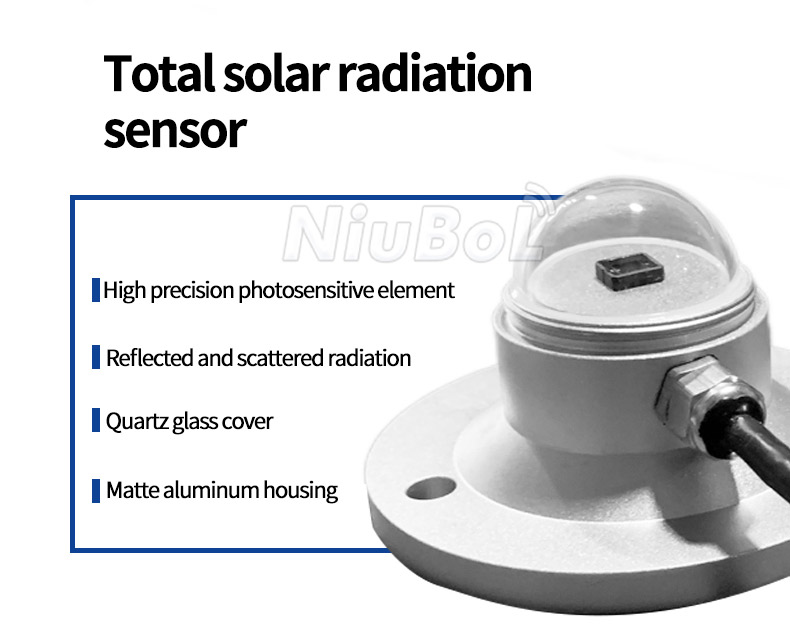
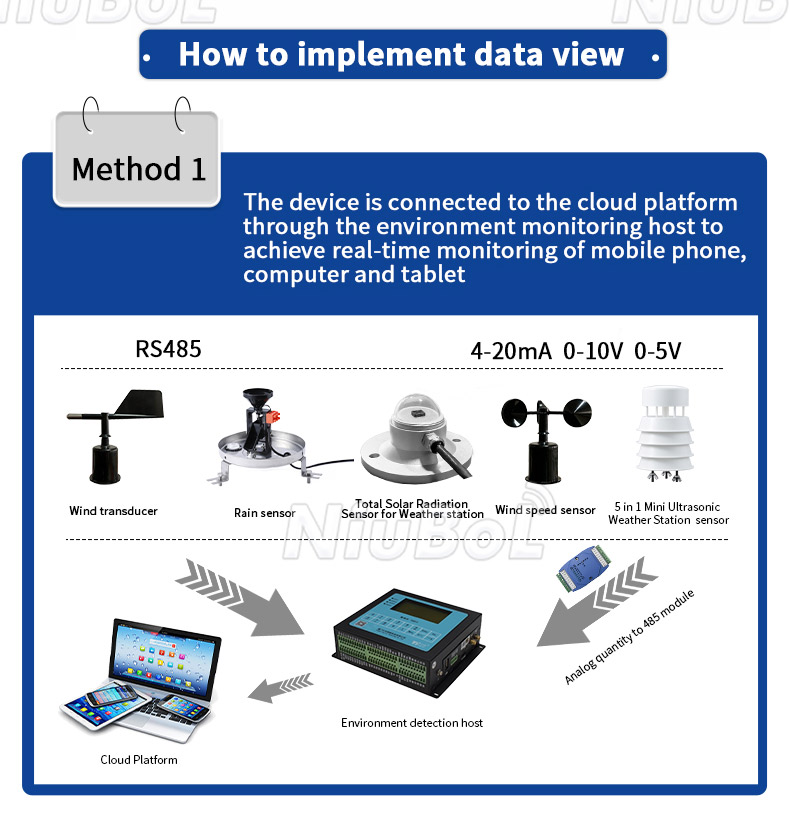
Data storage and transmission: modern solar radiation sensors not only have real-time data acquisition and display functions, but also can be transmitted to other devices through the standard Modbus-RTU 485 communication protocol, to facilitate data sharing and application. In addition, some high-end sensors also have data storage capabilities, can record historical data, convenient for users to analyze and utilize the data.
Solar powered: Most solar radiation sensors are powered by solar panels and can work continuously without utility power. This allows them to be used in remote areas or where there is no power supply, expanding their range of applications.
Low Maintenance Costs: Since the photovoltaic and electronic technologies used in solar radiation sensors are mature technologies, their maintenance costs are relatively low. In general, only regular cleaning and maintenance of sensors and solar panels can be, greatly reducing the cost of use.
In general, these application advantages of solar radiation sensors in the field of energy, environmental monitoring and other fields have a wide range of application prospects.
 NBL-W-HPRS-Solar-Radiation-Sensor-Instruction-Manual-V3.0.pdf
NBL-W-SRS-Solar-radiation-sensor-instruction-manual-V4.0.pdf
Related recommendations
Sensors & Weather Stations Catalog
 Agriculture Sensors and Weather Stations Catalog-NiuBoL.pdf
Weather Stations Catalog-NiuBoL.pdf
Agriculture Sensors Catalog-NiuBoL.pdf
Water Quality Sensor Catalog-NiuBoL.pdf
Related products
 Combined air temperature and relative humidity sensor
 TDR Soil Moisture & Temperature Sensor for irrigation| RS485 |4-20mA| NBL-S-THR
 Soil pH sensor RS485 soil Testing instrument soil ph meter for agriculture |NBL-S-PH
 Wind Speed sensor Output Modbus/RS485/Analog/0-5V/4-20mA
 Tipping bucket rain gauge for weather monitoring auto rainfall sensor RS485/Outdoor/stainless steel
 Pyranometer Solar Radiation Sensor 4-20mA/RS485

Screenshot, WhatsApp to identify the QR code
WhatsApp number:+8615367865107
(Click on WhatsApp to copy and add friends)

