





— Blogs —
—Products—
 Consumer hotline +8618073152920
 WhatsApp:+8615367865107
Address:Room 102, District D, Houhu Industrial Park, Yuelu District, Changsha City, Hunan Province, China
Product knowledge
Time:2026-02-07 15:46:09 Popularity:677
A non-contact road condition sensor observes a defined pavement target without placing the sensing element in the road surface. The useful integration question is what that target represents: a wheel track, a bridge-deck cold spot, a ramp or another selected area. A valid measurement at one spot is not proof that every lane has the same water, ice or temperature condition.
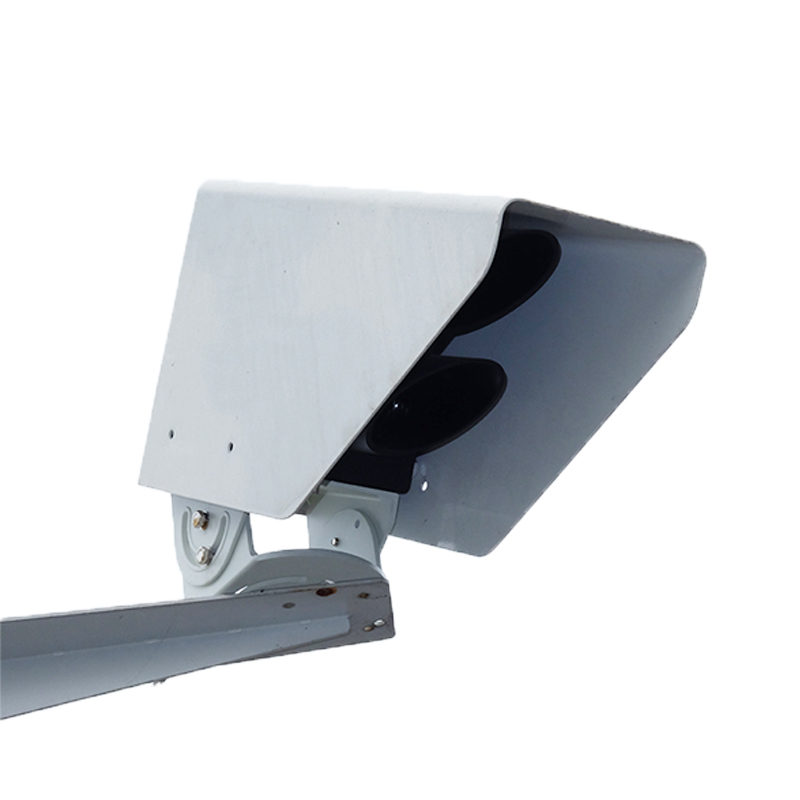
Road-surface temperature, surface-state classification and estimated contaminant thickness are different outputs. Optical classification may distinguish states supported by the selected instrument, but the exact categories, measurement ranges and uncertainty need their own technical definitions. An air-temperature sensor cannot replace pavement temperature, and a generic wet-state code cannot be treated as a measured water-film thickness.
A reported slipperiness or grip index also needs interpretation. It is not automatically a direct measurement of tyre-road friction for every vehicle, speed and pavement. Require the supplier to define the index, its validation method and intended use before connecting it to maintenance or traffic decisions. Do not calculate stopping distance from an undefined scalar tag.
| Required output | Define before ordering | Check at integration |
|---|---|---|
| Surface temperature | Range, accuracy conditions and pavement suitability | Correct unit, target and comparison method |
| Surface state | Available categories, including missing or unknown states | Actual code mapping, not guessed labels |
| Water, ice or snow thickness | Which layers are measured and over what validated range | Units, limits and out-of-range behavior |
| Grip or slipperiness index | Meaning and applicable assessment method | No substitution for unmeasured vehicle friction |
| Instrument validity | Available quality and diagnostic information | Unknown is distinct from dry or safe |
Keep the technical schedule specific to the offered model. Ask for supply voltage, operating and heater loads, environmental limits, enclosure rating, cable specification and communication definition. Those values cannot be established from a roadside photograph or from the specifications of a separate weather sensor on the same pole.
The mounting drawing needs the sensor height above the target, horizontal offset, slant distance and the angle reference. These dimensions are related but are not interchangeable. A permitted optical working distance usually concerns the actual path to the target rather than the horizontal distance from the pole base.
For illustration only, a sensor 3 m above a level target and 6 m horizontally away has a slant distance of about 6.71 m. Its optical axis is about 26.6 degrees above the pavement plane, or 63.4 degrees from the pavement normal. These are descriptions of the same geometry, not recommended mounting limits for a particular instrument.
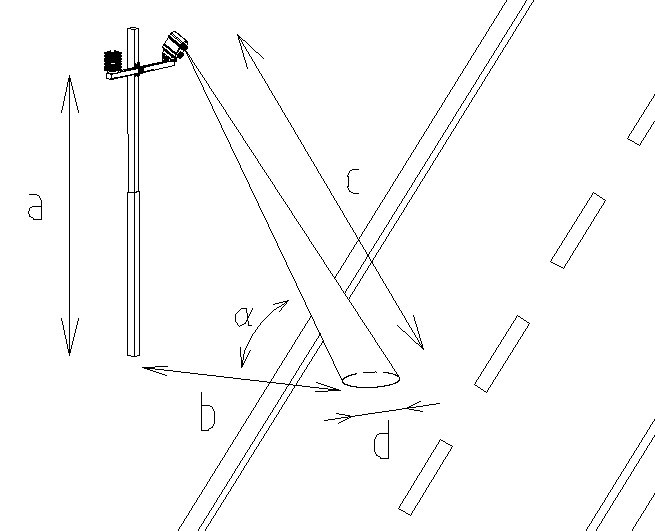
Confirm which angle the installation specification uses. A bracket set to 30 degrees from vertical is not the same as 30 degrees above the road. Include road crossfall, grade and the actual target elevation where relevant. The drawing should identify the point being observed, not simply show a beam directed somewhere across the carriageway.
The measurement footprint also depends on the optical field of view and incidence geometry. A larger slant distance can increase the footprint or introduce a different observation angle. Obtain the instrument's footprint information and check whether it crosses a lane marking, joint or different surface. Do not infer lane-wide coverage from the housing dimensions.
A bridge can contain shaded areas, exposed areas, joints, treated sections and wheel tracks with different conditions. An installation intended to capture a known local icing risk may deliberately observe a different target from one intended to describe more general pavement conditions. State that purpose in the site record.
The FHWA guidance on road-weather information requirements distinguishes local observations from more broadly representative sites. It explains why sensor selection should follow the information needed at that location. It does not justify treating one local target as evidence for an entire route.
Avoid unintended targets such as paint, drainage from a structure or the opposite side of a thermal boundary. Conversely, if ponding at a particular depression is the actual question, record that deliberate choice rather than presenting it as average road wetness. Reassess the target after resurfacing, repainting or changes to drainage.
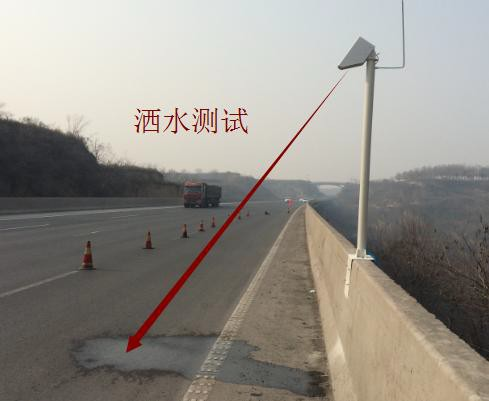
Agree an authorized test plan and traffic-management arrangement before visiting the pavement. Begin by confirming the aim and recording a photograph of the target and installation. Verify the instrument's identification and acquisition settings. Do not assume that a displayed dry category means the instrument is correctly aimed.
Compare reported states with suitable contemporaneous observations and reference methods. A photograph may help document a surface state but does not independently measure a thin water or ice layer. A temperature comparison also needs compatible methods, locations and timing; different spots can be genuinely different.
Never create ice or spread water on an operating traffic lane merely to demonstrate an alarm. Use an approved controlled arrangement or a suitable observation period. Where a required condition cannot be tested during commissioning, record the outstanding test rather than asserting that dry-weather agreement proves winter detection performance.
During traffic passage, establish how the supplied instrument handles obstruction and whether the reported pavement value remains valid. Do not assume a particular vehicle-rejection algorithm or contamination-warning threshold. Inspect the actual available status data and verify its meaning in the delivered interface.
If the selected road instrument uses RS485 Modbus RTU, match its actual device address, serial settings, registers, data types and scales in the RTU or PLC. Modbus does not standardize road-state codes across every manufacturer or model. An integer that means wet in one interface must not be assigned that meaning in another without confirmation.
Store instrument identity, pavement target, observation time, value and validity together. A communication timeout is not a dry road. A value beyond a measuring range is not automatically a measured deep-water condition. Where diagnostic information is unavailable, the receiving application still needs to identify an old or absent observation.
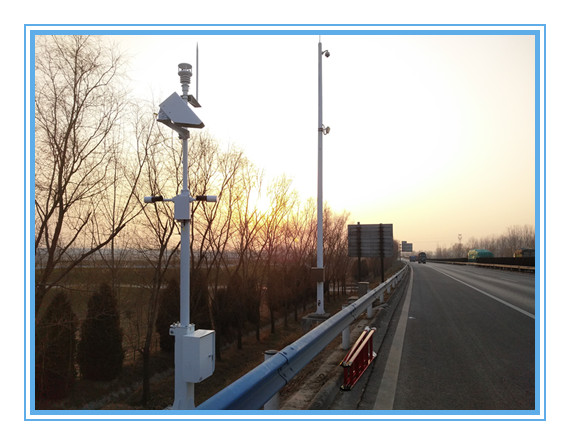
Separate the pavement sensor from the gateway and operational application. Remote server access, data retention and message-board control depend on the ordered acquisition and software package. An instrument can supply useful observations without being approved to make traffic-control decisions on its own.
Complementary measurements can improve context. Air temperature, humidity, rainfall, wind or visibility may help the operator interpret a pavement event. NiuBoL weather station configurations can be reviewed for those observations, but their measurements do not create an unmeasured pavement state or a guaranteed warning lead time.
Check safe maintenance access, structural attachment, cable protection and the possibility of splash, spray or lens contamination. Non-contact measurement can avoid embedding a sensor in the surface, but it does not guarantee that installation or maintenance can always occur without traffic restrictions.
Request the optical cleaning procedure and inspection criteria for the offered instrument. An automatic heater or diagnostic, where included, does not remove the need to inspect the window and mount. Changes to aim, bracket position or pavement condition should be recorded because they may change the interpretation of the existing series.
For a NiuBoL road-weather project enquiry, provide a site drawing, lane and target description, mounting height and offset, expected surface conditions, required outputs and the receiving system. Ask for an itemized technical proposal for the actual instruments and interfaces. Resolve any unconfirmed measurement claim before it becomes a project acceptance requirement.
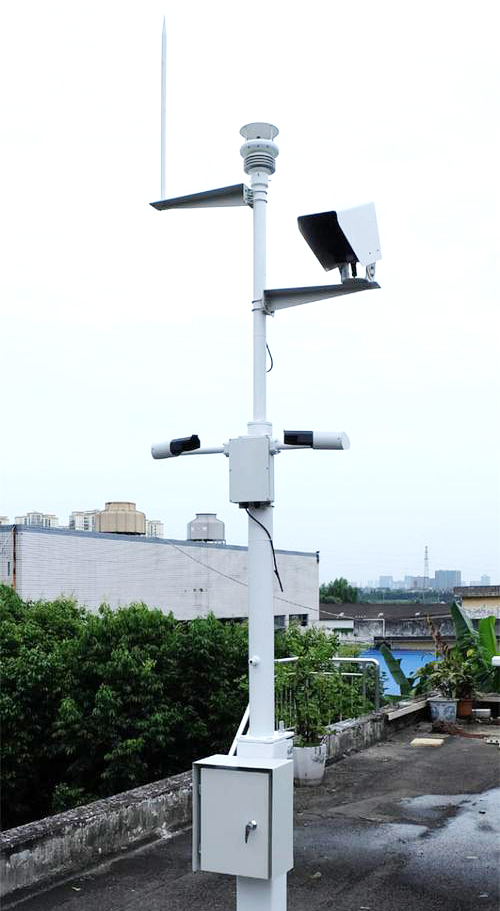
It observes the target within its optical footprint. Whether that spot represents a lane or short section depends on the pavement, exposure and monitoring purpose. Document the intended representativeness instead of assuming route-wide coverage.
No. Height and horizontal offset combine to give the optical path length. Check working distance and angle using the offered instrument's convention and the actual road elevation.
Only if its definition and validation support that use. An optical or model-derived index is not automatically a direct friction measurement applicable to every vehicle or speed. Keep the operational interpretation within the accepted method.
No. It can confirm some installation and acquisition functions, not every winter condition. Require suitable evidence for the specified detection task and identify any condition still awaiting an approved field test.
Mark it as missing or stale and apply the operator's approved response. Do not turn a failed read into a fresh dry-road observation or assume the sensor has issued a safe condition.
A non-contact road condition sensor is useful when its outputs, aiming geometry and pavement target are defined together. Verify the actual instrument specification, compare observations through an authorized method and preserve quality information in RWIS. These checks help the project team distinguish a valid local observation from an unsupported assumption about the entire road.
Prev:6-in-1 Weather Station Layout: Integrated or Separate Rain Gauge?
Next:Rain and Snow Sensor Integration for Weather Monitoring
Related recommendations
Sensors & Weather Stations Catalog
 Agriculture Sensors and Weather Stations Catalog-NiuBoL.pdf
Weather Stations Catalog-NiuBoL.pdf
Agriculture Sensors Catalog-NiuBoL.pdf
Water Quality Sensor Catalog-NiuBoL.pdf
Related products
 Combined air temperature and relative humidity sensor
 TDR Soil Moisture & Temperature Sensor for irrigation| RS485 |4-20mA| NBL-S-THR
 Soil pH sensor RS485 soil Testing instrument soil ph meter for agriculture |NBL-S-PH
 Wind Speed sensor Output Modbus/RS485/Analog/0-5V/4-20mA
 Tipping bucket rain gauge for weather monitoring auto rainfall sensor RS485/Outdoor/stainless steel
 Pyranometer Solar Radiation Sensor 4-20mA/RS485

Screenshot, WhatsApp to identify the QR code
WhatsApp number:+8615367865107
(Click on WhatsApp to copy and add friends)

