





— Blogs —
—Products—
 Consumer hotline +8618073152920
WhatsApp:+8615367865107
Address:Room 102, District D, Houhu Industrial Park, Yuelu District, Changsha City, Hunan Province, China
Product knowledge
Time:2026-02-07 15:45:50 Popularity:767
A 6-in-1 weather station layout must give each included sensor a suitable exposure. A compact head simplifies mounting, but the measurements still have different installation needs. For a rain-equipped NiuBoL NBL-W-61MUWS, the key question is whether wind, air measurements and rainfall can share a suitable location, or whether a separate rain gauge would provide a more serviceable and representative installation.
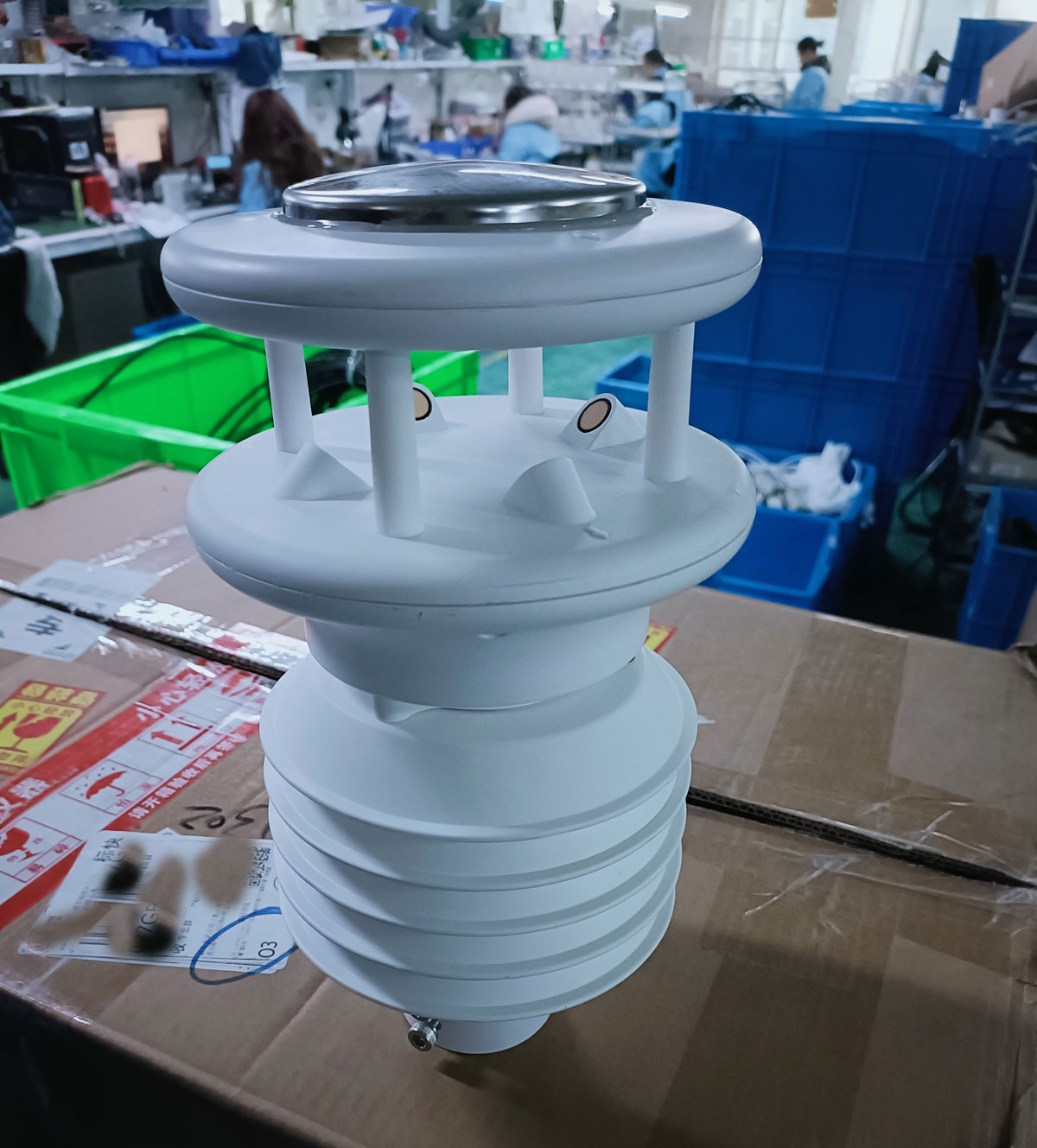
The rain-equipped configuration discussed here measures wind speed, wind direction, air temperature, relative humidity, atmospheric pressure and rainfall. It uses ultrasonic wind measurement and an impact-based piezoelectric rain sensor. Verify the actual model and options before ordering: the label six-parameter does not universally identify the same set of quantities across every product family.
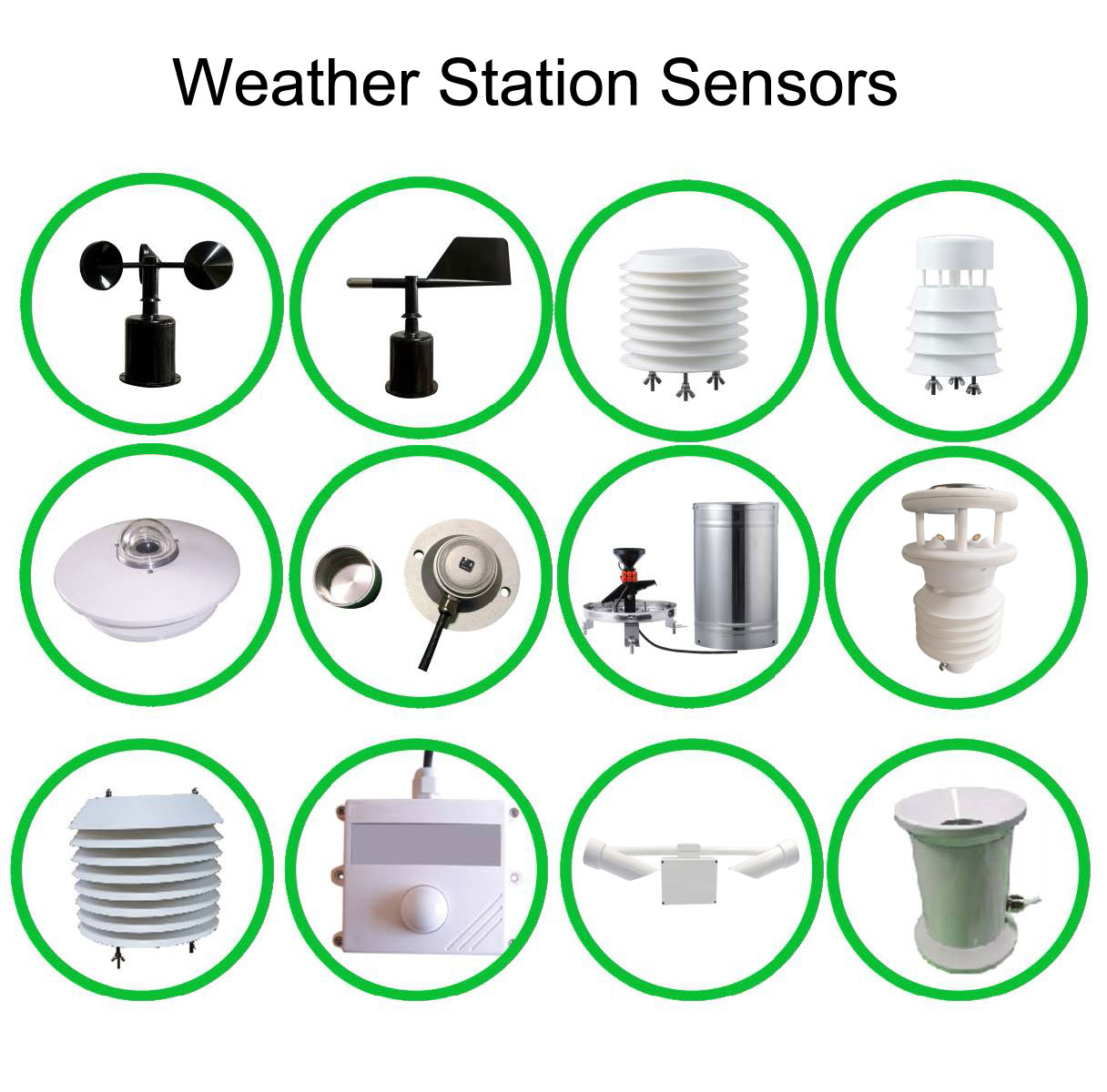
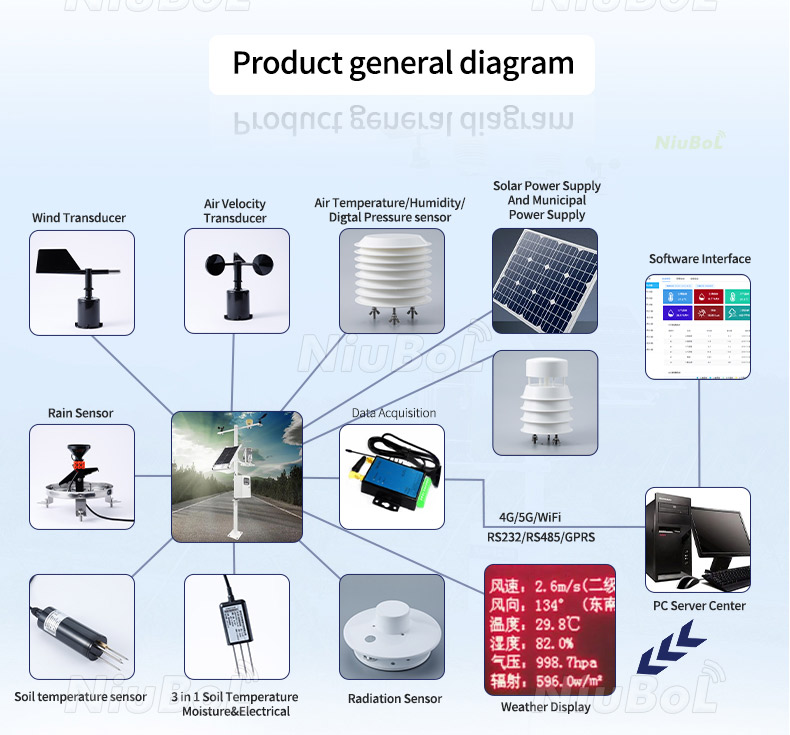
Related compact heads in the illustrations have different channel combinations. A wind-only ultrasonic instrument is not a six-channel station, and an extra illumination or particulate channel must be supported by actual hardware. Keep the quotation, instrument identity and receiving tag list consistent rather than copying a dashboard built for another head.
| 61MUWS rain configuration | Measurement information |
|---|---|
| Wind speed | 0-40 m/s; 0.01 m/s resolution |
| Wind direction | 0-359 degrees; +/-3 degrees; 1 degree resolution |
| Air temperature | -40 to +80 C measuring range; +/-0.5 C |
| Relative humidity | 0-100% RH measuring range; +/-5% RH |
| Pressure | 10-1,100 hPa; +/-1.5 hPa |
| Rainfall | 0-8 mm/min; +/-10% accuracy; 0.01 mm resolution |
| Supply and interface | 12-24 V DC; RS485 Modbus; 9600 bps |
| Construction | IP65; standard 2.5 m cable |
Agree on the rainfall test conditions and offered revision rather than assuming every accuracy statement uses the same method. Wind-speed range and accuracy also differ between compact families. A 0-60 m/s value from another ultrasonic instrument should not be applied to this 0-40 m/s configuration.
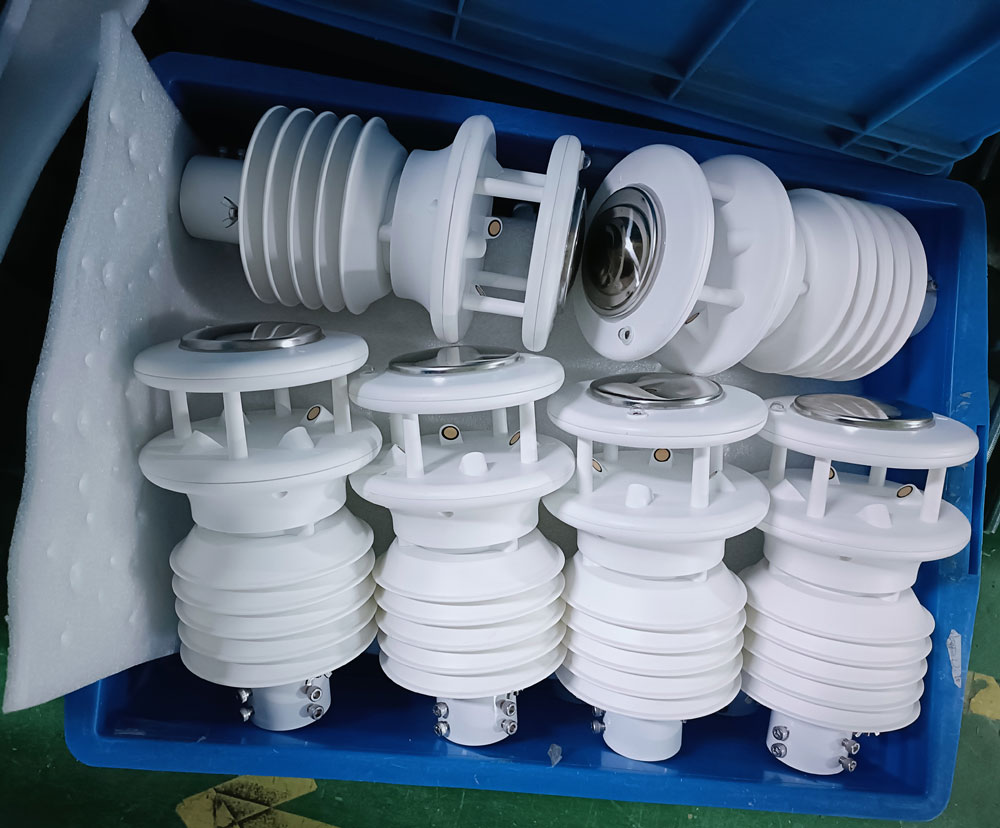
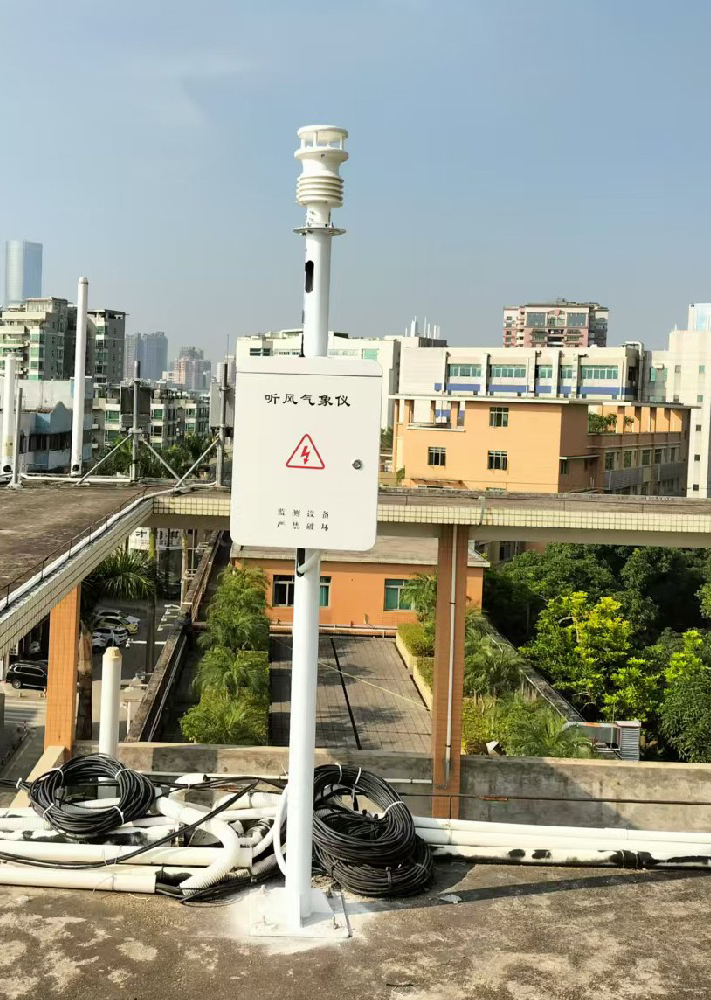
Wind measurement benefits from an appropriate unobstructed exposure. Air temperature needs protection from unwanted solar and nearby surface heating. Rainfall needs an exposure that avoids splash, runoff from structures and unsuitable airflow. A compact head reduces separate wiring and brackets but ties these functions to the same physical position.
A roof edge that gives a convenient wind mounting point can create turbulence and unusual precipitation exposure. A sheltered position convenient for servicing can obstruct wind. A long bracket may clear one obstruction while increasing vibration or making the rain surface difficult to inspect. Review the actual drawing and surroundings instead of accepting a generic pole height as correct for every channel.
A separate rain gauge allows its location and service height to be selected independently of the wind head. It also adds cable, an acquisition input and another installation to maintain. That is a real trade-off, not evidence that either compact or separated instruments are always preferable.
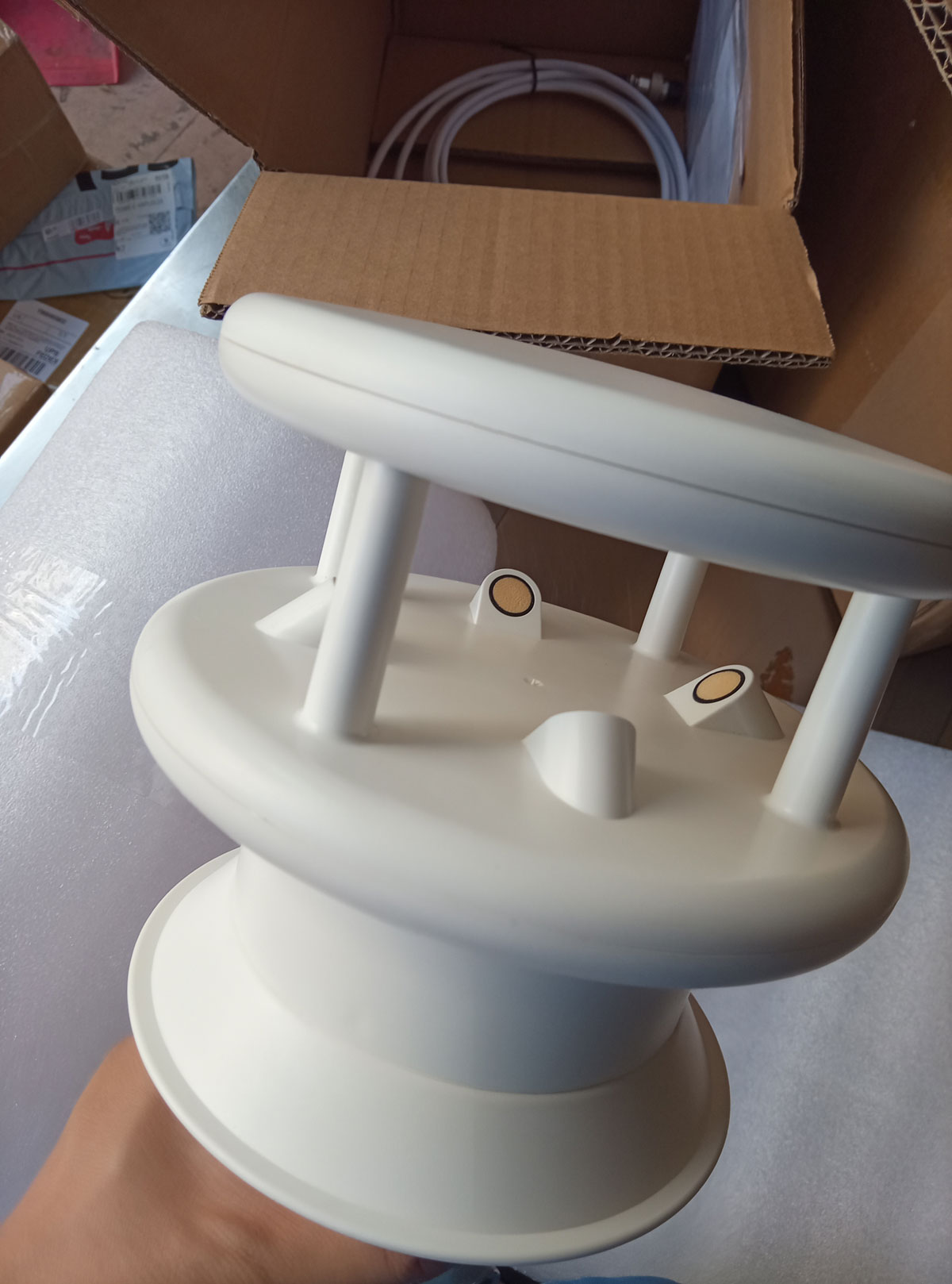
The integrated piezoelectric element estimates rainfall from drop impacts. A tipping bucket collects liquid water and registers bucket tips. Their workshop tests, exposure sensitivities and maintenance tasks are different. A 0.01 mm reported increment cannot by itself establish better field accuracy than a 0.2 mm bucket increment.
| Layout | Practical advantage | Task to retain |
|---|---|---|
| 61MUWS with integrated rain | One compact head and serial measurement interface | Inspect impact surface, mounting stability and shared exposure |
| Weather head plus NBL-W-RS tipping bucket | Independent rain location and collection-based checks | Inspect level, collector, drain and tipping mechanism |
| Weather head plus separate piezoelectric gauge | Independent impact-sensor location without a bucket mechanism | Inspect impact surface and use an appropriate verification procedure |
The NBL-W-RS tipping bucket has a nominal 0.2 mm increment and a 0-4 mm/min intensity range. Its +/-4% statement is tied to the specified indoor static test at 2 mm/min; do not compare it with another device's accuracy as though all field conditions were identical. A selected pulse version also needs a counter, unlike a serial transmitter.
Do not pour an arbitrary bottle of water onto an impact sensor and treat the result as an equivalent tipping-bucket volume test. The rain simulator or reference method needs to match the measurement mechanism. Where rainfall is critical, include a suitable field comparison and define the quantities being compared.
A compact NBL-W-61MUWS weather head can be practical when a single approved location provides suitable exposure and the project needs those six quantities. Include a logger or gateway appropriate to the required storage and remote access; the sensor head alone is not a complete network station.
Consider an independently located rain instrument when collection exposure, service access or an established rainfall comparison drives the project. The US National Weather Service rain-gauge guidance emphasizes the influence of exposure and turbulence on collection. That does not certify a particular electronic model, but explains why convenient elevated mounting is not sufficient justification for a rainfall site.
Compare the consequences of removing the compact head for service with servicing an independent rain instrument. Confirm the cold-weather capability needed for liquid or solid precipitation; a low ambient rating alone does not establish snow-water-equivalent measurement or an ice-free sensing surface. Determine whether replacement can preserve the remaining weather channels during the service period.
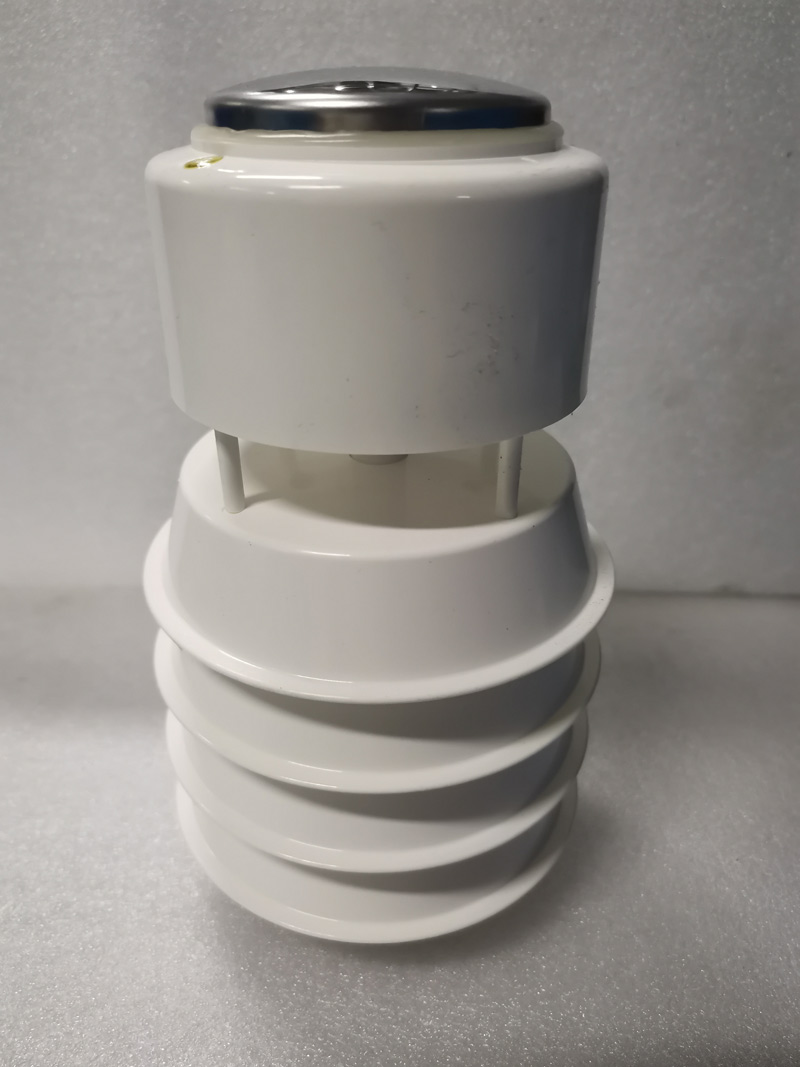
Map accumulation and intensity as different quantities. An accumulated depth in millimetres cannot be copied into an intensity tag in millimetres per minute. Confirm the rain-equipped head's actual register map, scaling, reset behavior and time basis. Six physical quantities do not necessarily occupy six consecutive registers, especially where a protocol includes reserved positions or several rain outputs.
If an application stores a true time-mean intensity of 0.5 mm/min over a complete ten-minute interval, the corresponding depth is 5 mm. An instantaneous value of 0.5 mm/min at the end of that interval does not establish that the previous ten minutes received 5 mm. A single poll cannot establish the interval accumulation.
When two rainfall instruments are present, name their locations and methods separately. Select the channel used by the receiving model or report rather than averaging them automatically. Differences can reflect exposure, time boundaries or the sensing method; retain those differences for investigation before declaring either instrument faulty.
RS485 Modbus communication connects the head to compatible acquisition equipment. Mobile transmission, historical storage and control rules require their own configured devices or software. Do not promise a particular cloud platform, disconnected-data cache or forecasting improvement from the head's serial interface alone.
Check the power and operating envelope for the exact offered revision. A 0.35 W head, for example, consumes 8.4 Wh during 24 hours of continuous operation, excluding the logger and modem. Other configurations may have a different load. Optional functions and the upstream communications equipment belong in the supply calculation.
Do not confuse a temperature measuring range with the ambient rating of the complete head. A configuration with a -40 to +80 C temperature channel can have a narrower permitted operating environment. Match the complete instrument and power equipment to the actual site temperatures before using the channel range as an installation limit.
For quotation comparison, provide the proposed measurement locations, required rainfall method, servicing access, output types and power source. Ask for compact and separated alternatives where the layout is undecided. Compare the complete logger and installation scope as well as the head price; a separate gauge may change inputs, cable routing and maintenance without changing the project's required measurements.
No. Check the exact model and channel list. The rain-equipped 61MUWS configuration has a defined set of six quantities; other compact heads can have different combinations. The order and data map must identify the actual measured quantities.
When rain exposure, maintenance access or an established measurement method needs an independent position. Include the extra acquisition input and installation work in the comparison rather than treating the gauge as a sensor-only addition.
Not by itself. Resolution, accuracy conditions and field exposure are different. Compare the actual test basis and the records needed by the project before ranking unlike instruments by their displayed increment.
Do not assume that it can. Establish the required precipitation type, measurement method and winter capability. Operating in cold air does not by itself demonstrate correct frozen-precipitation measurement.
Possibly, with the appropriate serial driver, supply and any required pulse counter or analog input. Confirm address mapping and time handling for both devices; spare terminals alone do not establish a complete integration.
Shared exposure for all six quantities, access for inspection, the exact channel map, the complete operating envelope and the required rainfall comparison. A smaller assembly is useful only if its location and records support the intended task.
Choose a 6-in-1 weather station when the selected channels can share a suitable and serviceable location. Choose an independent rain instrument when rainfall exposure or verification requires a different arrangement. For NiuBoL integration, compare the actual sensing methods, output versions and acquisition scope rather than assuming that one compact head eliminates every installation trade-off.
 All-in-One-Ultrasonic-Weather-Sensor-Instruction-Manual.pdf
NBL-W-61MUWS-Ultrasonic-Weather-Station-Instruction-Manual.pdf
Prev:High-Reliability Industrial-Grade Ultrasonic Integrated Weather Station
Next:Non-Contact Road Condition Sensor: Target Spot and RWIS Checks
Related recommendations
Sensors & Weather Stations Catalog
Agriculture Sensors and Weather Stations Catalog-NiuBoL.pdf
Weather Stations Catalog-NiuBoL.pdf
Agriculture Sensors Catalog-NiuBoL.pdf
Water Quality Sensor Catalog-NiuBoL.pdf
Related products
 Combined air temperature and relative humidity sensor
 TDR Soil Moisture & Temperature Sensor for irrigation| RS485 |4-20mA| NBL-S-THR
 Soil pH sensor RS485 soil Testing instrument soil ph meter for agriculture |NBL-S-PH
 Wind Speed sensor Output Modbus/RS485/Analog/0-5V/4-20mA
 Tipping bucket rain gauge for weather monitoring auto rainfall sensor RS485/Outdoor/stainless steel
 Pyranometer Solar Radiation Sensor 4-20mA/RS485


Screenshot, WhatsApp to identify the QR code
WhatsApp number:+8615367865107
(Click on WhatsApp to copy and add friends)

