





— Blogs —
—Products—
 Consumer hotline +8618073152920
WhatsApp:+8615367865107
Address:Room 102, District D, Houhu Industrial Park, Yuelu District, Changsha City, Hunan Province, China
Product knowledge
Time:2026-02-23 11:06:02 Popularity:911
Quick Answer: A multi-parameter water quality analyzer combines several measurements in one instrument or monitoring system, but the phrase does not specify the analytical methods. An immersed digital probe assembly, a reagent-based laboratory instrument and an automatic wet-chemistry station are different products. Select the required measurands and sample conditions first, then confirm the NiuBoL configuration, receiving equipment and service requirements. A long parameter list is not proof that every result is measured directly or simultaneously.
A project may need oxygen and pH trends for a pond, turbidity and conductivity at an intake, or nutrient results for a wastewater investigation. These tasks require different methods and levels of sample handling. The instrument should be chosen around the decision value, not around the largest advertised number of parameters.
Write the quantity and reporting basis next to each requested channel. Ammonium, ammonia expressed as nitrogen and total nitrogen are not interchangeable. Orthophosphate is not automatically total phosphorus. A UV-derived organic measurement may be an equivalent concentration referenced to a calibration compound rather than the same measurement performed by a digestion method.
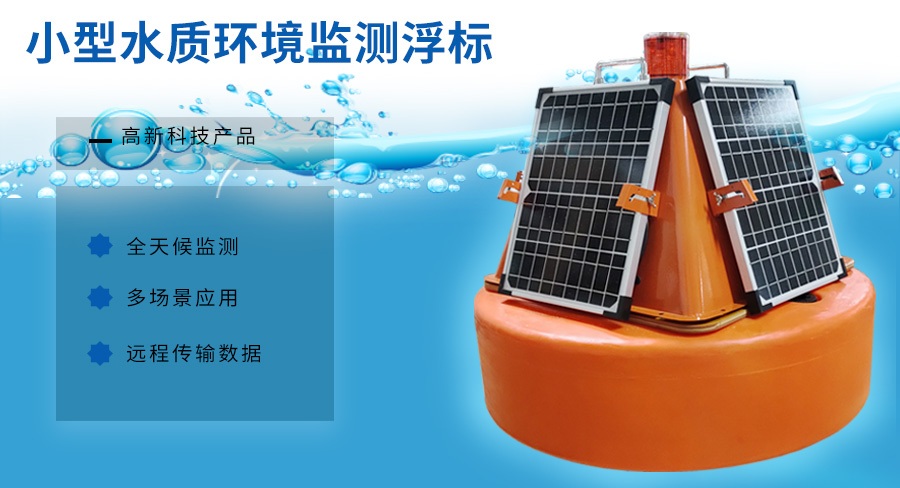
A floating platform, such as the example shown here, carries instruments and a data connection. It does not turn one chemical method into another. Likewise, an Android display, where fitted to a particular instrument, describes its operating interface rather than the validity of the analytical result.
| Instrument arrangement | Useful task | What must be checked |
|---|---|---|
| Immersed digital multi-parameter assembly | Repeated observations directly in the water | Fitted probes, sample exposure, fouling and channel-specific calibration |
| Portable or laboratory reagent instrument | Measurements on prepared samples during a visit or laboratory session | Reagents, reaction conditions, blanks and method-specific timing |
| Automatic wet-chemistry analyzer | Scheduled chemical analyses with controlled sample preparation | Digestion where required, reagents, waste handling and cycle time |
| Monitoring station combining instruments | Related measurements collected into one record | Different acquisition times, units, status and data interfaces |
An in-situ assembly observes water at its sensing surfaces. A chamber or pumped system observes the water delivered to it. That distinction matters when oxygen, temperature, suspended particles or dissolved gases change during transport. Establish which location and water layer the result should describe.
For aquaculture monitoring, compare circulation and depth rather than assuming a surface point represents every stocked layer. For an industrial intake or discharge, check mixing and changes through the operating cycle. A convenient sampling point can miss a short batch event or observe a stagnant side pocket.
Specify any filtration or conditioning by measurement method. Removing particles can protect an instrument but also change a total or particulate-related result. Do not label a filtered sample result as the original unfiltered total merely because the instrument still displays the same parameter name.
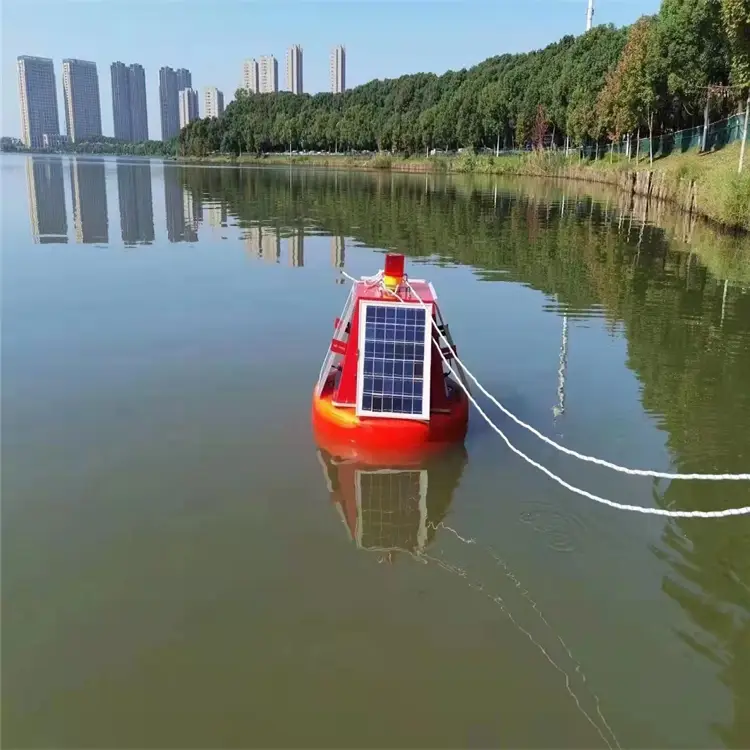
The NBL-WQ-MPS-5A and NBL-WQ-MPS-5B are immersed digital assemblies with mechanical cleaning arrangements. They are not universal reagent instruments with a fixed five-to-fifteen-minute analysis cycle. Their optional channels and assembly specifications differ, so a quotation should identify the actual model and installed sensing elements.
| Item | NBL-WQ-MPS-5A | NBL-WQ-MPS-5B |
|---|---|---|
| Reported quantities | Up to eight including temperature, according to selected channels | Up to six including temperature, according to selected channels |
| Typical selectable measurements | DO, COD, pH, ORP, EC/salinity, ammonium, turbidity and temperature | DO, EC/salinity, turbidity, pH, ORP and temperature |
| pH and ORP | 0-14 pH, +/-0.1 pH; -1500 to +1500 mV, +/-6 mV | 0-14 pH, +/-0.1 pH; -1500 to +1500 mV, +/-6 mV |
| Temperature channel | 0-50 degrees C, +/-0.3 degrees C | 0-50 degrees C, +/-0.3 degrees C |
| Supply and consumption | 12 VDC +/-5%; 5 W at 12 V | 12 VDC; 2 W at 12 V |
| Output | RS485 Modbus RTU | RS485 Modbus RTU |
| Assembly exposure | Confirm complete assembly limits for the ordered probes | 0-50 degrees C, pressure at most 0.2 MPa; IP68; POM and 316L construction |
| Cable | Standard 5 m; four-core twisted-pair shielded construction | Four-core twisted-pair shielded construction; confirm ordered length |
A reported-parameter count is not necessarily the number of independent physical probes. Conductivity and a derived salinity result can be related outputs, and an optical module can report more than one value. Ask which sensing method generates each requested result and whether any outputs share the same underlying signal.
The 5A's 12 VDC +/-5% input corresponds to 11.4-12.6 V. Do not connect it directly to a 24 V supply simply because other individual water-quality probes accept 12-24 V. The protective enclosure, power conversion and complete load belong in the installation design.
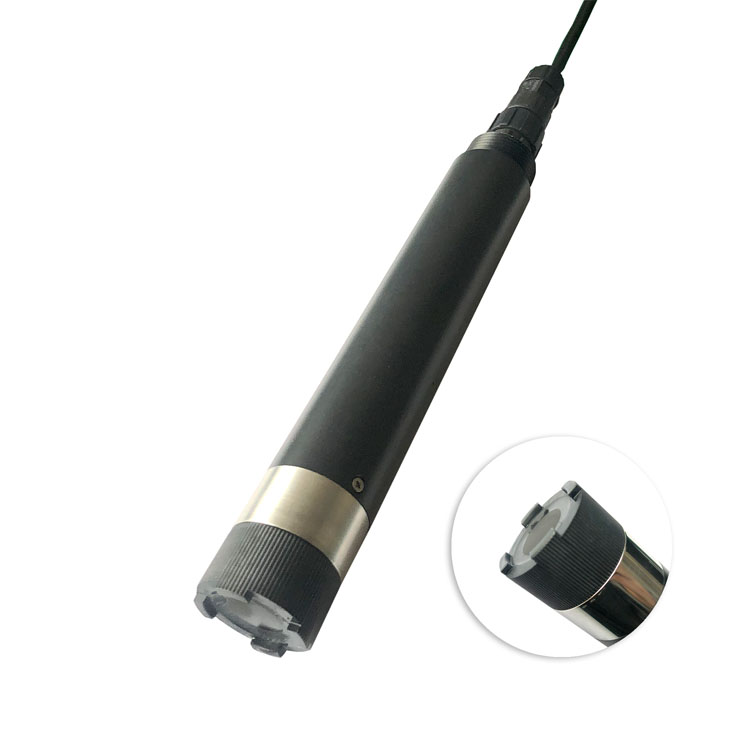
The MPS configurations offer an optical dissolved-oxygen channel with a 0-20 mg/L range and 0.01 mg/L resolution. The stated percentage accuracy and its basis must be confirmed for the fitted channel. Do not replace that specification with an assumed +/-0.1 mg/L figure or copy the error definition from a different standalone probe.
A temperature channel helps interpret oxygen, but compensation settings and exposure still matter. The oxygen cap must remain in representative water with its sensing surface clear of sediment and deposits. Fluorescence measurement avoids oxygen consumption by the measurement principle; it does not make an obscured sensing surface reliable.
For turbidity, the MPS-5B options include 0-20 NTU, 0-200 NTU and 0-1000 NTU versions. The 0-20 NTU option lists +/-3% or +/-1.5 NTU, whichever is greater, with 0.01 NTU resolution. The display increment is therefore not evidence of 0.01 NTU measurement accuracy. Select the range and uncertainty needed near the actual alarm or comparison point.
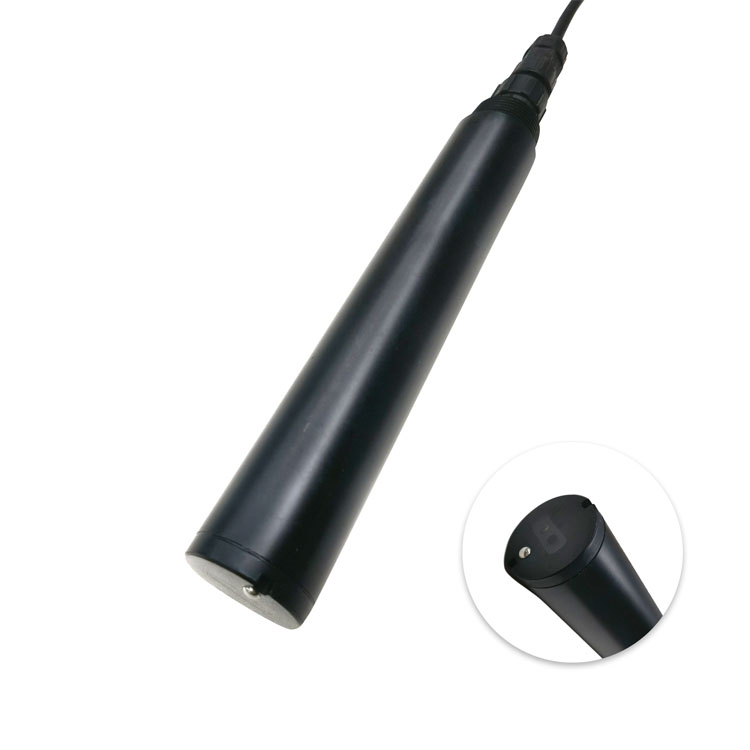
Turbidity describes an optical scattering response. It is not directly a mass concentration of suspended solids or an identification of the particles. A relationship with solids mass requires suitable paired samples and validation for the water, and that relationship can change when particle composition changes.
A transparency instrument measures a different optical property. It should not be treated as a second interchangeable turbidity sensor, nor as a direct substitute for an agreed visual transparency method without a defined relationship. Identify the quantity and units before combining the records in a dashboard.
The MPS-5A COD options include ranges expressed as equivalent KHP concentration. Optical response can support trending after suitable validation, but color, particles and changing organic composition can affect the relationship to a reference COD method. An automatic cleaning brush addresses some surface contamination, not every spectral interference.
Where results will support a contractual or regulated reporting task, establish the accepted analytical method and verification requirements with the responsible parties. A multi-parameter label or a calibration certificate does not automatically authorize every channel for every official reporting purpose.
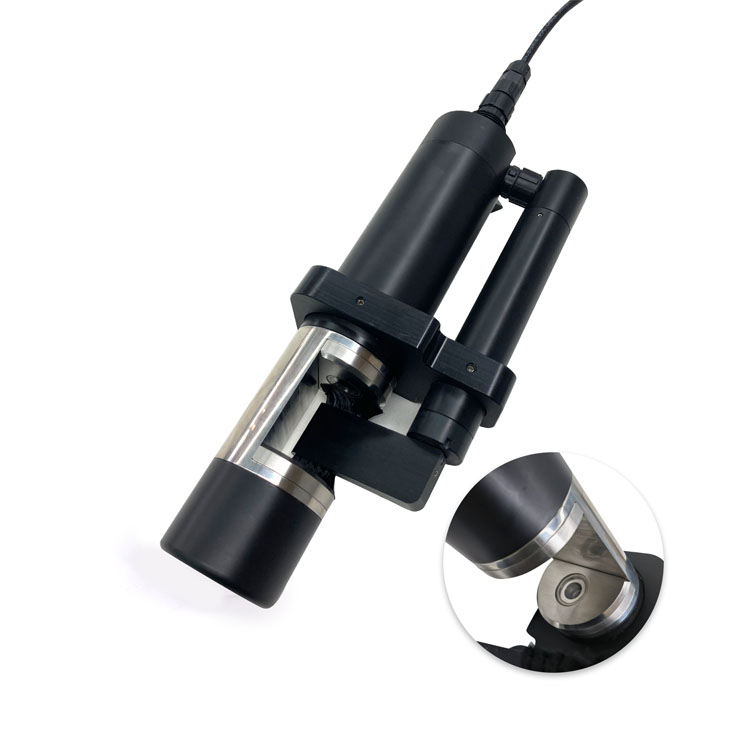
An intake or treated-water project may require residual chlorine, while a pond or river project may prioritize different measurements. Specify the particular oxidant quantity and method rather than treating a chlorine probe as a general indicator of water safety. The illustrated residual-chlorine sensor is a separate channel option, not a standard function of every MPS assembly.
Likewise, nitrite, alkalinity, hydrogen sulfide, total phosphorus and total nitrogen should not be added to a standard configuration by name alone. Each needs a suitable method, sample requirement and integration arrangement. Confirm whether the measurement is provided by an additional probe, a separate chemical analyzer or a laboratory test.
Parameter choices can affect mounting space, cleaning access, supply demand and acquisition time. Expand around a specific decision rather than adding values that the project cannot verify or use. There is no mandatory six- or eight-channel package that suits every aquaculture or wastewater project.
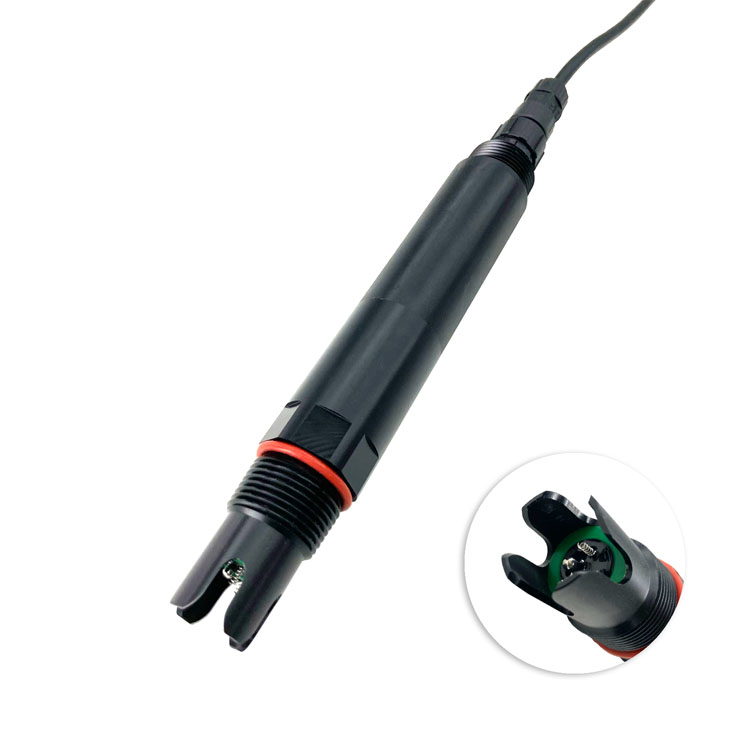
The digital assemblies provide RS485 Modbus RTU. They still need a compatible PLC, RTU, data logger or gateway for acquisition and any remote communication. Cellular transmission, MQTT, HTTP and application storage belong to the selected receiving equipment and software, not automatically to the immersed probe.
Confirm the address map and data representation for the delivered assembly. Preserve units and distinguish unavailable, out-of-range, maintenance and valid results where the configuration supports those states. A missing channel must not be converted into zero merely to keep a fixed-length application record.
Wiring is model-specific. In the configurations compared here, the MPS-5A uses blue for RS485 A and white for B; the MPS-5B uses blue for A and brown for B. Both use red for power positive and black for return. Keep the cable and connector identification with the corresponding assembly instead of assuming every four-core sensor lead is interchangeable.
A common timestamp does not prove that all methods observed the sample at the same moment. A reagent cycle can represent a different acquisition period from a direct sensor value. The receiving application should retain the measurement time and status supplied or established by the acquisition process.
Mechanical cleaning reduces some surface fouling but needs an unobstructed path and compatible fitted probes. Check the brush, guard, optical windows and electrode access during service. A brush that reaches one surface may not clean a reference junction or a sampling line.
Use appropriate standards for each channel. A pH buffer does not calibrate turbidity or ammonium, and one successful reference check does not validate the entire assembly. Retain pre-service readings when practical so cleaning effects can be distinguished from later calibration changes.
For a NiuBoL multi-parameter monitoring inquiry, provide the required quantities, reporting basis, expected ranges and sample conditions. Include the receiving system, intended acquisition interval, mounting position and service access. Request an itemized sensor and method list so an immersed probe proposal is not compared as though it includes automatic nutrient digestion or a complete sample-preparation station.
The ammonium electrode illustrated below can support its specified measurement when the water and required decision level suit it. It does not make the assembly a total-nitrogen analyzer. Confirm the selected ammonium range and error basis independently from the other channels.
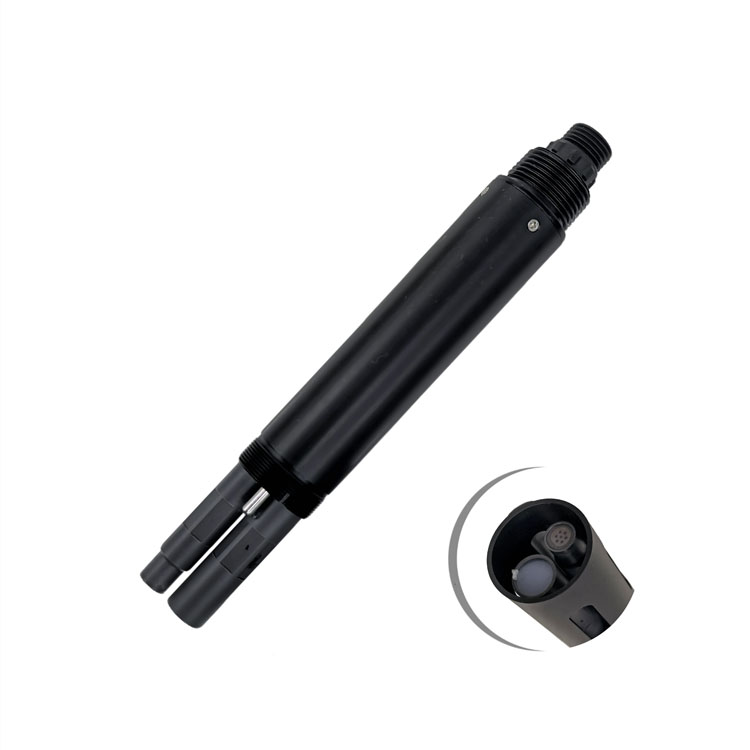
No. The system may combine different probes or chemical methods, and some reported values may share an underlying signal. Request the method, units and limitations for each result instead of relying on the parameter count.
No. They are different configurations with different selectable channels and assembly specifications. The 5A supports up to eight reported quantities including temperature; the 5B supports up to six. Confirm the fitted measurements and electrical requirements for the actual order.
The immersed assemblies discussed here provide RS485 Modbus RTU. Remote transmission requires a compatible acquisition and communication device. Confirm the gateway's payload, authentication and storage behavior separately from the probe connection.
No. It can protect some instruments while removing particles relevant to other measurements. Define conditioning by the analytical method and target quantity, and retain whether the result refers to filtered or unfiltered water.
No. Inspect the cleaning mechanism, sensing surfaces, connectors and guard, and perform channel-specific verification. Set the interval from local fouling and observed drift rather than a universal weekly or monthly promise.
Not without a valid method that accounts for the other relevant forms. Individual dissolved species do not establish total nitrogen or total phosphorus. Specify the total method and sample preparation when those results are required.
Resolution describes the displayed increment, not total uncertainty, selectivity or detection capability. For example, the MPS-5B 0-20 NTU option lists an absolute error term much larger than its 0.01 NTU increment. Compare the error specification with the decision level.
Demonstrate the ordered channels in representative water, suitable reference checks, complete receiving-system interpretation and the service procedure. Include interferents and the relevant concentration region. A readable screen with all fields populated is not enough.
A multi-parameter water quality analyzer is useful when each measurement is defined and verified. Distinguish immersed probes from reagent methods, keep NiuBoL model specifications separate and select channels around the sample and decision. The resulting system is easier to integrate and maintain because its parameter list describes actual measurements rather than assumed capabilities.
 NBL-RDO-206 Online Fluorescence Dissolved Oxygen Sensor.pdf
NBL-COD-208 Online COD Water Quality Sensor.pdf
NBL-CL-206 Water Quality Sensor Online Residual Chlorine Sensor.pdf
Prev:Flow and Water Quality Sensor Integration: Match Location and Sampling Time
Next:Solar Insect Killer Lamp Coverage: Plan Around Crop Blocks and Canopy
Related recommendations
Sensors & Weather Stations Catalog
Agriculture Sensors and Weather Stations Catalog-NiuBoL.pdf
Weather Stations Catalog-NiuBoL.pdf
Agriculture Sensors Catalog-NiuBoL.pdf
Water Quality Sensor Catalog-NiuBoL.pdf
Related products
 Combined air temperature and relative humidity sensor
 TDR Soil Moisture & Temperature Sensor for irrigation| RS485 |4-20mA| NBL-S-THR
 Soil pH sensor RS485 soil Testing instrument soil ph meter for agriculture |NBL-S-PH
 Wind Speed sensor Output Modbus/RS485/Analog/0-5V/4-20mA
 Tipping bucket rain gauge for weather monitoring auto rainfall sensor RS485/Outdoor/stainless steel
 Pyranometer Solar Radiation Sensor 4-20mA/RS485


Screenshot, WhatsApp to identify the QR code
WhatsApp number:+8615367865107
(Click on WhatsApp to copy and add friends)

