







Before ordering a drum of COD reagent, check the instrument nameplate. An optical immersion probe and a wet-chemical analyzer may both display COD, but only one carries out a reagent-based analytical reaction. A consumables plan built for the wrong method can order unnecessary chemicals while omitting the cleaning and verification work the installed instrument actually needs.
Does this COD sensor consume reaction reagents?
The NiuBoL NBL-WQ-COD probe uses dual-wavelength UV absorption: a 254 nm measurement channel and a reference channel for turbidity-related compensation. Its measurement does not dose digestion reagent. The product information also identifies a cleaning brush and RS485 Modbus RTU output.

The NBL-WQ-COD is an optical sensing component, not a wet-chemical digestion analyzer or a complete sampling cabinet.
Its COD-equivalent output depends on an optical relationship with the water; it does not measure oxidant consumption in a digestion reaction. Calibration solutions, approved cleaning materials and reference testing can still be needed. Therefore, no reaction reagent is not the same as no liquids, no consumables or no service visits.
A chemical COD analyzer has a different service scope. EPA Method 410.4, for example, uses dichromate digestion followed by colorimetric measurement and identifies chloride interference. It is an example of a defined chemical procedure, not a claim that every online analyzer implements that method. The COD analyzer methods guide covers that distinction; the task below is planning the work after the instrument type has been confirmed.
Build the service list by component, not by the word COD
Ask the supplier to mark each item as included, optional, site-supplied or not applicable. This makes two quotations comparable without inventing a standard monthly reagent volume or a universal service interval.
| Service item | Optical UV probe | Wet-chemical analyzer |
|---|---|---|
| Reaction reagents | Not consumed for direct UV measurement | Identify each reagent, dose and applicable analysis cycle |
| Check or calibration solutions | Confirm compatible solutions, quantities and handling | Follow the selected method and instrument procedure |
| Cleaning materials | Match windows, housing and any brush to the approved procedure | Confirm sample-path and reaction-path cleaning separately |
| Wear and service parts | Identify brush, seals and factory-service arrangements where applicable | Identify pumps, tubing, valves and other fitted components |
| Sample delivery | Include only if the installation has a bypass or sampling assembly | Confirm the actual installed sampling arrangement |
| Waste handling | Assess cleaning and check-solution waste | Assess spent reagents, reacted samples and cleaning waste |
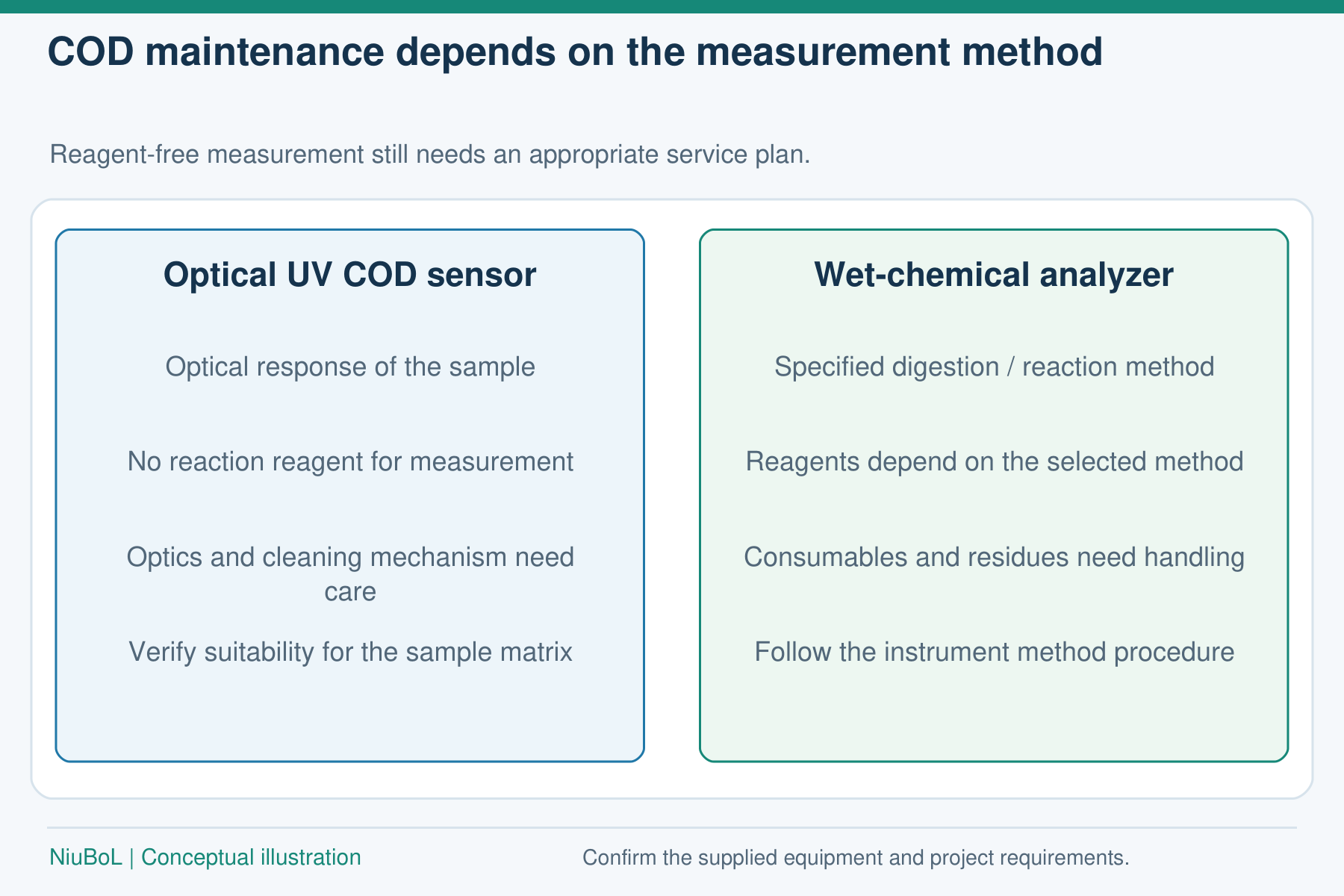
Method comparison only. A reagent-free optical probe is not a wet-chemical digestion analyzer; match maintenance and verification to the selected instrument.
For a chemical instrument, request consumption for each bottle separately. Different bottles can have different doses, capacities and expiry dates; adding their volumes together does not establish when any one bottle runs out. Include calibrations, blanks, retries, priming and cleaning where the actual procedure consumes them. Do not transfer that calculation to an optical probe.
For the optical installation, identify who supplies check solutions and who performs the verification. Confirm lead time and compatibility before buying a replacement brush or seal. A photograph of a similar-looking sensor is not a service-part identifier.
Make cleaning visits measurable
A self-cleaning brush reduces some deposition; it does not prove that every deposit has been removed or that the optical relationship remains valid. Establish an initial inspection plan with the supplier and adjust it from the actual window condition and verification history. Avoid promising a fixed number of unattended months before the water has been evaluated.
At each visit, retain a short record:
- Save the as-found reading, timestamp, maintenance state and visible condition.
- Inspect the optical region and brush without opening the sealed body.
- Clean only with the supplied procedure and compatible materials.
- Recheck under comparable conditions, recording any change and relevant check-solution result.
- Record the action, remaining concern and next inspection trigger.
Distinguish three outcomes. A changed result after cleaning can indicate fouling. Failure in an appropriate check solution can indicate an instrument or calibration problem. Acceptable check-solution response with poor performance on changed wastewater can indicate that the optical relationship needs reassessment. Repeating calibration is not a substitute for identifying which problem occurred.
Schedule the work around safe retrieval and operational needs. Name who can remove the probe, how the monitoring gap is marked, and what observation or reference result is used during the visit. A low-cost spare is useful only if its range, interface and site qualification are suitable for the same duty.
Keep brush servicing separate from routine window checks
The base NBL-WQ-COD product guidance recommends factory inspection and maintenance of the self-cleaning brush after 18 months, with frequency adjusted to actual use. Treat that as a manufacturer service recommendation for that configuration, not a guarantee of 18 months without inspection, cleaning or verification.
Ask for the current service procedure, expected turnaround and quotation before the visit becomes urgent. Confirm whether on-site replacement is permitted or factory service is required. Keep the instrument serial number and supplied revision with the service record so instructions for another COD variant are not applied accidentally.
The practical budget has separate lines for operator inspections, approved consumables, planned service and any replacement instrument needed during downtime. No universal price or annual parts allowance can be calculated from the term COD sensor alone.
Do not let sample-path maintenance disappear from the budget
Direct immersion introduces no sample line of its own. A bypass installation, however, adds its own pump, tubing, chamber and water-path responsibilities. The reagent-free COD installation guide addresses the choice of arrangement; include only the components actually installed in the maintenance scope.
If old water remains after a source change, inspect the path before changing a calibration coefficient. Sample-line deposits and stagnant branches are not repaired by wiping the probe window. Require the integrator to demonstrate representative sample replacement under the installed conditions, rather than specifying a universal three-volume rinse.
Do not import a chemical analyzer's chloride masking limit into an optical probe's acceptance criteria. Equally, turbidity compensation does not guarantee reliable COD estimates for every particle or color change. Extra flushing cannot fix an unsuitable optical relationship. Record water-composition changes and agree when a new suitability check is required.
Questions to settle before accepting a maintenance quotation
Q1. How much reaction reagent does the NBL-WQ-COD consume each month?
None for its direct UV measurement. Budget calibration or check solutions, cleaning, servicing and verification separately rather than assigning a wet-chemistry reagent dose to the probe.
Q2. Does reagent-free mean the probe is maintenance-free?
No. Inspect accessible optics and the cleaning mechanism, retain verification evidence and follow the current service instructions. The work depends on the water and installation.
Q3. Can the same reagent volume be used for every chemical COD analyzer?
No. Obtain bottle-specific consumption and the complete operating sequence for the exact analyzer. Analysis frequency alone cannot establish use if quality-control and cleaning cycles are omitted.
Q4. Should I replace the brush whenever a COD value looks wrong?
Not without investigation. Check the as-found condition, mechanism operation, suitable reference response and wastewater relationship. A new brush cannot correct the wrong method or an unrepresentative sample.
Q5. Does a fixed flush volume prove that carryover is controlled?
No. Geometry, flow, stagnant regions and deposits affect sample replacement. Demonstrate the installed path's performance and keep its maintenance separate from probe cleaning.
Q6. What information makes a service quotation useful?
Provide the exact model or nameplate photo, water and installation conditions, and the maintenance problem or intended service period. Ask which parts, service work and downtime arrangements are included.
Summary: budget the installed method and its upkeep
A UV COD probe removes reaction-reagent dosing from the measurement, not every operating task. A useful maintenance scope identifies the actual optics, cleaning mechanism, sample path, verification work and service responsibility. Keep chemical-analyzer consumables separate so the purchasing list addresses the equipment on site rather than a generic COD label.
Ask NiuBoL about your COD monitoring components using a model or nameplate photo, a brief description of the water and your maintenance goal. We can help check suitable optical sensor and acquisition-interface options and quote the confirmed probe or service scope; a complete wet-chemical analyzer package is a separate requirement to establish.









