





— Blogs —
—Products—
 Consumer hotline +8618073152920
WhatsApp:+8615367865107
Address:Room 102, District D, Houhu Industrial Park, Yuelu District, Changsha City, Hunan Province, China
Product knowledge
Time:2026-08-03 09:36:41 Popularity:230
Quick Answer: Install a reagent-free online COD sensor by direct immersion when the selected probe can remain in representative water and be retrieved safely. Consider a sample bypass when access or hydraulic conditions make immersion impractical, but verify sample transport, flow, pressure and the proposed chamber. A bypass changes the measurement point and adds equipment; it is not automatically a better measurement.
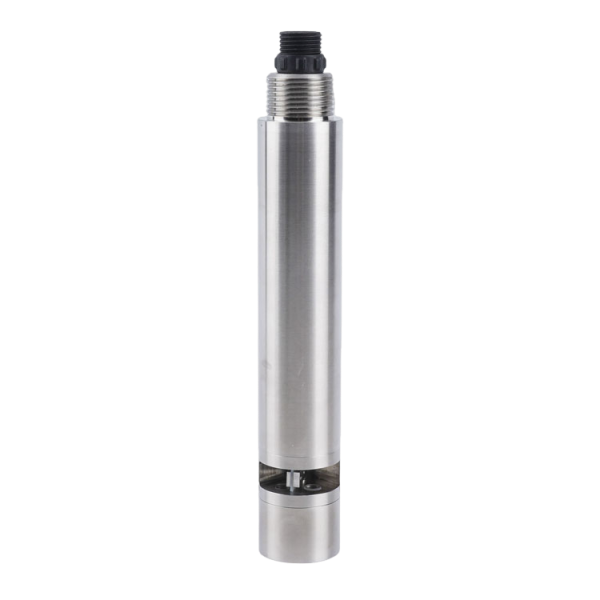
An optical COD trend can be useful between laboratory samples, especially for investigating influent fluctuation or an outlet change. Its value depends on which water reaches the optical window. A convenient mounting position in a stagnant corner may give a consistent record of the wrong part of the process.
Mark the intended process boundary: before or after equalization, treatment, mixing or discharge. Identify normal and minimum water levels, bubbles, floating material, sediment and safe retrieval access. For laboratory comparison, define where a representative sample will be collected.
For measurement-method suitability and representative-water validation, use the UV COD sensor selection guide. Once that question is resolved, installation must preserve the water and timing on which the intended comparison depends.
Immersion avoids a pump and sample line when a suitable open tank or channel is available. It leaves the instrument exposed to the local flow, level changes and deposits. Provide mechanical support, cable strain relief and an accessible retrieval arrangement; do not use the cable as the lifting member.
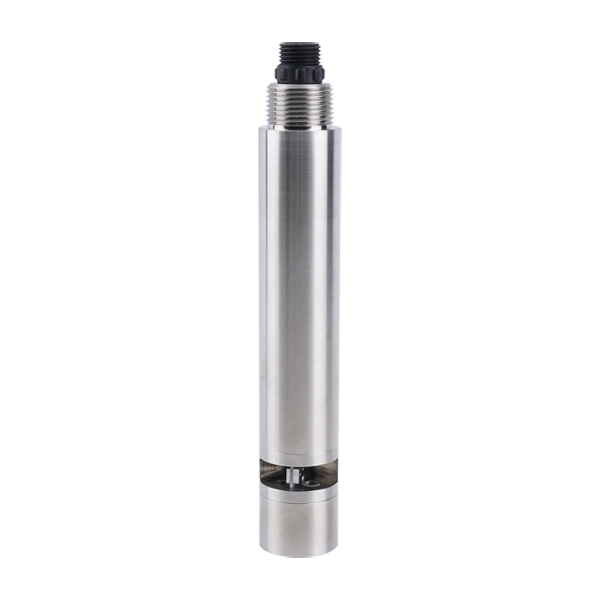
The opening photograph shows the NiuBoL base COD probe. The separate COD-408-S below has its own mounting instructions: horizontal orientation with the measurement region facing flow, at least 30 cm below the minimum water level and no more than 2 m installation depth. Do not assign those dimensions to every optical instrument.
| Installation-relevant item | Base COD probe | COD-408-S |
|---|---|---|
| COD range | 0-200 or 0-500 mg/L equivalent KHP | 0-200, 0-500 or 0-1500 mg/L by configuration |
| COD accuracy | +/-5% F.S. | +/-10% of reading for 0-1000 mg/L; +/-5% for 1000-1500 mg/L; confirm transition conditions |
| Working water limits | 0-45 degrees C; pressure below 0.1 MPa | Confirm ordered temperature and pressure limits; installation depth guidance is not a chamber pressure rating |
| Supply; consumption | 12-24 VDC; stated 0.3 W at 12 V | 12-24 VDC; operating 0.4 W, cleaning 2 W |
| Signal | RS485 Modbus RTU | RS485 Modbus RTU; optional 4-20 mA |
| Construction; protection | 316L; IP68; immersion | 316L; IP68; 3/4 NPT immersion assembly |
| Cable | Standard 5 m shielded; custom length available | Standard 5 m shielded; custom length available |
Specify the cable jacket, sealed junctions and cleaning access for the actual water. IP68 does not authorize an unverified pressurized flow cell, nor does a thread define the complete mechanical assembly.
A side stream can bring water to an accessible instrument location. Before selecting it, identify the takeoff, sample pump if needed, line volume, chamber, flow indication, isolation and safe return or disposal. Confirm that the sensor is approved for the proposed chamber and exposure rather than assuming any immersion probe can be screwed into a pipe.
Keep the sample representative. Settling in a long line, a strainer that removes the fraction of interest, air entrainment or a changing takeoff can alter the comparison. If filtration is necessary, document it and establish what fraction the online estimate and laboratory sample describe. A cleaner window is not sufficient reason to change the sample silently.
| Arrangement | Useful condition | Unresolved risk to test |
|---|---|---|
| Direct immersion | Representative open water with safe retrieval | Level loss, local bubbles, fouling or mechanical impact |
| Accessible bypass | A validated sample can be delivered to a suitable chamber | Transport delay, settling, pump failure and added maintenance |
| Existing sample cabinet | Available flow path and instrument fit are confirmed | Pressure, incompatible conditioning and insufficient space for cleaning |
For a filled line, nominal displacement time is line volume divided by sample flow. As an illustrative calculation, 1.5 L at 3 L/min gives 0.5 minutes, or 30 seconds, before chamber mixing and instrument response are considered. This is not a NiuBoL flow requirement or a measured site response.
Record the actual sample flow and account for line and chamber residence time when pairing observations. After a flow interruption, a current timestamp at the logger does not make the water in a stagnant chamber current. Define how loss of representative sample is identified and how the affected record is marked.
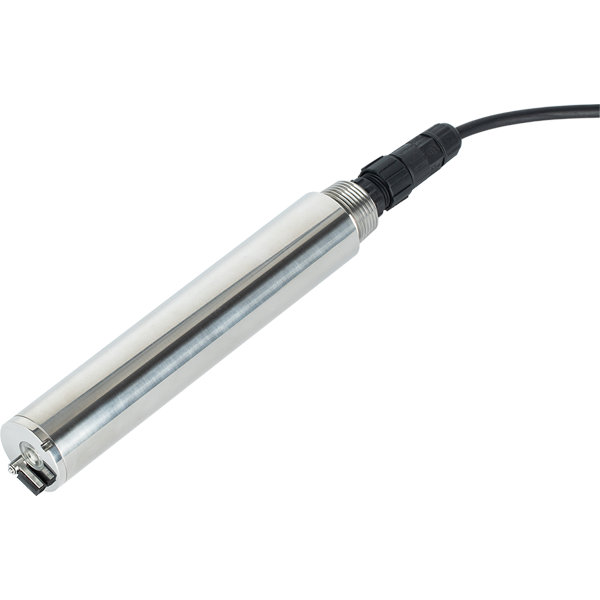
A separate BOD instrument, shown below, estimates another quantity. It cannot establish that the COD bypass has delivered an unchanged sample or compensate for a blocked line.

Automatic wiping addresses deposits at the optical region, not a settled sample line or every matrix effect. Include retrieval, window inspection and any pump or chamber service in the maintenance scope. A separate turbidity channel can help investigate solids events but does not prove that optical COD matches the required laboratory method.
No. Better access can help maintenance, but transport, conditioning and chamber behavior can change the sample. Validate the whole arrangement at the intended process point.
No. Confirm the exact probe and complete chamber assembly's permitted operating conditions. Ingress protection and pressure suitability answer different questions.
Only after evaluating what it removes and how that affects the monitoring task. Document sample conditioning and compare the same relevant fraction with the reference method.
Provide NiuBoL the takeoff and return arrangement, expected flow, pressure, temperature, sample-line volume, chamber concept and access restrictions. Separate probe supply from the pump, chamber and site pipework.
Check sample availability independently of the numerical reading. The receiver should identify the affected interval and follow the approved process response rather than treating stagnant water as a fresh observation.
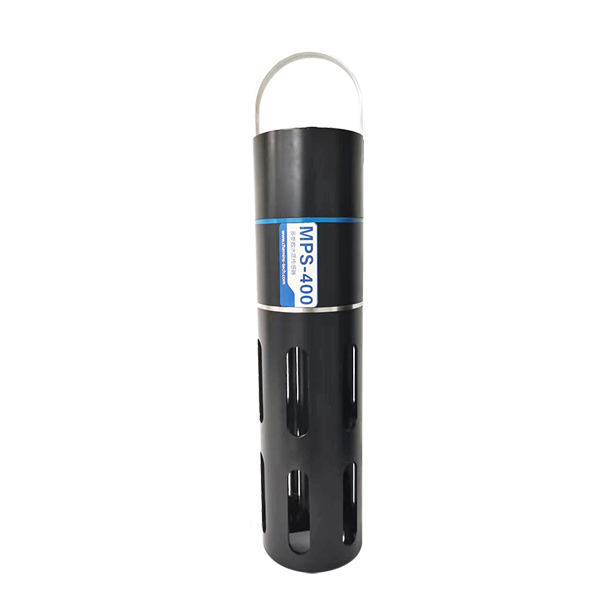
A reagent-free online COD sensor needs a representative, maintainable water path. Choose immersion or a verified bypass according to access and hydraulics, then test timing, sample condition and loss-of-sample behavior. A multiparameter package still requires each installed channel and its mounting arrangement to be confirmed.
Prev:Dissolved Oxygen Sensor Placement: Commissioning Before Automatic Aeration
Next:Online BOD Sensor: Keeping Wastewater Trends Valid After Process Changes
Related recommendations
Sensors & Weather Stations Catalog
 Agriculture Sensors and Weather Stations Catalog-NiuBoL.pdf
Weather Stations Catalog-NiuBoL.pdf
Agriculture Sensors Catalog-NiuBoL.pdf
Water Quality Sensor Catalog-NiuBoL.pdf
Related products
 Combined air temperature and relative humidity sensor
 TDR Soil Moisture & Temperature Sensor for irrigation| RS485 |4-20mA| NBL-S-THR
 Soil pH sensor RS485 soil Testing instrument soil ph meter for agriculture |NBL-S-PH
 Wind Speed sensor Output Modbus/RS485/Analog/0-5V/4-20mA
 Tipping bucket rain gauge for weather monitoring auto rainfall sensor RS485/Outdoor/stainless steel
 Pyranometer Solar Radiation Sensor 4-20mA/RS485


Screenshot, WhatsApp to identify the QR code
WhatsApp number:+8615367865107
(Click on WhatsApp to copy and add friends)

