







A rising fertigation filter pressure drop can justify cleaning, but only after checking the flow and valve arrangement. A different irrigation zone, a changed pump setting or a blocked pressure tap can change the reading without proving that the filter has collected more solids. Start with a clean-filter baseline at a known operating condition, then use the filter manufacturer's cleaning limits and the site's delivery requirements.
Establish a baseline that survives a zone change
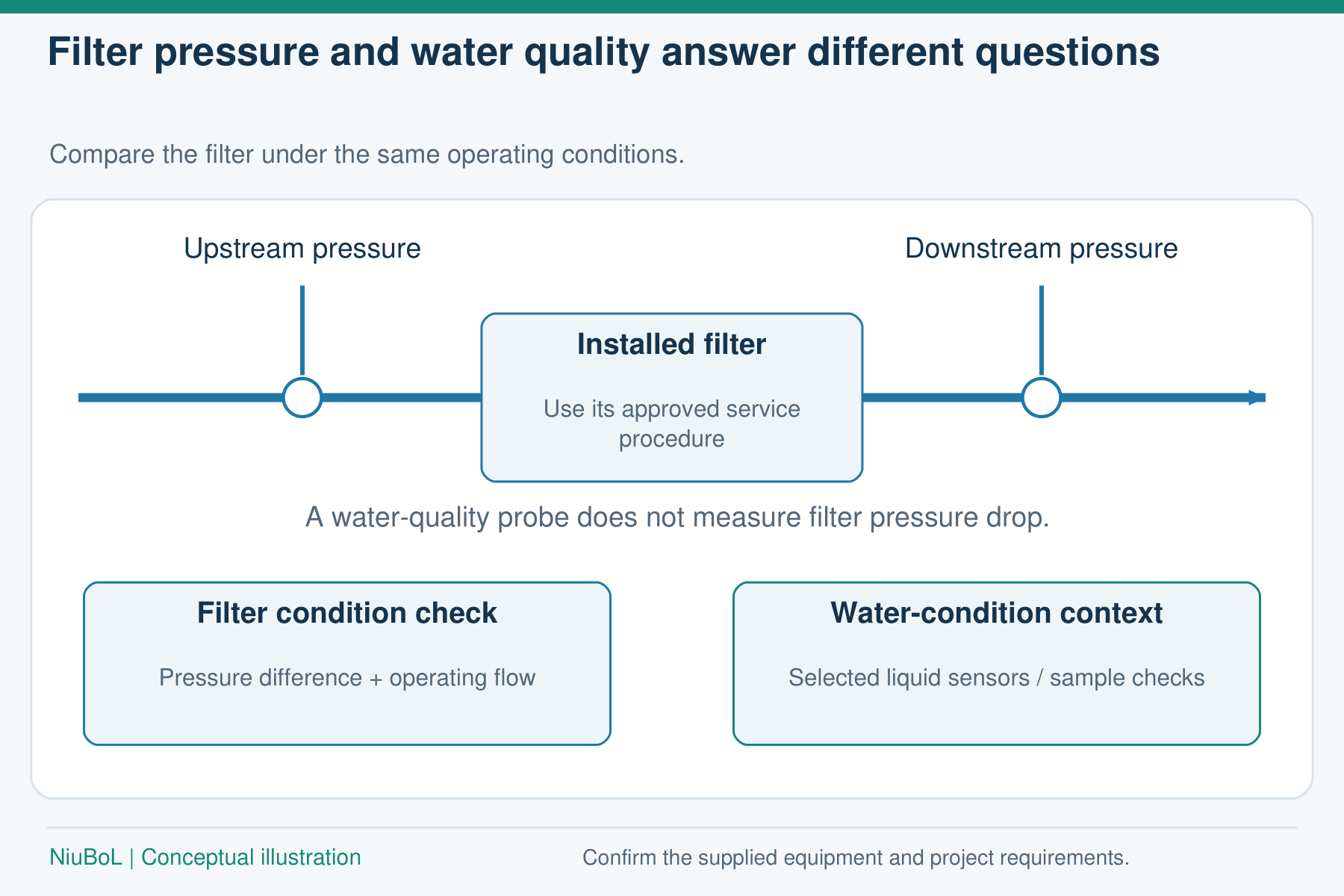
Conceptual measurement roles, not a supplied filter assembly. Operating limits and flushing requirements follow the installed filter and irrigation equipment.
Measure pressure immediately upstream and downstream of the filter using suitable, checked instruments. Differential pressure is upstream pressure minus downstream pressure. Record both values, flow, the active filter bank and the operating zone. Comparing only inlet pressure with yesterday's reading cannot separate filter loss from a changed supply.
After cleaning, establish the baseline at the normal operating flow. If several configurations are routinely used, retain a baseline for each important condition. Higher flow can increase clean-filter loss, so do not diagnose loading by comparing a low-flow clean reading with a high-flow operating reading.
Use the manufacturer's flow-versus-pressure-loss information rather than imposing a square-law estimate on every screen, disc element or loaded filter. A fouling layer does not necessarily behave like the clean element, and its growth need not be linear with running hours. A short trend is evidence to investigate, not a reliable forecast of the next cleaning time.
Which pattern are you actually seeing?
| Observation | Check first | What it does not prove |
|---|---|---|
| Differential rises at comparable flow | Loading, pressure taps and gauge condition | The identity of the retained material |
| Differential changes after switching zones | Actual flow and valve arrangement | A sudden increase in solids |
| Differential stays high after cleaning | Incomplete cleaning, persistent deposits or changed flow | That a longer timer is the solution |
| Emitters clog while differential stays low | Bypass, element damage and deposits forming downstream | That filtration is working correctly |
| Outlet turbidity rises briefly | Sample flow, bubbles, source changes and filter condition | Particle breakthrough on its own |
Inspect a deposit through the approved maintenance procedure before choosing a remedy. Grit, organic debris and mineral deposits need different investigations. Do not prescribe acid, chlorine or another treatment from appearance alone; chemical compatibility, worker protection and the irrigation equipment's instructions matter.
Set the cleaning decision from the actual filter
Ask whether the supplier's differential limit is an absolute pressure difference or an increase above the clean baseline. Confusing those conventions can make an otherwise sensible setting ineffective. Obtain the recommended operating flow, filtration grade, cleaning method and required backwash supply conditions for the installed model.
There is no universal mesh number or pressure trigger for every fertigation installation. Mesh count is not an exact micron rating without the screen construction. Select filtration against the emitter manufacturer's requirement and the water's particle characteristics, using the filter supplier's declared retention grade. Finer filtration can add pressure loss and maintenance without solving dissolved-salt problems.
A self-cleaning filter also needs enough pressure and water to complete its approved sequence. Verify those conditions while the relevant bank is washing, not just during normal irrigation. Include any required time-based backup or manual inspection in the operating procedure; a differential sensor should not be the only evidence that the filter is healthy.
Separate source-water solids from fertilizer precipitation
Mark the water source, injection point, mixing section and filter order on a simple sketch. Some arrangements place filtration before injection; others include downstream protection. Solids formed after the last filter cannot be removed by making that upstream filter finer.
For an investigation, take comparable samples immediately before and after the filter at a steady operating condition. If fertilizer-related deposits are suspected, also compare source water with the representative mixed solution after injection and mixing. These are different sample pairs answering different questions. Record the location, time, temperature and dosing state with each sample.
Cloudiness or sediment can prompt further testing, but a clear bottle does not exclude fine particles, biological growth or later precipitation. Nor does a recovered differential prove that the element is undamaged. Combine the observations with element inspection and appropriate water or deposit analysis.
Calcium-bearing fertilizers can precipitate with phosphate or sulfate ingredients under unsuitable mixing conditions. Separate compatible stock preparations and test the intended diluted mixture with the actual water source. Follow the fertilizer instructions rather than improvising chemical combinations. See the separate fertilizer compatibility guide for preparation questions; cleaning the filter cannot make an incompatible recipe remain dissolved.
Choose monitoring that answers the remaining question
A NiuBoL NBL-WQ-TS turbidity sensor can track changes in optical scattering at a representative water point. It is not a particle-size analyzer or an automatic measurement of suspended-solids mass. Confirm that the selected range and uncertainty suit the actual water; bubbles, deposits and unsuitable mounting can also affect observations.
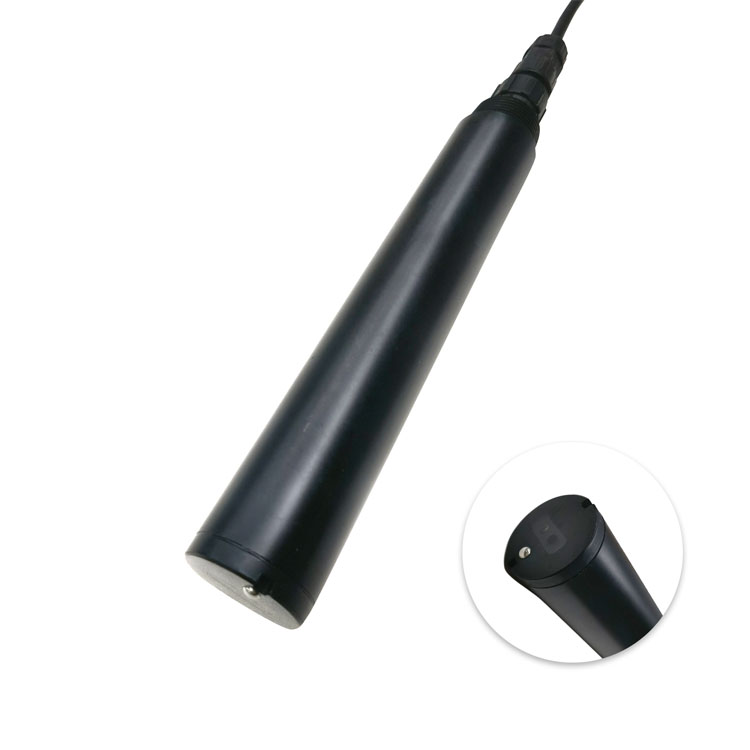
A turbidity monitoring component, not a filter or a differential-pressure instrument.
The NBL-WQ-EC liquid conductivity sensor answers a separate question: whether dissolved ionic conditions are changing. The current product page lists RS485 Modbus RTU output and range-dependent configurations. Conductivity cannot identify a precipitate, establish fertilizer compatibility or prove removal of solids. Use suitable laboratory analysis when the decision concerns hardness, alkalinity or a specific constituent.
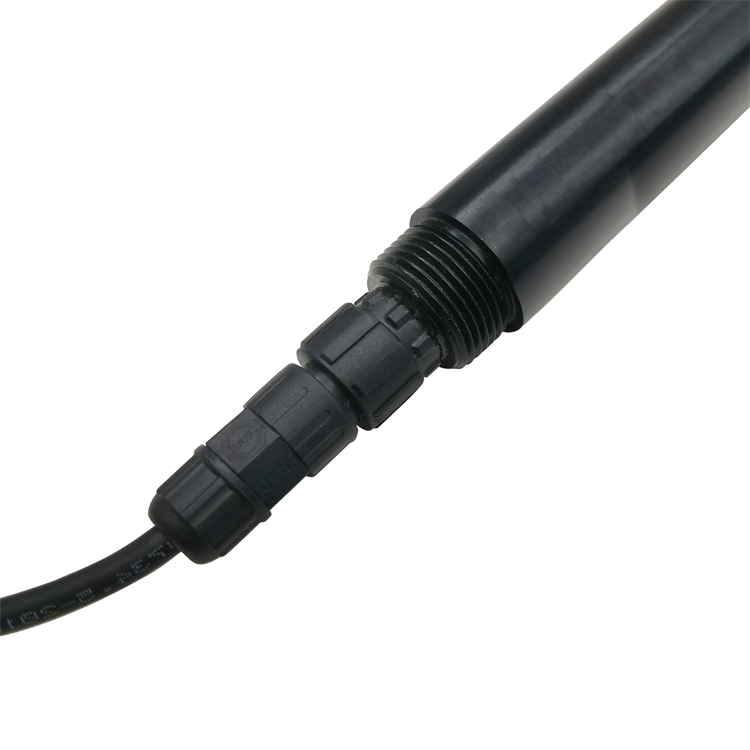
Liquid conductivity provides water-quality context; it does not replace pressure and flow observations.
Do not add either probe simply because a filter is present. A reliable differential and flow record may answer the immediate cleaning question. Add water-quality measurements when they resolve a named uncertainty, with a suitable sample path and receiving interface. NiuBoL's linked sensor listings do not establish supply of a complete filter or backwash skid.
Budget the wash water without predicting a fictitious cycle
Use the measured discharge and actual wash duration. As one illustrative calculation based on assumed site values, not a measured field record, suppose a single wash stage discharges steadily at 30 L/min for 2 minutes. Volume equals flow multiplied by time: 30 × 2 = 60 L, or 0.060 m³ per event. Four such events would discharge 240 L, or 0.240 m³.
This example excludes rinse water, simultaneous stages and changing discharge. Measure or totalize the full sequence where those matter. It does not set a trigger or establish how many events the installation needs. Keep fertilizer injection inhibited during washing where required by the approved system sequence, and verify the actual equipment behavior rather than assuming the timer supplies that interlock.
After washing, compare differential at the corresponding baseline flow and check normal delivery. Record unsuccessful recovery separately from a completed wash command. Repeatedly shortening the interval without resolving poor recovery can conceal an inadequate cleaning supply or a persistent deposit.
Questions about filter cleaning and water monitoring
Q1. What pressure drop should trigger backwashing?
Use the installed filter's instructions and confirm whether the setting is an absolute differential or a rise above the clean baseline. Check delivery requirements and available wash pressure. A generic value from another filter is not a commissioning limit for yours.
Q2. Does rising differential always mean clogging?
No. Compare actual flow, valve configuration and pressure measurements first. At comparable flow, a rising differential supports investigating loading, but it does not identify the deposit or rule out an instrument problem.
Q3. Can a finer mesh prevent fertilizer precipitation?
It can retain some solids already formed upstream, but it cannot prevent dissolved ingredients reacting after the filter. Check compatibility at stock and final dilution conditions, then select filtration for the emitter and water requirements.
Q4. Why do emitters block when the filter differential is normal?
Possible causes include bypass, damaged elements, deposits forming downstream and biological fouling. Check the actual hydraulic route and inspect through the maintenance procedure. A normal differential does not prove clean downstream water.
Q5. Can EC or turbidity decide when every filter should wash?
Neither provides a universal cleaning command. EC tracks aggregate ionic behavior; turbidity tracks optical scattering. Correlate useful observations with the filter's approved differential, operating state and maintenance evidence before considering automatic logic.
Q6. What should be checked after cleaning?
Confirm the expected differential at comparable flow, acceptable downstream delivery and the approved return-to-service state. If recovery is poor, inspect cleaning performance and deposits rather than treating a completed timer as proof of success.
Make the cleaning record useful
Fertigation filter pressure drop is useful when it is tied to flow, filter condition and a model-specific cleaning rule. Distinguish captured solids from reactions occurring downstream, and verify recovery after each wash. Add water-quality observations only where they help identify the cause or validate the operating decision.
Send NiuBoL the water-quality problem, an existing sensor or controller nameplate photo, and the sample conditions. NiuBoL can assess suitable turbidity or conductivity monitoring components, check the receiving-interface requirements and provide a quotation for the selected sensors.









