







Before changing the calibration offset on a greenhouse climate sensor, inspect what happens when the shade screen moves. If a reading rises as sunlight reaches the housing, the probe may be responding to its own heating as well as a genuine change in crop-zone air temperature. A second probe near a vent may tell a different story because it measures a different air stream.
The practical question is whether the reading represents the growing zone well enough for the intended decision. Check radiation shielding, airflow and location first. Then compare instruments and investigate calibration if a discrepancy remains under controlled conditions.
Separate a hot sensor from hot crop-zone air
An air-temperature element exchanges heat with the surrounding air, but also receives radiation and can conduct heat through its mounting. Direct sunlight can therefore make its temperature differ from the air temperature being sought. A reflective, ventilated shield reduces that exposure while allowing sampled air to reach the element.
There is no universal conversion from solar irradiance to sensor error. The same sunlight can produce different errors with different shields, ventilation, mounting arrangements and surface condition. A fan does not guarantee fixed accuracy. Its airflow path must remain effective, and a stalled fan or blocked inlet can change performance.
Keep three questions separate: Is the probe heated by its surroundings? Is the air at this location representative? Is the instrument within its stated measurement specification? A shaded probe near a heater can still measure the wrong location. A well-placed probe can still need calibration.
Choose the air point before choosing an offset
For a crop-zone measurement, identify the part of the canopy and growing area the reading must represent. Record probe height relative to the crop and revisit it as the canopy grows. Do not apply one fixed height to all crops or assume roof-level air describes conditions around leaves.
Keep the sensing inlet clear of leaf contact, irrigation spray, condensation drips and surfaces that can transfer heat. Avoid placing a representative zone sensor directly in a heater discharge, incoming vent stream or mist plume. Those locations may deserve diagnostic points, but they answer different questions.
Mark the sensor, vents, circulation fans, heating lines and shade screens on a greenhouse plan. If a bay contains distinct environments, compare candidate positions before selecting the permanent point. Adding a measurement for a real gradient is more useful than forcing different locations to agree through software offsets.
The NBL-W-LBTH atmospheric temperature, humidity and pressure sensor is one NiuBoL option for evaluating the measurement and receiver interface. Its listed temperature range is -40 to 80°C with ±0.5°C accuracy; relative humidity is 0–100% RH with ±5% RH accuracy. These are instrument specifications, not a guarantee of the installed point's error in sunlight.

An atmospheric sensing component, not a complete greenhouse controller or a verified fan-aspirated assembly.
Inspect the shield and its ventilation path
A passive shield relies on natural air movement. Outside wind speed does not establish airflow through a shield inside a greenhouse. Inspect whether leaves, insect debris or the mounting arrangement obstruct its openings. Clean it using the supplied procedure; do not coat or modify the sensing element to simplify cleaning.
An aspirated assembly moves air past the probe using a fan. Ask how air reaches the element, whether fan heat can enter the sample, and how fan operation is checked. The assembly needs a suitable power and maintenance arrangement. Confirm available shield options rather than assuming aspiration is built into every NiuBoL temperature sensor.
| Observation | Check before recalibrating | Next useful action |
|---|---|---|
| Difference grows when shade retracts | Radiation, shield condition and airflow | Compare co-located, properly shielded probes |
| Difference persists at one location | Nearby heat, wetting or a separate air stream | Exchange probe positions without changing settings |
| One trace settles later after venting | Probe response, filtering and recording | Compare aligned traces and settings |
| Humidity stays unusually high after misting | Wetting, condensation and recovery | Inspect and repeat after appropriate recovery |
| Value freezes during an outage | Retained data and observation age | Check validity and timeout behavior |
Do not cover the sensor with an opaque bag or sealed box to remove sunlight. That changes air exchange and humidity as well as radiation exposure, so it cannot serve as an air-temperature reference.
Response lag is not the same as a slow greenhouse
The greenhouse air changes after a vent, heater or shade action. The sensor responds to that changing air, and the receiving system may filter the result again. A slow chart can reflect actual air movement, the probe assembly, logger processing or several of these together.
T90 is the time to reach 90% of a defined step change under stated test conditions. Vent opening rarely gives every probe an immediate, identical step. Its trace alone does not establish laboratory T90. Ask for response information for the delivered probe and shield, including test airflow and whether temperature or humidity was tested.
Do not add an assumed greenhouse air-change time to a guessed sensor T90 and treat the sum as a guaranteed control delay. Nor should fast communication be confused with a fast physical measurement. A time-aligned comparison under representative conditions is more useful than an unsupported lag calculation.
Temperature, humidity and CO2 channels can respond differently. Their ordering is not universal, and a shared housing does not prove identical filtering. Check the actual configuration rather than assigning assumed response times.
Compare probes without erasing a real gradient
Start with a suitable reference whose uncertainty and response are understood. Put its air inlet near the installed point at the same height, without blocking airflow or letting either housing heat the other. Keep both appropriately shielded. A second uncharacterized probe can reveal disagreement but cannot establish which reading is correct.
Record both traces through relevant shade and ventilation states, including steadier periods. Note fan operation, misting, nearby equipment and exposure changes. Use a logging interval that resolves the behavior of interest within the instruments' supported update limits. Timestamp operating actions separately.
Exchange probe positions if practical and safe. A discrepancy that follows the instrument suggests a different investigation from one that stays with the location. Check stable periods for persistent offset and transitions for response differences. When conditions vary strongly, do not turn the largest difference into a calibration correction.
For humidity, compare measurements in the same air at comparable temperatures and allow recovery from wetting as instructed. Relative humidity depends on temperature; different thermal exposure can contribute to differing RH readings. Air RH is not a direct measurement of leaf wetness or canopy surface temperature.
An integrated temperature, humidity and CO2-capable sensor can supply additional channels where required. Confirm range, interface and placement for the crop application. Extra channels do not remove the need to validate the air point.
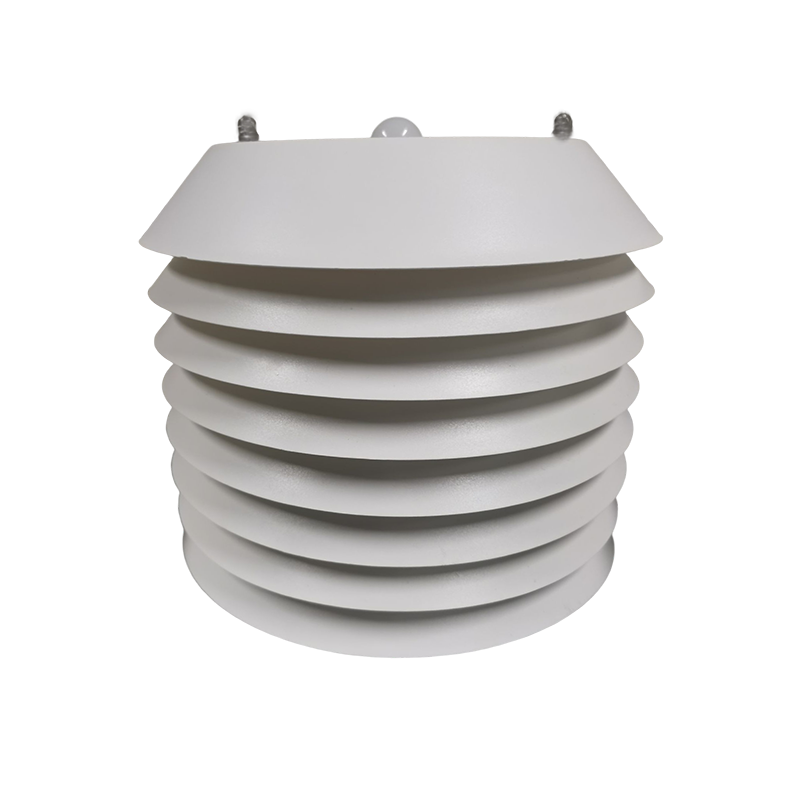
An integrated sensing component, not proof of fan aspiration, a shared channel response time or a complete control system.
Specify what the installer must demonstrate
Bring the receiver model and required output to the discussion. The RS485 Modbus NBL-W-LBTH page describes the digital configuration; another ordered output must match the receiving input. A sensor alone does not supply a complete vent controller or establish its logic.
Agree the acceptable difference, response behavior and reference method for the task. Retain shield type, height, cleaning access, logger filtering and comparison results. For broader handover, use the greenhouse weather station commissioning guide. Here the acceptance question is narrower: does this air point remain representative as sunlight and ventilation change?
Questions about sunlit greenhouse readings
Q1. Does a high noon reading mean the sensor is out of calibration?
Not necessarily. Radiation heating, a warm mounting surface or a real crop-zone temperature rise can contribute. Compare properly shielded, co-located measurements before deciding whether calibration is needed.
Q2. Can I subtract one fixed sunlight correction?
Not reliably when the difference changes with shade, airflow or surface condition. Correct exposure first. A calibration adjustment needs an appropriate reference and stable comparison conditions.
Q3. Will adding a fan guarantee the stated sensor accuracy?
No. Aspiration can improve air exchange, but the installed result depends on the shield, airflow path, fan condition and location. Request assembly-specific evidence and a way to inspect operation.
Q4. Where should I place a sensor for a tall crop?
Choose the canopy zone relevant to the decision, keep the inlet clear, and record its relation to crop height. Adjust as the crop grows. A roof point should not silently substitute for a crop-zone point.
Q5. Can a ventilation test establish T90?
It can reveal installed response differences, but not necessarily sensor T90. That specification requires a defined step and test conditions; greenhouse air usually changes unevenly after vent opening.
Q6. What helps select a replacement probe?
Start with the existing sensor label, receiver model and measurement problem. These help check output compatibility and whether the issue calls for another probe, exposure arrangement or further comparison.
Fix the measurement point before tuning the number
Representative greenhouse climate measurement depends on the probe, shield, air path and location together. Investigate sun exposure and ventilation before changing offsets, and separate real spatial differences from instrument error. A documented comparison is a sounder basis for maintenance or replacement than an assumed noon correction.
Share your sensor or label photo, receiver model, and reading problem. NiuBoL can help assess temperature/humidity sensing and acquisition-interface options and quote suitable monitoring components.








