







A pond's pH rises during the afternoon, but its ammonium reading falls slightly. Is the ammonia nitrogen sensor failing, or has the water changed? Neither the direction nor the size of that change can be interpreted until the measured species and compensation are known. A rise in the free-ammonia fraction is not automatically an increase in total ammonia nitrogen, and it is not a matching error in an ammonium electrode.
First establish which channel changed
An ammonium ion-selective electrode responds to NH4+ activity. Its calibrated concentration output must be distinguished from free, un-ionized NH3 and from total ammonia nitrogen, or TAN. TAN includes NH4-N and NH3-N on the same nitrogen-mass basis; it is not total nitrogen, which includes other nitrogen forms.
Before recalibrating, save the original trend and identify the displayed quantity. Is it measured ammonium, a TAN estimate calculated inside the instrument, or a value calculated in the PLC? Record whether mg/L means as N, as NH4+ or as NH3. A unit conversion changes the mass basis; a speciation calculation estimates the split between forms. Neither operation repairs an electrode.
The ammonia versus ammonium procurement guide explains those reporting conventions. The practical question here is narrower: what should an engineer check when pH and the ammonia-channel trend move together?
A pH change alters the chemical split, not the nitrogen total
Consider one closed, equilibrated freshwater sample with an assumed TAN of 1.00 mg/L as N at 25 °C. For this illustration, use the freshwater relation pKa = 0.09018 + 2729.92/T, with T in kelvin. At 298.15 K, pKa is approximately 9.2464. The un-ionized fraction is f = 1 / [1 + 10^(pKa − pH)].
| Assumed sample condition | Free NH3 fraction | NH3-N, mg/L as N | NH4-N, mg/L as N |
|---|---|---|---|
| pH 7.0, 25 °C | 0.56% | 0.0056 | 0.9944 |
| pH 8.0, 25 °C | 5.37% | 0.0537 | 0.9463 |
Result: The calculated free-NH3 fraction increases about 9.5-fold, while the ammonium fraction decreases modestly and TAN remains unchanged. These are chemical fractions, not predicted instrument readings or a 9.5-fold sensor error.
Boundary: This is an illustrative calculation based on assumed site values, not a measured field record. It assumes freshwater equilibrium and negligible changes in the activity relationship. Real pH adjustment can change ionic strength, dilute the sample or promote ammonia loss; an open pond is not a closed sample. Use a salinity-appropriate model for saline water rather than extending this freshwater equation unchanged.
This distinction prevents a costly mistake: recalibrating an NH4+ electrode because a calculated NH3 value rose can conceal a legitimate chemical change. It can also create a new error when the water returns to its earlier condition.
Check what temperature compensation actually does
The NBL-WQ-NHN liquid-water probe uses a PVC-membrane ammonium ion-selective electrode and lists Pt1000 temperature compensation. Its documented sample pH window is 4–10, and it supports RS485 Modbus RTU. That description does not establish automatic pH or potassium correction for the basic probe.
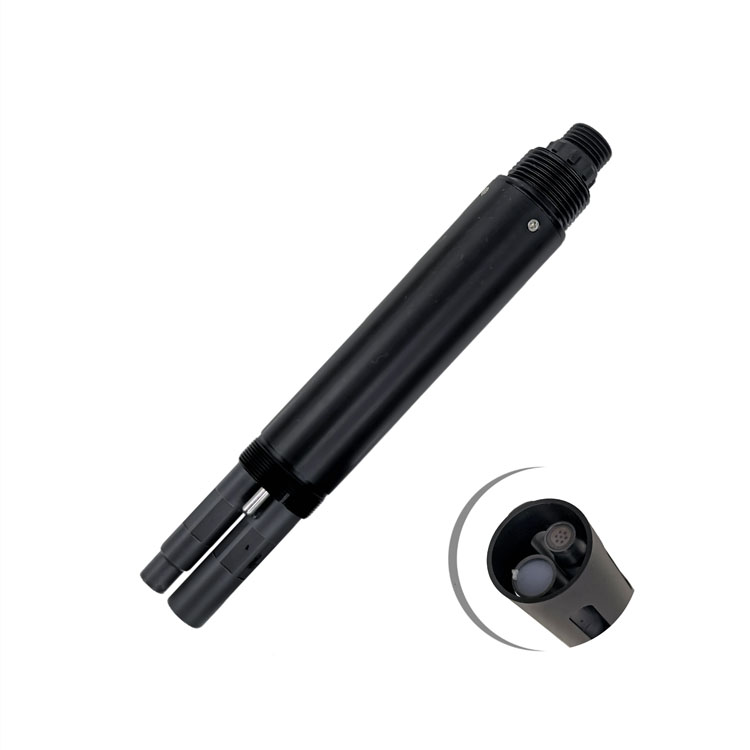
The NBL-WQ-NHN is an ammonium measurement component for water, not a gas detector or a complete monitoring station.
Temperature can affect both electrode response and the NH4+/NH3 equilibrium. Compensating the former does not prove that the instrument calculates the latter. Ask which quantity the firmware reports, which temperature it uses, whether a pH input is involved, and what happens if a required input is unavailable.
At a fixed pH, warmer freshwater generally has a larger un-ionized fraction. However, the resulting displayed change still depends on the channel definition, calibration and matrix. Do not apply a universal percentage correction per degree or assume that a temperature-compensated ammonium value is already TAN.
The separately listed NBL-WQ-NHN-302 configuration includes potassium, pH and temperature compensation. Confirm the delivered configuration and calculation basis; additional compensation does not eliminate every matrix effect.
Separate pH input problems from ammonium interference
An NH3 calculation can be wrong even when the ammonium electrode is responding normally. Check the pH probe's condition and calibration before altering an ammonia coefficient. A pH value from another tank, a stale communication value or a fouled electrode cannot describe the current water at the ammonium probe.
The NBL-WQ-PH water pH sensor lists 0.01 pH resolution but ±0.1 pH accuracy. Those are different specifications. More decimal places in a logger cannot make a calculated ammonia fraction more certain than its inputs allow.
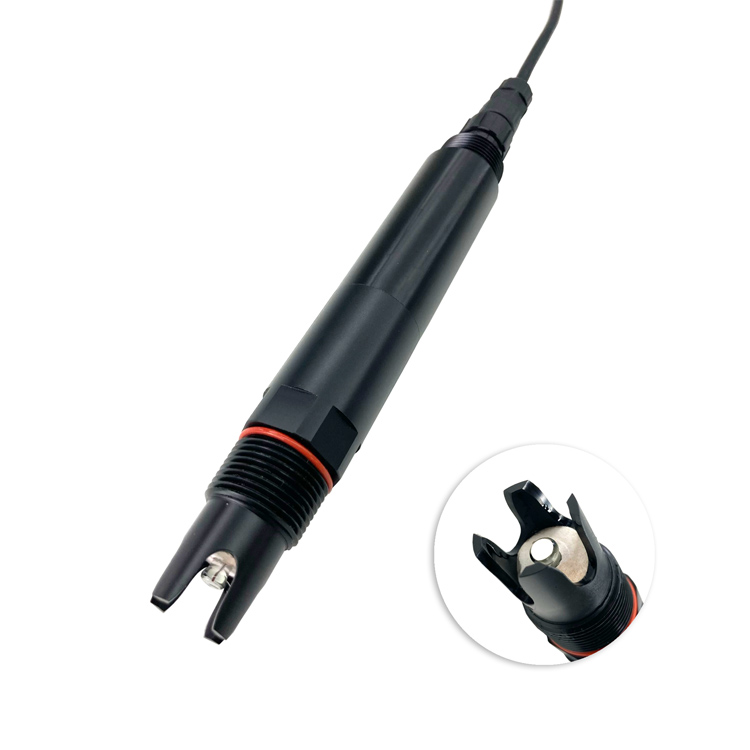
A separate liquid-water pH electrode can supply a speciation input; it does not independently measure ammonia or provide a complete compensated system.
Potassium and other ions can interfere with an ammonium membrane, while ionic strength affects the relationship between activity and concentration. A freshwater calibration may not transfer unchanged to a saline process stream. Record feed, fertilizer, salt or cleaning-chemical changes when investigating the event. Conductivity can provide context about a changed ionic background, but it cannot identify potassium concentration.
There is no universal potassium concentration above which every ammonium sensor fails. Assess the relevant electrode's interference information, ammonium level, compensation and actual water together. Do not insert an assumed selectivity coefficient into the PLC and call the resulting number corrected.
Use the event pattern to choose the next check
Keep the as-found reading before any cleaning or adjustment. Review the same water and time period, allowing for sample transport and different channel response times. The following observations guide an investigation; none is a diagnosis by itself.
- Calculated NH3 rises while measured NH4-N changes little: inspect the pH and temperature inputs and calculation definition. The pattern may reflect a genuine change in speciation.
- Ammonium changes after a salt or fertilizer addition: investigate the ionic matrix and electrode interference, not only pH.
- All channels hold steady through a known water change: check timestamps, sample availability and communications before interpreting the chemistry.
- A cleaned electrode behaves differently in a compatible check solution: investigate fouling, conditioning or calibration using the supplied electrode procedure.
Keep measured and calculated channels separate in the historian. Agree the maximum acceptable age and timing mismatch for the site's process rather than imposing one logging interval on every installation. If a required input is invalid, flag the derived result instead of silently using an old pH value.
Frequently asked questions
Q1. Does raising pH from 7 to 8 cause a tenfold ammonium reading error?
No. The example shows a near-tenfold increase in the free-NH3 fraction, not in an NH4+ electrode's error. Identify the measured species and any internal calculation first.
Q2. Can a lower NH4-N reading mean a lower free-ammonia risk?
Not necessarily. Changing pH or temperature can shift the split toward NH3 while NH4-N falls. Interpret the water using the site's validated assessment, not the ammonium trend alone.
Q3. Does automatic temperature compensation make the output TAN?
Not by itself. Confirm whether compensation addresses electrode response, chemical speciation or both, and whether valid pH information is required.
Q4. Should I acidify the process to stabilize the measurement?
Do not change the process solely to make a sensor reading steady. Sample conditioning and process dosing are different operations; each needs an approved procedure and a defined measurement purpose.
Q5. Can potassium interference be removed with one fixed offset?
A fixed offset is not a general solution for a changing matrix. Evaluate the electrode and any compensation across the actual ammonium and interfering-ion conditions.
Q6. What records help investigate a pH-related change?
Start with the model or nameplate photo, a short synchronized ammonium/pH/temperature trend, and the water type. Include the displayed units so the measured and calculated channels can be distinguished.
Summary: diagnose the channel before changing calibration
A pH-related ammonia change may come from speciation, an invalid calculation input, electrode interference or a real process change. Establish the measured species and mass basis, preserve the original trend, and check the compensation before adjusting calibration. That approach avoids correcting away valid chemistry while leaving a genuine measurement problem unresolved.
Contact NiuBoL with your probe model or nameplate photo, water type and a short event trend. We can help identify suitable ammonium and pH sensor options, check the required acquisition interface and prepare a quotation for the confirmed components.









