





— Blogs —
—Products—
 Consumer hotline +8618073152920
WhatsApp:+8615367865107
Address:Room 102, District D, Houhu Industrial Park, Yuelu District, Changsha City, Hunan Province, China
Product knowledge
Time:2026-09-20 13:00:00 Popularity:210
Ammonia vs ammonium in water monitoring is a measurement-definition issue before it is a sensor-price issue. Ammonium is NH4+; un-ionized ammonia is NH3. NH4-N expresses the nitrogen in ammonium, while total ammonia nitrogen includes both forms on a nitrogen-mass basis. An ammonium ion-selective electrode does not automatically provide all four quantities. Specify the required species, mass basis and any calculation before comparing an online reading with a laboratory result or writing a PLC alarm.
A tender asking for an "ammonia sensor, 0-100 mg/L" leaves two important questions unanswered: what chemical quantity is measured, and what mass is represented by mg/L? A supplier can provide a working instrument and still deliver a value that the receiving system interprets incorrectly. Resolve this in the instrument schedule, not after the first disagreement with the laboratory.
| Requested quantity | Meaning | Selection consequence |
|---|---|---|
| NH4+, mg/L | Mass concentration of the complete ammonium ion | Do not compare directly with a result expressed as nitrogen. |
| NH4-N, mg/L as N | Nitrogen mass associated with ammonium | Confirm that the sensor output or receiving-system conversion uses this basis. |
| Total ammonia nitrogen, TAN | NH3-N plus NH4-N | An ammonium-only signal needs a justified speciation calculation before it represents TAN. |
| Un-ionized NH3 or NH3-N | The un-ionized fraction, expressed as molecule mass or nitrogen mass | Requires a suitable measurement or calculation with valid pH, temperature and water-chemistry inputs. |
For nitrification monitoring, the useful result may be ammonium nitrogen entering or leaving a treatment stage. For an aquaculture risk assessment, the un-ionized fraction may matter alongside TAN. For discharge reporting, the required analytical method and reporting basis govern the comparison. These are different duties even when purchasing documents use the same word, ammonia.
The EPA's ammonia overview distinguishes the ionized and un-ionized forms and explains why pH, temperature and ionic strength matter to their distribution. This distinction does not turn an online trend instrument into an approved reporting method. The project must still establish how its measurements relate to the required laboratory test.
Using rounded molecular masses, convert ammonium to ammonium nitrogen by multiplying by 14/18, approximately 0.778. Conversely, multiply NH4-N by 18/14, approximately 1.286, to express the same ammonium quantity as NH4+. For example, 1.80 mg/L NH4+ corresponds to approximately 1.40 mg/L NH4-N. The water has not changed; only the mass basis has changed.
This arithmetic cannot convert ammonium into total ammonia nitrogen when a material NH3 fraction is present. It also cannot correct potassium interference, an aged membrane or a contaminated standard. Keep these operations separate in the data logger: unit conversion changes the label and scale, speciation estimates the chemical fractions, and calibration adjusts the instrument response.
A useful acceptance test starts with a known, compatible reference solution whose certificate states the concentration basis. Compare the instrument value, controller display and exported history against that basis. If the controller shows 1.80 and the laboratory reports 1.40, first check the units before applying an offset. An offset that conceals a mass-basis error at one concentration will not correct the proportional error across the range.
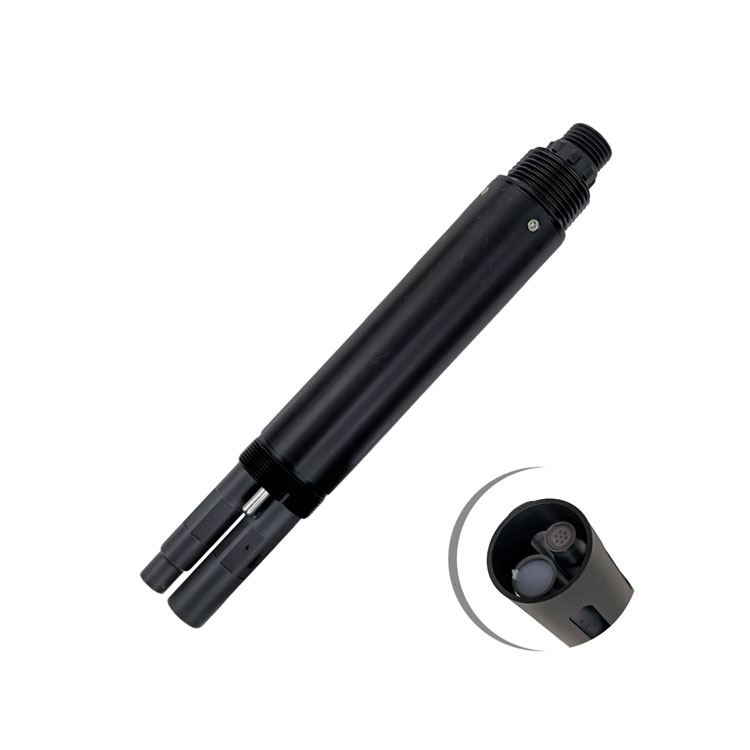
The NiuBoL NBL-WQ-NHN uses a PVC-membrane ammonium ion-selective electrode with temperature compensation. Its electrical response is related to ion activity; conversion to a reported concentration depends on calibration and the sample matrix. It is therefore suited to a qualified ammonium monitoring duty, not an assumption that every nitrogen species is independently measured.
| Item | NBL-WQ-NHN selection data | Practical implication |
|---|---|---|
| Range options | 0-10.00, 0-100.00 or 0-1000.0 mg/L | Specify the required reporting basis with the selected range. |
| Resolution | 0.01 mg/L on the two lower ranges; 0.1 mg/L on the highest range | Display resolution does not establish low-level accuracy. |
| Accuracy requirement | Obtain the ordered range's percentage basis and absolute-error term | Set an acceptance tolerance at the intended decision concentration. |
| Power and output | 12-24 VDC; 0.2 W at 12 V; RS485 Modbus RTU | A PLC or RTU needs the actual register map and data scaling. |
| Application envelope | 0-40 degrees C; pressure below 0.1 MPa; medium pH 4-10 | Check the actual water and mounting pressure, not only the cabinet temperature. |
| Installation | 3/4 NPT immersion mounting; IP68 probe; standard 5 m cable | Specify a retrievable holder and waterproof cable terminations. |
| Cable and wetted construction | Confirm the delivered cable jacket and wetted-material schedule for the water chemistry | IP68 alone does not establish chemical resistance. |
Do not select a low-range installation from the 0.01 mg/L display increment alone. Ask for the maximum permitted error at the normal concentration and alarm boundary. If the site's decision involves changes smaller than that error, a field comparison or a different analytical arrangement is necessary. Adding decimal places in SCADA does not improve the measurement.
Conductivity provides context about the dissolved-ion background, not an ammonium concentration. The conductivity probe below cannot identify potassium interference or replace a defined nitrogen measurement.
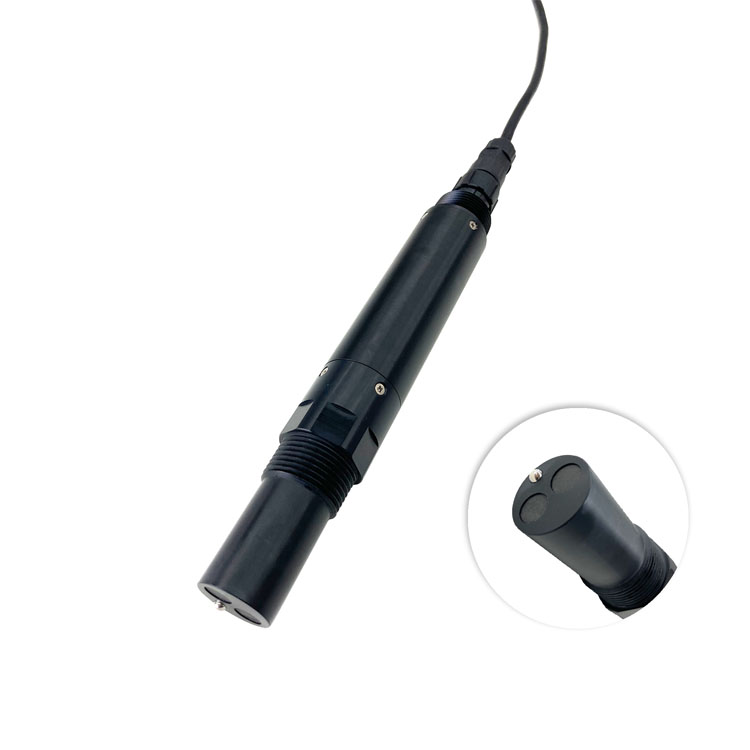
Temperature compensation addresses temperature-dependent sensor response. It does not, by itself, prove that an output is corrected for changing ammonia speciation or interfering potassium. The NBL-WQ-NHN-407C is a separate configuration incorporating pH and potassium electrodes. Its additional channels support those compensation functions; they also introduce electrodes that must remain calibrated and serviceable.
For a wastewater line with changing potassium concentration, assess the compensated configuration using paired samples across the expected operating conditions. A favorable result at one steady condition does not establish performance during a different industrial discharge. For brackish or saline water, review the complete ionic matrix. Potassium compensation is not blanket compensation for all dissolved salts.
In a treatment basin, place the ammonium electrode in representative mixed water while avoiding rags, grease deposits and direct violent aeration. In a surface-water station, investigate whether low concentrations and seasonal matrix changes fit the available error budget. At a process-water point with rapid pH excursions, synchronize the pH and temperature measurements with the ammonium sample rather than using a value from a different tank.
Name the tags so that an operator can distinguish measured ammonium from calculated TAN or NH3. Store the original instrument channel separately from any calculated channel. Each calculation needs its equation version, input units and validity limits. When a required pH input is stale, mark the derived value unavailable; do not silently continue calculating from yesterday's measurement.
RS485 Modbus RTU transports the instrument data but does not determine its chemical meaning. Commission the slave address, register type, decimal scaling and temperature channel using the supplied instrument configuration. Confirm whether the sensor or the PLC performs the nitrogen-mass conversion. Applying it twice is as misleading as omitting it.
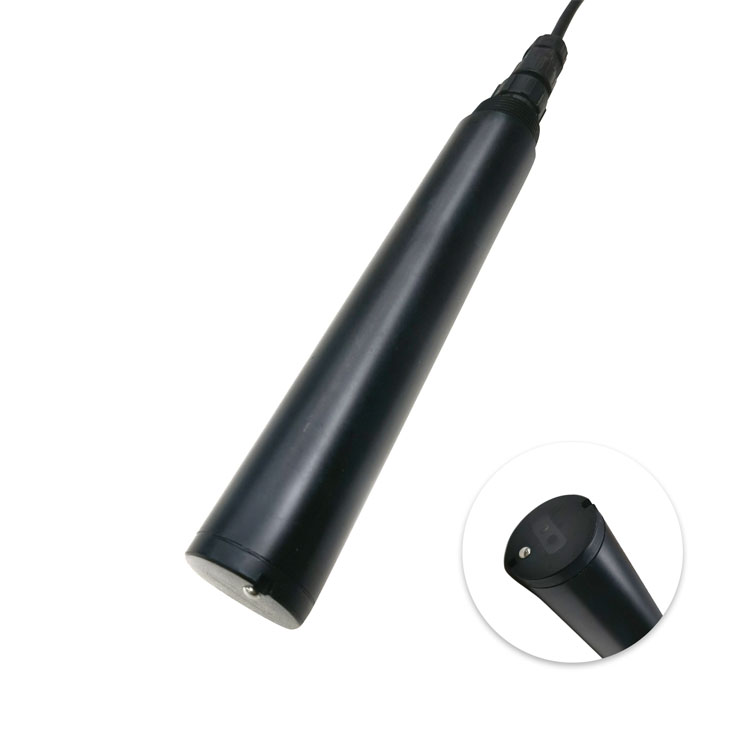
A turbidity channel can help identify a changing sample matrix or fouling episode, but cannot determine the ammonia fraction. The separate turbidity probe shown below is a particle-monitoring component, not an ammonium electrode or a complete multi-parameter station. Specify companion channels only when they answer a separate operational question.
Only after the measurement duties are reconciled. Compare species, nitrogen-mass basis, sampling point, sample treatment and analytical method. A field trial can establish usefulness for continuous control or warning, but it does not automatically authorize substitution for a required laboratory reporting method.
Not necessarily. An ammonium ion-selective electrode responds to NH4+. Request a written definition of the output, including any internal conversion. A calculated NH3 result needs valid speciation inputs and must be labelled as calculated, rather than presented as an independently measured channel.
Check mass basis and host scaling before adjusting calibration. NH4+ and NH4-N differ by approximately 18/14 for the same ammonium quantity. A decimal-register error can produce a larger ratio. If these checks pass, investigate sample timing, analytical differences and matrix interference.
No single answer covers all duties. Assess the pH variation, required output and decision tolerance. A stable ammonium trend can have different requirements from a calculated TAN or NH3 channel. Select the compensation arrangement after reviewing the expected water, not simply because additional electrodes are available.
State NH4+, NH4-N, TAN or NH3 explicitly; add normal, alarm and peak concentrations, pH and temperature ranges, salinity or conductivity, likely potassium changes, mounting conditions and the receiving controller. Include a laboratory report showing the unit and method. This is more useful for configuration than a request for an unspecified ammonia probe price.
The measurement configuration, replaceable electrode arrangement, controller, holder, cable route, standards and commissioning comparison all affect the quotation. A pH-and-potassium-compensated assembly is not equivalent to a temperature-compensated probe. Ask NiuBoL to price the required configuration and its service parts separately; there is no defensible universal installed price for these different duties.
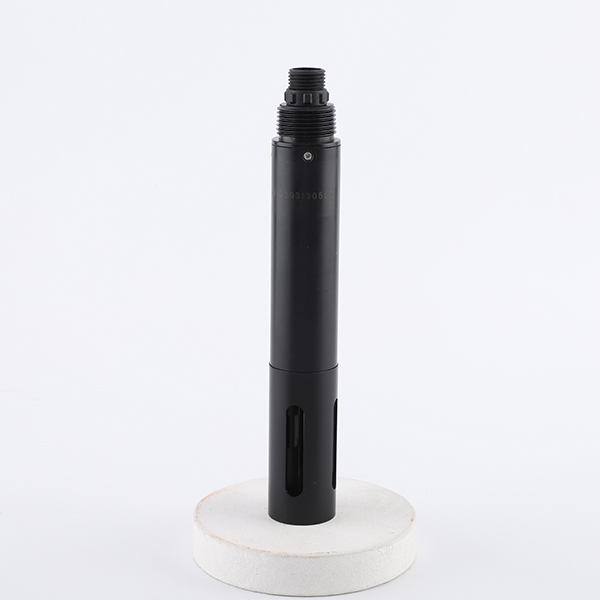
The NHN-4A pictured below is a separate model. Confirm its own output definition and limits; its appearance does not establish the pH-and-potassium-compensated configuration described above.
Resolve ammonia vs ammonium in water monitoring by defining the chemical quantity first, then the mass basis, sensor configuration and receiving-system calculation. NiuBoL ammonium sensors can provide online process information when their range, matrix limits and comparison method match the application. Send the required output definition and representative water data with the inquiry so the proposed probe and compensation arrangement address the actual decision.
Prev:Online Ammonia Nitrogen Sensor: Can One Configuration Serve Several Sites?
Next:NH4-N Sensor Calibration, pH Compensation and Field Maintenance Requirements
Related recommendations
Sensors & Weather Stations Catalog
 Agriculture Sensors and Weather Stations Catalog-NiuBoL.pdf
Weather Stations Catalog-NiuBoL.pdf
Agriculture Sensors Catalog-NiuBoL.pdf
Water Quality Sensor Catalog-NiuBoL.pdf
Related products
 Combined air temperature and relative humidity sensor
 TDR Soil Moisture & Temperature Sensor for irrigation| RS485 |4-20mA| NBL-S-THR
 Soil pH sensor RS485 soil Testing instrument soil ph meter for agriculture |NBL-S-PH
 Wind Speed sensor Output Modbus/RS485/Analog/0-5V/4-20mA
 Tipping bucket rain gauge for weather monitoring auto rainfall sensor RS485/Outdoor/stainless steel
 Pyranometer Solar Radiation Sensor 4-20mA/RS485


Screenshot, WhatsApp to identify the QR code
WhatsApp number:+8615367865107
(Click on WhatsApp to copy and add friends)

