







A weather station that disappears from the dashboard each night does not automatically need a larger battery. The battery may be depleted, but a voltage drop during cellular transmission, a protection trip or a communication fault can produce a similar complaint. Before ordering parts, establish whether measurement stopped, the logger restarted or only transmission failed.
This guide addresses that fault investigation. For initial panel, battery and controller selection, use the separate solar-power sizing guide. The useful outcome here is a short evidence record that identifies what to inspect or change.
Start with the interruption, not the ampere-hour label
Record the last valid measurement time, the last upload time and any available restart or protection indication. Ask whether the failure coincides with sunset, a scheduled upload, cold mornings or several poorly charged days. Correlation helps select a test; it is not yet a diagnosis.
NiuBoL's automatic weather station can combine measurement sensors, acquisition, communications and a configured solar supply. There is no single station-wide current or battery capacity that applies to every assembly. A heater, display or separately powered router changes the load being investigated.
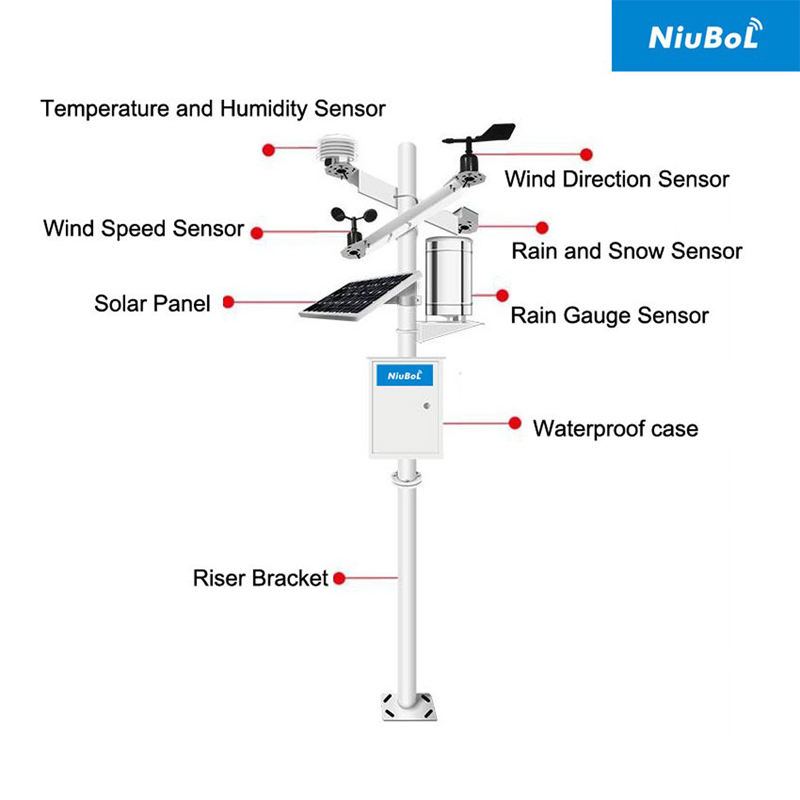
Weather-station assembly shown; confirm the ordered sensors and power configuration.
Where the supplied logger retains local records, inspect them. An intact local series through the dashboard gap points away from a complete acquisition-power failure. Missing records alone do not prove battery depletion: check storage, clock and configuration issues as well. Confirm what the actual model records rather than assuming it provides a restart log or remote battery telemetry.
Capture voltage at the place that fails
A battery-terminal reading taken after the system stops can miss the event. Under the approved electrical test procedure, record voltage at the battery and at the affected logger or router during startup and transmission. Use equipment that can capture brief changes; a single slow meter reading may not show the minimum.
If the battery remains within its documented operating limits while the device input drops below its allowed range, investigate the supply path. Inspect connections, cable sizing, fuse holders and regulators. A replacement battery may conceal a high-resistance connection temporarily without correcting it.
If both readings fall together, check the available charge, battery condition and current demand. Protection status helps distinguish a depleted pack from a current-limit or temperature event. Do not apply a universal cutoff voltage to every nominal 12 V battery: chemistry, battery management and the controller's settings matter.
| Observation | Evidence to collect | Next check |
|---|---|---|
| Restart during an upload | Device-input voltage and current during the event | Wiring, regulator and peak-current capability |
| Shutdown after several low-charge days | Daily load energy, charging history and protection state | Usable battery energy and recovery shortfall |
| Battery charged, but no dashboard update | Local records, modem status and server receipt times | Communications before replacing storage |
| Charging absent in cold weather | Battery temperature, charge-enable state and controller status | Delivered battery's permitted charging conditions |
These checks guide the investigation; they are not automatic fault codes. A site can have both inadequate energy reserve and an intermittent connector.
Measure a complete duty cycle
Measure the complete station, not just the sensor head. Include continuous sensing, the logger, communications, converter losses and scheduled accessories. Integrate power over a representative operating cycle to obtain Wh/day. If measuring at the battery output, avoid adding the same downstream conversion losses a second time.
Record the reporting interval and network conditions with the test. A modem reconnecting repeatedly can behave differently from one with a stable connection. Less frequent uploads may reduce energy use, but not if the radio remains continuously active or the firmware cannot enter the intended low-power state. Check the selected configuration rather than assuming a proportional saving.
The TR341 industrial router is one possible communications component, not the mandatory radio in every station. Its listed supply rating is not a measured average current for an entire weather station. Obtain operating-power information for the ordered device or measure it in the intended installation.

Communications component only: this router is not a complete weather station.
One calculation to challenge an autonomy claim
This is an illustrative calculation based on assumed site values, not a measured field record. Suppose a station consumes 48 Wh/day at the load. Its hypothetical battery is rated 12 V, 38 Ah. Assume an allowed discharge fraction of 0.50, a combined temperature-and-age capacity factor of 0.80 and delivery efficiency of 0.90.
Delivered usable energy = 12 × 38 × 0.50 × 0.80 × 0.90 = 164.16 Wh. With zero charging, estimated operation = 164.16 / 48 = 3.42 days. A seven-day requirement would consume 336 Wh, exceeding this assumed reserve by 171.84 Wh.
Those factors are explicit assumptions, not NiuBoL battery specifications. The calculation does not establish when the real low-voltage protection will operate. Use the delivered pack's capacity data, discharge limits and temperature conditions, then validate operation at the agreed load. Start-of-test charge also matters: a partially replenished pack cannot provide the reserve of a fully charged one.
Find why yesterday's deficit was not recovered
A sunny afternoon does not prove that the battery returned to full charge. Look at the charging history alongside the continuing load. Poor exposure, dirty panels, damaged connections, controller limits or temperature-related charge restrictions can leave the next night starting with less reserve.
Compare repeated days at the same reporting configuration. If the end-of-day battery condition progressively declines, investigate the daily energy balance. If it recovers adequately but the device still resets during transmission, return to the peak-current and supply-path checks. These patterns distinguish two different reasons for an apparently identical nightly outage.
Use the battery manufacturer's permitted charge-temperature range. Lithium packs do not share one universal low-temperature charging threshold; a sensor's ambient operating range does not establish that its power pack can charge across that range. Do not defeat battery protection to complete a field test.
Verify the repair without overstating the test
Agree the required uninterrupted measurement period, communication duty and battery condition before testing. Record hardware identity, relevant settings and temperature. Repeat the operating event that previously caused the interruption, then confirm that measurements continue and the device input stays within its documented limits.
A short bench test can reveal a transmission-related reset. It cannot establish several days of winter autonomy. A longer no-charge test needs a supplier-approved isolation method, suitable supervision and a stopping limit that protects the battery. Do not improvise a deep discharge or disconnect energized components without the approved procedure.
After correction, check charging recovery as well as survival. Ask how the station resumes acquisition and communications after a permitted shutdown. Keep the acceptance evidence separate from any promised service life or all-season runtime.
Battery and power-loss FAQ
Q1. Does a larger battery stop every nighttime outage?
No. It can increase stored reserve, but it does not necessarily correct wiring voltage drop, regulator limits or a communications failure. Capture the fault conditions first.
Q2. Can the panel's wattage tell me how many rainy days are covered?
No. No-charge autonomy depends on delivered usable battery energy and the complete load. Charging during a cloudy period is a separate, site-dependent contribution.
Q3. Why does the battery voltage look normal after a reset?
The load may have fallen when the device stopped. Compare voltage during the event with the device's input limits and the battery's protection state; a later reading cannot reconstruct that minimum.
Q4. Is a missing cloud record proof that the station had no power?
No. Check retained local data where available, timestamps and communication status. A gap can occur after acquisition or within the acquisition system itself.
Q5. Can a room-temperature discharge test prove winter runtime?
Not on its own. Capacity, charging permissions and the load can differ in the cold. Use the actual battery data and the agreed environmental conditions.
Q6. What should I send when asking about a repeated shutdown?
Start with the station or power-pack nameplate photo, the approximate failure time and any voltage or status record. These are more useful than an unsupported estimate of how many sunny hours the site received.
Restore the measurement chain, then confirm the reserve
Separate a loss of acquisition power from a loss of delivery. Measure the full duty cycle, capture voltage where the affected device is connected and check whether charging restores the previous deficit. Replace or resize components only after those observations identify the constraint.
For help with NiuBoL weather sensors, compatible data acquisition or communication equipment, contact NiuBoL with your model photo, failure time and available power readings. We can check the relevant configuration and interfaces and prepare a quotation for confirmed replacement or supply options.









