







The light comes on at dusk, but the collection box stays empty. Has the wind-suction solar insect trap failed? Not necessarily. First establish whether the fan ran when required, whether its airflow path was clear and whether the collection assembly was fitted correctly. A glowing tube proves none of those things. Only after checking the mechanism should an empty box be interpreted as an insect observation.
This is a functional troubleshooting and handover guide for a fan-assisted trap. Whole-night energy demand and recharge belong in the separate solar insect lamp power-budget guide. Keep that assessment with the installation, but do not replace a fan-function check with a battery calculation.
Confirm that the ordered head is a wind-suction type
NiuBoL's wind-suction solar insect trap uses an attraction light and a fan to draw insects toward a collection chamber. Its product page lists a 20 W / 12 V fan and local light, time, moisture and temperature controls. These identify the published arrangement; they do not establish a universal fan sequence or an on-site airflow acceptance value.
The ordered model and supplied instructions take priority when defining the test. A frequency-vibration grid lamp uses a different capture mechanism. An imaging terminal adds another workflow. Do not ask a suction head to pass a grid-only test, or diagnose it from the status screen of a separate insect-identification cabinet.
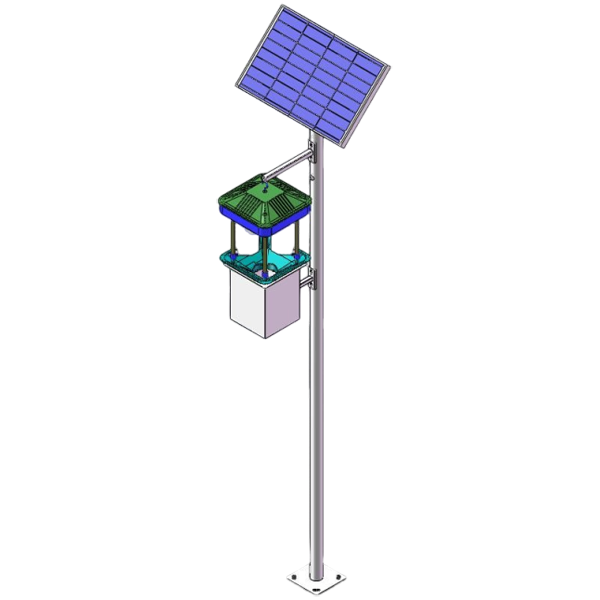
Wind-suction assembly shown; this product illustration does not demonstrate airflow, operating time or automated insect identification.
Before commissioning, request the supplied light/fan operating sequence, enabled time modes, protection conditions and safe inspection procedure. If the sequence is not documented, obtain confirmation before treating a stopped fan as a fault. Do not invent a rule that the fan must always follow the light or run for a fixed period afterward.
Separate an empty box from an inactive mechanism
Record the complaint precisely: light on with no observable fan activity, fan starting then stopping, apparent fan operation with poor collection, or no attraction light at all. Note when the condition occurs and the selected operating mode. These observations lead to different checks.
| What is observed | Evidence needed next | What it does not prove |
|---|---|---|
| Light on, fan not observed running | Expected fan state at that time; controller condition; approved fan-function test | That the battery or fan motor must be defective |
| Fan starts, then stops while the light remains on | Event time, expected sequence and supply condition under load | That the programmed night window completed |
| Fan appears active, but collection is poor | Approved airflow check; unobstructed passage; correct collection assembly | That turning blades provide the intended suction |
| No collected insects after a completed functional test | Actual operating period and field observations | That the crop contains no target insects |
Observe the head externally with its guards in place. Sound can help locate an operating component but cannot verify airflow or collection. Do not insert fingers, paper, tools or loose test material into an energized inlet to see whether the fan is working.
Inspect the airflow path with power safely isolated
Follow the manufacturer's shutdown, isolation and any discharge instructions before approaching moving or electrical parts. Solar and battery sources need the appropriate isolation procedure; a dark lamp is not proof that every circuit is safe. Service access should be planned rather than improvised by climbing the pole.
Within the permitted user-service scope, inspect accessible intake and discharge openings for accumulated insects, debris or a misplaced cover. Check that the collection box is correctly seated, not overfilled and assembled as the supplied instructions require. A collector that looks attached from the ground still needs its intended closure checked.
Look for shipping material or assembly mistakes before changing controls. Record visible damage and stop if the guard, wiring or enclosure is unsafe. Do not dismantle the motor, alter blade clearances or remove protective parts to improve apparent suction. Refer work beyond the supplied maintenance procedure to the supplier.
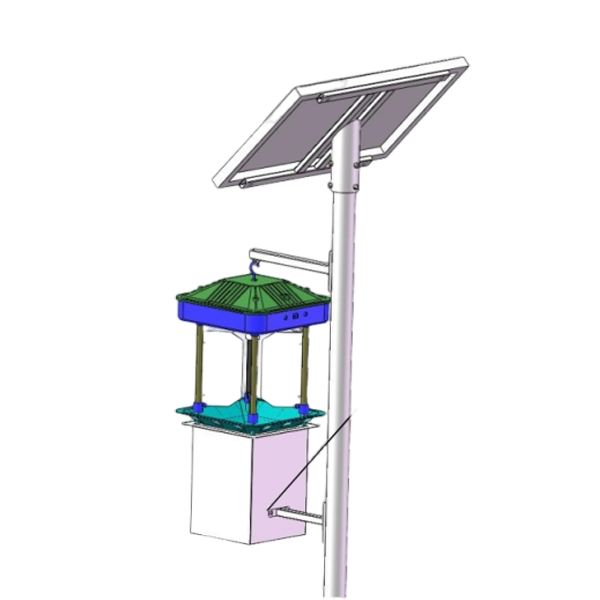
Head and collector shown; use the supplied maintenance instructions to identify accessible parts, not the illustration alone.
After permitted cleaning or reassembly, repeat the approved functional check and record whether the same symptom remains. A successful restart alone does not establish that collection will remain functional through the intended night.
Check the fan supply while the symptom occurs
If the expected fan state is on but operation is absent or intermittent, a competent technician can record the relevant supply conditions using the approved test points and procedure. Measure during the failed start or running event, not only after the load has stopped. Compare results with the supplied head and controller limits.
Where authorized, compare battery-side and head-input voltage under the same load. A difference can direct attention to wiring, connectors or the supply path. If the head input remains suitable but the fan does not operate as required, send the observation to NiuBoL for model-specific controller or fan checks. Neither pattern alone identifies which part must be replaced.
Do not use the published fan power as a fault-current threshold. Do not create a universal minimum terminal voltage or field RPM pass limit from catalogue text. Starting current, control mode and the delivered revision matter. Replacement testing also needs electrical and mechanical compatibility; a similarly sized generic fan is not automatically an approved substitute.
Demonstrate the sequence, then observe the night
Separate a controlled functional demonstration from an overnight observation. First use the supplier's approved procedure to show the expected light and fan states in the selected mode, the appropriate collection arrangement and any approved airflow check. Operate with protective parts fitted. Do not defeat moisture, temperature or low-voltage protection to make the demonstration pass.
Then observe the actual installation through the agreed night window. Record when the light and fan are required to operate and when their operation is observed. Mark any intentional stop, unexplained interruption or period that was not observed. An end-of-night photograph cannot establish uninterrupted fan operation.
If the project needs continuous evidence, agree a suitable observation or measurement method. Local automatic control does not establish a remote fan-status register. An electrical current record can support an operating check but does not, by itself, prove an unobstructed airflow path or retained insects. Confirm the specific states and interfaces available before promising remote diagnosis.
Retest the original symptom after correction under the same relevant settings. State whether the result demonstrates startup, the controlled sequence or the complete agreed night. Do not label an unobserved interval as verified simply because the light was still on at the next visit.
Keep the handover useful for the next service visit
The handover should identify the model, fan/collector configuration, selected mode and documented sequence. Include the symptom and timestamp, inspection findings, approved tests and any unresolved intervals. This gives the next technician a basis for comparison without inventing a universal maintenance interval or capture threshold.
If the mechanism completes its checks but catches remain unexpectedly low, investigate the field question separately. The lamp-location and catch-comparison guide explains why location and operating conditions affect observations. Do not increase battery capacity or replace the fan solely to make an insect count rise.
Wind-suction trap troubleshooting FAQ
Q1. The light is on. Should the fan also be running?
Check the documented sequence for the supplied mode. The attraction light alone does not establish the commanded fan state; confirm the expected state before calling it a fault.
Q2. Does fan noise prove that suction is adequate?
No. Use the supplier's approved functional or airflow check and inspect the permitted parts of the flow path after safe isolation. Noise is not an airflow measurement.
Q3. Can I test suction with paper held inside the inlet?
Do not insert loose material, hands or tools into energized moving parts. Obtain the approved test procedure and keep guards in place during operation.
Q4. Should I replace the battery if the fan stops?
Not without evidence. Check expected state, protection indications and supply conditions during the event. A control, connection or fan problem can require a different repair.
Q5. Does a full night with an empty collector prove no pests were present?
No. First verify mechanism operation and the actual observation period, then assess location and the target insect. Electrical acceptance is not a biological absence test.
Q6. Can NiuBoL diagnose fan operation through our gateway?
Only if the delivered equipment exposes suitable status through a confirmed interface. Local automatic control does not establish remote fan or airflow diagnostics.
Accept the capture mechanism, not just a visible light
A useful night check establishes the expected light/fan sequence, a serviceable airflow and collection path, and evidence of operation during the agreed period. Investigate those functions separately from battery autonomy and pest abundance. That separation makes a light-on, low-collection complaint actionable without guessing which component failed.
For configuration or replacement support, contact NiuBoL with the model photo, a short description or safely recorded video of the symptom, and the selected operating mode. We can check the supplied wind-suction configuration and confirm suitable service or replacement options for quotation; any separate sensing or data-acquisition interface requires its own compatibility check.









