

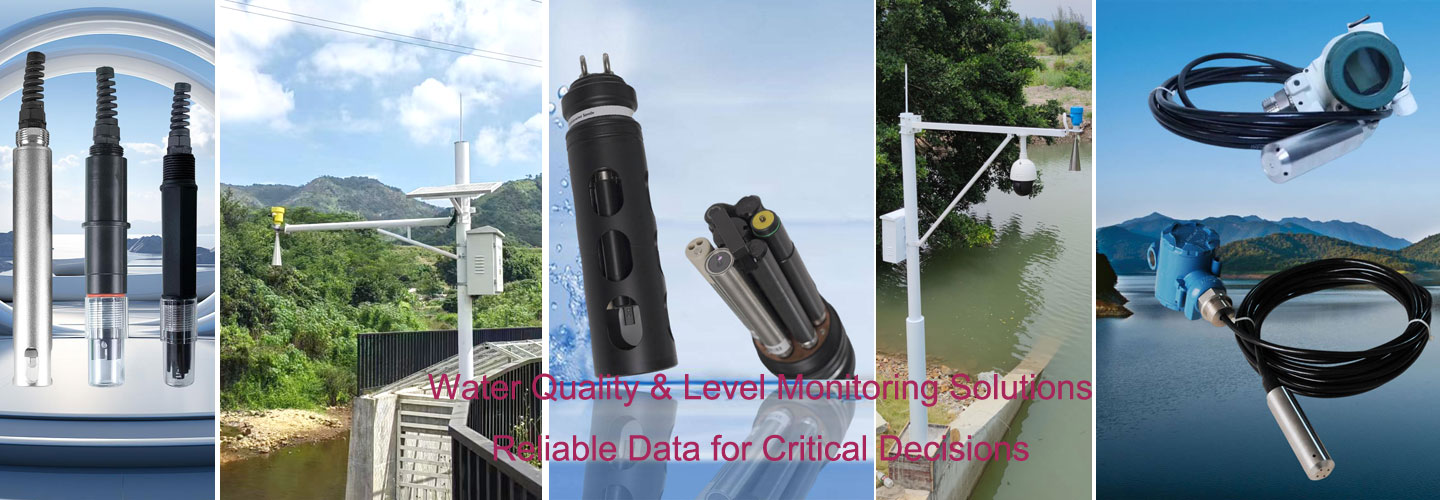
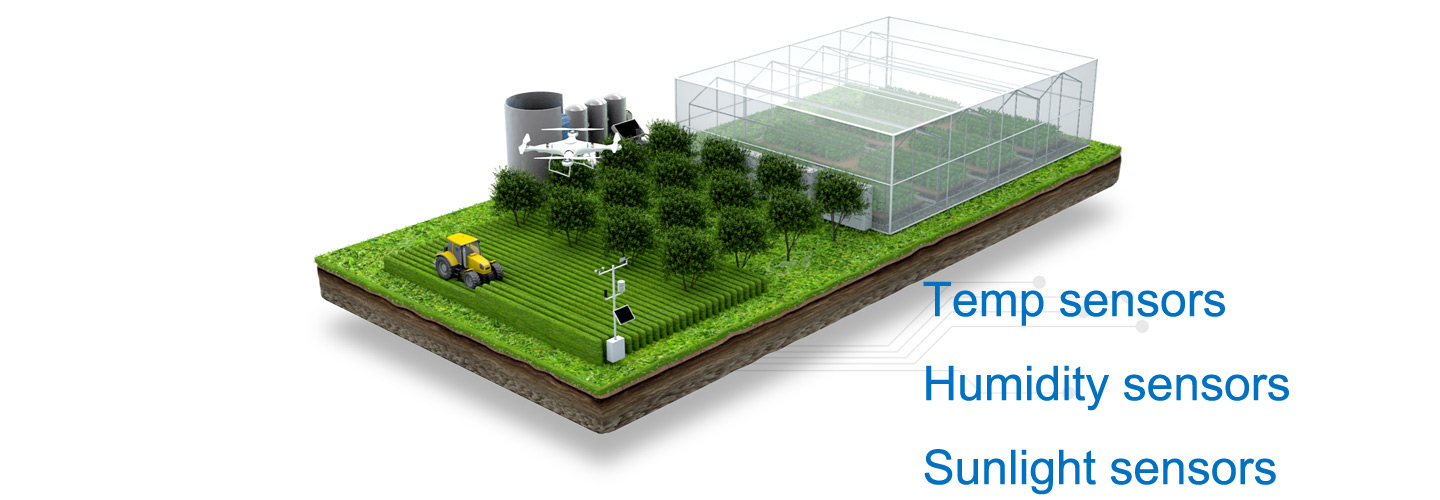

Before disconnecting the modem, ask who can still stop the water. In an irrigation control system, losing the cloud connection, losing the sensor bus and losing panel power are different faults. A screen that continues showing yesterday's moisture reading does not prove that today's local control is working.
The purchasing decision is whether the installed controller has an approved, tested operating policy for each failure. Gateway memory, an RS485 connector or a relay output does not establish an offline watering schedule. Start with the division of responsibility, then test behavior on the exact hardware and software being supplied.
Separate the monitoring path from the valve controller
The sensor measures a condition. A logger or gateway reads and transports that measurement. The local controller decides whether an event is permitted, and the actuator circuit operates the valve. One device can perform several roles, but each required function still needs evidence.
The NiuBoL Smart Data Collector page identifies a TG451 edge gateway with serial interfaces and relay-control interfaces. Those interfaces can support an integration; they do not prove that an irrigation application, an offline schedule or a particular restart policy is installed.
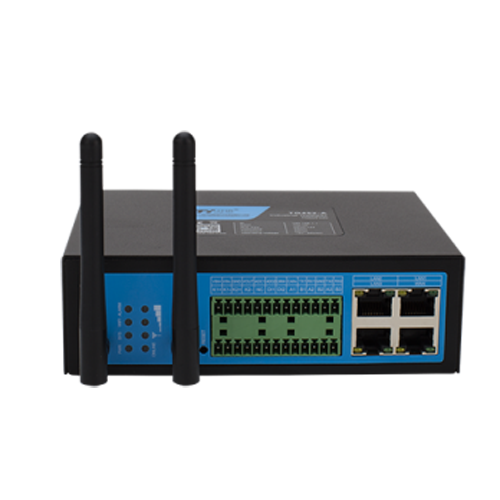
TG451 data-collection and communication hardware. The pictured component is not evidence of a complete irrigation controller or validated safety function.
Write the controller model, firmware or application version and owner of the operating logic into the purchase scope. If that role belongs to an existing PLC, retain it explicitly. Do not replace a working local controller with a router on the assumption that edge computing means ready-made valve control.
Agree the permitted action for each fault
There is no universal rule that loss of telemetry must either close every valve or continue the last schedule. The approved response depends on the crop, water source, actuator and consequences of interrupted or excessive watering. The site owner and responsible controls integrator must agree it before acceptance.
A communications timeout is a software decision about missing messages. A processor watchdog detects a different problem and may reset a device. Neither function, by its name alone, establishes the valve's physical position or proves that a local timer will survive a restart.
| Fault or condition | What the acceptance specification must answer |
|---|---|
| Cloud or mobile uplink lost | Which local functions remain permitted, and how is the outage indicated? |
| Soil sensor unavailable | Are moisture-based starts inhibited, or is a separately approved fallback allowed? |
| Measurement too old | Which decisions reject it, and where is its age calculated? |
| Active watering when the link fails | What locally enforced stop condition remains effective? |
| Controller restarts | Which state, schedule and execution records survive, and what requires operator review? |
| Panel supply fails | What actually happens to each actuator and the local clock? |
| Communications returns | How are expired commands and already executed events handled? |
| Operator places a local hold | Can any remote or cached action override it, and who can release it? |
For an actuator designed to close when de-energized, verify that behavior in the installed arrangement. A latching valve can retain its position without continuous power. A relay state is not a valve-position measurement, and a stop command is not proof that water has stopped. Do not describe the whole installation as a certified safety system on the basis of these monitoring functions.
Treat measurement age as a control input
Keep acquisition time separate from receipt time. When a gateway forwards a stored soil reading after an outage, the server has received a new message containing old information. Replacing the acquisition timestamp with upload time can make stale data appear suitable for a fresh watering decision.
Agree a maximum usable age for each decision with the process owner; do not borrow a timeout from a different sensor or crop. Preserve invalid and missing states instead of converting them to zero moisture or zero rainfall. A live modem connection does not establish a live soil measurement.
Also separate conditions that permit a start from those needed to finish an active event. If soil feedback disappears during watering, the approved local stop rule must still be defined. Record whether operation stopped, continued within an existing limit or required operator intervention, rather than leaving an unexplained gap in the event history.
Ask what an offline schedule really contains
A cached measurement archive is not a cached executable schedule. For any required offline operation, ask the controller supplier to demonstrate schedule retention, expiry, allowed operating periods and locally enforced duration or volume limits. Include which sensor and equipment conditions remain mandatory.
Clock validity matters more than a memory-capacity headline. Specify the time basis, synchronization method, holdover requirement and response to an unset clock. A retained schedule should not become permission to run at an arbitrary time after a power interruption. If the clock changes backward, confirm that a previously completed event cannot silently become due again.
The TG501 RTU page describes data acquisition and 4G transmission, RS485/RS232 interfaces and configuration-dependent switching I/O. It is a candidate for the monitoring and integration layer. Confirm the ordered outputs and software; the page does not establish the application-specific offline behavior above.
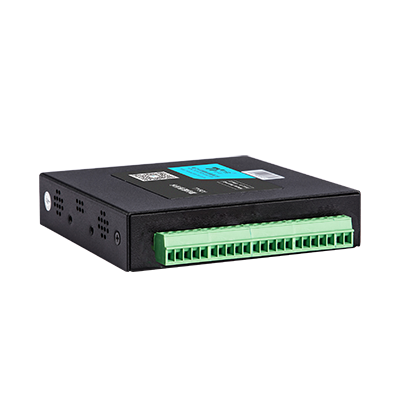
RTU monitoring and I/O hardware. Local scheduling, actuator compatibility and recovery behavior must be confirmed for the supplied configuration.
The existing guide to offline data logging and store-and-forward covers preserving and forwarding measurement records. Use that for telemetry retention. Acceptance of a watering action needs a separate controller test.
Reconnect without blindly repeating watering
Define measurement backfill and command recovery as separate paths. Uploading historical observations may be useful; replaying every missed start command can water a crop again after the need has passed. An old schedule is not an automatic instruction to make up every missed event.
Require durable event identities, expiry rules and an execution history appropriate to the controller design. A sequence number can help, but comparing only the highest number can hide skipped or uncertain events. Reboot, counter reuse and out-of-order messages must not silently turn one event into two.
A network acknowledgment proves only the acknowledgment boundary it represents. Keep command received, action started, action completed and delivery verified distinguishable. If power fails between actuation and recording the result, the outcome may be uncertain. Route that case to the approved reconciliation rule rather than claiming exactly-once physical watering from a message flag.
Make any catch-up watering a new authorized decision based on current conditions and the recorded uncertainty. Preserve local holds during reconnect, and retain who approved the next action.
Use a witnessed outage test before handover
Run disruptive tests on an isolated commissioning setup or through an approved site procedure. Save the configuration and establish how the operator will stop the test. Do not interrupt a live crop process merely to prove that a gateway reconnects.
- Remove the uplink while local devices remain powered. Compare the agreed policy with actual permitted starts and stops.
- Leave the uplink working but stop sensor updates. Confirm stale or invalid readings are visibly rejected where required.
- Interrupt controller power at an agreed point. Inspect retained schedule, clock validity and uncertain event handling after restart.
- Resend a completed command and present an expired command. Verify the agreed rejection and logging rules.
- Restore communications while a local hold is active. Confirm the hold remains effective and history is reconciled before further operation.
Retain actual test times, configuration version, observed actuator or delivery evidence, skipped-event reasons and operator actions. Mark untested cases explicitly. A successful modem reconnect alone is not acceptance of offline irrigation control.
Questions to settle before ordering
Q1. Will an RS485 gateway keep irrigating without 4G?
Not necessarily. It can remain a measurement interface while an existing controller operates locally. Autonomous watering requires a verified local application and suitable actuator circuitry, not just continued sensor polling.
Q2. Should every valve close on communication failure?
That must be an approved site policy, not a universal claim. Verify the installed actuator behavior and the controller's response separately, including what happens when power is also lost.
Q3. Does local storage guarantee an offline schedule?
No. Measurement storage, execution records and schedules have different purposes. Ask for the exact schedule function, its limits and a demonstration with the ordered software.
Q4. Can restored measurements immediately trigger irrigation?
Only when their quality and age satisfy the approved rule. Delayed records must retain their acquisition time and must not be mistaken for current conditions.
Q5. What prevents duplicate watering after a lost acknowledgment?
The controller needs persistent event tracking and a defined rule for uncertain outcomes. A retransmitted message, a broker acknowledgment or a high sequence number alone does not prove the physical event completed once.
Q6. Can an operator take control during an outage?
Only through the supported local facilities and agreed procedure. Test access without cloud dependence, record overrides and specify how automatic control is deliberately restored.
Buy against demonstrated behavior
Offline irrigation control is a set of tested decisions, not a gateway feature inferred from storage capacity. Define stale-data handling, local stop conditions, clock recovery and command reconciliation, then retain the evidence for the supplied configuration.
Contact NiuBoL with the existing controller model or panel photo, required sensor interfaces and the outage behavior you need. We can help select monitoring sensors and acquisition or gateway components, confirm available interfaces and quote that scope alongside your controller integration requirements.