





— Blogs —
—Products—
 Consumer hotline +8618073152920
 WhatsApp:+8615367865107
Address:Room 102, District D, Houhu Industrial Park, Yuelu District, Changsha City, Hunan Province, China
Product knowledge
Time:2026-02-07 15:28:37 Popularity:629
Quick Answer: An ultrasonic integrated weather station reduces separate sensor bodies, but reliable operation still depends on its selected channels, exposure, electrical limits and data handling. For the NiuBoL NBL-W-10GUWS configuration, check the full-scale wind accuracy term, optional rainfall and particulate channels, and the logger's decoding before accepting the installation. No rotating cups does not mean no maintenance.
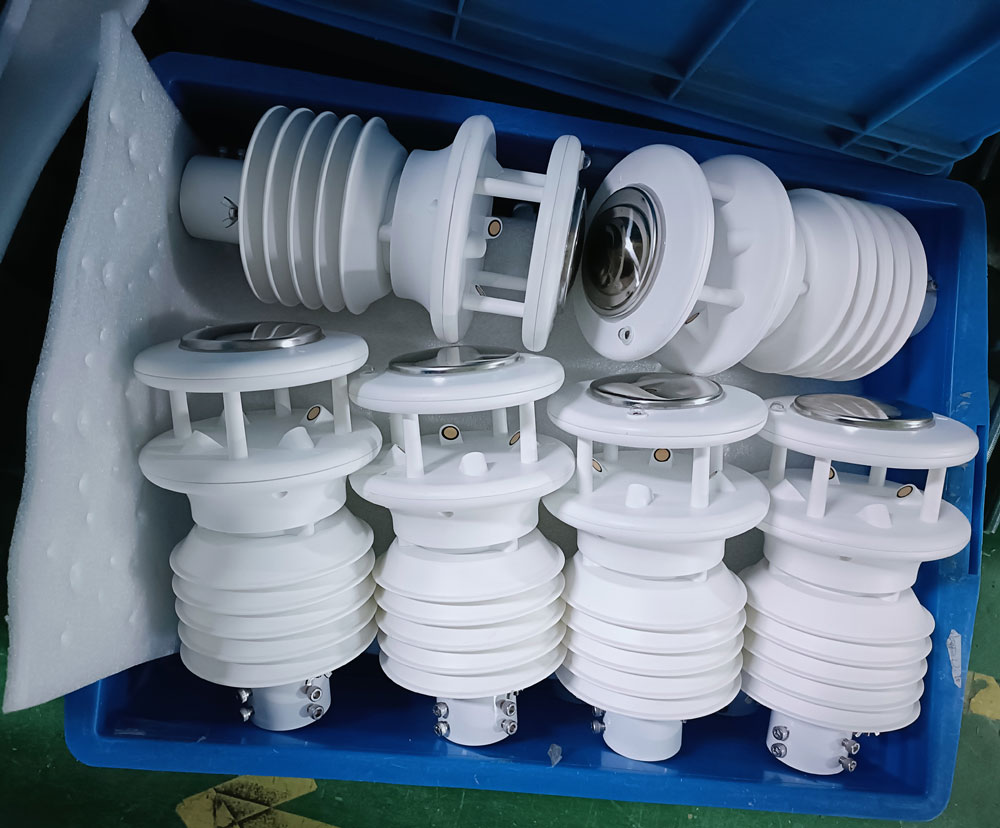
The NBL-W-10GUWS family combines ultrasonic wind speed and direction with atmospheric temperature, RH and pressure. Other channels are options, not proof that every delivered head measures every environmental quantity. Similar compact housings may contain different sensor combinations.
Define the channels needed by the project before choosing the head. A weather record, a solar-resource observation and a construction-site environmental display need different measurements. Adding a particle or noise channel should follow an actual requirement rather than an assumption that more channels improve every decision.
Integration can simplify mounting and serial wiring, but the common location must suit the measurements. If the method requires different heights or exposure for wind, air temperature and rainfall, consider separate instruments or additional reference points. One integrated housing cannot physically occupy several observation positions at once.
Ultrasonic wind measurement compares acoustic transit times along opposing paths. It avoids conventional cup bearings and a rotating vane. Airflow disturbed by a mast, building or deposited material can still change the result, and a blocked acoustic path is not repaired by applying a software offset.
For the 0-60 m/s NBL-W-10GUWS configuration, the wind accuracy expression is +/- (0.3 m/s + 3% FS). The full-scale term is 1.8 m/s, making the combined stated allowance 2.1 m/s. It is not 3% of the current reading.
For illustration, replacing FS with a 5 m/s reading would produce 0.45 m/s, which is a different and incorrect interpretation of that specification. At low wind speeds this distinction can change whether the instrument meets the project's uncertainty requirement. Evaluate the full expression rather than selecting from resolution alone.
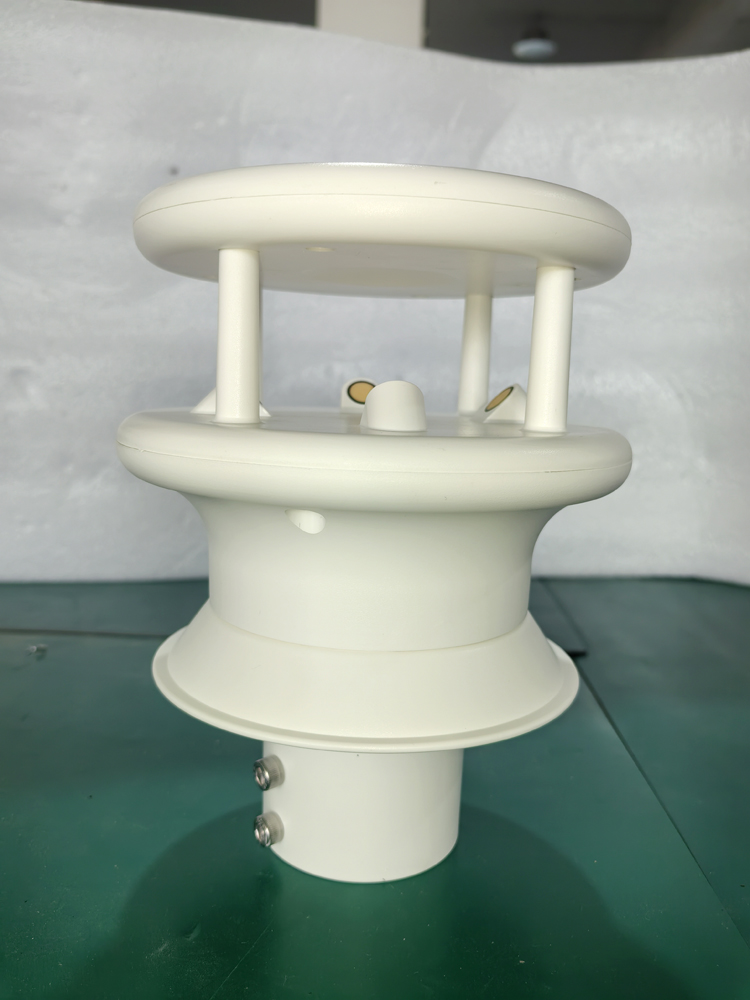
The values below apply to this configuration. They should not be transferred to a two-parameter wind-only head, a different compact model or an entire station including its logger and power system.
| Parameter | Configuration and limit |
|---|---|
| Wind speed | 0-60 m/s; +/- (0.3 m/s + 3% FS); resolution 0.01 m/s |
| Wind direction | 0-359 degrees; stated accuracy +/-3 degrees; resolution 1 degree |
| Air temperature | -40 to 80 degrees C; stated accuracy +/-0.5 degrees C |
| Relative humidity | 0-100% RH measurement span; stated accuracy +/-5% RH |
| Atmospheric pressure | 10-1100 hPa; stated accuracy +/-1.5 hPa |
| Supply and output | 9-24 VDC; RS485 / Modbus RTU; 9600 bit/s configuration |
| Average sensor power | 0.4 W without the dust sensor; 1 W with the dust sensor; heating requires separate power confirmation |
| Operating environment | -40 to 80 degrees C; 0-95% RH |
| Ingress protection | IP65 sensor assembly; does not establish protection of external connectors or the data logger |
| Optional rainfall | 0-8 mm/min; resolution 0.01 mm; stated accuracy +/-10% |
| Optional radiation or illuminance | 0-1500 W/m2 radiation or 0-200000 lux illuminance; these options are alternatives in this configuration |
| Optional particles | PM2.5 0-1000 ug/m3 and PM10 0-2000 ug/m3; verify required reporting suitability |
| Optional noise | 30-130 dB; stated accuracy +/-5 dB, not evidence of an acoustic instrument class |
| Cable and connector | Specify length, jacket, shielding and mating connector for the order and exposure; do not infer them from the IP rating |
The RH measurement span and electronics operating-humidity limit are not the same specification. Likewise, the temperature range does not guarantee valid wind measurements through any amount of ice. If heating is required, confirm the fitted option and its performance and electrical demand separately.
When fitted, the rainfall channel uses piezoelectric response to drop impacts and an instrument-specific conversion to rainfall. It is not optical rainfall sensing. Momentum m x v and kinetic energy one-half m x v squared are different physical quantities; neither simple expression alone provides a field calibration for rainfall.
Specify whether the host needs a one-minute rainfall amount, rainfall intensity or a cumulative total. The NBL-W-10GUWS data arrangement distinguishes minute rainfall from accumulation. Repeatedly polling the same minute value and adding every reply can overcount the event.
For example, a minute amount of 0.20 mm represents an average intensity of 12 mm/h over that minute. Reading it five times during the minute does not make it 1.00 mm. Check minute boundaries, reset behavior and cumulative increments with the selected firmware before calculating event totals.
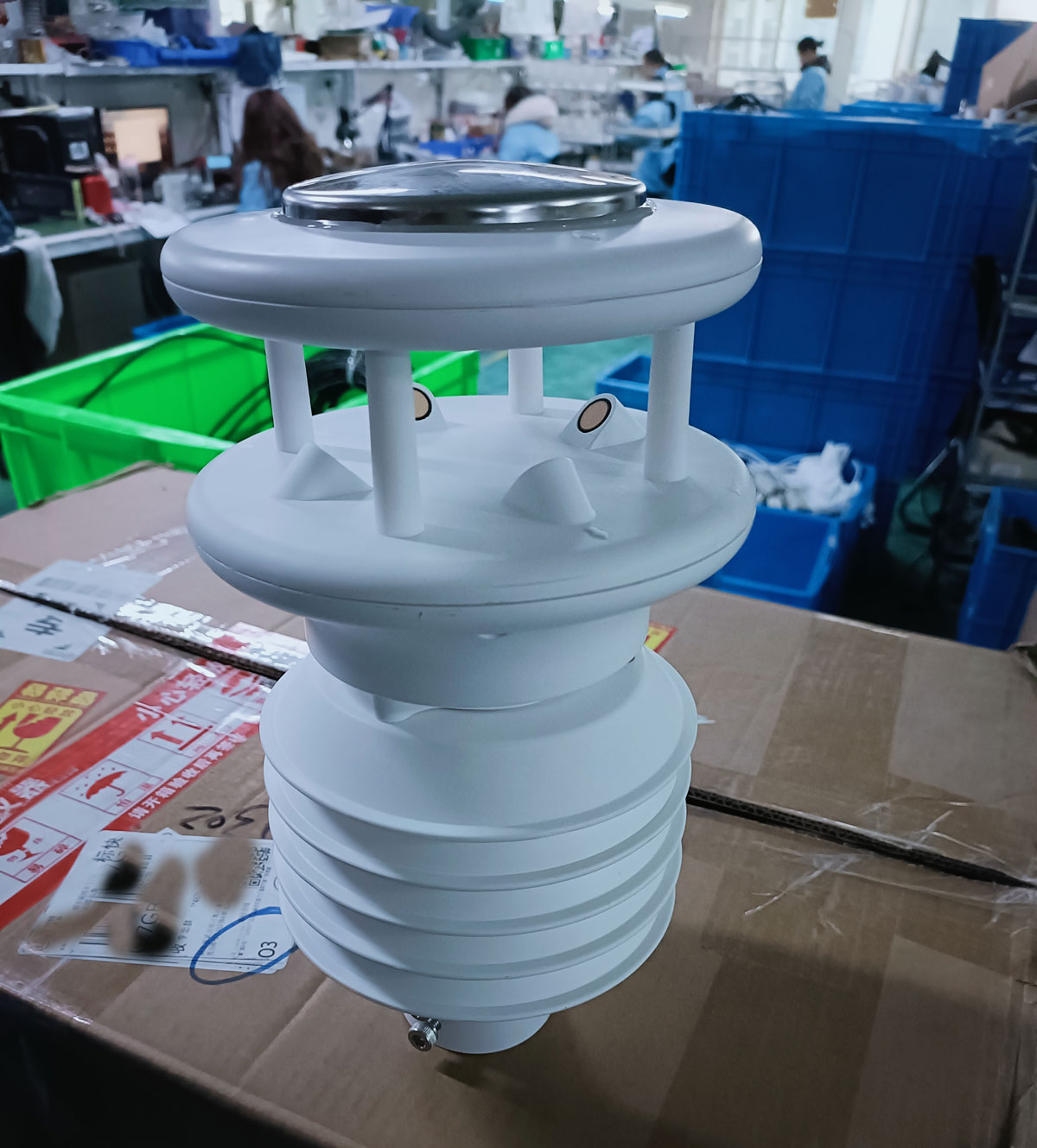
A light-scattering particle channel measures an optical response associated with airborne particles. Humidity, contamination and aerosol properties can affect interpretation. Do not assume that a temperature/RH channel proves the presence of a validated particle-humidity correction algorithm or establishes equivalence to a regulatory reference method.
For noise, define the acoustic quantity, weighting, averaging and required instrument class before ordering. A dB range alone cannot establish those functions. For solar observations, use W/m2 when irradiance is required; a lux channel cannot be substituted by changing the unit label in software.
Derived values also need a defined calculation. Temperature and RH can support a dew-point estimate in suitable software, but that does not mean the sensor includes a commissioned frost-protection controller. Keep measurement, calculation, alarm and physical control responsibilities separate.
At the stated average powers, the sensor consumes 9.6 Wh/day without the dust option or 24 Wh/day with it. These are sensor-only calculations. A modem, data logger, conversion loss and any heater add demand, so they must be included before assigning battery reserve.
Verify supply voltage at the head during normal operation and communications activity, not only at an unloaded cabinet terminal. Match the field cable and connector, provide strain relief and protect connections against their actual exposure. An unsuitable joint can fail while the sealed sensor remains intact.
RS485 / Modbus RTU is the field interface, not a declaration of native cellular or Ethernet service. A compatible PLC, RTU or data logger polls the head and transfers records as required. Confirm one request source on the serial bus and the appropriate command timing for the delivered revision.
For this communication configuration, allow at least 1000 ms between communications. Polling every available register as separate rapid requests can violate that timing. Read a supported block where appropriate and verify the complete scan period with the selected channels. Faster requests cannot make a slow physical measurement respond faster.
In the configuration's sample mapping, a wind-speed integer of 272 represents 2.72 m/s; temperature 250 represents 25.0 degrees C. Negative temperatures require signed decoding: 0xFF65 represents -155, or -15.5 degrees C at a 0.1-degree scale. Treating that word as unsigned produces a plausible communications frame but a false temperature.
Only expose configured channels in the final tag list. An empty register for an absent radiation or particle option should not become a measured zero. Confirm the mapping with a known condition and a response capture, including the units used by the destination platform.
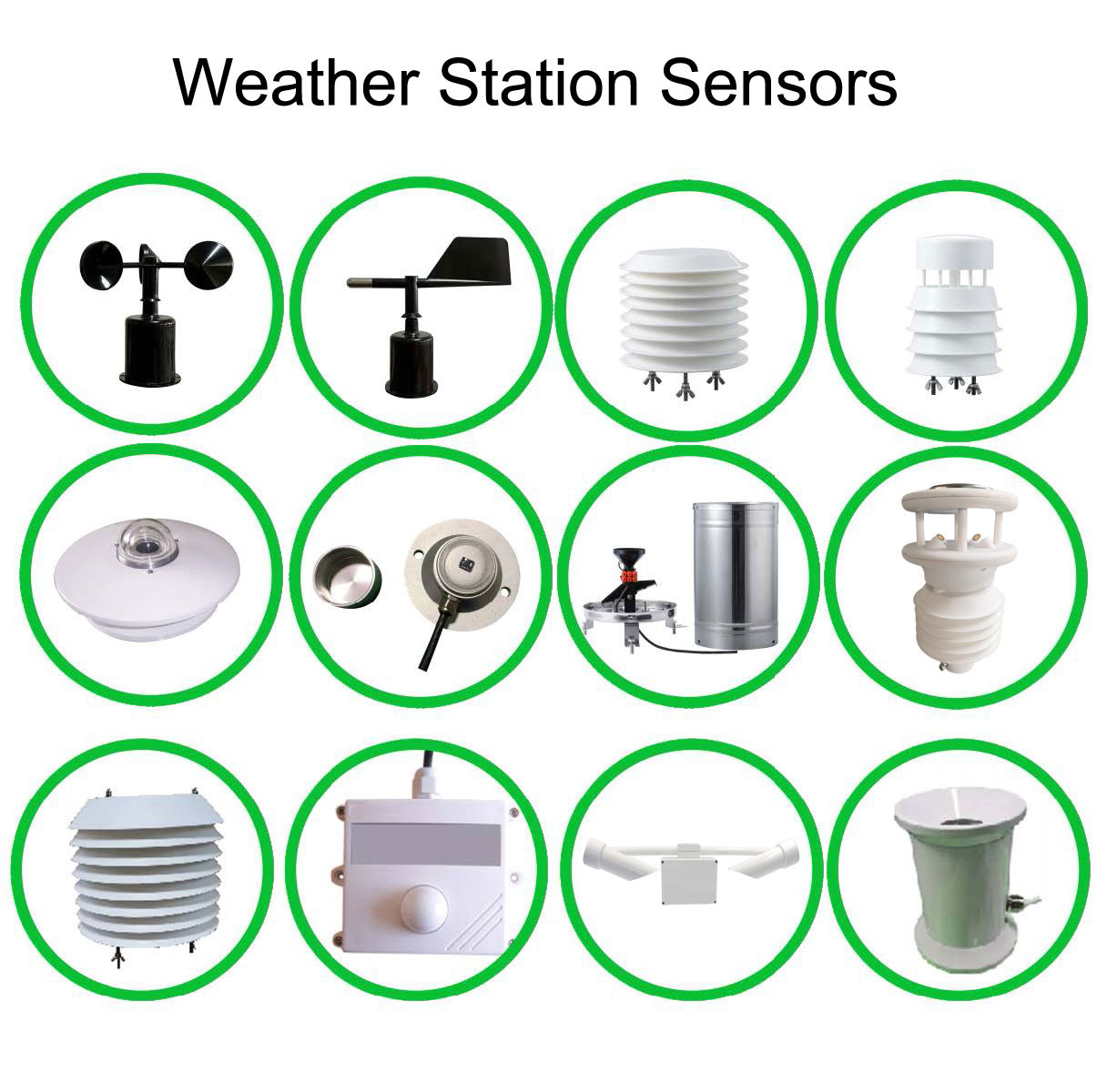
Set the direction reference to the project's geographic orientation and document any applied offset. A compass observation may need local magnetic-declination correction and can be disturbed by nearby steel. Do not assume that the head automatically finds north when power is applied.
Choose a rigid mounting position with suitable airflow and access for inspection. If a radio or radar transmitter is nearby, conduct a site-specific interference assessment. A nominal separation distance is not a universal electromagnetic-compatibility clearance for every transmitter power and antenna arrangement.
Do not add vibration-isolating pads or alter a support without reviewing stability and exposure. Service checks should cover the acoustic paths, rainfall sensing surface where fitted, particle inlet, connector seals and alignment. A broad claim of unchanged lifetime accuracy would overlook these field conditions.
Investigate a discrepancy before recalibrating. Compare like-for-like heights and averaging methods; an open-field reference and a roof-edge installation can disagree because their winds differ. An offset can conceal the installation effect while degrading the result under another wind direction.
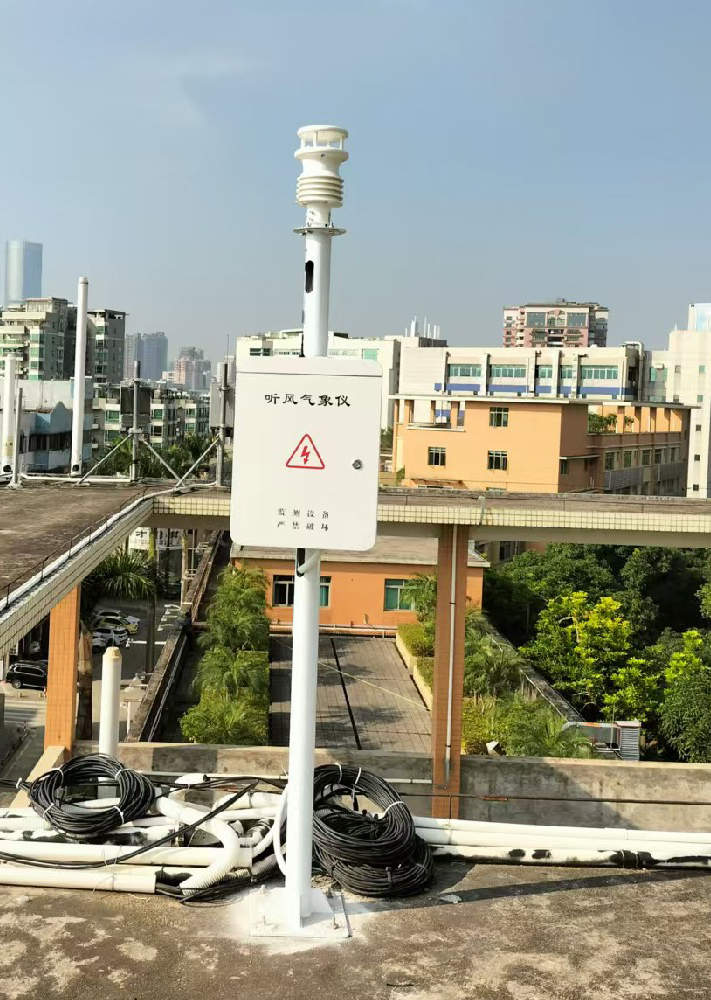
Yes. It avoids conventional rotating wind components but still needs checks for fouling, obstruction, alignment, connections and the fitted optional channels. Choose service intervals from exposure and observed condition rather than declaring the assembly maintenance-free.
For a 60 m/s full scale, 3% FS is 1.8 m/s regardless of the present wind reading. Together with the 0.3 m/s term, the stated expression gives 2.1 m/s. It must not be replaced with 3% of the measured value.
No. They are alternative options in this configuration. Select the quantity the application needs and verify the actual tag list. Illuminance in lux is not solar irradiance in W/m2.
No. Resolution is an output increment. Verify the stated accuracy, exposure and rainfall-processing method separately, including whether the host reads minute amounts, intensity or an accumulated counter.
Not automatically. Include dust sensing, heating if supplied, the logger and uplink duty in the load calculation, then review usable battery capacity and seasonal recharge. The sensor's base-power figure is not a complete-station autonomy claim.
Match the included channels, voltage, connector, cable definitions, register mapping and orientation method. A similar housing or the same RS485 interface does not make the replacement interchangeable without configuration checks.
Provide the required channels, accuracy conditions, site exposure, existing acquisition equipment and power arrangement. Include any measurement-method or reporting requirements so NiuBoL can distinguish basic environmental observation from applications needing separate qualified instruments.
An ultrasonic integrated weather station is useful when the compact configuration matches the measurement task and the data chain is checked end to end. For the NBL-W-10GUWS, confirm full-scale accuracy, option selection and decoded records before relying on alarms. Send NiuBoL the channel list and installation conditions for a configuration review.
 All-in-One-Ultrasonic-Weather-Sensor-Instruction-Manual.pdf
NBL-W-61MUWS-Ultrasonic-Weather-Station-Instruction-Manual.pdf
Prev:Tower Crane Dust Monitor: Placement, Sampling and Safe Access
Next:6-in-1 Weather Station Layout: Integrated or Separate Rain Gauge?
Related recommendations
Sensors & Weather Stations Catalog
Agriculture Sensors and Weather Stations Catalog-NiuBoL.pdf
Weather Stations Catalog-NiuBoL.pdf
Agriculture Sensors Catalog-NiuBoL.pdf
Water Quality Sensor Catalog-NiuBoL.pdf
Related products
 Combined air temperature and relative humidity sensor
 TDR Soil Moisture & Temperature Sensor for irrigation| RS485 |4-20mA| NBL-S-THR
 Soil pH sensor RS485 soil Testing instrument soil ph meter for agriculture |NBL-S-PH
 Wind Speed sensor Output Modbus/RS485/Analog/0-5V/4-20mA
 Tipping bucket rain gauge for weather monitoring auto rainfall sensor RS485/Outdoor/stainless steel
 Pyranometer Solar Radiation Sensor 4-20mA/RS485

Screenshot, WhatsApp to identify the QR code
WhatsApp number:+8615367865107
(Click on WhatsApp to copy and add friends)

