





— Blogs —
—Products—
 Consumer hotline +8618073152920
WhatsApp:+8615367865107
Address:Room 102, District D, Houhu Industrial Park, Yuelu District, Changsha City, Hunan Province, China
Product knowledge
Time:2026-02-03 13:29:34 Popularity:609
Agricultural weather station model inputs need an agreed meaning before they are useful to irrigation, crop-development or disease-risk software. Air temperature at a field reference point is not leaf temperature. Solar irradiance is not illuminance, and measured rainfall is not automatically effective root-zone recharge. A NiuBoL station can supply the observations, but the integrator must connect the correct variables, units, exposure and time periods to the selected agricultural model.
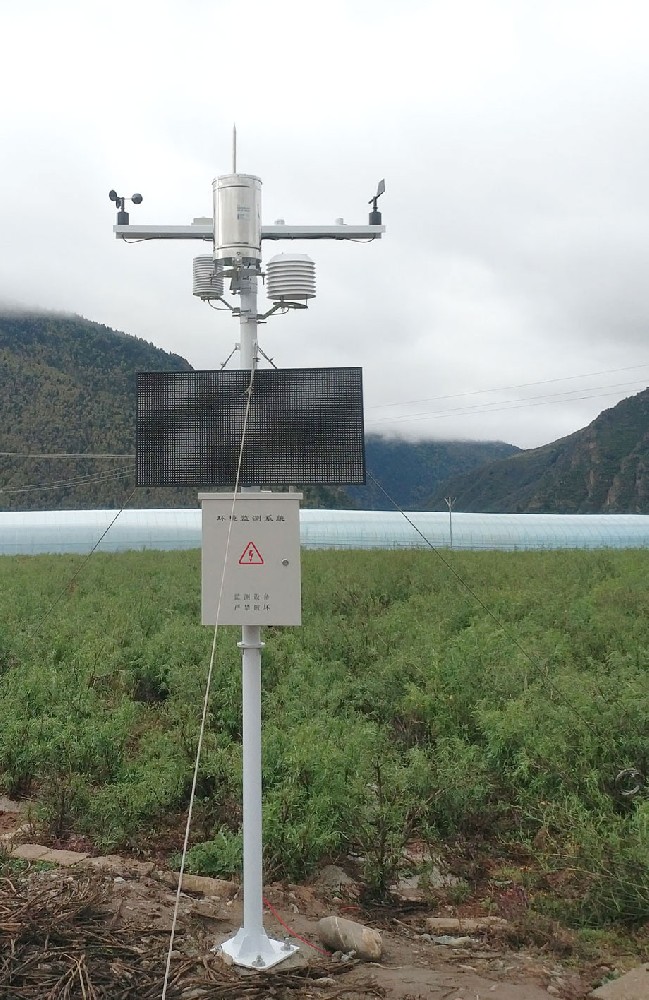
Ask the agronomy or software team for a variable dictionary before choosing the sensor count. It should identify each required quantity, unit, reporting interval, measurement height or depth, and permitted treatment of missing observations. Record whether a variable is directly measured, calculated locally, imported from a forecast or estimated from another quantity. An attractive dashboard can conceal those differences if every channel is presented simply as weather data.
For reference evapotranspiration (ETo), the FAO-56 Penman-Monteith approach uses radiation, air temperature, humidity and wind information with defined reference conditions. It is not a calculation based only on soil moisture or relative humidity. Its reference result is not the actual water use of every crop; crop and field conditions are separate parts of an irrigation assessment. Select the calculation method before substituting a conveniently available sensor channel.
| Application | Input to establish | Common wrong substitution |
|---|---|---|
| Reference ETo | Required weather variables, radiation basis and wind reference height | Using lux as broadband radiation or crop-canopy wind as an unqualified reference |
| Crop development | Temperature statistic, base temperature and model time step | Applying one crop's thermal threshold to every variety |
| Disease-risk model | Temperature and moisture variables required for that crop and pathogen | Replacing leaf wetness duration with air humidity without validation |
| Irrigation adjustment | Rainfall, root-zone observations and the selected water-balance method | Counting all collected rain as stored water available to roots |
This input list also defines the equipment scope. A five-channel weather head may supply wind, temperature, humidity and pressure while lacking radiation or rainfall. An instrument offering several optional channels does not necessarily include every option. List the purchased elements explicitly and check what the logger actually receives before commissioning the model.
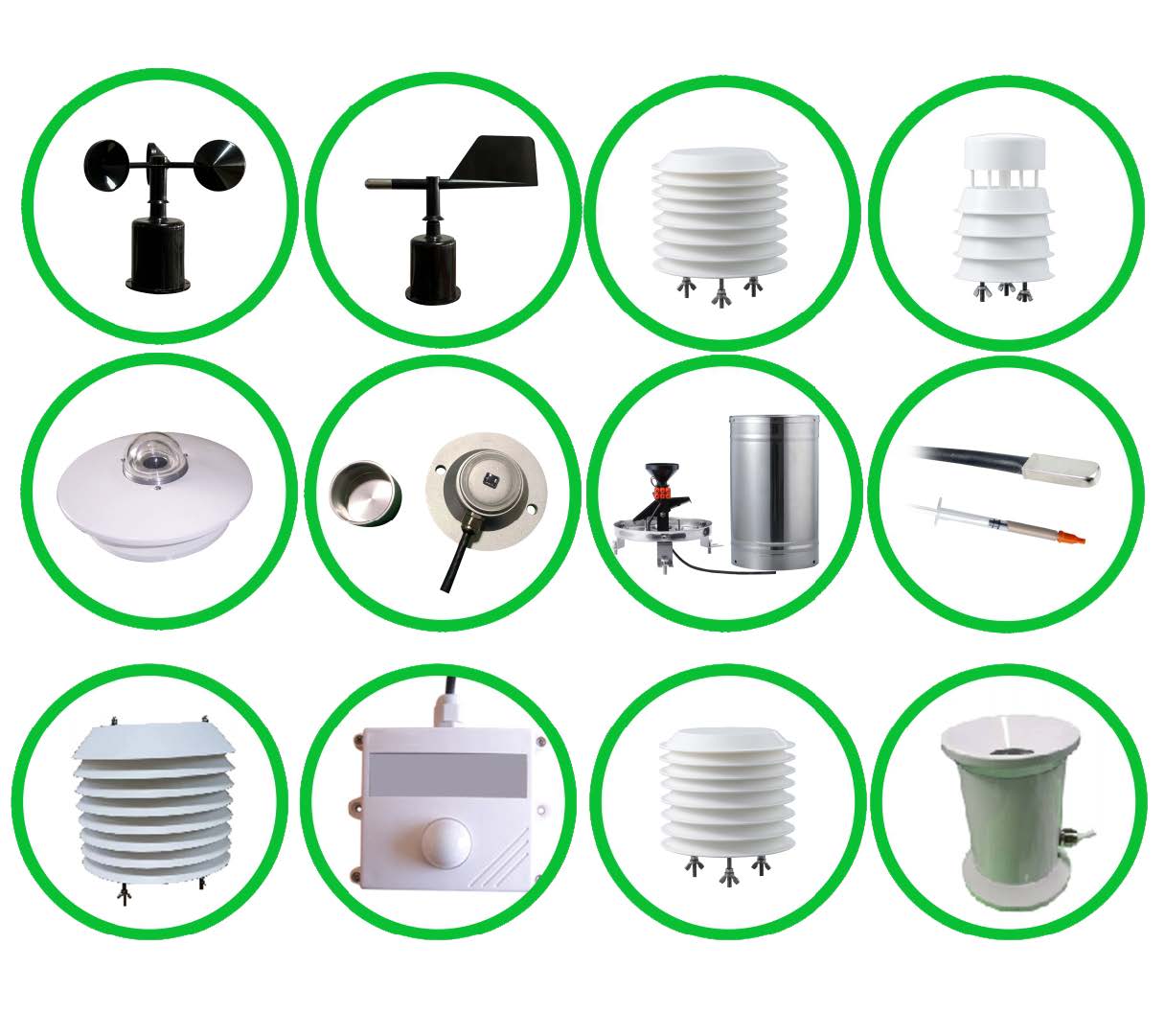
A reference weather point describes a defined exposure, while a sensor inside a canopy describes the local crop environment. Both can be useful, but their values answer different questions. A sheltered orchard-row temperature sensor can capture a cold pocket that a more open station does not. It should not replace the reference series silently, especially when the crop grows or pruning changes the exposure.
Record mounting height, shielding, neighboring obstacles and changes through the season. For wind, keep the measured height with the record and use the selected model's height treatment. A wind instrument on a 10 m mast is not an unmodified 2 m input. The FAO reference method uses wind standardized to 2 m; any conversion must follow an appropriate procedure and the actual exposure, rather than a fixed multiplier invented for the project.
For frost investigation, an air-temperature alarm does not itself establish tissue temperature or whether a protection method will work. Keep the crop stage and location-specific response procedure separate from the sensor. Do not use falling pressure as an independent frost predictor, or assume a weather station can automatically choose a safe protection action from one threshold.
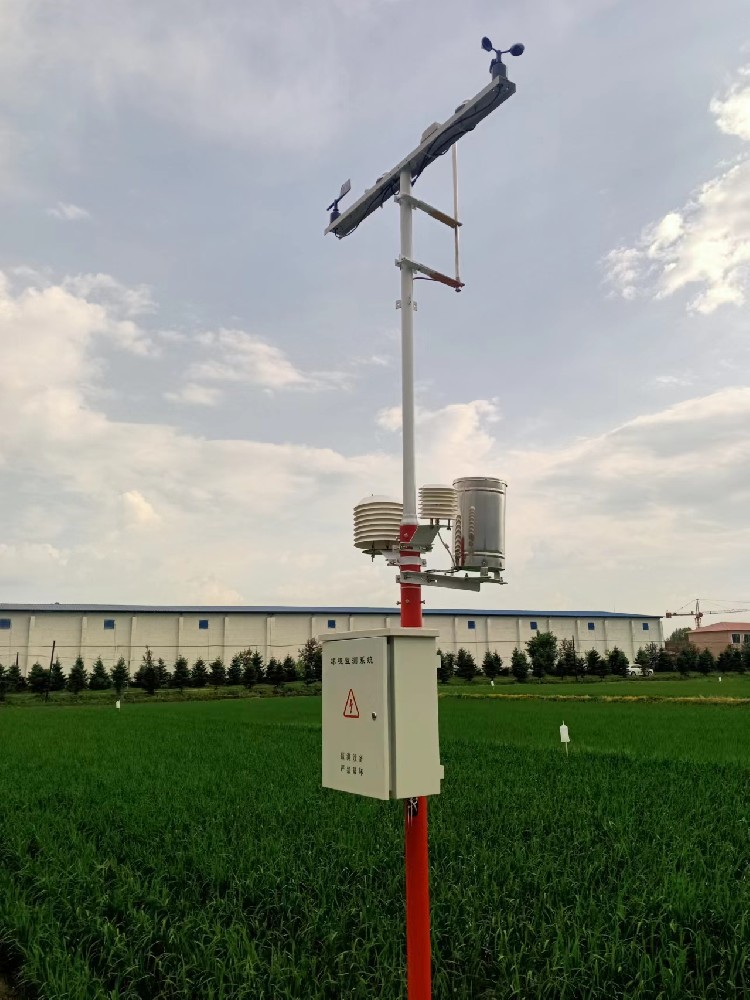
The NBL-W-LBTH temperature, humidity and pressure sensor is a possible source for these atmospheric channels. Its measurements remain distinct from the logger's derived variables. A dew-point value or vapor-pressure deficit shown by software needs a defined calculation and valid source observations; it should not be listed as a separately measured channel unless separate equipment is installed.
| LBTH channel or interface | Model specification |
|---|---|
| Air temperature | -40 to +80 C; +/-0.5 C accuracy; 0.1 C resolution |
| Relative humidity | 0-100% RH; +/-5% RH accuracy; 0.1% RH resolution |
| Atmospheric pressure | 10-1200 hPa; +/-1.5 hPa accuracy; 0.1 hPa resolution |
| Supply | 12-24 V DC configuration; confirm the ordered output version |
| Output options | RS485 Modbus RTU or selected 4-20 mA configuration |
| Digital acquisition | 9600 bps; at least 1000 ms between communications for the documented interface |
Do not assign those limits to the entire station. Other instruments, batteries and communication equipment have their own operating envelopes. Specify power consumption, protection rating, cable jacket and wiring for the actual supplied assembly rather than copying one probe's values across the equipment list. When separate NBL-W-SS and NBL-W-DS wind instruments are used, specify IP65 for those sensors.
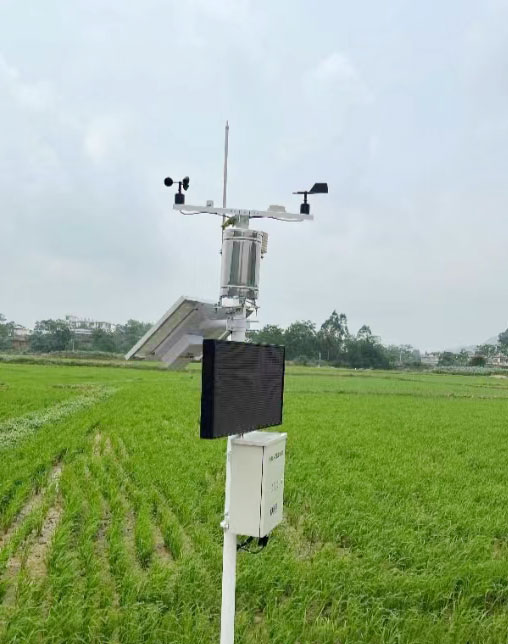
A pyranometer such as NBL-W-HPRS measures broadband solar irradiance, with a 0-2000 W/m2 measuring range for this model. A PAR instrument addresses photosynthetically active radiation, while a lux instrument describes illuminance. They cannot be exchanged by relabeling a software tag. Select the quantity the model expects, and document any validated conversion rather than applying a universal light-to-radiation factor.
Some calculations need accumulated energy rather than an instantaneous irradiance. For an illustrative constant 400 W/m2 over one hour, energy is 400 x 3600 / 1000000 = 1.44 MJ/m2. That is not the energy of a whole day. Integrate over the required interval using valid observations, and mark gaps or estimates. A midday reading multiplied across all 24 hours would manufacture nighttime solar input.
For the HPRS model, output and supply options must match the ordered instrument and logger input. A millivolt thermopile signal, an amplified voltage, a current loop and RS485 require different acquisition arrangements. Keep the calibration sensitivity with a raw millivolt installation. Purchasing a digital logger does not make an analog radiation element directly compatible with it.
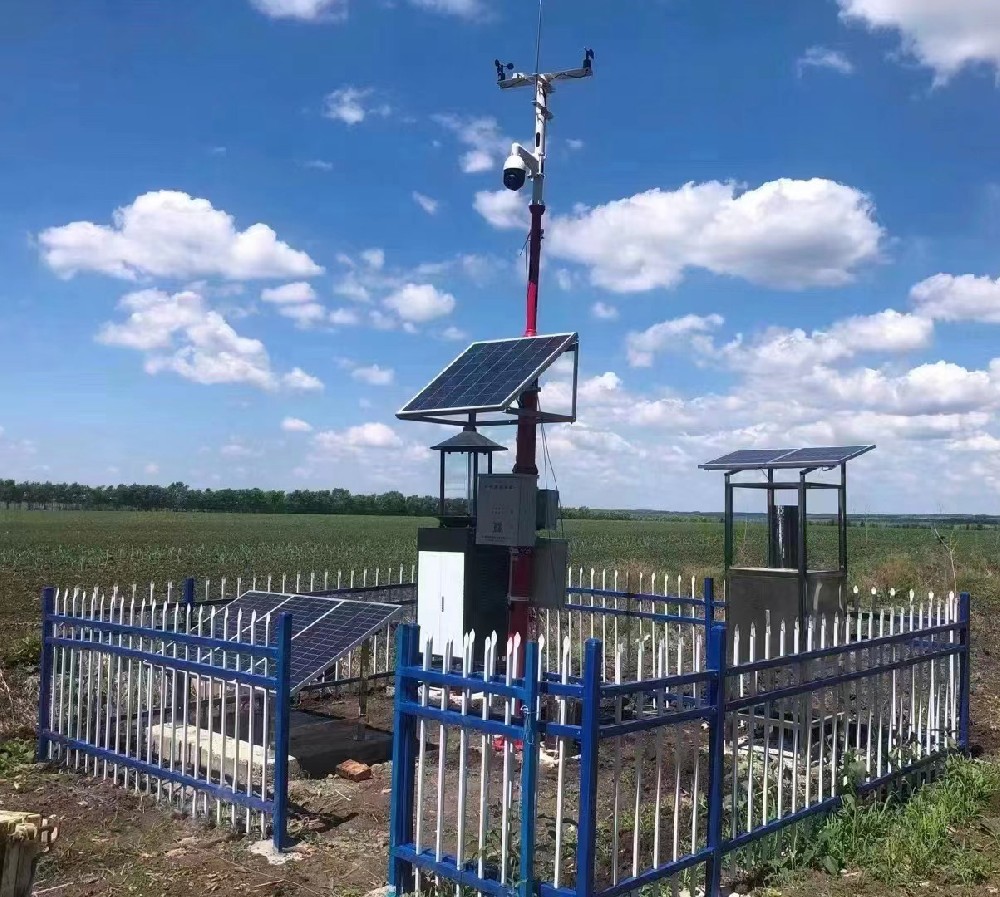
Rain collected above the field may run off, be intercepted by foliage or drain below roots. A soil-moisture profile helps investigate the resulting wetting and depletion at selected depths; it does not establish a universal rainfall-efficiency coefficient. Record soil type, probe position relative to emitters, rooting depth and whether a sensor was moved during cultivation. These details influence whether the model's assumed root-zone condition is represented.
Likewise, air relative humidity is not a direct record of leaf wetness. If a disease model requires wetness duration, specify the corresponding sensing method, placement and interpretation. The resulting risk is conditional on the chosen model, crop and pathogen. Do not promise a fixed three-to-five-day warning or treatment outcome simply because a station includes humidity and temperature.
Use one documented day boundary and time zone. Temperature maxima, rain totals and radiation energy must refer to compatible periods. Store observation times separately from upload times, and prevent a cumulative rain counter from being mistaken for rainfall in every interval. Keep missing values distinguishable from zero rain, zero irradiance and a valid temperature of zero degrees.
For an illustrative thermal-time model using mean daily temperature minus a base, a mean of 20 C and a base of 10 C gives 10 degree-days for that day, if it is within the model's permitted conditions. The base, upper limits and averaging procedure are model choices, not weather-sensor settings. Replacing missing temperature with zero can distort the calculation rather than simply leave an obvious gap.
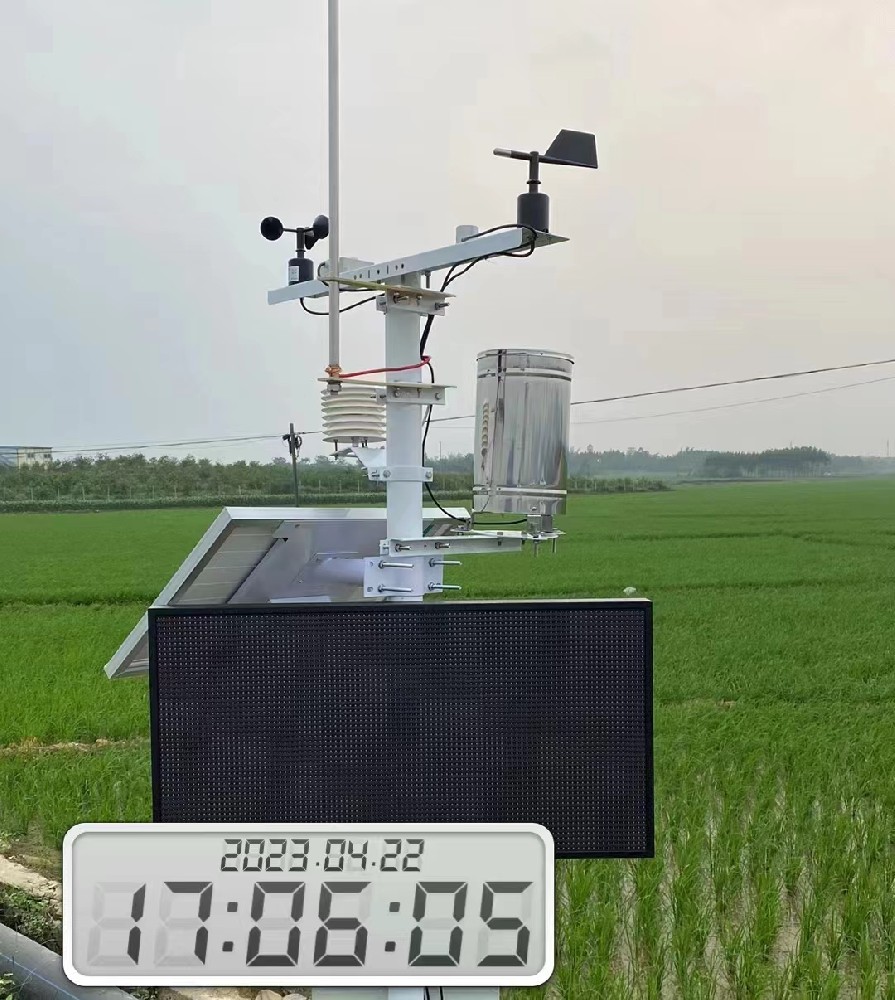
During acceptance, export a complete test period and reproduce the calculation outside the dashboard. Compare input units, aggregation and missing-data handling before judging model outputs. Keep configuration versions with the records so a revised threshold or crop coefficient is not presented as though it governed earlier decisions. Adding a new field node requires its own exposure record, not just another address on the gateway.
For a NiuBoL configuration review, supply the crop and model input list, existing sensors, field layout, required observation intervals and receiving software. Identify whether the objective is a field reference, canopy investigation or root-zone assessment. The station proposal can then address the measurements that are actually missing instead of adding channels that do not improve the decision.
Not necessarily. Check the installed channels and the selected calculation. Crop requirements also depend on field and crop information outside the weather head. Keep measured inputs, model estimates and the resulting irrigation instruction as distinct records.
No universal substitution is appropriate. Establish the radiation quantity and unit required by the method. Use a suitable broadband instrument or an explicitly validated estimation procedure rather than renaming the PAR channel.
No. Height and exposure follow the measurement purpose. Reference weather, canopy conditions and root-zone measurements require different positions. Record each position and apply the model's required reference treatment where relevant.
It provides a device communication method. The logger still needs correct register interpretation, units, timestamps and an export or upstream interface accepted by the software. Test the complete input path with an actual data file or live connection.
Verify sensor identity and exposure, reproduce a calculation from exported data, test missing observations and have the agronomy team review the output under relevant field conditions. A running dashboard alone is not model validation.
Agricultural weather station model inputs are useful when the measured quantity, location and time basis match the application. NiuBoL weather and field instruments can provide those observations, while the selected model interprets them. Preserve that distinction when specifying equipment, accepting data and reviewing crop-management advice.
Prev:Compact PV Weather Stations for Solar Plant O&M
Next:Railway Automatic Weather Station: Route Exposure and Data Handover
Related recommendations
Sensors & Weather Stations Catalog
 Agriculture Sensors and Weather Stations Catalog-NiuBoL.pdf
Weather Stations Catalog-NiuBoL.pdf
Agriculture Sensors Catalog-NiuBoL.pdf
Water Quality Sensor Catalog-NiuBoL.pdf
Related products
 Combined air temperature and relative humidity sensor
 TDR Soil Moisture & Temperature Sensor for irrigation| RS485 |4-20mA| NBL-S-THR
 Soil pH sensor RS485 soil Testing instrument soil ph meter for agriculture |NBL-S-PH
 Wind Speed sensor Output Modbus/RS485/Analog/0-5V/4-20mA
 Tipping bucket rain gauge for weather monitoring auto rainfall sensor RS485/Outdoor/stainless steel
 Pyranometer Solar Radiation Sensor 4-20mA/RS485


Screenshot, WhatsApp to identify the QR code
WhatsApp number:+8615367865107
(Click on WhatsApp to copy and add friends)

