





— Blogs —
—Products—
 Consumer hotline +8618073152920
 WhatsApp:+8615367865107
Address:Room 102, District D, Houhu Industrial Park, Yuelu District, Changsha City, Hunan Province, China
Product knowledge
Time:2023-11-03 15:10:11 Popularity:9073
The price of a soil moisture sensor can vary significantly because products that appear similar may use very different sensing technologies, accuracy specifications, probe materials, communication interfaces and environmental protection levels.
A low-cost probe for a hobby project should not be compared directly with an IP68 industrial RS485 soil sensor designed for long-term buried monitoring. Likewise, a single-parameter soil moisture probe will normally cost less than a sensor that also measures temperature, EC, salinity, pH or other parameters.
For agricultural and IoT projects, the final cost may also include cable extensions, data loggers, LoRaWAN nodes, 4G gateways, solar power systems, enclosures and installation accessories. Therefore, the correct way to compare soil moisture sensor prices is to compare the complete required specification, not only the probe price.
There is no single standard price because soil moisture sensors cover several very different product categories. Instead of relying on one fixed price range, it is more useful to divide the market by application and specification.
| Sensor Type | Relative Cost | Typical Use |
|---|---|---|
| Basic Hobby Moisture Probe | Low | Arduino, education, indoor plants |
| Industrial Soil Moisture Sensor | Medium | Agriculture, irrigation, greenhouse |
| Soil Moisture + Temperature Sensor | Medium | Smart farming and continuous monitoring |
| Moisture + Temperature + EC Sensor | Medium to High | Irrigation and root-zone monitoring |
| Multi-Parameter Soil Sensor | Higher | Comprehensive agricultural IoT projects |
| Complete IoT Monitoring System | Project Based | Remote farms, greenhouses and distributed monitoring |
For an accurate quotation, the supplier normally needs to know the sensor model, quantity, output signal, cable length and whether additional communication or power equipment is required.
One of the biggest price differences comes from the sensing principle.
| Technology | Characteristics | Typical Cost Level |
|---|---|---|
| Resistive | Simple design; electrode resistance changes with moisture | Low |
| Capacitive / Dielectric | Measures changes related to soil dielectric properties | Low to Medium |
| FDR | Frequency-domain dielectric measurement | Medium |
| TDR | Time-domain electromagnetic measurement | Medium to High |
Technology alone does not determine whether one sensor is better. Accuracy, calibration, installation, soil conditions and project requirements should also be considered.
Sensors with tighter accuracy requirements generally need better electronics, calibration and manufacturing control, which increases cost.
However, purchasing the highest stated accuracy is not always necessary. For irrigation control, repeatability and correct sensor placement may be more important than paying for laboratory-level specifications that the field installation cannot support.
A single moisture sensor is normally less expensive than a multi-parameter sensor.
Typical configurations include:
Soil moisture only
Soil moisture + temperature
Soil moisture + temperature + EC
Moisture + temperature + EC + salinity
Multi-parameter sensors including pH or other measurements
For larger projects, one multi-parameter probe can sometimes reduce total wiring, installation and data-acquisition costs compared with installing several separate sensors.
The required communication interface also affects the product configuration and price.
| Output | Typical Application |
|---|---|
| RS485 Modbus | PLC, RTU, data logger and IoT integration |
| 4–20 mA | Industrial analog input systems |
| 0–5 V | Controllers and analog acquisition systems |
RS485 versions are popular for agricultural IoT projects because several sensors can share one communication bus and individual devices can use unique Modbus addresses.
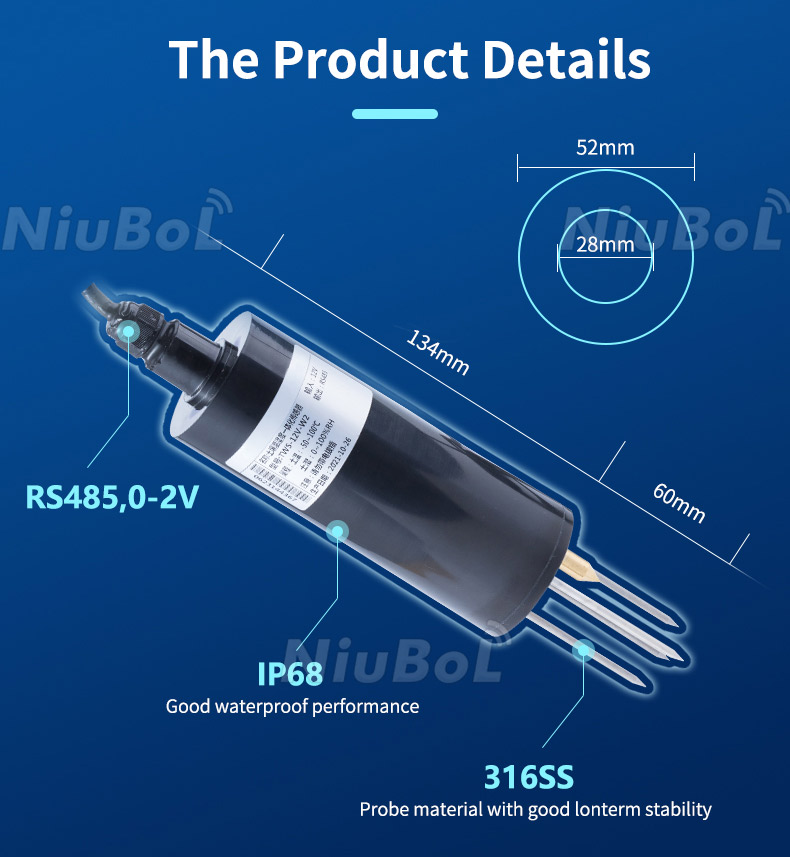
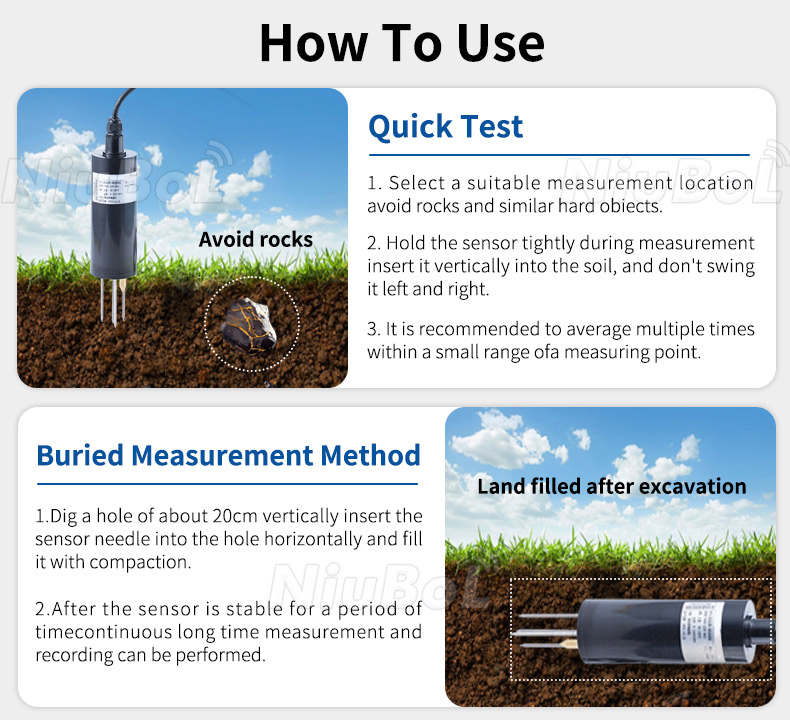
Long-term buried sensors require better sealing, corrosion-resistant probes and cable protection than low-cost indoor or hobby sensors.
IP68 protection, stainless-steel electrodes, sealed electronics and durable cables increase manufacturing cost but are important for long-term agricultural deployment.
Standard sensor pricing normally includes a specified cable length. Longer cables increase material cost and may also require greater attention to power-voltage drop and communication quality.
For projects with long distances between sensors and data loggers, provide the actual cable requirement before ordering instead of extending cables on site without considering signal and power requirements.
Unit price usually decreases as project quantity increases because procurement, production and shipping can be consolidated.
When requesting a quotation, specify both the initial quantity and the expected future project volume if the installation will be expanded in stages.
The soil sensor itself only provides the measurement signal. Remote monitoring requires additional equipment.
Soil Sensor → RS485 → Data Logger / Gateway → 4G / Ethernet / LoRaWAN → Cloud or Private Server
A customer who only needs an RS485 probe will therefore have a much lower system cost than a project that requires 4G communication, MQTT upload and a solar power supply.
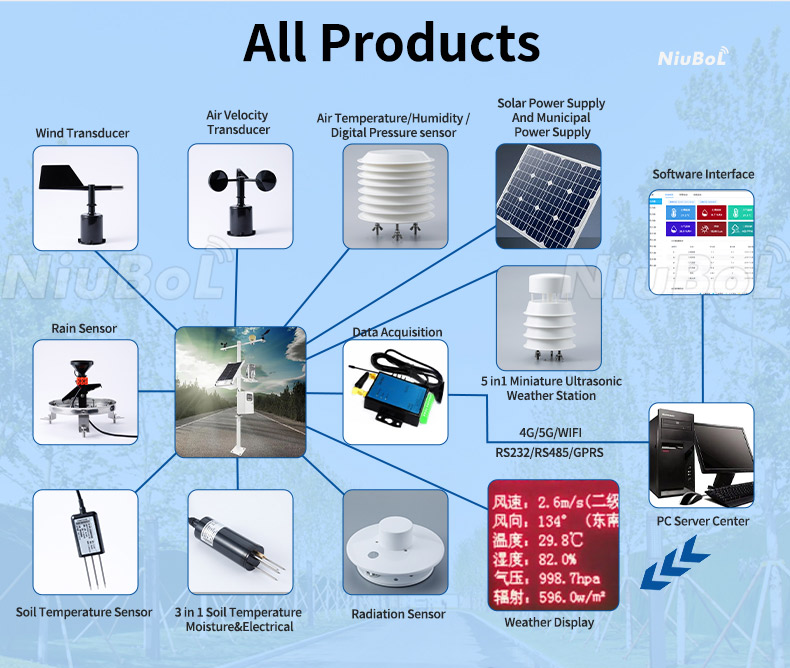
Wireless communication is normally provided by an external node or gateway rather than by the basic RS485 sensor itself.
A LoRaWAN project may require:
RS485-to-LoRaWAN node
LoRaWAN gateway
Correct regional frequency band
Battery or solar power
Payload decoder
Network server integration
These items increase system cost but can significantly reduce long signal-cable requirements across distributed farmland.
Remote monitoring stations may also require solar panels, batteries, charge controllers, waterproof enclosures, mounting brackets and poles.
Solar power should be sized according to total daily energy consumption, communication frequency, battery autonomy and local solar conditions. One fixed panel and battery size should not be applied to every project.
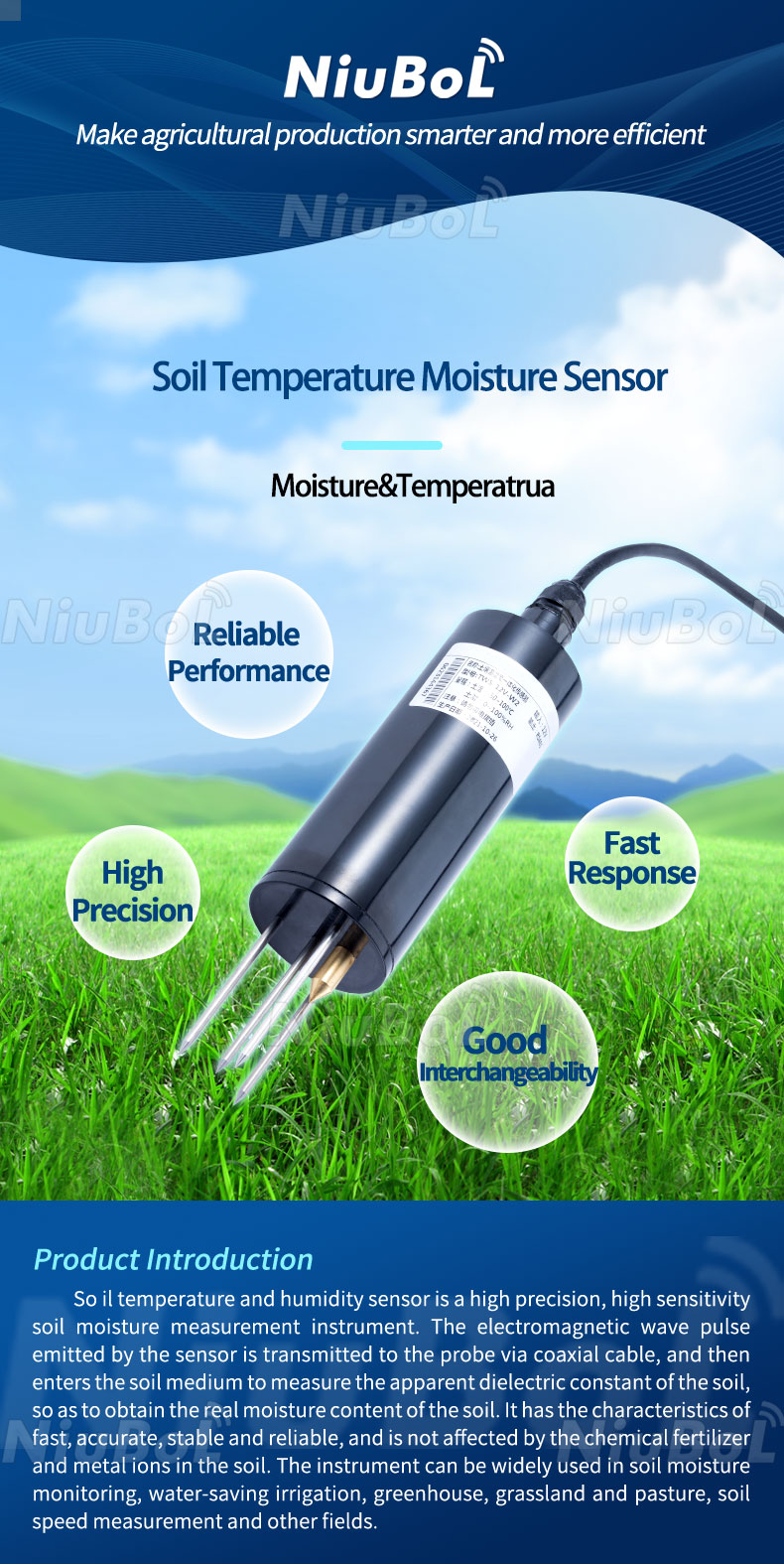
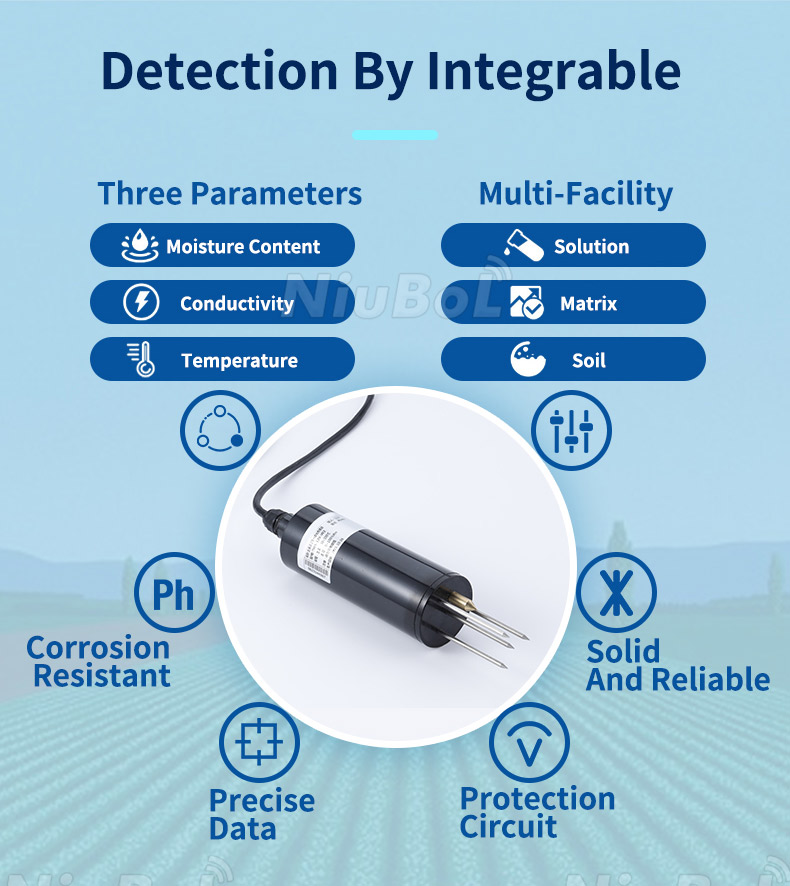
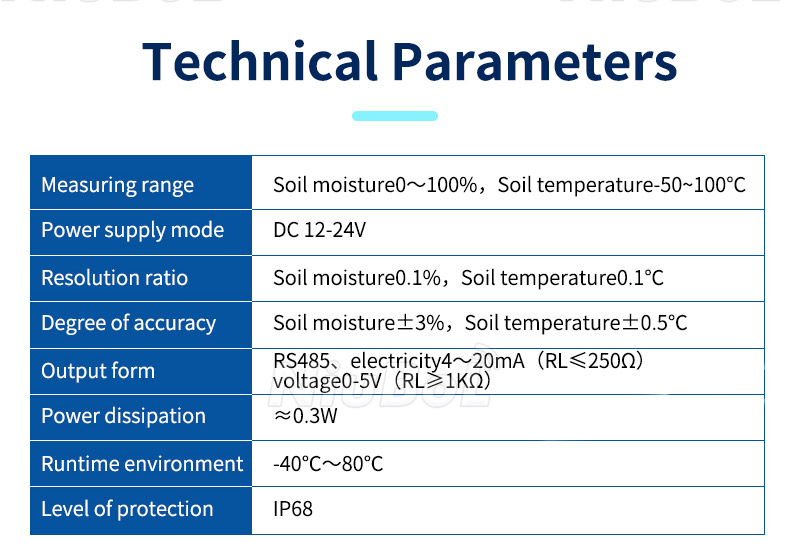
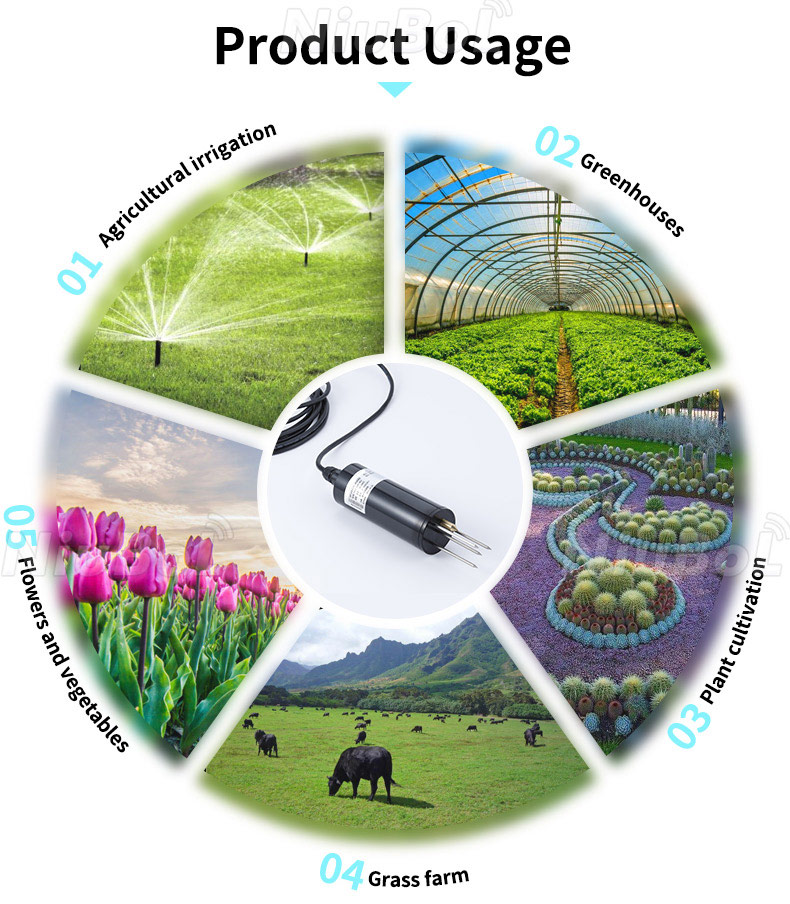
The NBL-S-THR Soil Temperature and Moisture Sensor is designed for agricultural irrigation, greenhouse, soil research and continuous soil monitoring.
It uses a dielectric-based electromagnetic measurement method to determine soil water content and provides simultaneous soil moisture and temperature data.
| Soil Moisture Range | 0–100% |
| Soil Temperature Range | -50 to 100°C |
| Moisture Resolution | 0.1% |
| Temperature Resolution | 0.1°C |
| Moisture Accuracy | ±3% |
| Temperature Accuracy | ±0.5°C |
| Output Options | RS485 / 4–20 mA / 0–5 V |
| Power Supply | 12–24 V DC |
| Protection | IP68 |
For project budgeting, separate the sensor price from the complete monitoring-system cost.
| Item | Required? | Cost Impact |
|---|---|---|
| Soil Sensor | Always | Base product cost |
| Extra Cable | Optional | Depends on length |
| Data Logger | For automatic collection | Medium |
| LoRaWAN Node | Wireless option | Medium |
| 4G Gateway | Remote cellular monitoring | Medium |
| Solar + Battery | Remote sites | Medium to High |
| Cloud / Private Server | Optional | Depends on architecture |
The cheapest sensor is not necessarily the lowest-cost option over the life of a project. Before comparing quotations, confirm:
What parameters need to be measured?
Is the sensor for temporary measurement or permanent burial?
What measurement depth is required?
What accuracy is actually required?
Does the PLC or logger require RS485, 4–20 mA or voltage output?
How long should the sensor cable be?
How many sensors will be installed?
Will multiple sensors share one RS485 bus?
Is wireless LoRaWAN or 4G communication required?
Is mains power available?
Does the project require a cloud platform or private server?
A1. Industrial sensors normally use more durable probes, sealed electronics, higher-grade cables, calibrated measurement circuits and standard interfaces such as RS485 or 4–20 mA. They are designed for long-term outdoor or buried operation rather than short-term experimental use.
A2. It may cost more than a simple analog hobby sensor because RS485 requires digital communication electronics and Modbus support. However, RS485 can reduce system-integration costs when multiple sensors share one bus.
A3. Yes. Extra cable increases material cost. Long cable runs may also require power-voltage-drop and RS485 communication considerations.
A4. Usually yes, because an additional measurement channel and calibration are required. However, a combined probe may reduce installation and wiring cost compared with using two separate sensors.
A5. No. The correct technology depends on accuracy requirements, soil conditions, installation method, budget and project purpose. Measurement technology is only one part of sensor selection.
A6. Yes. Multiple compatible Modbus sensors can share one RS485 bus if each device has a unique address and the power supply, cable length, topology and termination are designed correctly.
A7. Normally yes, because LoRaWAN requires acquisition nodes and a gateway. However, it may reduce cabling costs for widely distributed monitoring points.
A8. Provide the required model or parameters, quantity, output signal, cable length, installation depth, site distance, communication method and whether a data logger, LoRaWAN, 4G or solar power system is required.
A9. Industrial sensors such as the NBL-S-THR are designed for long-term soil monitoring when installed correctly. Good soil contact, cable protection and appropriate maintenance are still important.
A10. No. Reliability, repeatability, waterproofing, communication compatibility and installation requirements can have a greater impact on long-term project cost than the initial sensor price alone.
1. NBL-S-THR Soil Temperature and Moisture Sensor Instruction Manual
 NBL-S-THR-Soil-temperature-and-moisture-sensors-Instruction-Manual-V4.0.pdf
NiuBoL provides soil moisture sensors, soil moisture and temperature sensors, EC sensors, multi-parameter soil sensors and IoT monitoring equipment for agriculture, irrigation, greenhouse and research projects.
For an accurate quotation, provide the required quantity, parameters, output signal, cable length and destination country. For complete monitoring systems, also provide the number of monitoring points, distance between locations, communication method, power supply and server requirements.
View NBL-S-THR Soil Moisture & Temperature Sensor →
Related recommendations
Sensors & Weather Stations Catalog
 Agriculture Sensors and Weather Stations Catalog-NiuBoL.pdf
Weather Stations Catalog-NiuBoL.pdf
Agriculture Sensors Catalog-NiuBoL.pdf
Water Quality Sensor Catalog-NiuBoL.pdf
Related products
 Combined air temperature and relative humidity sensor
 TDR Soil Moisture & Temperature Sensor for irrigation| RS485 |4-20mA| NBL-S-THR
 Soil pH sensor RS485 soil Testing instrument soil ph meter for agriculture |NBL-S-PH
 Wind Speed sensor Output Modbus/RS485/Analog/0-5V/4-20mA
 Tipping bucket rain gauge for weather monitoring auto rainfall sensor RS485/Outdoor/stainless steel
 Pyranometer Solar Radiation Sensor 4-20mA/RS485

Screenshot, WhatsApp to identify the QR code
WhatsApp number:+8615367865107
(Click on WhatsApp to copy and add friends)

