





— Blogs —
—Products—
 Consumer hotline +8618073152920
WhatsApp:+8615367865107
Address:Room 102, District D, Houhu Industrial Park, Yuelu District, Changsha City, Hunan Province, China
Product knowledge
Time:2026-01-18 19:42:43 Popularity:3299
A portable USB Type-C soil tester field survey is useful when an agronomist, irrigation contractor or research team needs comparable readings from several locations during one visit. The NiuBoL 8-in-1 instrument connects to a compatible phone and records temperature, moisture, EC, salinity, N, P, K and pH. Its value depends on a repeatable sampling method: carrying eight displayed values between plots does not make unlike soil conditions directly comparable.
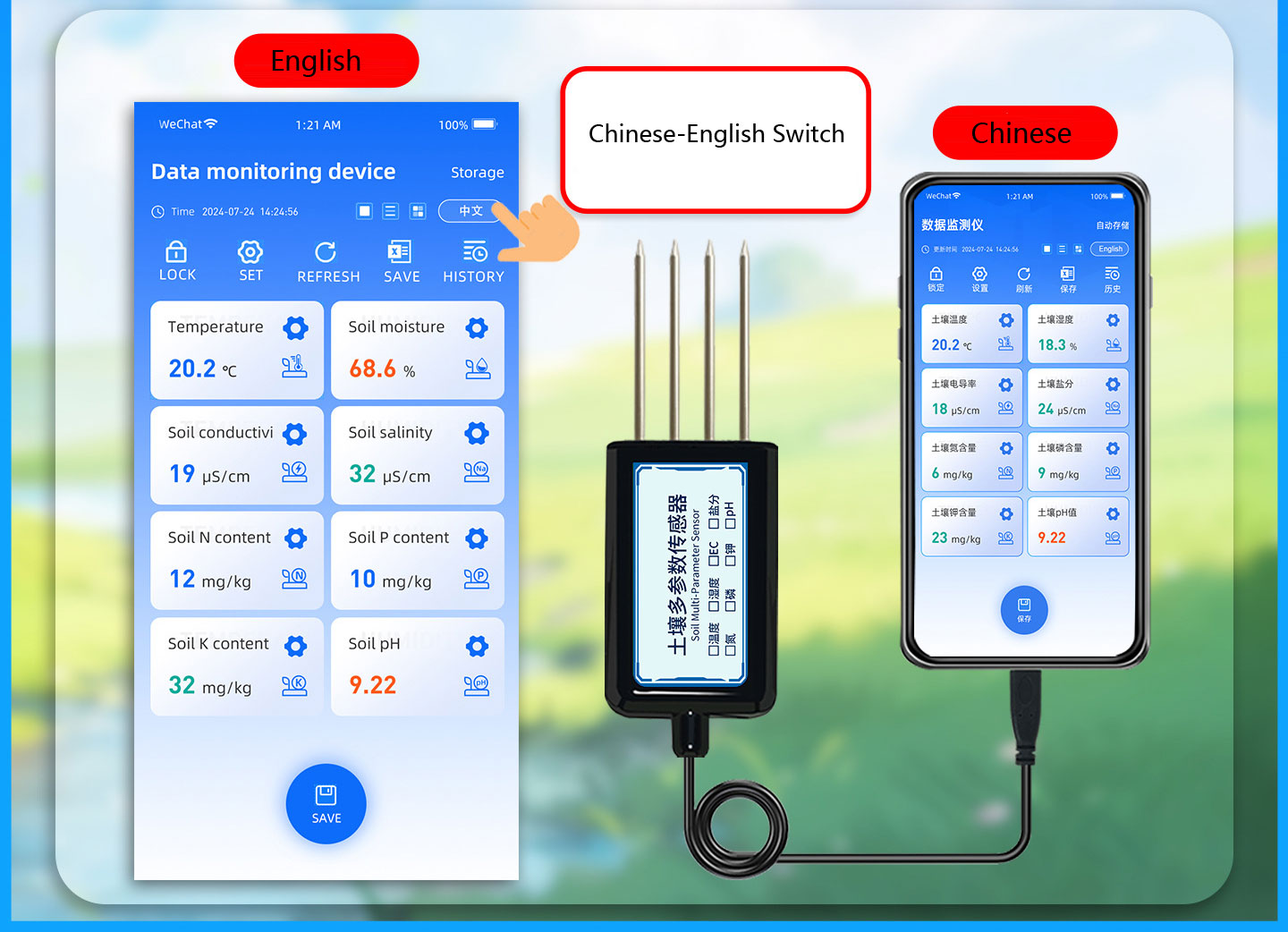
For irrigation inspection, the question may be whether two beds or zones show different root-zone moisture under the same operating schedule. For a greenhouse service visit, it may be whether elevated conductivity follows particular irrigation lines. For a field trial, the task may be to identify locations that need paired laboratory samples rather than to issue an immediate fertilizer prescription.
These tasks need different sampling layouts. A survey of irrigation uniformity should include the relevant positions along the water distribution pattern. A comparison between management zones should keep sampling depth and timing consistent within the comparison. Do not mix a recently wetted emitter pocket with a dry inter-row point and describe the difference as an instrument error.
The portable tester complements fixed monitoring. It can inspect additional locations around an installed station, but a sequence of handheld visits does not capture the continuous wetting and drying history at each location. Use a fixed logging system when the decision requires unattended time-series data or automatic control.
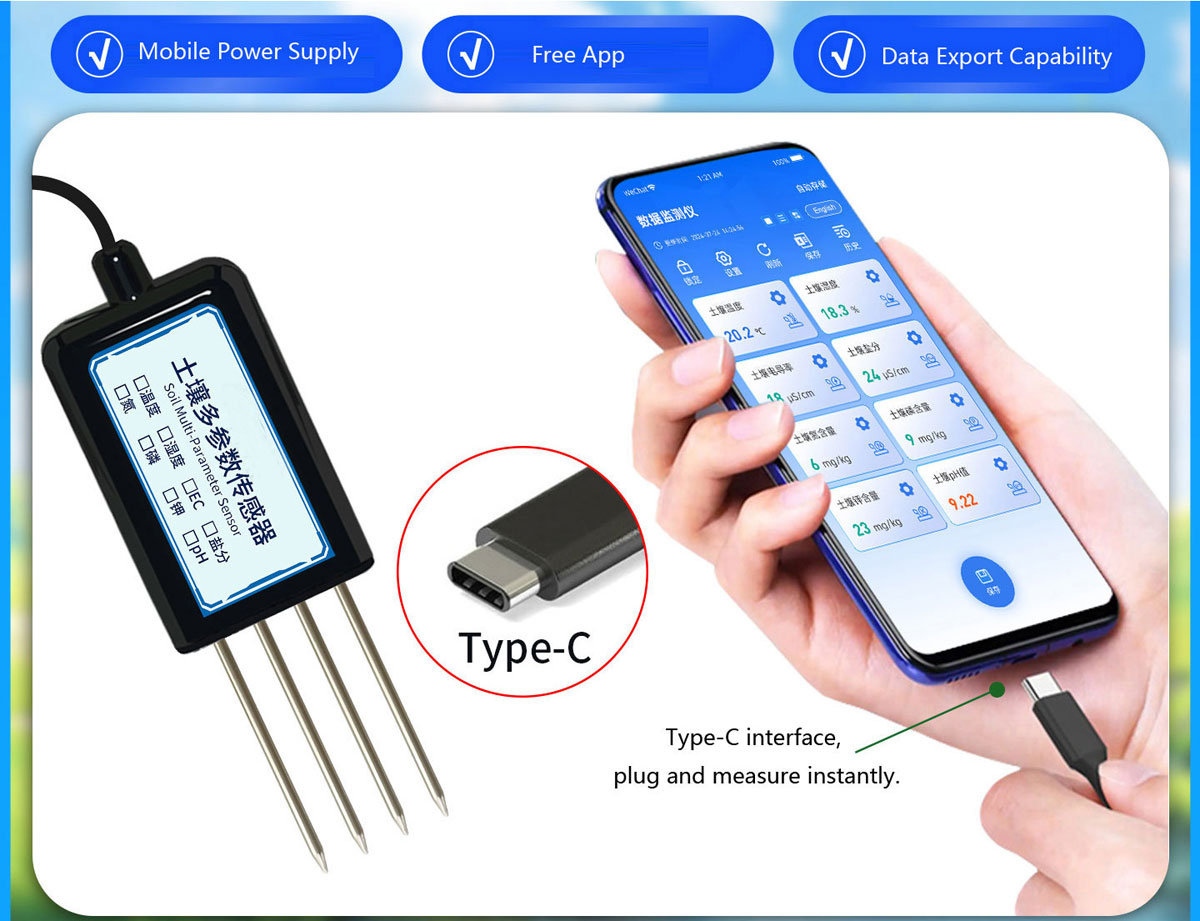
The Type-C connector carries the sensor connection and phone-supplied power. The phone must support the required USB host/OTG operation as well as the NiuBoL application. A matching connector shape alone does not establish compatibility.
| Phone or workflow item | Check before deployment |
|---|---|
| Android device | Check Type-C/USB connection, OTG support and recognition by the application on the actual handset. |
| HarmonyOS | This application version supports 4.3 and below; 5.0 and above is not supported. |
| Apple iOS | Not supported by this configuration. |
| Power | No separate sensor supply is required for phone operation; plan phone charging for the survey. |
| Application | Check real-time display, record storage, history, curves and Excel export. |
| Project data handover | Export a trial file and open it in the receiving team's workflow before field deployment. |
Install the application from the NiuBoL product instructions and use the organisation's approved software-installation process. Avoid broad changes to phone security settings merely to complete a hurried field visit. After connection, enable OTG if required and grant the relevant USB access permission. If recognition fails, distinguish a connection problem from a measurement problem before inserting the probe.
The NPK channels are empirical estimates derived from soil electrical conductivity and conversion factors. They are not independent chemical determinations of available nitrogen, phosphorus and potassium. Changes in water content or dissolved salts can therefore change the nutrient reference values without demonstrating an equivalent change in plant-available nutrient mass.
Use these channels for cautious field comparison under comparable soil conditions. For fertilizer rates, compliance work or research requiring nutrient quantification, collect appropriate samples for the specified laboratory methods. Agreement between the three NPK displays is not independent confirmation when they share a conductivity-based calculation.
| Channel | Range | Accuracy / resolution |
|---|---|---|
| Temperature | -40 to 80°C | ±0.3°C / 0.1°C |
| Volumetric moisture | 0–100% | ±2% / 0.1% |
| EC | 0–20000 µS/cm | ±3% / 1 µS/cm |
| Salinity reference | 0–20000 mg/L | ±3% / 1 mg/L |
| N reference | 0–1999 mg/kg | ±3% output specification / 1 mg/kg |
| P reference | 0–1999 mg/kg | ±3% output specification / 1 mg/kg |
| K reference | 0–1999 mg/kg | ±3% output specification / 1 mg/kg |
| pH | 3–10 | ±0.2 / 0.01 |
The percentage accuracy entries above do not establish a laboratory nutrient recovery rate, and the NPK output specification does not validate the underlying nutrient estimate for every soil. The moisture percentage is volumetric water content; 25% corresponds to 0.25 m³/m³, not a gravimetric water percentage. Agree the relevant verification method if acceptance depends on a specified uncertainty.
Likewise, the salinity display does not identify individual ions. For a crop salinity threshold defined by a laboratory extraction method, use the corresponding test rather than treating a direct field reading as the same result. Keep the measurement method with the value when comparing reports.
Very dry or stony soil can prevent reliable contact. Do not add water to one sampling point merely to obtain a convenient reading and then compare it with untreated points. If an alternative preparation method is needed, document it and apply it consistently within that comparison.

The application supports local storage, historical records, curves and Excel export. Those functions provide a starting point for project documentation, not an automatic guarantee that every required location, unit and field condition appears in the exported file.
Open a sample export and confirm column meaning, decimal format, timestamps and units. Check whether location identifiers are entered in the application or maintained in the field log. Keep the original export when making a cleaned analysis copy. A renamed spreadsheet with mixed sampling depths can otherwise appear more consistent than the underlying survey.
For example, a contractor comparing two greenhouse zones should be able to identify which measurements belong to each zone, at what depth, and how long after irrigation they were taken. An average without that information cannot show whether the observed difference reflects distribution, sampling timing or soil variation.
This portable USB configuration is intended for a phone-based workflow. It should not be specified as a native RS485 Modbus RTU device simply because other NiuBoL soil sensors offer that interface. Do not assume that the mobile application includes a public API, automatic server synchronisation or a PLC driver.
For unattended monitoring, select a fixed sensor with the required documented protocol, power supply and environmental protection, then pair it with a compatible data logger or gateway. Keep the portable tester as an inspection tool if useful. The two roles can coexist without requiring the handheld instrument to act as a permanent network node.
For procurement, include the intended phones and operating-system versions, soil types, survey volume, required export fields and any calibration or reference-test requirement. Ask for a sample connection and export demonstration before buying for a whole team. Equipment cost should be assessed alongside phones, charging, operator time and any laboratory work the project still needs; an unsupported universal unit price would not describe that scope.
No. The handset needs compatible software and USB host/OTG operation. Test the exact phone model and operating-system version with the application. A charging connector that physically fits does not establish data compatibility.
Not on their own. They are conductivity-derived reference values rather than independent nutrient analyses. Use appropriate laboratory tests and agronomic interpretation when calculating nutrient application rates or reporting quantified nutrient availability.
Moisture and dissolved-ion conditions affect conductivity, and the NPK estimates depend on that conductivity. Compare points at similar irrigation stages and review moisture alongside EC. A changed nutrient display is not proof that an equivalent nutrient mass was added or removed.
Repeat selected measurements using consistent depth, soil contact and timing, then compare nearby points separately from reinsertion repeats. This helps distinguish insertion effects from real spatial variation. Do not conceal the spread by saving only the most convenient value.
It is not a direct replacement for unattended logging or automatic control. A phone survey samples locations during visits; a fixed sensor and logger track a location through time. Select the architecture according to the decision that needs the data.
No such integration should be assumed. Local export is a file-handover function. If the project needs automatic transfer, a documented API or a server connection, agree and test that requirement separately.
Check a representative phone connection, application language, saved-file structure and the customer's measurement expectations. Confirm that nutrient reference values are acceptable for the intended use and that continuous monitoring has not been mistaken for portable inspection.

The NiuBoL portable USB Type-C soil tester is useful for structured field surveys when phone compatibility, sampling depth and record identity are controlled. Its conductivity-derived NPK values support field reference, not laboratory-equivalent nutrient analysis. A sample survey and export demonstration will show whether it fits the team's actual workflow before a larger order is placed.
 8-in-1 Soil Sensor Portable Type-C/USB Soil Multi-Parameter Tester & Analyzer.pdf
Prev:Submersible Level Meter Application Selection: Tanks, Wells and Rivers
Next:Professional USB Soil Sensor Soil NPK/PH/EC Analyzer Moisture Nutrient Sensor for Agriculture
Related recommendations
Sensors & Weather Stations Catalog
Agriculture Sensors and Weather Stations Catalog-NiuBoL.pdf
Weather Stations Catalog-NiuBoL.pdf
Agriculture Sensors Catalog-NiuBoL.pdf
Water Quality Sensor Catalog-NiuBoL.pdf
Related products
 Combined air temperature and relative humidity sensor
 TDR Soil Moisture & Temperature Sensor for irrigation| RS485 |4-20mA| NBL-S-THR
 Soil pH sensor RS485 soil Testing instrument soil ph meter for agriculture |NBL-S-PH
 Wind Speed sensor Output Modbus/RS485/Analog/0-5V/4-20mA
 Tipping bucket rain gauge for weather monitoring auto rainfall sensor RS485/Outdoor/stainless steel
 Pyranometer Solar Radiation Sensor 4-20mA/RS485


Screenshot, WhatsApp to identify the QR code
WhatsApp number:+8615367865107
(Click on WhatsApp to copy and add friends)

