





— Blogs —
—Products—
 Consumer hotline +8618073152920
WhatsApp:+8615367865107
Address:Room 102, District D, Houhu Industrial Park, Yuelu District, Changsha City, Hunan Province, China
Product knowledge
Time:2026-01-17 11:24:17 Popularity:731
Submersible level meter application selection starts with whether a pressure probe can remain in contact with the liquid under normal operation and maintenance. A vented hydrostatic meter is useful in many wells and tanks, but it is not automatically the right instrument for corrosive liquids, pressurised vessels or heavy sludge. The following comparisons help engineers decide when to use a NiuBoL immersion probe, when to change its installation and when to consider another measuring method.
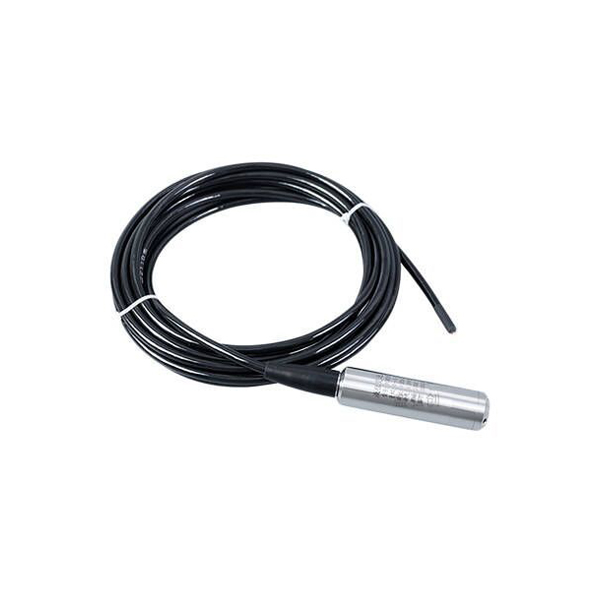
First, can the sensing inlet remain below the lowest level that needs to be measured? An exposed probe no longer measures a water column. Second, can the probe be retrieved for inspection? A low-cost sensor in an inaccessible location can require costly shutdown work later.
Third, are the liquid and operating temperature compatible with the complete assembly, including seals and cable? Finally, is the surface pressure atmospheric? A vented probe references ambient air. In a sealed tank with changing headspace pressure, its output includes pressure that is not caused by liquid height.
These checks should precede comparisons of accuracy grades or radio options. Better resolution cannot make a chemically unsuitable probe acceptable, and remote reporting cannot correct the pressure reference of the wrong instrument.
| Application | Reason to consider immersion | Condition that changes the choice |
|---|---|---|
| Groundwater well | A narrow probe can measure below a restricted wellhead. | Insufficient clearance, excessive temperature or no safe retrieval route. |
| Open clean-water tank | Measures head above a fixed submerged point without an overhead beam path. | The tank empties below the required sensing position or hygiene rules prohibit immersion. |
| Wastewater wet well | Works below the surface where overhead access is limited. | Rags, grease, grit or chemistry make inlet fouling and servicing unacceptable. |
| River or reservoir | A protected submerged point can measure stage through water-level changes. | Bed movement, debris or flooding makes the probe position unreliable. |
| Oil or process tank | Hydrostatic measurement can suit compatible, known-density liquids. | Changing density, headspace pressure, hazardous-area requirements or aggressive media need another design. |
This comparison is a method-selection aid, not a declaration that one standard probe covers all five environments. For example, a wastewater application may be suitable after an inlet and retrieval redesign, whereas the same installation could remain unsuitable if grease routinely isolates the sensing surface.
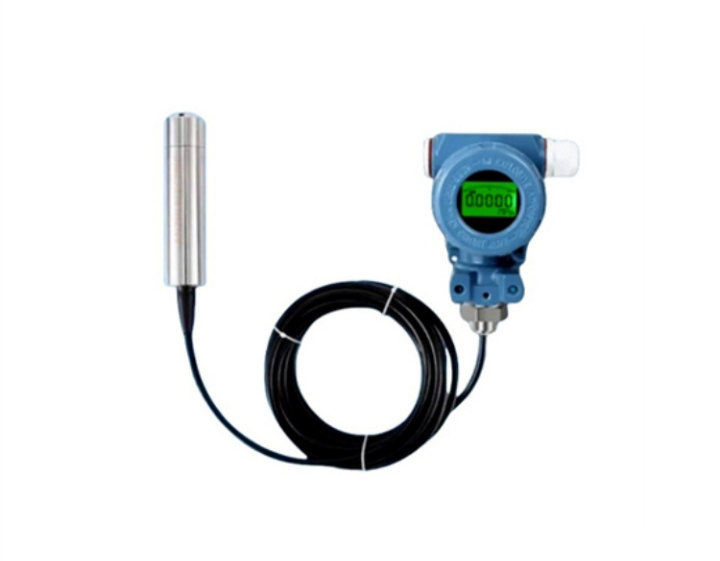
A hydrostatic probe measures pressure below the surface. Radar measures distance from a mounting point above the surface. A float or other point-level switch normally changes state at a set level rather than reporting a continuous profile. The required decision determines which output is useful.
For tank inventory or drawdown trends, a continuous signal provides information that a single high-level switch cannot. For a simple independent overflow indication, a point-level device may be more appropriate than adding another continuous reading to the same controller. Safety-related duties need a separate assessment of independence, failure behaviour and applicable requirements.
| Site constraint | Method to examine |
|---|---|
| Only a small access opening above a well | Immersion probe, provided the body and retrieval fittings fit. |
| No wetted parts permitted | Non-contact radar with suitable mounting clearance and a usable beam path. |
| Only one high or low threshold is needed | A point-level switch, with appropriate material and switching duty. |
| Heavy deposits at the bottom | Relocated hydrostatic inlet or non-contact measurement, depending on access and surface conditions. |
| Variable sealed-tank pressure | A pressure-compensated arrangement or another method designed for that vessel. |
Radar is not a universal substitute for immersion. Internal structures, mounting geometry and surface behaviour still require review. Likewise, a hydrostatic meter avoids the need for an overhead beam but introduces wetted-material, density and vent-maintenance responsibilities.
The NiuBoL NBL-L-WLPS configuration considered here is an RS485 Modbus RTU immersion transmitter. It supplies measurement data to a compatible PLC, RTU or data logger. A local display, analog current output, cellular modem and cloud service are not interchangeable features of that basic configuration.
| Characteristic | Selection information |
|---|---|
| Range | Order the span for maximum liquid head above the installed probe. |
| Accuracy | 0.5%FS standard; 0.2%FS configuration available. |
| Supply and consumption | DC 10–30 V, typical 24 V; maximum 0.2 W. |
| Signal | RS485 using Modbus RTU. |
| Probe | 26.8 mm outside diameter; IP68. |
| Thermal limits | -20 to 80°C transmitter circuit; at or below 60°C liquid for long-term measurement. |
| Materials | Stainless-steel wetted body and vented cable; specify the required grade, jacket and length for the medium. |
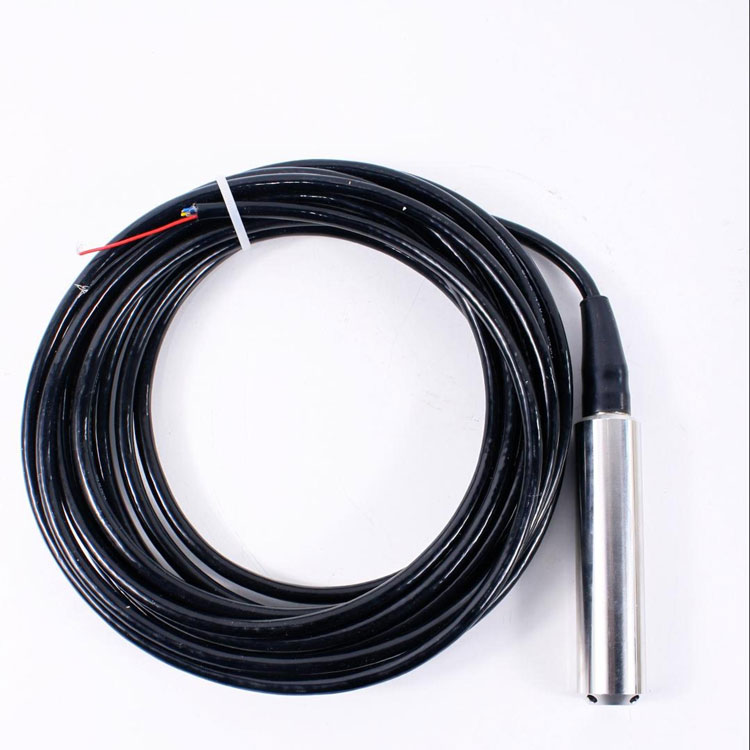
Where an existing cabinet accepts only 4–20 mA, select a suitable analog transmitter or evaluate a conversion arrangement rather than wiring RS485 to an analog input. Where an operator needs a local screen, assess the separate display assembly and its installation environment. Neither requirement should be inferred from the appearance of a product-family photograph.
An open clean-water reservoir often offers a relatively simple hydrostatic application if the probe can stay submerged and accessible. A wet well is different: ragging, deposits and pump-induced disturbance can dominate the measurement problem. Put the pressure inlet where it represents the pool, not directly in a jet or under falling influent.
If a guide tube is used, it needs enough water exchange to follow the process without trapping air or becoming a sediment pocket. Compare its response with the basin during actual fill and drawdown. A smooth trend that lags the basin can be unsuitable for pump control even when its static reading is correct.
Before selecting the instrument, agree who can remove it, how the basin will be accessed and what cleaning is permitted. Cleaning effort is a site property as much as a sensor property. Do not assign one quarterly interval to both a clean-water tank and a greasy wet well.
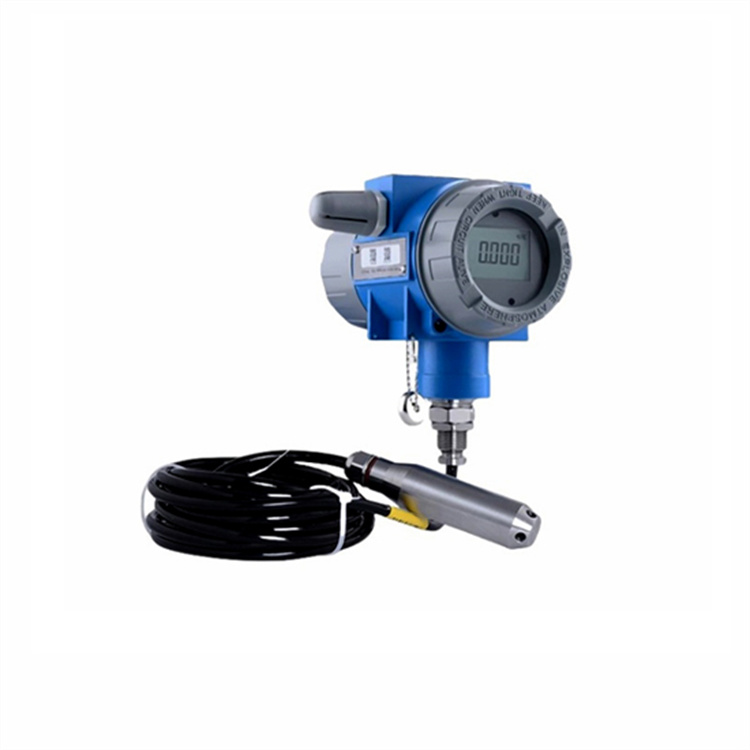
For river stage, establish a durable reference elevation and protect the cable against debris and flood movement. A shifted probe changes the apparent stage even if its pressure measurement remains accurate. Inspect its location after events that could alter the bed or mounting structure. In very mobile channels, a non-contact method may reduce the risk of losing the submerged reference.
For a process tank, obtain the composition and density range rather than a general description such as “industrial liquid.” Hydrostatic pressure changes with both height and density. If density varies enough to matter to the control or inventory decision, address that uncertainty before selecting an accuracy grade.
Also distinguish level from volume. A uniform cross-section may allow a simple conversion, but a horizontal cylinder or irregular sump needs the appropriate geometry or calibration table. Replacing the sensor does not supply a valid tank-volume relationship. For flammable service, the complete installation needs the appropriate approvals; a rugged housing is not evidence of hazardous-area suitability.
Test the condition most likely to make the chosen method fail. In a wet well, observe fouling and recovery after cleaning. In a narrow well, confirm that the assembly can be inserted and removed. In a tank with a mixer, compare readings with the mixer running and stopped. In a river, compare the installed stage against the same reference at different water levels.
Write acceptance limits in the units needed by the process, together with reference uncertainty and operating conditions. A single displayed value at commissioning cannot demonstrate performance through a full process cycle. Retain the trial results so subsequent maintenance can distinguish a changed installation from an instrument fault.

No. Chemical compatibility, deposits, ragging and retrieval access determine suitability. Examine the inlet location and service method first. Where fouling cannot be managed, compare a non-contact method rather than relying on a higher IP rating.
Changing headspace pressure appears in the measured pressure and can be interpreted as liquid head. Use a vessel-appropriate pressure-compensated arrangement or another suitable method. Do not treat an ambient vent as compensation for tank pressure.
No. Accuracy grade describes instrument performance, while density determines the pressure-to-height relationship. Review density variation and the permitted level error before deciding whether compensation or a different method is needed.
Not as a standalone wireless device. It needs a compatible powered receiver; remote access requires the selected logger, gateway and server arrangement. Check protocol handling and data availability separately from probe measurement.
When a defined high or low switching duty is required, especially if it must be independent of the continuous measurement. Determine the safety and control requirements before deciding whether two signals may share a controller or power supply.
Send the liquid composition, temperature, level range, tank or channel drawing, access restrictions and the action taken from the reading. Add existing PLC inputs and any hazardous-area requirement. This allows NiuBoL to compare immersion and alternative arrangements against the actual site constraints.

Choose a submersible level meter when immersion, pressure reference, materials and maintenance access are all acceptable. Use a different method when those conditions cannot be maintained. The useful comparison is not which sensor has the most features, but which installation can continue to represent the process and be serviced without avoidable disruption.
Prev:Submersible Level Transmitter Deep Well Installation: Range and Cable
Next:Portable USB Type-C Soil Tester Field Survey: Sampling and Data Quality
Related recommendations
Sensors & Weather Stations Catalog
 Agriculture Sensors and Weather Stations Catalog-NiuBoL.pdf
Weather Stations Catalog-NiuBoL.pdf
Agriculture Sensors Catalog-NiuBoL.pdf
Water Quality Sensor Catalog-NiuBoL.pdf
Related products
 Combined air temperature and relative humidity sensor
 TDR Soil Moisture & Temperature Sensor for irrigation| RS485 |4-20mA| NBL-S-THR
 Soil pH sensor RS485 soil Testing instrument soil ph meter for agriculture |NBL-S-PH
 Wind Speed sensor Output Modbus/RS485/Analog/0-5V/4-20mA
 Tipping bucket rain gauge for weather monitoring auto rainfall sensor RS485/Outdoor/stainless steel
 Pyranometer Solar Radiation Sensor 4-20mA/RS485


Screenshot, WhatsApp to identify the QR code
WhatsApp number:+8615367865107
(Click on WhatsApp to copy and add friends)

