





— Blogs —
—Products—
 Consumer hotline +8618073152920
 WhatsApp:+8615367865107
Address:Room 102, District D, Houhu Industrial Park, Yuelu District, Changsha City, Hunan Province, China
Product knowledge
Time:2026-03-02 14:08:58 Popularity:582
A solar-powered rain gauge station must keep counting during the weather that reduces its charging input. A large solar panel alone does not establish reliability: the logger's sleep behaviour, modem connection time, battery temperature limits and low-voltage restart can determine whether a storm record survives. Specify continuous rainfall capture separately from how often the station sends data.
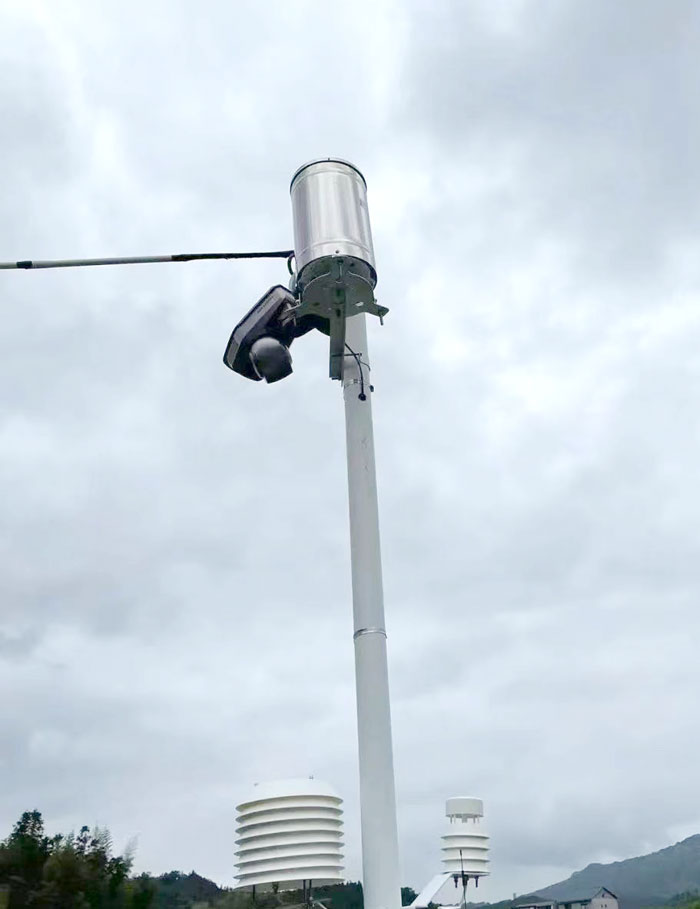
A tipping bucket produces discrete events. If a logger powers down its input between scheduled readings, rain can fall without being recorded. A suitable pulse-counting arrangement must capture events while the processor or modem sleeps, within the input's documented electrical and timing limits. Waking every fifteen minutes to inspect a contact is not equivalent to counting continuously.
An RS485 rain gauge is a different arrangement. Determine whether its cumulative count is retained inside the gauge, what happens when sensor power is interrupted and how the logger identifies a reset. RS485 Modbus RTU describes communication, not non-volatile rainfall storage. Do not switch the gauge supply off to save energy until that behaviour has been tested.
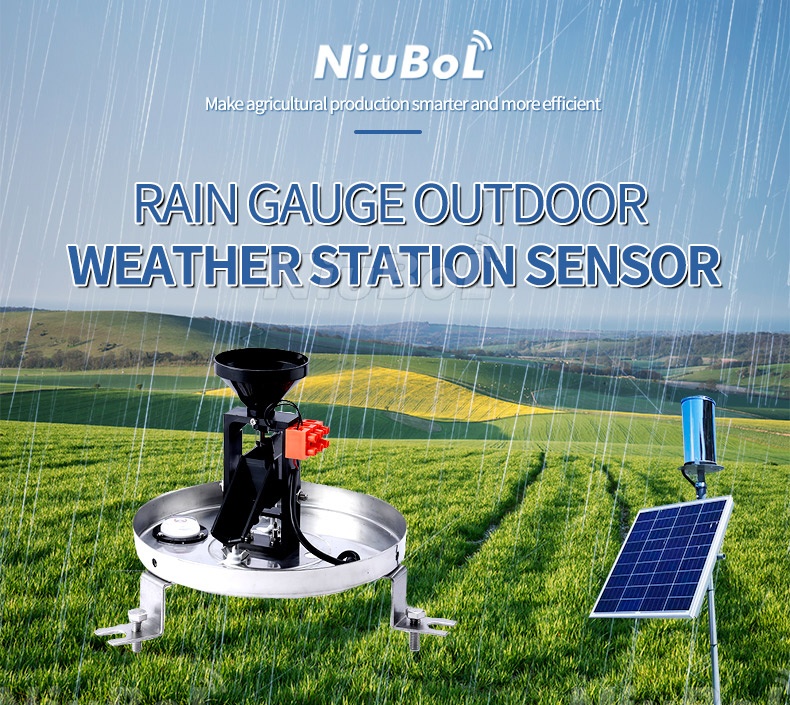
The NiuBoL NBL-W-RS offers different output configurations. A reed-switch model needs a compatible counter input; an RS485 model needs an appropriate serial interface and protocol map. They are not interchangeable merely because both eventually display rainfall in millimetres.
| NBL-W-RS parameter | Specification | Design consequence |
|---|---|---|
| Collection opening | Diameter 200 ±0.6 mm | Keep the opening level and unobstructed |
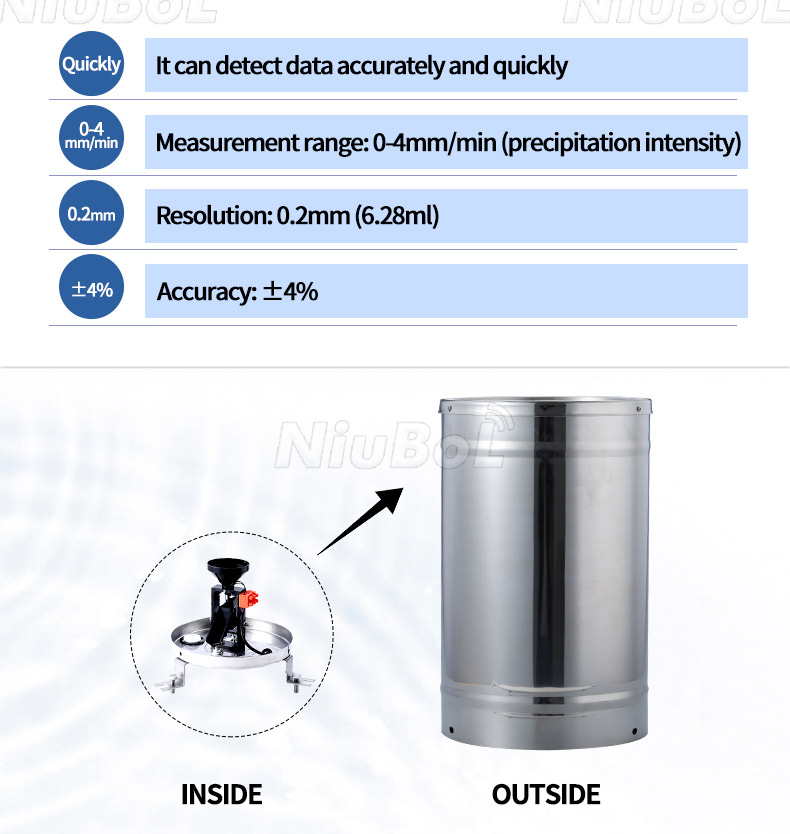
| Resolution | 0.2 mm per tip; nominal 6.28 mL | Apply the configured tip factor once |
| Intensity range | 0-4 mm/min | Do not confuse intensity with an accumulation capacity |
| Accuracy condition | ±4% at 2 mm/min in the specified indoor test | Not a blanket field accuracy at every intensity |
| Supply options | 5 VDC or 12-24 VDC, according to version | Match the delivered electronics and regulator |
| Output options | Reed contact, voltage or RS485, according to version | Confirm input circuit and digital protocol before ordering |
| Operating temperature | 0-50 C | Do not specify the standard instrument as a snow gauge |
| Instrument lead | 5 m | Confirm extensions, jacket material and outdoor routing separately |
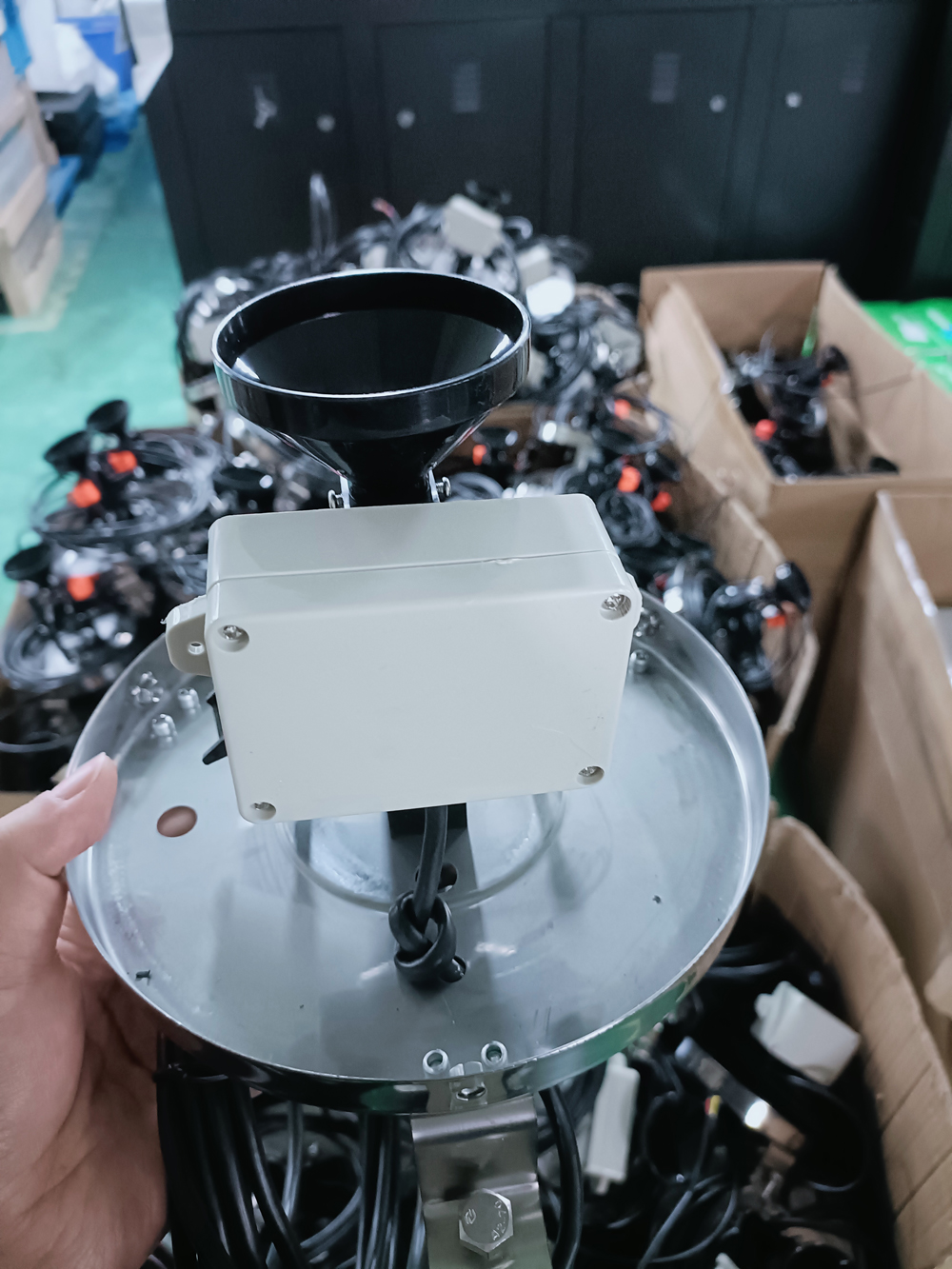
The housing does not reveal the output version. Read the equipment label and wiring schedule before connecting power. The pulse option can reduce sensor-side electronic demand, but the complete station still needs a counter, memory, controller and possibly a radio. Obtain their actual currents rather than assigning one generic wattage to the installation.
Use watt-hours per day, not just the modem's peak watts. List the continuously powered loads, the duration of each radio session, sensor warm-up if required, regulator losses and controller standby. Measure the assembled station during normal reporting and unsuccessful network registration; repeated connection attempts can produce a substantially different energy demand.
For an illustrative design, assume the logger and continuously required electronics average 0.4 W. That is 9.6 Wh/day. An additional radio load of 3 W operating for two minutes every hour uses 2.4 Wh/day. The combined load is 12 Wh/day before conversion and other losses. These are assumed loads, not NiuBoL component specifications.
At a nominal 12 V and 12 Ah, a battery contains 144 Wh by simple nameplate multiplication. If the design allows only 60% of that energy to be used, 86.4 Wh remains. Dividing by a hypothetical complete demand of 15 Wh/day gives about 5.8 days without charging. Temperature, ageing, protective cutoffs and actual discharge performance can reduce that result; it is not a guaranteed autonomy figure.
Size the panel using the installation's design-season solar resource and a documented loss allowance. In a calculation example, a 20 W panel receiving two equivalent full-sun hours with an assumed 0.65 overall yield supplies 26 Wh/day. Against a 15 Wh daily load, only 11 Wh remains for battery recovery. Replacing a 60 Wh deficit would therefore take roughly 5.5 such days if conditions stayed the same.
This explains why a station can operate on a clear day yet enter a repeating low-voltage cycle after prolonged rain. Include panel shading, battery charge-temperature restrictions and the controller's supported battery chemistry in the calculation. A larger panel cannot correct an incompatible charging profile or a battery that refuses charging at the site's temperature.
The rain collector needs representative precipitation exposure, while the panel needs useful solar access. Do not let a panel, cabinet roof or support arm overhang the collector. Check drip paths, splash from nearby surfaces and access for cleaning. Where the two requirements conflict, separate the mountings rather than placing the collector under the most convenient bracket.
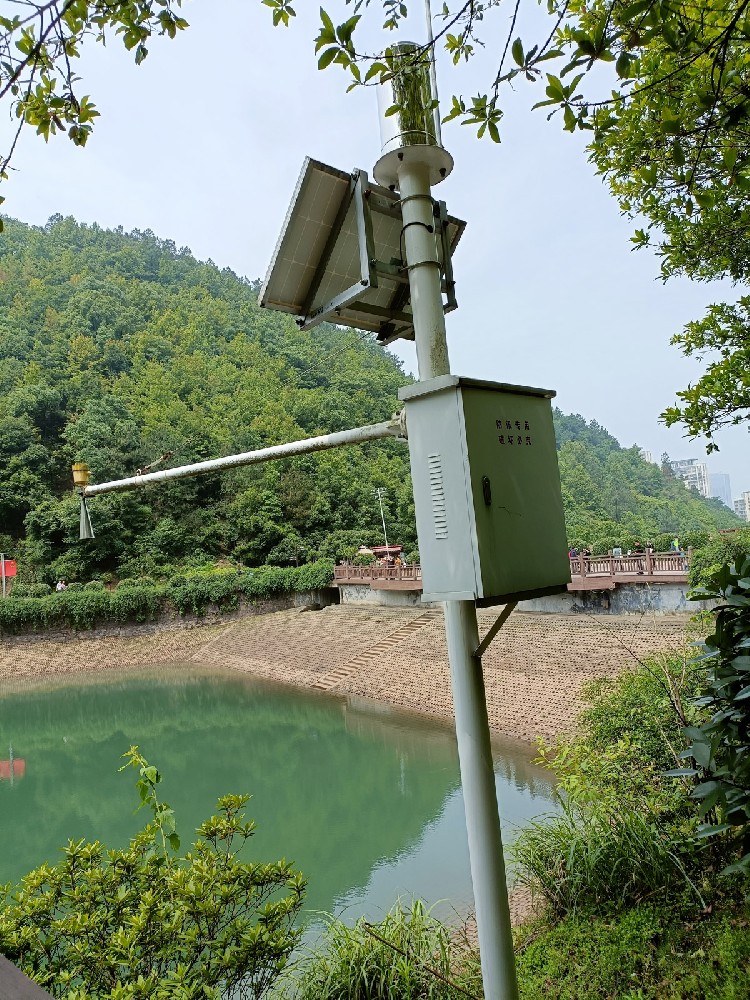
Reservoir banks and forest margins deserve a seasonal inspection: leaf growth can shade the panel and debris can obstruct the collector. The pictured installations illustrate equipment arrangements, not a transferable site design. Cable routes should include strain relief, protected entries and a way to service the gauge without pulling its conductors.
Surge protection and bonding require a coordinated electrical design for the site. Do not create an arbitrary isolated sensor earth or copy a universal conductor spacing from an unrelated installation. If wind channels are added, the NBL-W-SS wind speed sensor and NBL-W-DS wind direction sensor have IP65 protection; that does not establish the rating of the battery box, cable joints or entire station.
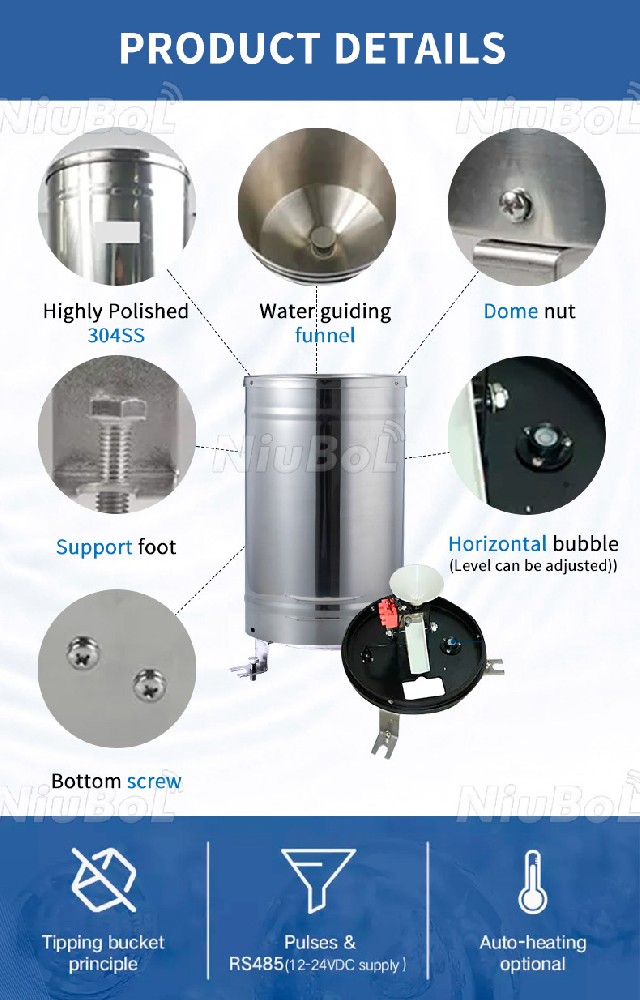
A manual bucket movement checks event capture but does not establish rainfall calibration. For a metered-water check, use the appropriate flow-controlled method and allow for wetting, residual water and incomplete final tips. At the nominal 0.2 mm factor, fifty complete tips correspond to 10 mm. A fast pour that produces a different count is not sufficient evidence for changing the calibration.
A farm recording seasonal rainfall may tolerate less frequent uploads while still counting every tip locally. A catchment warning application may require short reporting intervals and event-triggered messages, with greater power and communications demand. Neither arrangement turns a point rainfall measurement into an automatic safe gate-control decision.
For a remote industrial site, compare service access with the cost of a larger energy reserve. A low purchase price can become expensive if a technician must travel whenever a battery reaches cutoff. Ask for a quotation identifying the gauge output, logger input, battery and controller, panel rating, enclosure, communications equipment and any separately priced installation work.
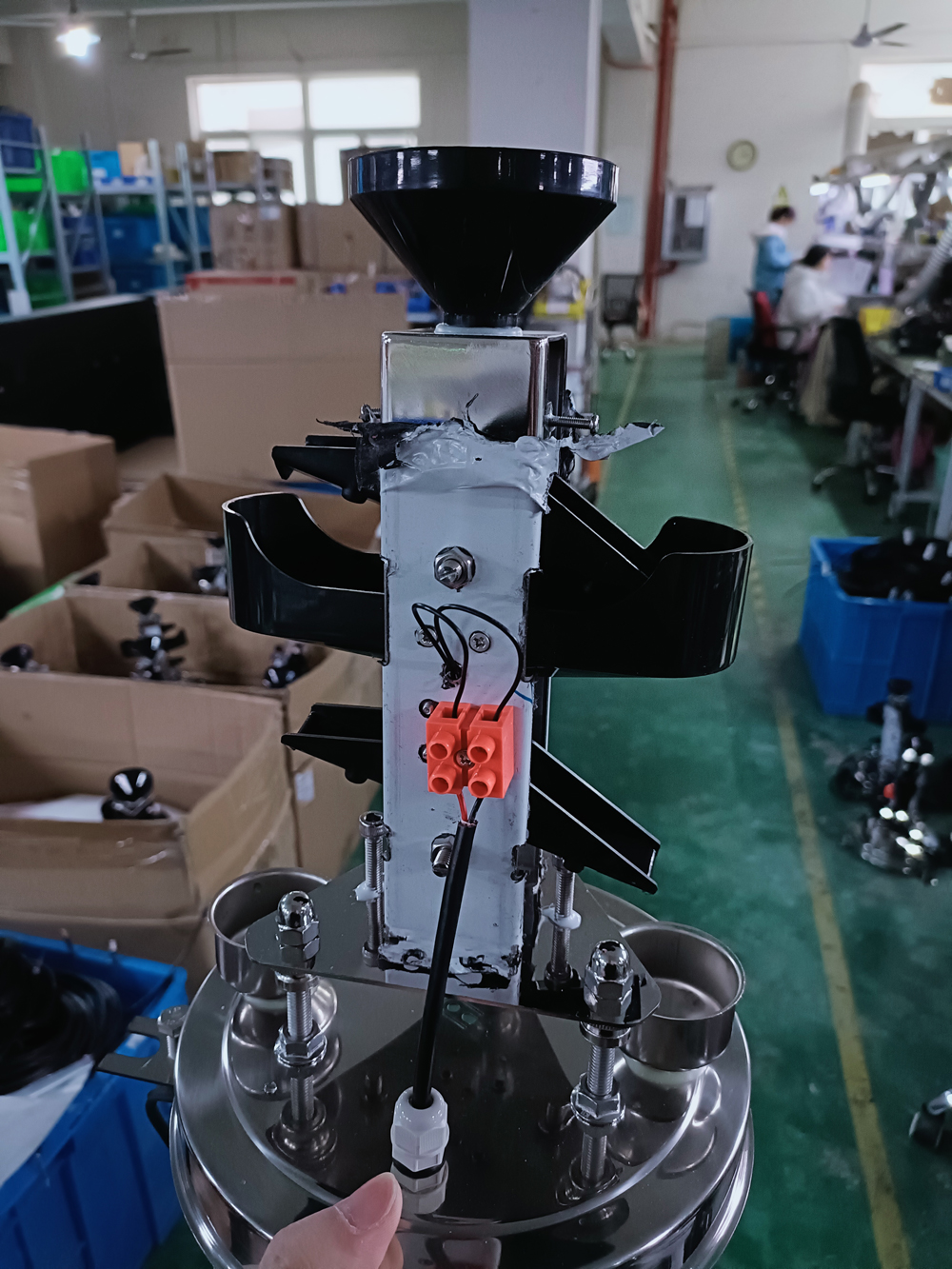
The radio may be switched off if the design permits it. The rainfall capture path must remain able to record events, or the gauge must independently retain a readable count. Verify that capability through an actual power-cycle test; a configurable reporting interval does not prove continuous counting.
Not necessarily. Compare counter inputs, cable protection, diagnostic needs and integration work as well as sensor price. A pulse channel needs correct event conditioning and reset handling. An RS485 configuration needs a powered device and correct protocol, but can simplify digital acquisition in a compatible system.
Set the requirement from local conditions, access time and acceptable observation gaps. Specify an energy budget and usable battery capacity at the relevant temperature. A fixed number of days without the load profile and cutoff assumptions is not a useful sizing specification.
Only records actually captured and retained can be recovered. A gauge that was unpowered and retained no events cannot reconstruct them after restart. Flag the affected interval rather than reporting a zero that implies verified dry weather.
The standard NBL-W-RS operating range is for non-freezing liquid precipitation measurement. A cold-climate project needs a specifically suitable precipitation instrument and a separate heating and power assessment. A heated enclosure alone does not make the collector a validated snow measurement system.
Send the site location, lowest operating temperature, required observation and reporting intervals, available network, service access and no-charge autonomy target. Include whether the gauge is pulse or digital and which extra sensors are planned. NiuBoL can then assess an itemised solar-powered rain gauge station configuration.
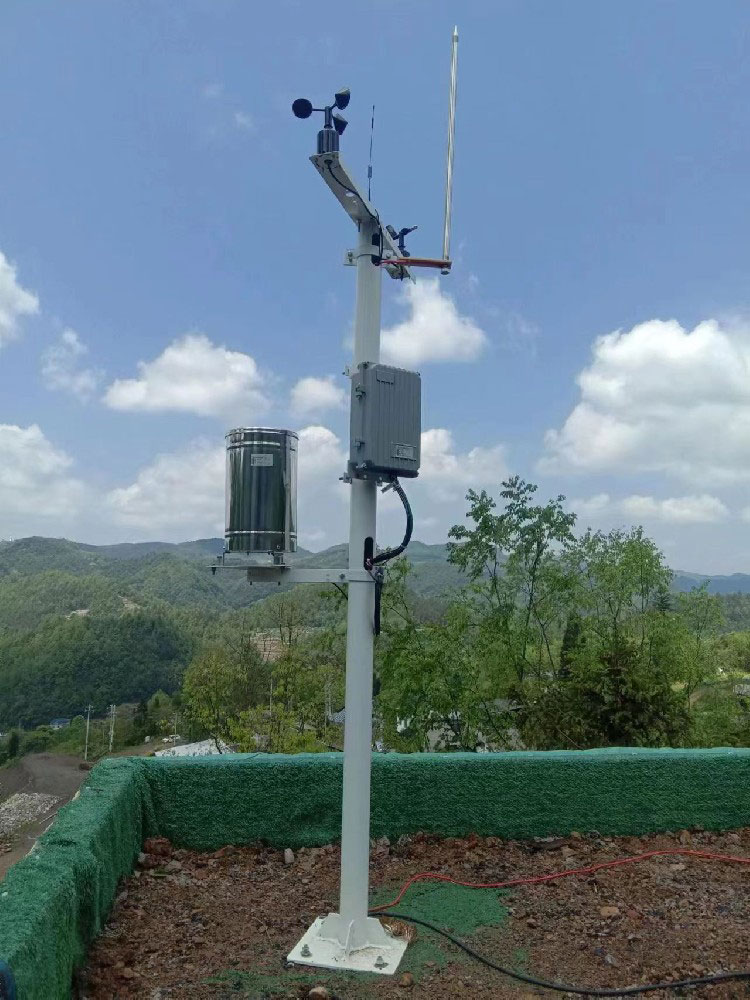
Reliable solar rainfall monitoring starts with uninterrupted event capture, a measured energy budget and a tested restart sequence. Select the collector output and logger together, then size charging and storage for the deployment season. Treat missing powered observation as a data gap, not zero rainfall, and request a configuration based on the site's actual operating requirements.
Prev:Solar-Powered Rain Gauge Station Integration Guide
Next:Campus Weather Station Installation: Separate Observation and Public Access
Related recommendations
Sensors & Weather Stations Catalog
 Agriculture Sensors and Weather Stations Catalog-NiuBoL.pdf
Weather Stations Catalog-NiuBoL.pdf
Agriculture Sensors Catalog-NiuBoL.pdf
Water Quality Sensor Catalog-NiuBoL.pdf
Related products
 Combined air temperature and relative humidity sensor
 TDR Soil Moisture & Temperature Sensor for irrigation| RS485 |4-20mA| NBL-S-THR
 Soil pH sensor RS485 soil Testing instrument soil ph meter for agriculture |NBL-S-PH
 Wind Speed sensor Output Modbus/RS485/Analog/0-5V/4-20mA
 Tipping bucket rain gauge for weather monitoring auto rainfall sensor RS485/Outdoor/stainless steel
 Pyranometer Solar Radiation Sensor 4-20mA/RS485

Screenshot, WhatsApp to identify the QR code
WhatsApp number:+8615367865107
(Click on WhatsApp to copy and add friends)

