





— Blogs —
—Products—
 Consumer hotline +8618073152920
 WhatsApp:+8615367865107
Address:Room 102, District D, Houhu Industrial Park, Yuelu District, Changsha City, Hunan Province, China
Product knowledge
Time:2026-03-02 14:54:28 Popularity:633
Quick Answer: Compact weather station procurement should cover a functioning measurement system, not only a sensor head. Specify the channels, data logger, communications, power supply, mounting and acceptance tests together. A station is ready for handover when it produces correctly identified, time-stamped measurements at the required destination and behaves predictably during the interruptions the project expects.
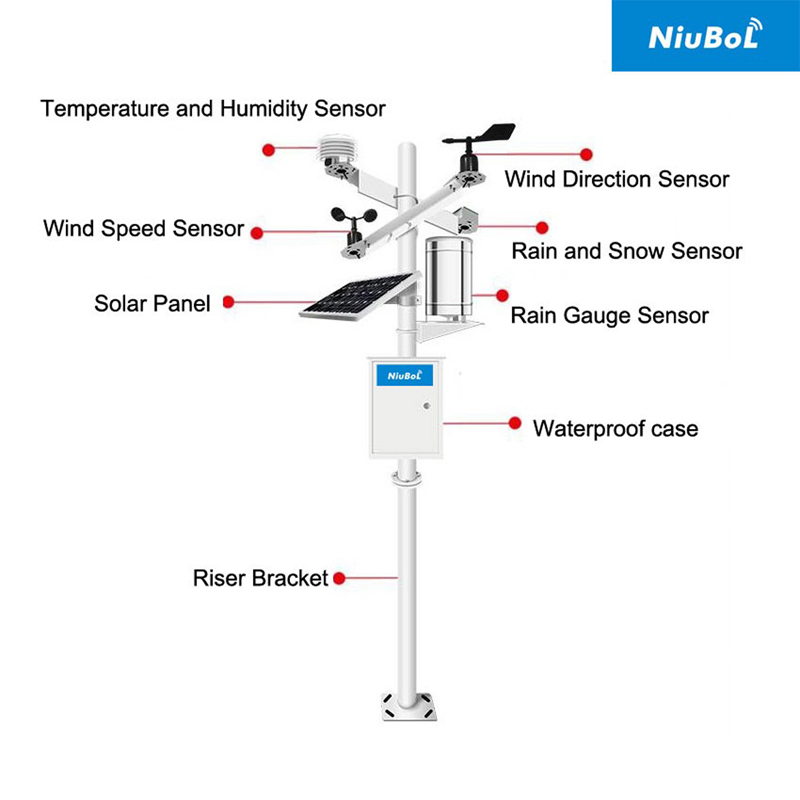
Two quotations headed "compact weather station" may cover substantially different equipment. One can be an RS485 sensor with a short cable; another can include a mast, logger, solar supply, enclosure and configured remote connection. Comparing the totals before identifying these differences can leave the contractor responsible for unpriced installation work or an incompatible data interface.
Request a line-item equipment list and a connection drawing. The drawing should show where each sensor terminates, which device timestamps the readings, where data is stored and how it reaches the operator. Identify who supplies the foundation, earthing, SIM or network service, server destination and installation labor. This is particularly important when the sensor supplier, electrical contractor and software integrator are different companies.
| Part of the station | What to establish before ordering | Typical omission to prevent |
|---|---|---|
| Sensor package | Named channels, model, range, accuracy, output and mounting accessories | Assuming an advertised option is installed |
| Data logger or RTU | Supported inputs, driver configuration, clock, storage and export format | A serial port without a working sensor driver |
| Communications | Network interface, antenna, destination, credentials and recurring charges | Confusing local RS485 with remote internet connectivity |
| Power package | Load budget, battery chemistry, charging limits, panel and controller | Sizing for the sensor alone |
| Outdoor installation | Mast, brackets, enclosure, cable entries, protection and access | Missing foundations or incompatible mounting dimensions |
For agriculture, first decide whether the station provides general weather context, supports an evapotranspiration calculation or informs irrigation decisions. These uses do not have identical inputs. Root-zone moisture and soil temperature require sensors in the soil; adding channels to an above-ground weather head cannot provide those measurements. PAR is appropriate when the project needs plant-light measurements, not automatically for every farm installation.
For road projects, wind and air conditions can support local operational awareness, but they do not establish road-surface temperature, visibility or ice conditions. Those quantities need suitable additional instruments and application logic. For industrial or construction monitoring, state whether dust and noise readings are for trend investigation or a specified regulatory measurement method before choosing a compact combination.
The equipment below illustrates the range of separate sensing functions that can form a station. It should not be interpreted as a standard package containing every pictured product. A shorter channel list with a defined use is easier to commission than a larger list whose data is never checked or acted upon.
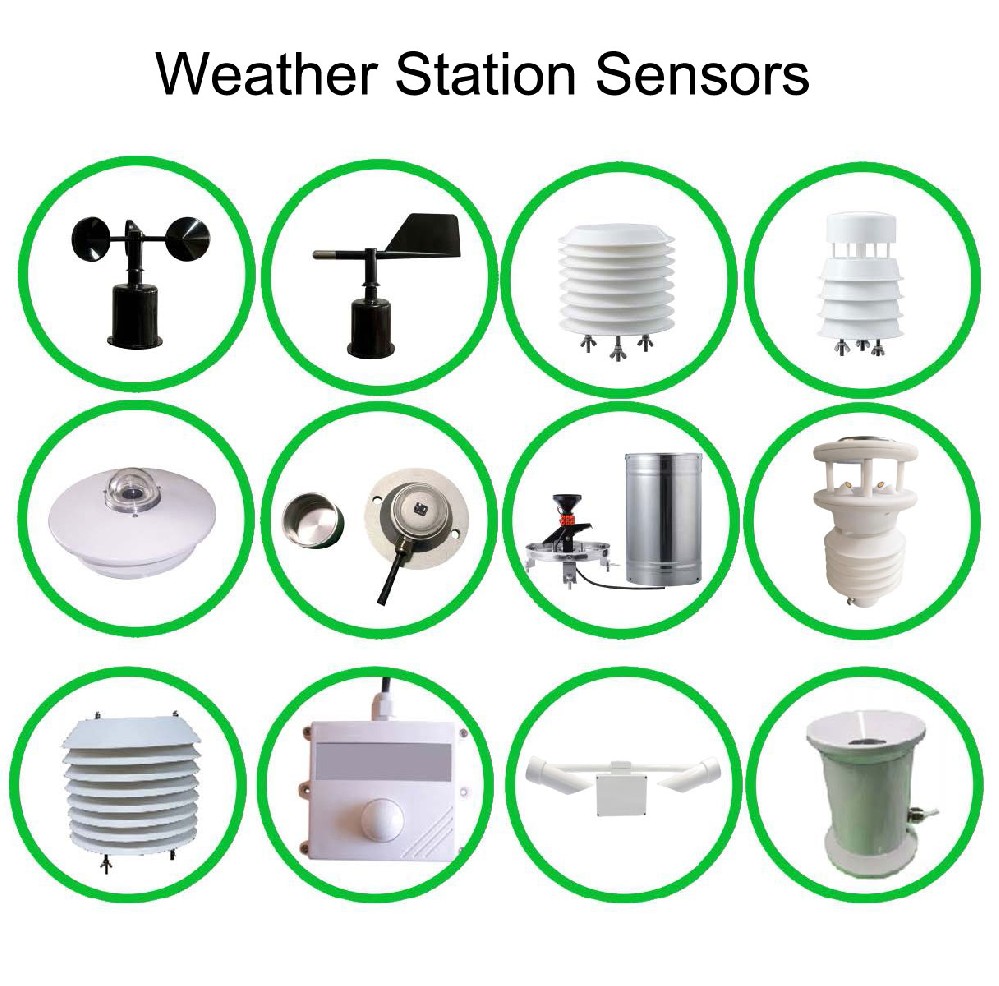
A single integrated head is useful when space and cable routes are limited. Separate sensors become preferable when wind, rainfall, temperature or irradiance must be measured at different positions. Before approving the mounting arrangement, compare the proposed location with the quantity the project wants to represent. A sheltered courtyard reading cannot be relabeled as unobstructed regional wind.
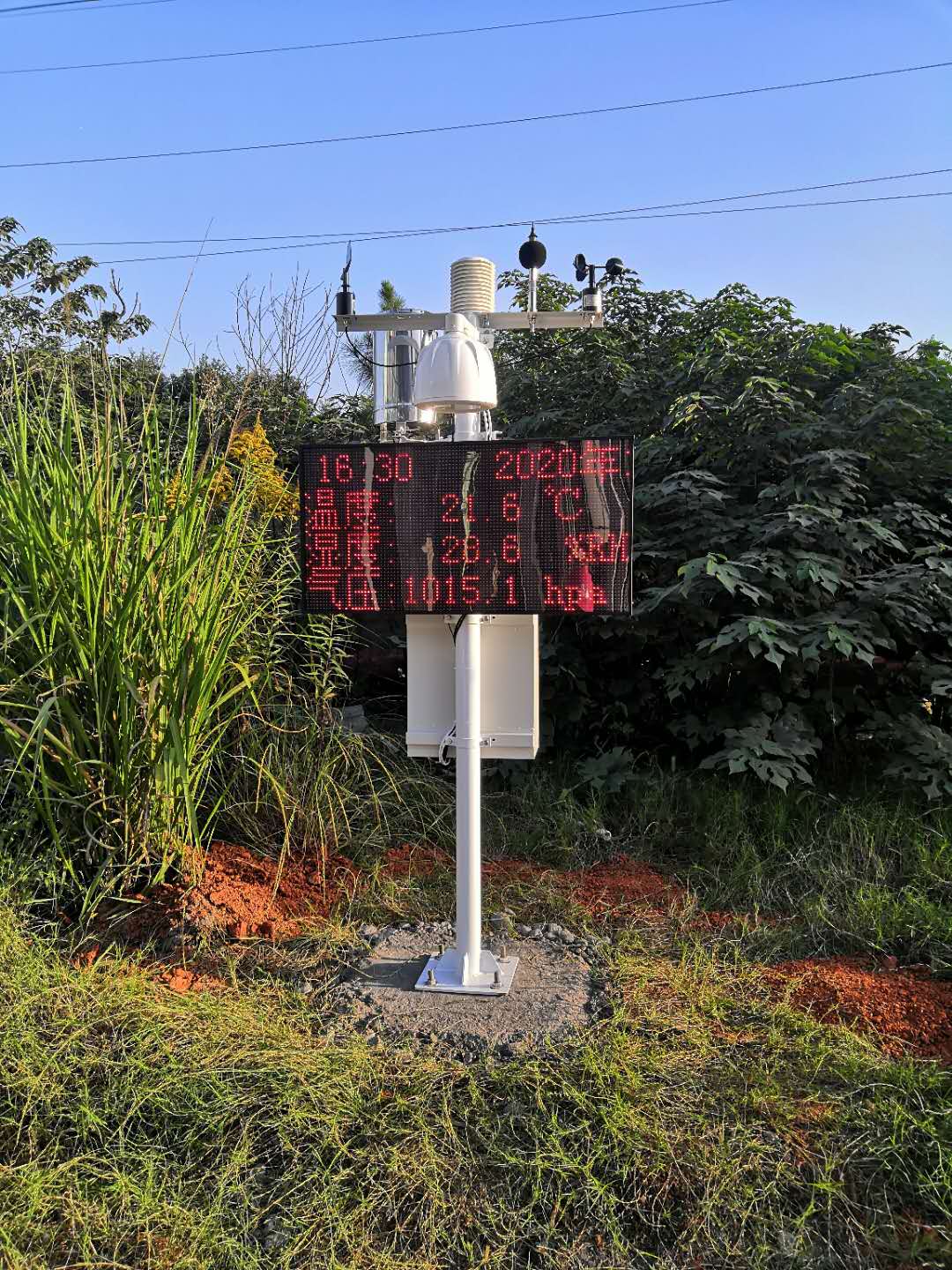
Ask the installer to identify nearby heat sources, vegetation, roof edges and future obstructions on the site drawing. Include safe access for cleaning and replacement. If every service visit requires specialist lifting equipment, that access cost belongs in the procurement decision. A compact sensor does not make a tall or inaccessible mount inexpensive to maintain.
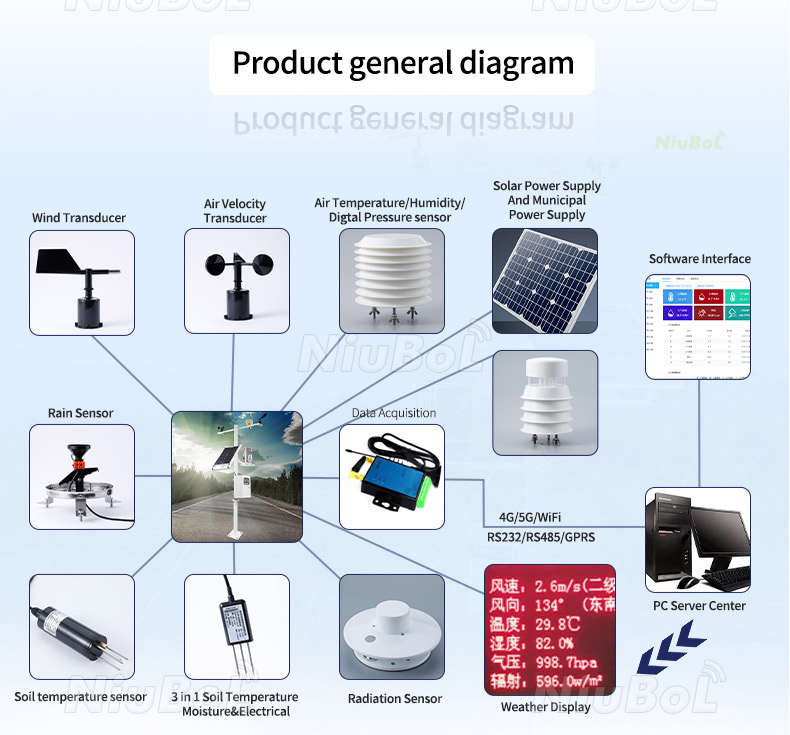
An RS485 Modbus RTU sensor delivers measurement registers. The receiving data logger, PLC or RTU must interpret those registers, apply the correct units and record time. A modem or gateway then provides a supported route to the destination. Do not assume that Modbus TCP, MQTT, cellular service or cloud storage is included because the field sensor has RS485.
Give the supplier the actual receiving system rather than asking only for "open protocol." For example, a PLC may need a register list and serial settings, while a remote server may require a defined payload, authentication and handling of delayed records. Agree where unit conversion takes place so the same value is not scaled twice in the logger and again in the server.
Decide whether a reported wind value is an instantaneous sample, an average or a gust statistic, and state the associated time window. A cloud upload interval is not necessarily the sampling interval. A five-minute upload containing one instantaneous value cannot be treated as a five-minute average without appropriate processing.
Storage should be sized from the record format and retention period, not a generic memory-capacity claim. As an illustration, ten 4-byte values plus an 8-byte timestamp make a 48-byte payload. At one record per minute that is 69,120 bytes per day before status fields, indexing and filesystem overhead. Actual storage must be assessed using the logger's implemented record format and the required outage duration.
Test the timestamp convention, including time zone and how the clock recovers after power loss. When communication resumes, historical records should retain their measurement time instead of being labeled as newly measured at upload time. Where the selected logger cannot buffer and backfill, make that limitation explicit before ordering.
The NiuBoL NBL-W-71GUWS integrated weather sensor is one possible measurement head for a compact station. Its seven-channel combination includes wind speed, wind direction, air temperature, humidity, pressure and rainfall, plus solar radiation or illuminance. The selected optical channel must be named in the equipment list.
| Sensor item | NBL-W-71GUWS value | Whole-station check |
|---|---|---|
| Wind speed / direction | 0-60 m/s / 0-359 degrees; resolutions 0.01 m/s / 1 degree | Check exposure, north alignment and the required wind statistic |
| Air temperature | -40 to 80 C; accuracy +/-0.5 C | Battery, logger and enclosure conditions need their own temperature review |
| Relative humidity | 0-100% RH; accuracy +/-5% RH | Assess ventilation and condensation exposure at the installation |
| Pressure | 10-1100 hPa; accuracy +/-1.5 hPa | Label measured station pressure separately from calculated values |
| Rainfall | 0-8 mm/min; accuracy +/-10% | Specify accumulation and reset handling in the logger |
| Communication | RS485 Modbus RTU; 9600 bps | Remote transmission depends on the chosen logger or gateway |
| Average sensor power | 0.4 W for the configuration without PM sensing | Add logger, modem, heater and conversion loads separately |
| Sensor protection | IP65 | Enclosure, connectors and cable entries require their own protection specification |
Specify the delivered sensor's supply-voltage range and the voltage available at the end of its cable. Avoid transferring a sensor's environmental rating to the complete station. In particular, an outdoor sensor temperature range does not establish a battery's charging limits or a modem's operating range. Cable jacket material, length and strain relief also belong to the installation specification, not to an assumed generic kit.
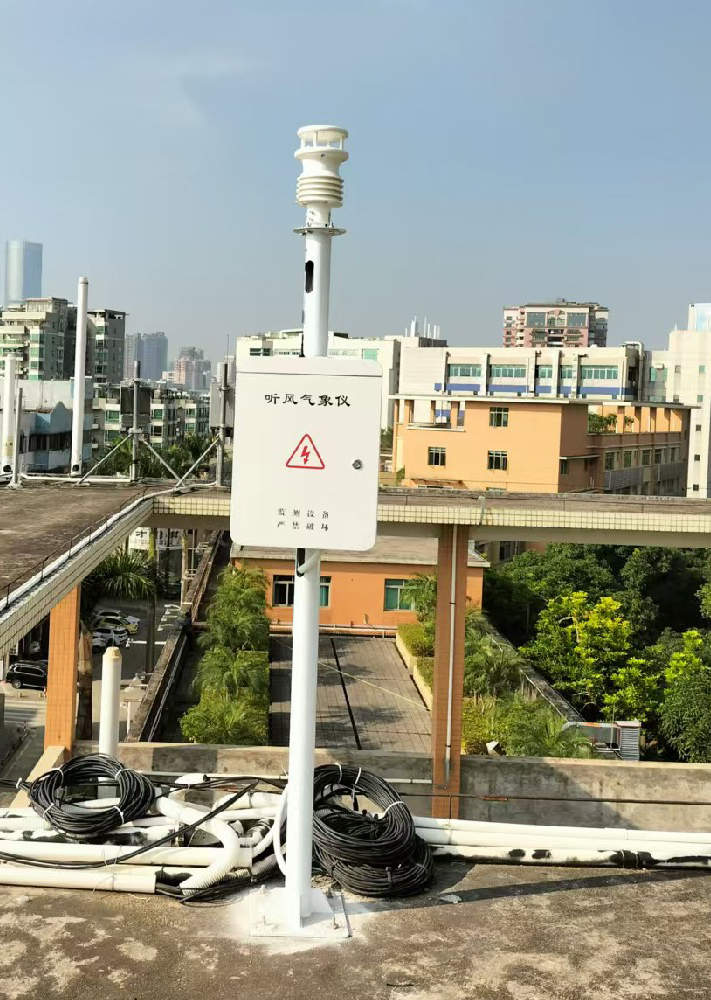
Separate continuously powered loads from intermittent loads. Sensor consumption can be a small part of the total once a logger, modem, display, ventilation or heater is included. Record both average energy demand and peak current: sufficient battery energy does not prevent a voltage dip if a radio transmission exceeds the wiring or regulator capability.
For an illustrative station averaging 5 W, daily demand is 5 x 24 = 120 Wh. Three days without useful charging require 360 Wh at the loads. If the design allows 80% usable battery capacity and 90% delivery efficiency, nominal capacity is 360 / (0.8 x 0.9) = 500 Wh before temperature and aging allowances. At a nominal 12 V that is approximately 41.7 Ah. These assumptions demonstrate the calculation; they are not a battery recommendation for every climate.
Panel selection must then account for the site's low-sun period, shading, charging losses and the time allowed to recharge after an outage. Ask for the load calculation and the local solar assumptions behind the offered panel size. Optional heating can change the result substantially, so an unheated summer load test cannot establish winter autonomy.
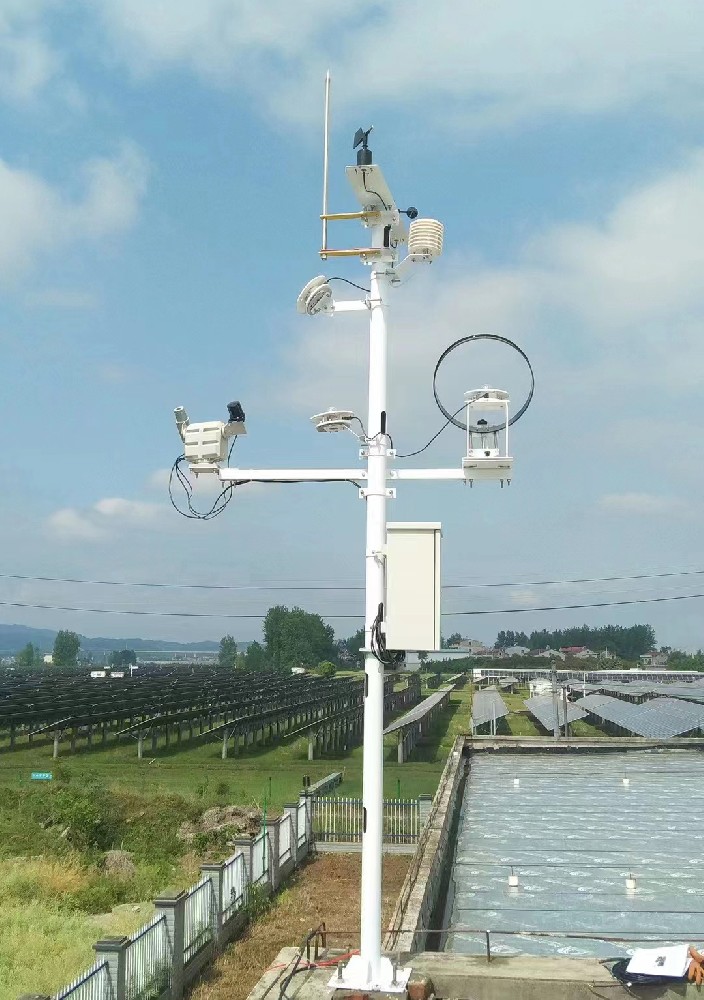
At a PV site, specify whether the project needs GHI, array-plane irradiance or another radiation component. A single ordinary pyranometer does not independently provide global, direct-normal and diffuse measurements. Direct-normal or diffuse measurements need the appropriate instrument and arrangement. Module temperature is a separate channel, and its installation should represent the module condition of interest.
The pictured monitoring arrangement illustrates why radiation exposure and mounting deserve a dedicated decision. Determine sensor planes, shading constraints, cleaning access and how the readings will be compared with electrical generation. Do not choose the radiation configuration solely because it can share the weather station's mast or fit a spare logger input.
Set numerical measurement tolerances from the project specification and the selected instruments. An online dashboard and plausible values are not sufficient acceptance evidence. Conversely, do not reject two differently exposed sensors simply because their values differ; resolve the measurement conditions before assessing accuracy.
For quotation, provide NiuBoL with the site location, application, required channels, mounting constraints, existing receiving system, available power and expected communication outages. Request separate prices for essential equipment and optional functions, with delivery and support terms stated for that configuration. A fixed generic online price cannot resolve these engineering differences.
Yes, if the PLC has a compatible interface and can implement the selected sensor's register map or analog scaling. Check address settings, polling timing, signed values and fault handling before installation. An RS485 terminal alone does not establish software compatibility.
The difference may be in sensing performance, logger functions, power autonomy, mounting, communications or service scope. Compare those items line by line. Ask which equipment and recurring services are excluded before treating a lower total as an equivalent offer.
No. Suitability depends on seasonal solar resource, shading, load and battery operating limits. A heated installation at a low-sun site can need a different supply arrangement from an unheated station with infrequent transmission. Size against the difficult operating period, not the annual average.
Not unless the specified package includes separate soil sensors and compatible acquisition inputs. Choose measurement depths and positions for the actual agricultural question. Above-ground air conditions cannot substitute for root-zone water content.
Agree the required behavior before purchase. If continuity is necessary, select a logger with sufficient local storage and a tested backfill method. The receiving system must distinguish delayed records from current data. A gateway that only forwards live readings may not meet this requirement.
No. The rating applies to the specified sensor enclosure. The logger box, antenna connections, cable glands and field joints each need appropriate protection. Installation workmanship and maintenance can affect the assembled system even when individual components have suitable ratings.
Compact weather station procurement succeeds when the equipment list, data path, power calculation and acceptance tests describe the same system. Select only measurements that serve the application, identify where integration ends and site work begins, and test the complete chain before handover. This makes quotations comparable and reduces avoidable commissioning gaps.
Prev:Campus Weather Station Installation: Separate Observation and Public Access
Next:Agricultural Meteorological Instruments: Match Each Measurement to a Farm Decision
Related recommendations
Sensors & Weather Stations Catalog
 Agriculture Sensors and Weather Stations Catalog-NiuBoL.pdf
Weather Stations Catalog-NiuBoL.pdf
Agriculture Sensors Catalog-NiuBoL.pdf
Water Quality Sensor Catalog-NiuBoL.pdf
Related products
 Combined air temperature and relative humidity sensor
 TDR Soil Moisture & Temperature Sensor for irrigation| RS485 |4-20mA| NBL-S-THR
 Soil pH sensor RS485 soil Testing instrument soil ph meter for agriculture |NBL-S-PH
 Wind Speed sensor Output Modbus/RS485/Analog/0-5V/4-20mA
 Tipping bucket rain gauge for weather monitoring auto rainfall sensor RS485/Outdoor/stainless steel
 Pyranometer Solar Radiation Sensor 4-20mA/RS485

Screenshot, WhatsApp to identify the QR code
WhatsApp number:+8615367865107
(Click on WhatsApp to copy and add friends)

