





— Blogs —
—Products—
 Consumer hotline +8618073152920
 WhatsApp:+8615367865107
Address:Room 102, District D, Houhu Industrial Park, Yuelu District, Changsha City, Hunan Province, China
Product knowledge
Time:2026-05-31 12:01:23 Popularity:358
Quick Answer: Conductivity sensor calibration after cleaning should follow an inspection and verification, not an automatic reset. Identify the NBL-WQ-EC range, use the appropriate zero procedure and a known conductivity standard, and compare the result before and after service. Ultrapure rinse water is not a universal slope-calibration standard.
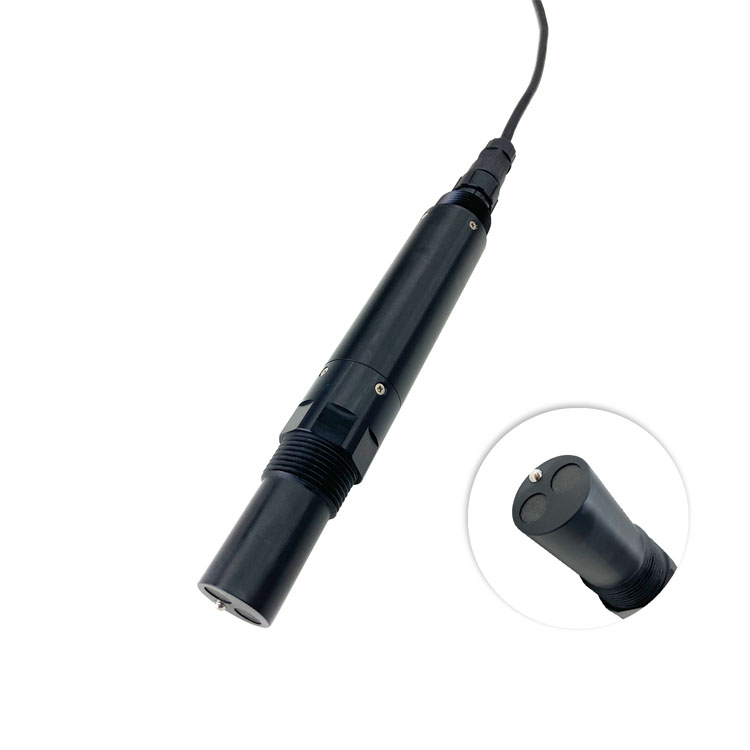
Record the process reading, temperature, range and receiving-system value before removing the probe. Where practical, obtain a suitable comparison without changing the stored calibration. This separates an actual instrument change from a shift caused by cleaning, temperature, position or the process itself.
After removal, inspect deposits, physical damage, cable condition and the measurement region. Use the permitted cleaning method for the exact electrode configuration. A standard that was contaminated by an unclean probe cannot then establish whether the probe needed adjustment.
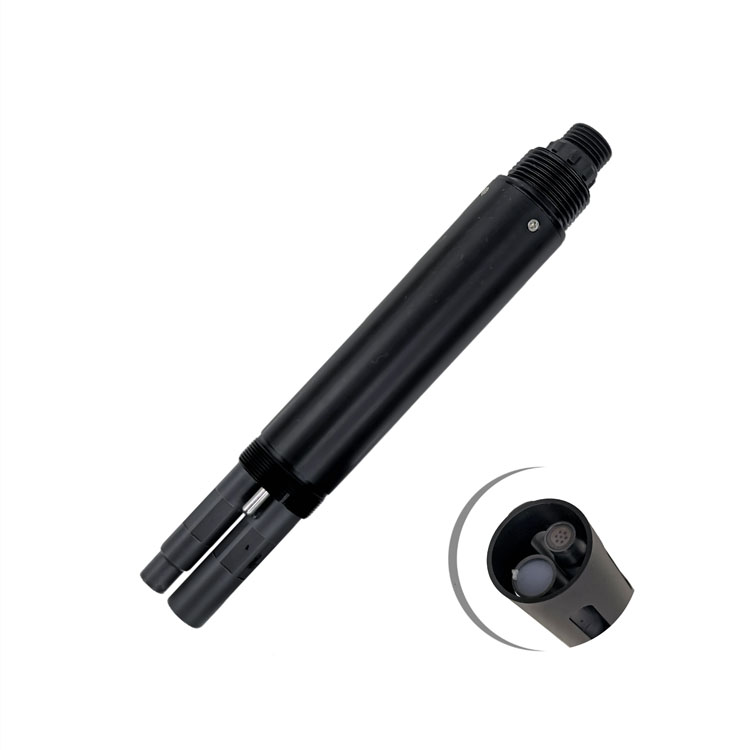
The ammonium probe shown below belongs to a different analytical channel. Its membrane preparation and storage needs are not conductivity calibration instructions. In a multiparameter station, label the probe and its service procedure before shared maintenance work begins.
| Configuration | Range / resolution | Calibration consideration |
|---|---|---|
| EC-0.01 | 0-20.00 uS/cm / 0.01 uS/cm | Low-conductivity references are sensitive to contamination and handling. |
| EC-0.1 | 0-200.0 uS/cm / 0.1 uS/cm | Use a known standard appropriate to this span and the specified procedure. |
| EC-1.0 | 0-5000 uS/cm / 1 uS/cm | Do not reuse a low-range standard merely because it gives an on-scale number. |
| EC-SI | 0-200.0 mS/cm / 0.1 mS/cm | Preserve the mS/cm unit and check the applicable calibration arrangement. |
The basic EC accuracy is +/-1% F.S., with temperature accuracy of +/-0.3 degrees C. On a 5000 uS/cm span, the full-scale term is 50 uS/cm. If that is too large for the process decision, a calibration adjustment cannot turn the instrument into a more suitable range. The conductivity range guide addresses that separate selection issue.
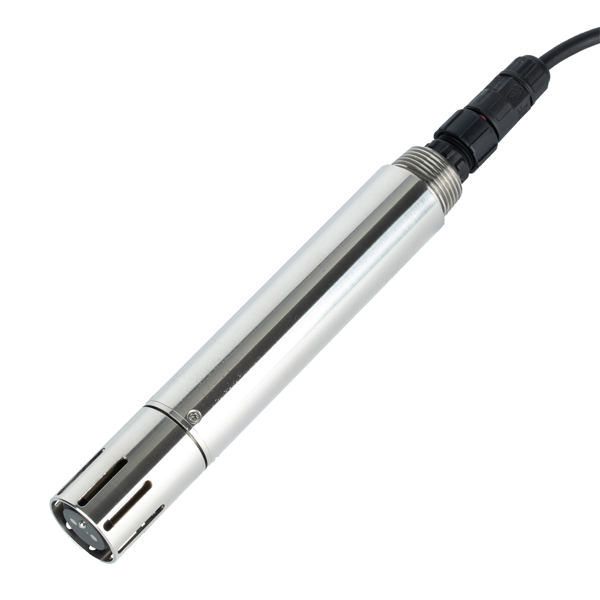
Salinity instruments such as the configuration below require their own quantity and calibration basis. Do not relabel a conductivity standard as a salinity standard or assume that a shared Modbus interface makes service commands interchangeable.
| Task | Purpose | Frequent mistake |
|---|---|---|
| Rinsing after cleaning | Remove cleaning residue and carryover without damaging the sensing region | Treating the rinse-water conductivity as a certified reference value |
| Zero calibration | Establish the model's specified zero condition | Applying one drying or immersion procedure to every range |
| Slope calibration | Adjust response using a known conductivity standard | Entering an assumed standard value without considering temperature, units or contamination |
| Verification | Check performance against an appropriate reference without changing calibration | Reporting an adjustment as though it were an independent check |
For the basic low-conductivity ranges, zero calibration uses the clean probe in air after stabilization. That condition is different from immersion in rinse water. Follow the procedure for the ordered range rather than extending a low-range air-zero instruction to an unidentified sensor.
For slope, use a known standard in the concentration interval specified for the selected range. Identify the standard value, reference temperature, batch and validity. Let the probe and solution stabilize under the required conditions. Do not copy a single 147 uS/cm standard recommendation across spans that differ by several orders of magnitude.
A nominal ultrapure-water resistivity specification does not establish the conductivity of an opened working aliquot at the time of calibration. Carbon dioxide uptake, container contamination, carryover and temperature can change a low-conductivity sample. Use rinse water for the preparation task it is intended to perform; use an appropriate established standard for calibration.
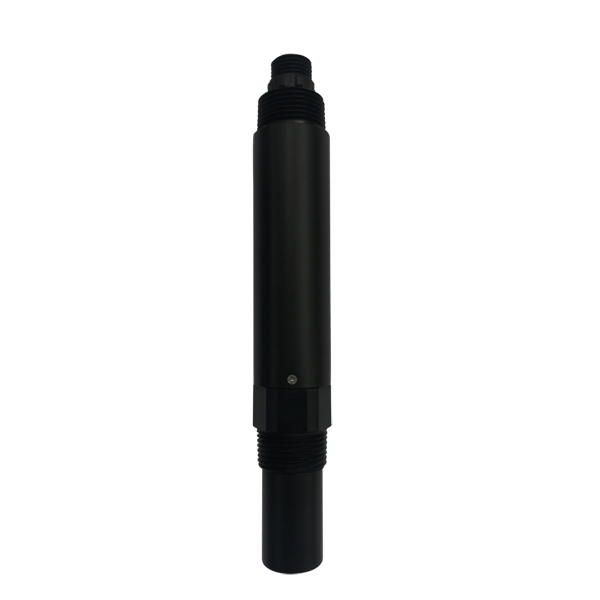
The EC-4A illustrated above has its own specification and service instructions. Its accuracy must not be substituted for the basic EC specification. Compare the exact model and stored settings before deciding that an apparent difference after replacement requires slope adjustment.
Removing a probe can change its immersion, trapped bubbles and distance from nearby structures. For basic EC-1.0 and EC-SI configurations, maintain at least 2 cm clearance from side walls and the bottom. Confirm the applicable arrangement for other configurations and avoid touching the sensing region against the vessel.
Restore representative water contact, relieve cable tension and protect the terminations. The basic EC operates at 0-50 degrees C and below 0.6 MPa, with IP68 protection and 3/4 NPT mounting. It uses 12-24 V DC +/-10%, consumes 0.2 W at 12 V and has a standard 5 m cable. Select ABS, SUS316L or PVC wetted materials according to the ordered configuration and chemical exposure, including the cable jacket.
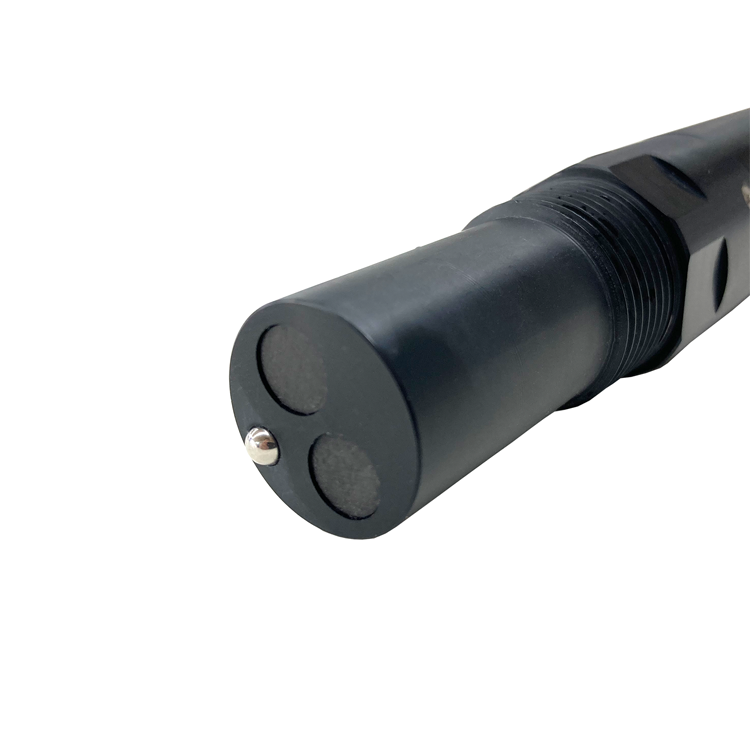
Compare a direct probe read with the PLC or logger through RS485 Modbus RTU. Check the conductivity integer, decimal position and unit for the supplied protocol. A decoding change can look like a calibration shift even when the sensor response is unchanged.
TDS is derived using a coefficient, so a matching EC and TDS trend is not an independent verification. If the measured EC is correct but calculated TDS differs, inspect the coefficient and reporting basis before adjusting the electrode. The distributed EC data guide covers those configuration checks.
Not automatically. Inspect, clean and verify against a suitable reference. Adjust when required by the observed result, the applicable procedure or the project's quality requirements, while retaining the pre-adjustment evidence.
No. They are different measurement conditions. Use the zero procedure for the identified model and range; do not substitute a convenient liquid for a specified air-zero condition.
No. Check the recommended calibration interval and the accuracy needed at the operating point. An on-scale reading alone does not establish that the selected standard is suitable for slope calibration.
The returned observation can change if deposits, bubbles, immersion, geometry or temperature change. Re-establish the intended position and stable water conditions, then verify the sensor rather than assuming removal is always irrelevant or always causes damage.
Provide the full model and range, standard identification and value, temperature, readings before and after cleaning, calibration actions, installation geometry and direct versus controller values. NiuBoL can then distinguish a reference, sensor, range or data-path problem.
Conductivity sensor calibration after cleaning is a sequence of preparation, verification, justified adjustment and return-to-service checks. Use the exact range and a suitable reference, preserve the measuring position and confirm the received value. Repeatedly changing slope cannot repair a contaminated standard, inappropriate range or wrong decoder.
 NBL-WQ-CL Water Quality Sensor Online Residual Chlorine Sensor.pdf
NBL-WQ-DO Online Fluorescence Dissolved Oxygen Sensor.pdf
NBL-WQ-NHN Ammonia Nitrogen Water Quality Sensor.pdf
NBL-WQ-COD Online Water Quality COD Sensor.pdf
NBL-WQ-PH Online pH Water Quality Sensor.pdf
NBL-WQ-EC water quality conductivity sensor.pdf
Prev:Paired Chlorine and pH Monitoring: Specify Two Measurement Channels
Next:Industrial pH Sensor Control: Mixing, Sample Delay and Dosing Response
Related recommendations
Sensors & Weather Stations Catalog
Agriculture Sensors and Weather Stations Catalog-NiuBoL.pdf
Weather Stations Catalog-NiuBoL.pdf
Agriculture Sensors Catalog-NiuBoL.pdf
Water Quality Sensor Catalog-NiuBoL.pdf
Related products
 Combined air temperature and relative humidity sensor
 TDR Soil Moisture & Temperature Sensor for irrigation| RS485 |4-20mA| NBL-S-THR
 Soil pH sensor RS485 soil Testing instrument soil ph meter for agriculture |NBL-S-PH
 Wind Speed sensor Output Modbus/RS485/Analog/0-5V/4-20mA
 Tipping bucket rain gauge for weather monitoring auto rainfall sensor RS485/Outdoor/stainless steel
 Pyranometer Solar Radiation Sensor 4-20mA/RS485

Screenshot, WhatsApp to identify the QR code
WhatsApp number:+8615367865107
(Click on WhatsApp to copy and add friends)

