





— Blogs —
—Products—
 Consumer hotline +8618073152920
 WhatsApp:+8615367865107
Address:Room 102, District D, Houhu Industrial Park, Yuelu District, Changsha City, Hunan Province, China
Product knowledge
Time:2026-03-03 12:04:59 Popularity:583
Agricultural meteorological instruments should be selected from the decisions a farm needs to make, not from the largest available sensor count. Rainfall helps describe water input, a soil probe measures conditions near its electrodes, and a light sensor answers a different question from a humidity sensor. A useful station combines those observations without treating them as interchangeable evidence.
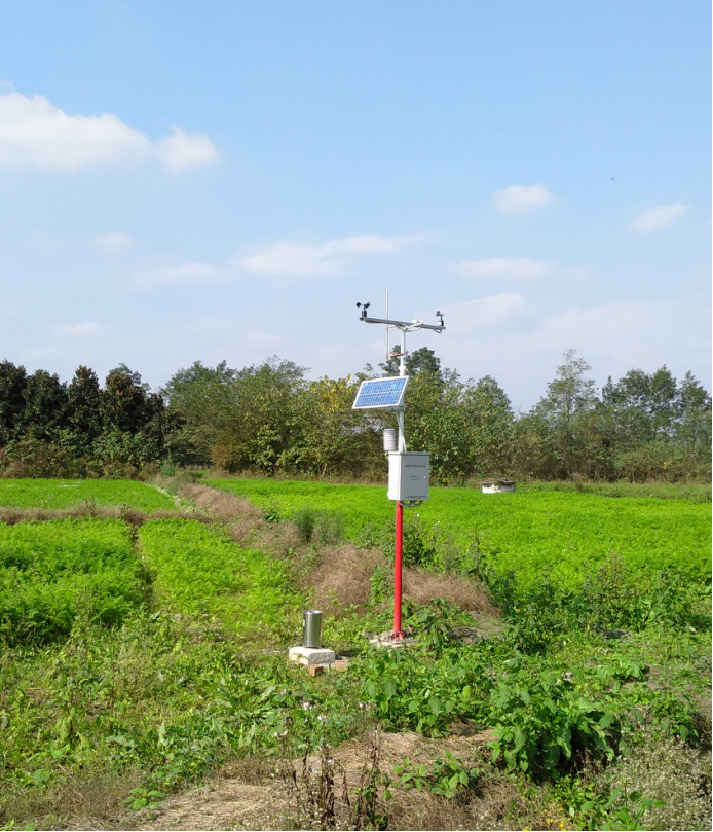
For an irrigation project, the question may be whether water has reached the active root zone. For spraying, it may concern wind conditions during the planned application. A greenhouse operator may need to compare light available to the crop with ventilation and carbon dioxide management. Each question needs different measurements and a different location.
The table below is a measurement selection aid, not an automatic control recipe. Crop stage, soil, agronomic practice and local operating requirements determine how observations become actions. Where a decision requires an additional field assessment or a validated model, adding more dashboard channels does not remove that requirement.
| Farm decision | Relevant observations | What remains unresolved |
|---|---|---|
| Check an irrigation response | Root-zone moisture and temperature; rainfall and irrigation records | Actual emitter distribution and crop-specific thresholds |
| Assess a spraying opportunity | Wind speed and direction; relevant temperature and humidity | Product label restrictions, application equipment and field inspection |
| Manage greenhouse lighting | Crop-level PAR and its daily integral | Crop target, lamp contribution and shading distribution |
| Investigate frost exposure | Temperature at relevant crop positions, with wind context | Crop susceptibility and performance of any protection system |
| Support disease-risk assessment | Temperature, humidity and leaf wetness where the model requires it | Pathogen presence and local model validation |
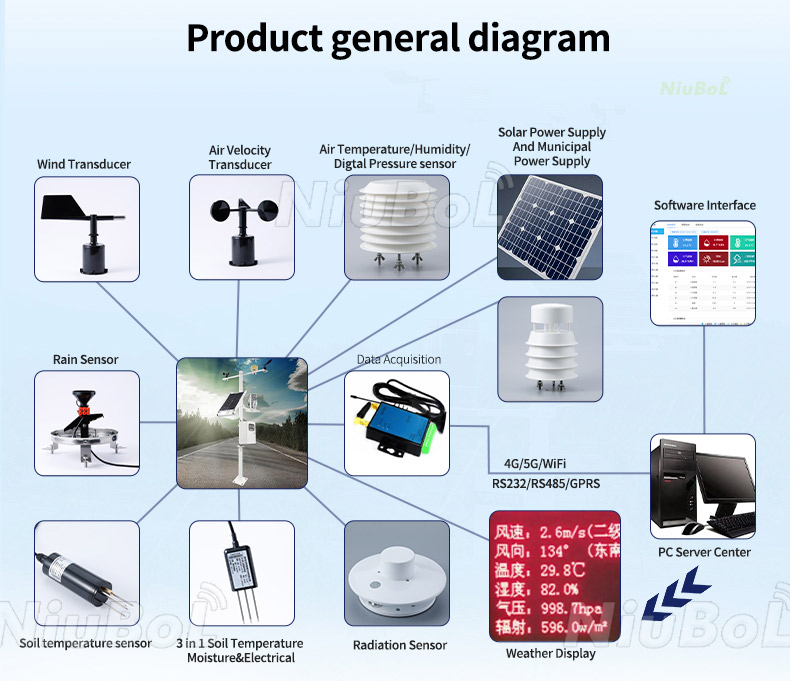
A rain gauge measures precipitation arriving at its collector. It does not measure how much infiltrates a specific soil layer, how uniformly sprinklers apply water, or whether runoff removes part of the input. For irrigation decisions, compare rainfall with soil response and field records instead of subtracting every measured millimetre from an irrigation requirement.
The NiuBoL NBL-S-TM measures soil temperature and volumetric water content. Its reading represents the local sensing volume, not an average of an entire field. Place probes at depths and positions relevant to the crop and irrigation pattern, with consistent contact in representative soil.
A useful commissioning exercise is to record a normal irrigation event and inspect the sequence: application starts, the shallower measurement responds, then a deeper measurement may respond. A rapid isolated spike beside an emitter and no response elsewhere can indicate placement or distribution differences. It should not automatically trigger a recalibration or a claim that the whole root zone is wet.
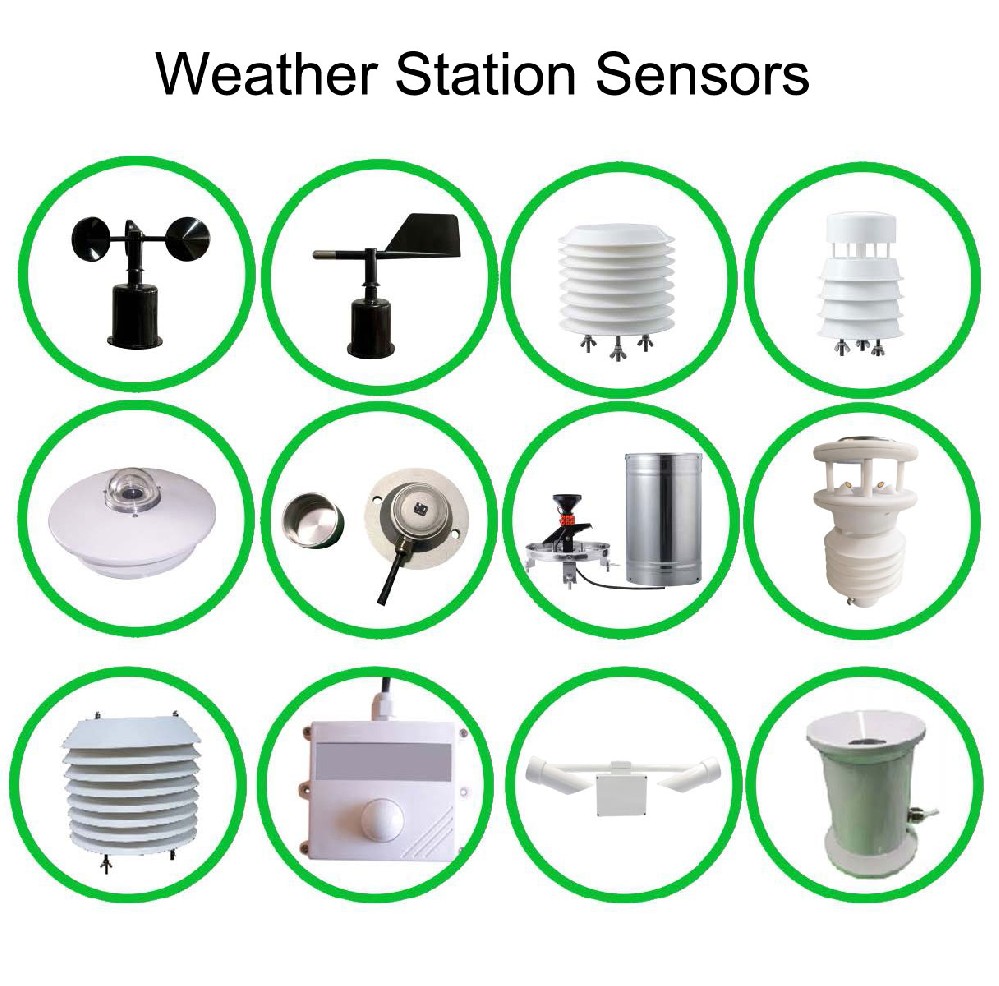
PAR measurement is relevant to photosynthetic light; total solar radiation describes broadband solar energy; illuminance is weighted toward human vision. Their units and spectral responses differ. Do not replace a crop light requirement expressed in micromoles per square metre per second with a lux reading or a pyranometer value using an unexplained constant.
For a greenhouse, decide whether the instrument measures outdoor incoming light, light beneath a cover or light at crop height. A sensor above the structure cannot quantify the effect of dirty glazing, a closed shade screen or uneven supplemental lighting below it. If both external conditions and crop exposure matter, label the measurements as separate positions.
Daily light integral also requires time integration. In a deliberately simplified example, a constant photon flux of 300 micromoles per square metre per second for twelve hours gives 12.96 moles per square metre per day: 300 multiplied by 43,200 seconds, divided by one million. Real sunlight varies; missing intervals cannot be treated as measured darkness without qualification.
Purdue University's greenhouse light guidance explains the distinction between instantaneous photon measurements and daily light integral. Use a suitable quantum sensor and a defined integration method when that is the crop-management quantity required.
A shielded air temperature sensor and a sunlit leaf do not necessarily have the same temperature. Similarly, high relative humidity does not prove that leaves stayed wet for the duration required by a disease model. Use an appropriate crop-position or leaf-wetness measurement where the decision requires it, rather than assigning extra capabilities to the atmospheric sensor.
University of Florida guidance on leaf-wetness monitoring describes the importance of installation and maintenance for disease-risk inputs. Apply the chosen model's measurement arrangement rather than treating a humidity threshold as a universally equivalent wetness record.
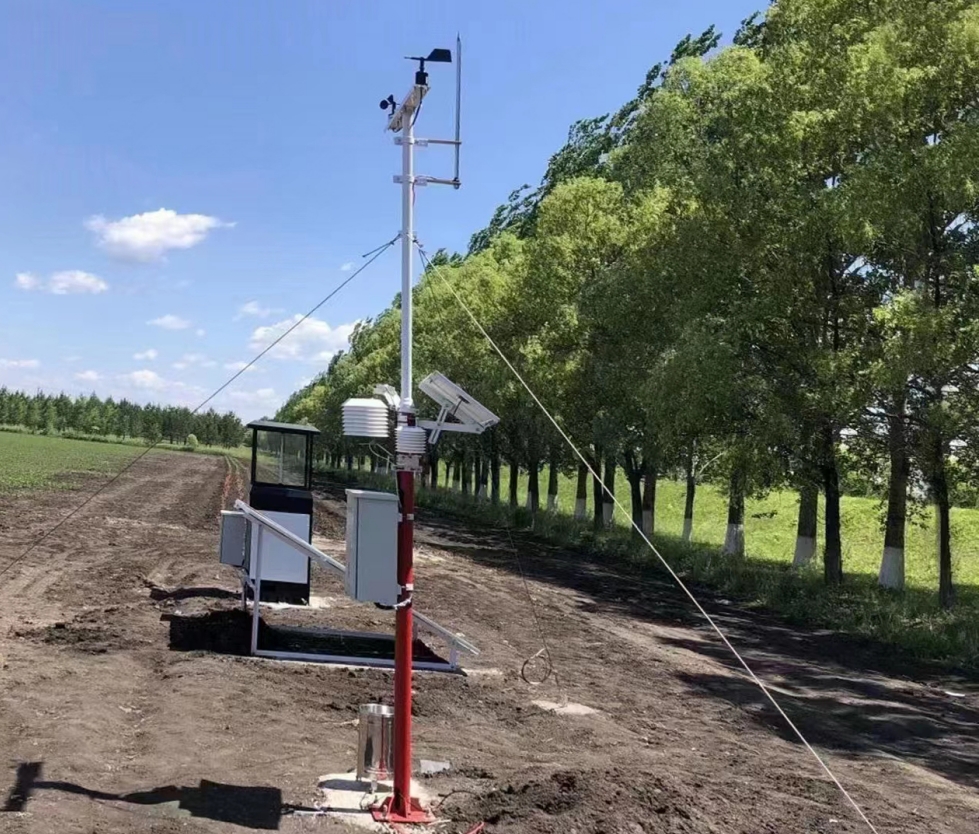
The NBL-W-LBTH combines air temperature, humidity and pressure. Pressure can support atmospheric records, but it is not a substitute for root-zone moisture in an irrigation project. For a greenhouse carbon dioxide question, specify a suitable gas instrument separately; adding an atmospheric pressure channel does not measure carbon dioxide concentration.
| Instrument | Model-specific parameters | Selection boundary |
|---|---|---|
| NBL-S-TM | Soil temperature -40 to 80 C, ±0.5 C; volumetric moisture 0-100%, stated accuracy ±5%; IP68 | FDR soil temperature and moisture probe, not an EC or nutrient analyser |
| NBL-S-TM interface | RS485 Modbus RTU; 5-24 VDC or 12-24 VDC according to configuration | Confirm supply version and soil-specific interpretation |
| NBL-W-LBTH | Air temperature -40 to 80 C, ±0.5 C; RH 0-100%, ±5%RH; pressure 10-1200 hPa, ±1.5 hPa | Atmospheric observations, not leaf temperature or wetness |
| NBL-W-LBTH interface | 12-24 VDC; RS485 Modbus RTU option | Match digital or analog ordered version to the logger |
| NBL-W-RS | Nominal 0.2 mm rainfall resolution | Liquid precipitation; choose the required output version |
| NBL-W-SS / NBL-W-DS | Separate wind speed and direction sensors; IP65 | Choose exposure and output for the specific farm task |
Soil moisture accuracy notation does not by itself establish a crop irrigation threshold. Texture, density, salinity and contact affect dielectric measurements. Establish useful local interpretation against soil and crop observations. Cable jacket, extensions, connector protection and complete-station power demand should be specified for the delivered assembly rather than inferred from a probe's ingress rating.
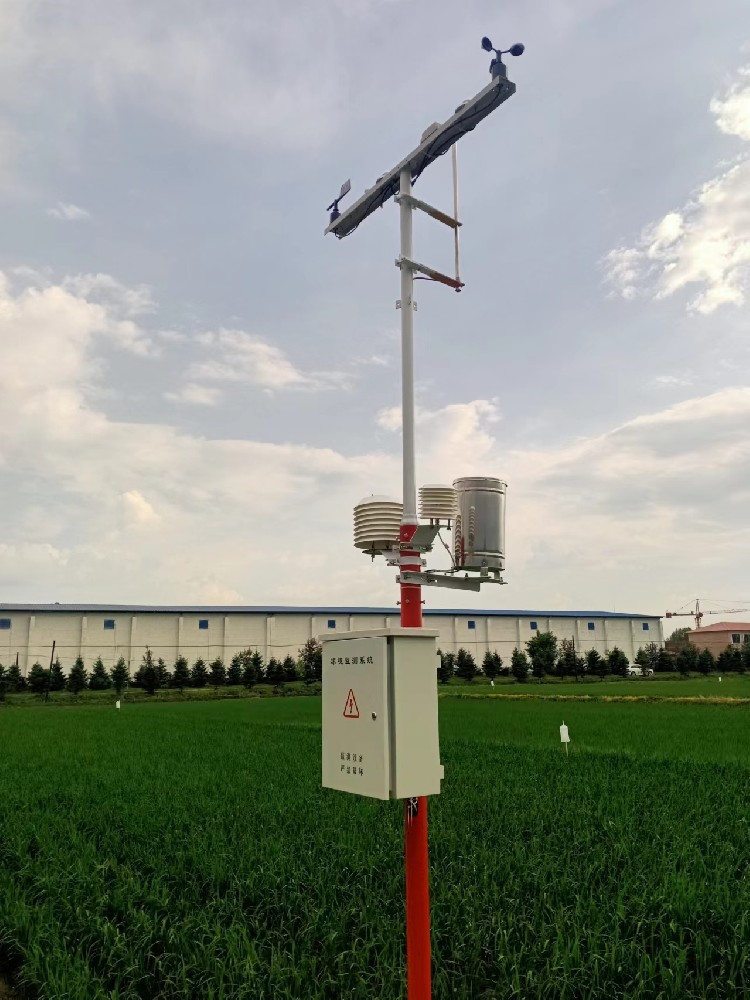
An open-field grain project can combine atmospheric observations, rainfall and representative soil measurements. Its weather mast should not force every soil probe into the same small patch beside the foundation. A separately identified soil installation can serve the irrigation zone while the mast records the surrounding atmosphere.
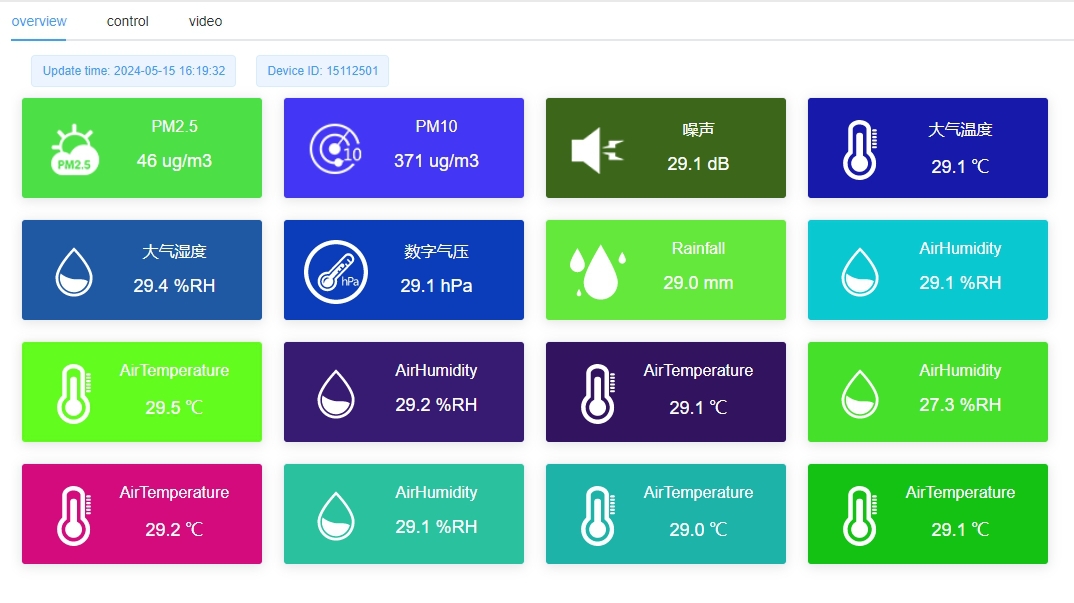
In a greenhouse, group measurements around the controlled compartment. A single sensor near an open door may not represent a closed crop bay, and an outdoor rain gauge does not report water applied through indoor irrigation. Keep the outside station as weather context and identify the crop compartment measurements separately.
An orchard may need measurements near a vulnerable block or different elevations rather than one generic farm reference. For a frost investigation, compare locations before making a protection decision; one warmer reading cannot establish that all low areas are safe. For a disease project, select the instruments required by the actual crop model and retain field scouting.
With RS485 Modbus RTU instruments, a compatible data logger, RTU or PLC reads the sensor values. A separate gateway can forward them to the farm system if the ordered communications configuration supports that path. Sensor protocol compatibility does not prove a particular cloud connection, automatic valve output or remote software update function.
Before enabling an irrigation or ventilation action, run the measurement system in observation mode. Compare the intended action against field conditions over relevant operating cycles. Set appropriate failure behaviour in the controller: a disconnected moisture probe must not silently become a valid dry reading that keeps a valve open indefinitely.
Budget the complete installation. A basic atmospheric station and a multi-zone agricultural system differ in probe quantities, trenching, protection, logger capacity, communications and agronomic setup. Request itemised options tied to the decision table rather than comparing a low headline price that omits the measurements needed for the job.
Start with the measurements required for the first operational decision. Irrigation generally needs representative root-zone information plus records of water input; a greenhouse light project needs appropriate crop-level light measurement. Order expansion channels when their location and intended use are defined, not merely to increase the element count.
Only after establishing what it means in the installed soil and crop context. A percentage suitable for one texture or root zone may not transfer to another. Check contact, depth, soil response and agronomic targets before using the reading for automatic control.
No. Select the quantity needed by the calculation or management task. PAR is relevant to crop photon exposure, while broadband radiation serves other energy and weather applications. Use both only when the project has a defined need for both quantities.
Not when the disease assessment requires measured leaf-wetness duration. Relative humidity describes the air at the sensor; surface wetness depends on additional conditions. Follow the inputs required by the chosen model and verify that its assumptions fit the crop and location.
Check available input types, power demand, address capacity, polling time and cable topology. Some instruments use pulse or analog outputs rather than Modbus. Larger properties may need several acquisition points rather than one long sensor bus with uncertain voltage drop and interference exposure.
Provide the crop, management question, field or compartment layout, irrigation arrangement and existing controller. Identify available power and communications, desired monitoring positions and whether the project is observation-only or includes control. NiuBoL can use these details to propose a measurement configuration rather than an undifferentiated sensor bundle.
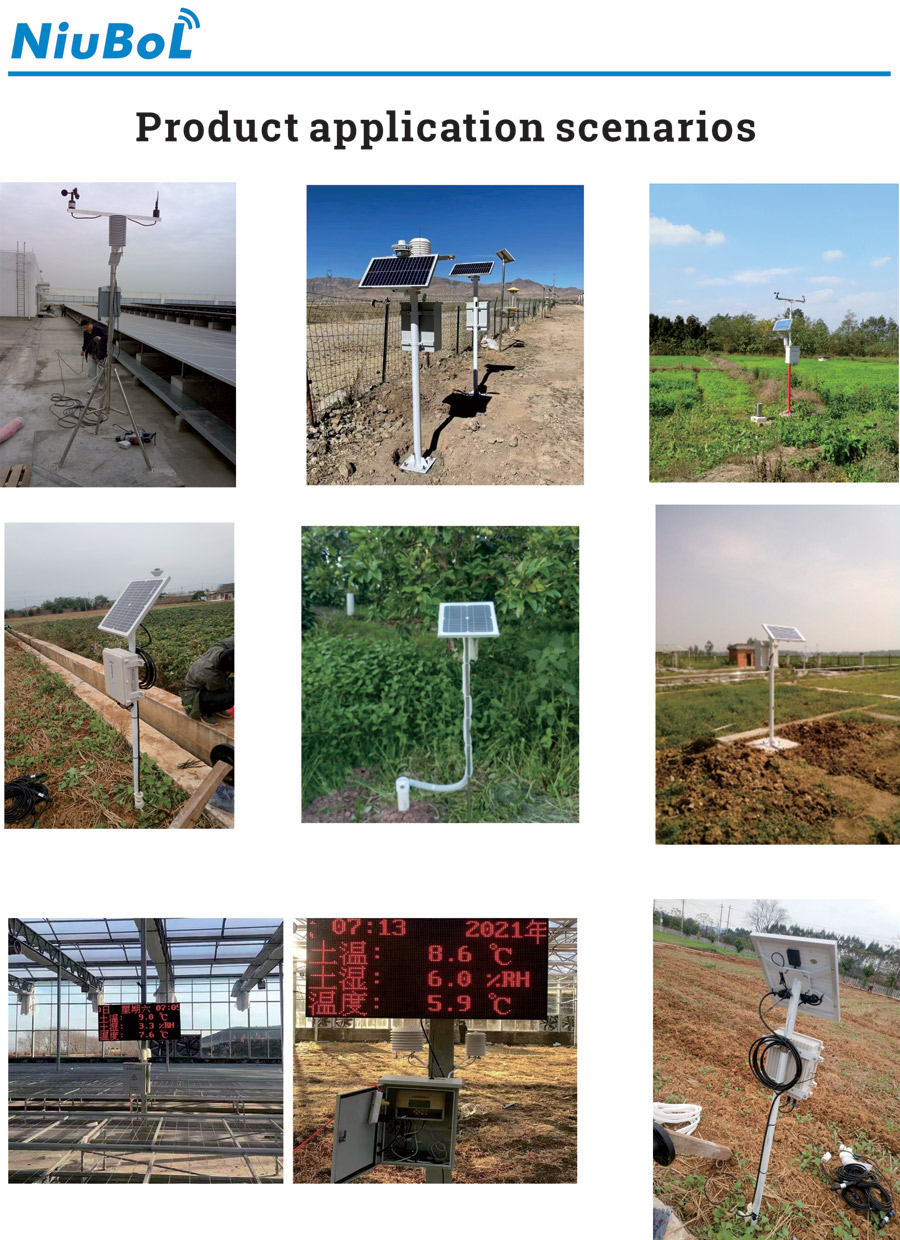
The value of agricultural instruments lies in distinguishing what is measured from what still needs interpretation. Combine rainfall with root-zone response, choose the correct light quantity and use crop-specific observations where atmospheric readings are insufficient. A clearly defined measurement task produces a more useful station and a more comparable quotation than simply requesting more channels.
Prev:Compact Weather Station Procurement: Logger, Power and Site Acceptance
Next:Agricultural Meteorological Station: Check ET0 Inputs Before Irrigation Use
Related recommendations
Sensors & Weather Stations Catalog
 Agriculture Sensors and Weather Stations Catalog-NiuBoL.pdf
Weather Stations Catalog-NiuBoL.pdf
Agriculture Sensors Catalog-NiuBoL.pdf
Water Quality Sensor Catalog-NiuBoL.pdf
Related products
 Combined air temperature and relative humidity sensor
 TDR Soil Moisture & Temperature Sensor for irrigation| RS485 |4-20mA| NBL-S-THR
 Soil pH sensor RS485 soil Testing instrument soil ph meter for agriculture |NBL-S-PH
 Wind Speed sensor Output Modbus/RS485/Analog/0-5V/4-20mA
 Tipping bucket rain gauge for weather monitoring auto rainfall sensor RS485/Outdoor/stainless steel
 Pyranometer Solar Radiation Sensor 4-20mA/RS485

Screenshot, WhatsApp to identify the QR code
WhatsApp number:+8615367865107
(Click on WhatsApp to copy and add friends)

