





— Blogs —
—Products—
 Consumer hotline +8618073152920
WhatsApp:+8615367865107
Address:Room 102, District D, Houhu Industrial Park, Yuelu District, Changsha City, Hunan Province, China
Product knowledge
Time:2022-05-23 20:30:24 Popularity:2419
Quick Answer: A portable soil multi-parameter meter combines a handheld host with selected probes for spot measurements and local records. Its main advantage is comparing several soil properties during the same field visit. Choose the probe set, measurement method and export workflow together. A portable kit is not automatically a nutrient laboratory, a continuous monitoring network or a direct PLC input.

Portable systems may support interchangeable or integrated probes for soil temperature, volumetric water content, electrical conductivity and pH. Some hosts can also accept atmospheric sensors. The exact parameter set depends on the selected probe, so the quotation and acceptance record should list each sensor rather than describe the unit only as a “soil tester.”
One reading also does not describe an entire field. Soil texture, compaction, stones, fertilizer placement, root distribution and recent irrigation can cause large spatial variation. A useful survey therefore combines a consistent measurement method with enough locations to represent each management zone.
For an agricultural service team, soil survey instrument selection should begin with the question the visit must answer. Uneven watering calls for moisture measurements at comparable positions and depths. Suspected salt accumulation calls for conductivity measurements interpreted alongside moisture and irrigation-water conditions. A pH investigation requires a defined sampling and measurement method. Ordering more parameters does not remove these differences in procedure.
The NiuBoL NBL-S-HS host-and-probe arrangement suits teams that need an independent display and stored records. It is different from a phone-connected USB probe: the handheld host supplies its own display and battery, while a phone-dependent instrument needs a compatible phone, connection and application. A probe with a similar connector is not necessarily interchangeable with either system.
| Channel | Useful field question | Interpretation limit |
|---|---|---|
| Soil temperature | Are comparable root-zone locations experiencing different thermal conditions? | Measure at the same depth and time; a surface reading is not a full root profile. |
| Soil moisture | Does wetting differ across the irrigation zone? | Establish what the percentage represents; it is not air relative humidity or automatically plant-available water. |
| Soil conductivity | Does ionic response differ between surveyed positions? | Moisture, temperature and measurement method affect comparisons; EC is not an individual nutrient assay. |
| Salinity indication | Does the selected instrument show a repeatable salt-related trend? | Identify whether the value is derived from conductivity and its conversion basis. |
| Soil pH | Is there a repeatable acidity difference requiring further investigation? | Direct-contact and prepared-extract methods are not automatically equivalent. |
Do not buy a five-parameter kit on the assumption that it measures nitrogen, phosphorus and potassium. Those channels must be separately specified. Likewise, an EC-based salinity indication does not independently identify sodium, chloride or other ions. If a fertilizer recommendation or a contractual soil classification depends on the result, select the relevant analytical method and reference testing first.
One technician can carry a host between locations, but field throughput depends on access, insertion, stabilization, probe cleaning and recording, not just display refresh. A narrow probe may suit loose cultivated soil but be difficult to insert into a compacted or stony layer. Specify the required measuring depth and soil condition before choosing probe geometry. Do not force a probe through stones or use its cable as a handle.
The following NBL-S-HS figures describe the handheld arrangement and supported channel ranges, not a promise that all probes are included. Ask for the exact probe list on the quotation. Channel accuracy must be tied to that probe and its test conditions; display resolution alone is not field accuracy.
| Item | NBL-S-HS arrangement | Purchase or acceptance check |
|---|---|---|
| Power | Internal 4000 mAh lithium-ion battery | Match the charger to the delivered host; capacity alone does not establish runtime. |
| Data connection | USB connection to PC software; spreadsheet export | Test installation, drivers and exported records on the intended computer. |
| Logging interval | Configurable from 10 seconds to 30 minutes | Confirm whether the field task needs manual records or repeated logging. |
| Host dimensions / mass | 100 x 200 x 28 mm; approximately 0.5 kg | Allow for probes, cables and carrying case as well as the host. |
| Host operating environment | -20 to +80 degrees C; 5-95% RH | Not a statement that the host or its USB port can be immersed. |
| Supported moisture range | 0-100%, with the appropriate moisture probe | Agree the soil-water basis and probe-specific accuracy before setting acceptance limits. |
| Supported EC range | 0-10 mS/cm, with the appropriate conductivity probe | Identify compensation and test conditions, not only the range. |
| Supported pH / salinity ranges | 0-14 pH / 0-8000 mg/L, using the corresponding probes | Define the pH procedure and the basis of the salinity indication. |
| Protection and cable | Host, probe, connector and cable specified separately | State exposure, cleaning and jacket-material requirements; do not assign one probe rating to the complete kit. |
For a field team, the important memory specification is the number of usable, retrievable survey records under the chosen logging mode. Request that capacity for the delivered firmware and record format. A large memory does not establish long battery endurance or prove that a record contains coordinates, a depth label and all selected channels. Those are separate checks.

| Requirement | Portable meter | Fixed online sensors |
|---|---|---|
| Spot survey across many locations | Well suited; one instrument can be moved between points. | Usually uneconomical if every point does not need continuous data. |
| Continuous trend and alarms | Depends on manual visits and operator consistency. | Well suited when connected to a logger, RTU or gateway. |
| Automatic irrigation control | Useful for verification, not continuous control input. | Can provide scheduled data to the control system. |
| Commissioning and troubleshooting | Useful as a reference tool at several locations. | Provides the installed system record for comparison. |
For RS485 / Modbus RTU monitoring, use compatible permanent probes and an appropriate data logger or RTU. USB export from a portable host is a different data path; it does not mean the host can be connected directly as a Modbus RTU slave to a PLC. A contractor may use both systems, provided the observations are labeled by instrument and method rather than combined as if they were identical continuous channels.
Before the visit, define management zones from soil, irrigation layout or previous observations. Choose repeat locations and measurement depths within each zone, with a separate label for visibly unusual places. Record recent irrigation or rainfall. A convenient point beside an access road should not silently become the representative point for an entire block.
At each point, inspect the probe and connectors, insert using the approved method and wait for a stable response appropriate to that probe. Keep depth and orientation consistent. If contact is poor, document the problem and repeat the measurement at a representative nearby position. Adding water to obtain a more plausible number changes the soil condition and is not a valid repair to the measurement.
Record point ID, depth, time, operator and the selected channels before moving. GPS can assist relocation, but coordinates alone do not identify which bed, row position or root layer was tested. Check the actual outdoor position fix, especially beside buildings or dense cover. Do not describe ordinary handheld positioning as survey-grade guidance for excavating or installing equipment.
After each zone, examine the spread before calculating a single average. If one point differs markedly, repeat the measurement and inspect contact, local wetting and fertilizer placement. Do not discard it only because it spoils the mean. A genuine wet patch and a loose probe connection require different actions, and both would be hidden by an unexamined average.
As an illustrative survey, a team might measure three positions along a drip lateral at two selected depths. If the far end is consistently drier than the inlet, check emitter discharge and pressure as well as soil texture. The meter identifies a pattern worth investigating; it does not measure pipe pressure or prove that the irrigation hardware caused the difference. Repeat the observations under comparable irrigation timing before deciding on a repair.
Soil moisture values should be evaluated against crop rooting depth, soil texture and field-specific thresholds. Electrical conductivity is influenced by moisture, temperature and dissolved ions; it is not a direct reading of one fertilizer nutrient. Soil pH can vary with sampling location and contact conditions, so field readings may need confirmation with an agreed laboratory method when compliance or agronomic prescriptions depend on the result.
For greenhouse substrate testing, confirm suitability for the specific medium. A probe response established in mineral soil should not be assumed valid in dry peat, coco coir, rockwool or an unusually coarse blend. Contact geometry and the relationship between response and water content can change. Agree a comparison procedure before using the instrument to set a substrate irrigation threshold.
When pH controls an agronomic decision, keep the measurement method consistent between visits. Record whether the test is direct contact or uses a prepared soil suspension, together with the preparation ratio and solution where applicable. An apparently precise display does not make results from unlike procedures comparable. Use appropriate reference measurements when the decision needs laboratory-level agreement.
Handheld soil data export should be tested with a small real record set, not only an empty software screen. Set the clock, save measurements at more than one point, download them through USB and open the exported file on the project computer. Check time, units, decimal placement, channel labels and record count. Add point and depth information through a documented field sheet if the host does not store those labels.
Check soil probe compatibility by connecting each ordered probe and confirming recognition and sensible values. Test one reconnect and one host restart, then verify that saved records remain available. A missing probe indicator should not be interpreted as a valid zero. Before buying spare probes, confirm connector pinout, electrical supply, communication and host firmware compatibility; a matching plug body is insufficient.
For a quotation, provide the survey task, soil or substrate, channels, required depth, number of kits and intended computer environment. Request the host, each probe, charger, cable, case and calibration accessories as separate listed items. Include any need for export examples, spare probes or remote setup assistance. This is more actionable than asking for the price of a generic soil tester.
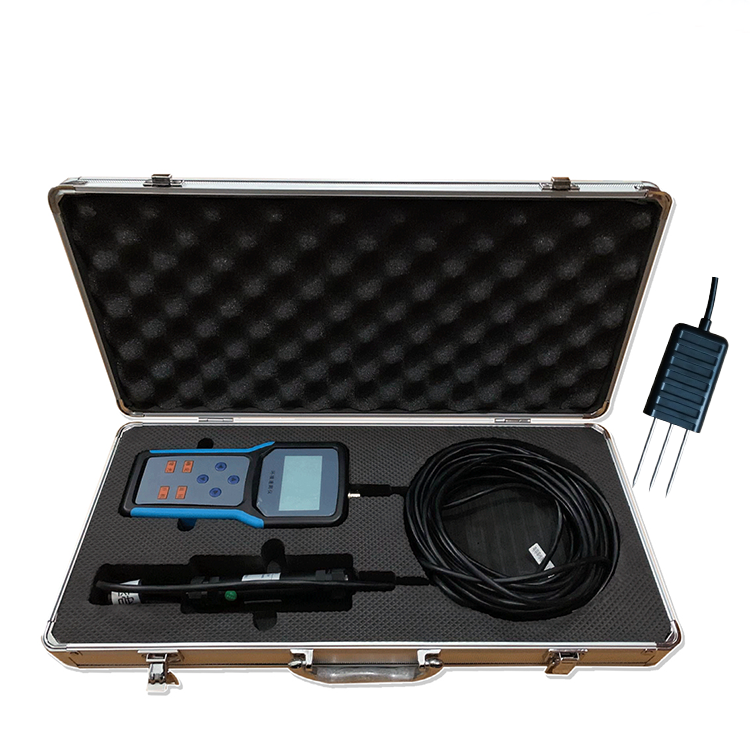
Choose the host-and-probe configuration that supports the actual survey decisions and site conditions. A moisture-only check does not require every possible channel. A salt-related investigation needs a defined conductivity method, while a pH investigation needs a suitable probe and procedure. Confirm the included probes rather than judging by the product name.
No. EC responds to combined ionic and physical conditions and does not isolate one nutrient. Interpret it alongside moisture, temperature and the measurement method. Nutrient prescriptions require appropriate nutrient testing and agronomic interpretation rather than conversion of a single EC reading into a fertilizer dose.
Do not assume so. Local recording capability does not establish weather protection, unattended battery endurance or telemetry. For continuous trends, alarms or control, select permanent probes with suitable protection and an acquisition system. The portable kit can provide complementary surveys.
Only after confirming electrical and firmware compatibility, identification, units and scaling. Send the host model and version with the spare-probe request. Mechanical connector fit alone is not an acceptance test, and a USB phone probe should not be assumed compatible with the NBL-S-HS host.
First compare moisture, temperature, depth, location, contact and the measurement procedure. Recent fertilizer or irrigation can produce a real difference. Repeat under controlled conditions and check calibration where appropriate before concluding that either instrument is defective.
Verify the ordered kit contents, charging, probe recognition, timestamp settings, record retrieval and export on the intended PC. Obtain a lead time and support arrangement for the actual configuration. A demonstration on another computer does not establish compatibility with a managed project laptop.
A portable soil multi-parameter meter is useful when its probe set and record workflow match the field task. NiuBoL handheld kits support surveys without requiring a fixed installation at every point. Purchase the measurements and compatibility you need, keep methods consistent and confirm the complete path from soil contact to an interpretable exported record.
Related recommendations
Sensors & Weather Stations Catalog
 Agriculture Sensors and Weather Stations Catalog-NiuBoL.pdf
Weather Stations Catalog-NiuBoL.pdf
Agriculture Sensors Catalog-NiuBoL.pdf
Water Quality Sensor Catalog-NiuBoL.pdf
Related products
 Combined air temperature and relative humidity sensor
 TDR Soil Moisture & Temperature Sensor for irrigation| RS485 |4-20mA| NBL-S-THR
 Soil pH sensor RS485 soil Testing instrument soil ph meter for agriculture |NBL-S-PH
 Wind Speed sensor Output Modbus/RS485/Analog/0-5V/4-20mA
 Tipping bucket rain gauge for weather monitoring auto rainfall sensor RS485/Outdoor/stainless steel
 Pyranometer Solar Radiation Sensor 4-20mA/RS485


Screenshot, WhatsApp to identify the QR code
WhatsApp number:+8615367865107
(Click on WhatsApp to copy and add friends)

