





— Blogs —
—Products—
 Consumer hotline +8618073152920
WhatsApp:+8615367865107
Address:Room 102, District D, Houhu Industrial Park, Yuelu District, Changsha City, Hunan Province, China
Product knowledge
Time:2023-11-11 16:50:57 Popularity:7979
Weather stations are systems used to observe and record atmospheric conditions such as air temperature, relative humidity, atmospheric pressure, wind speed, wind direction, precipitation and solar radiation. Different types of weather stations are designed for different observation methods, installation environments and monitoring applications.
Weather stations can be classified by their level of automation, installation method, sensor configuration and purpose. Common examples include automatic weather stations, manual weather stations, portable weather stations, mobile weather stations, agricultural weather stations and specialized meteorological stations.
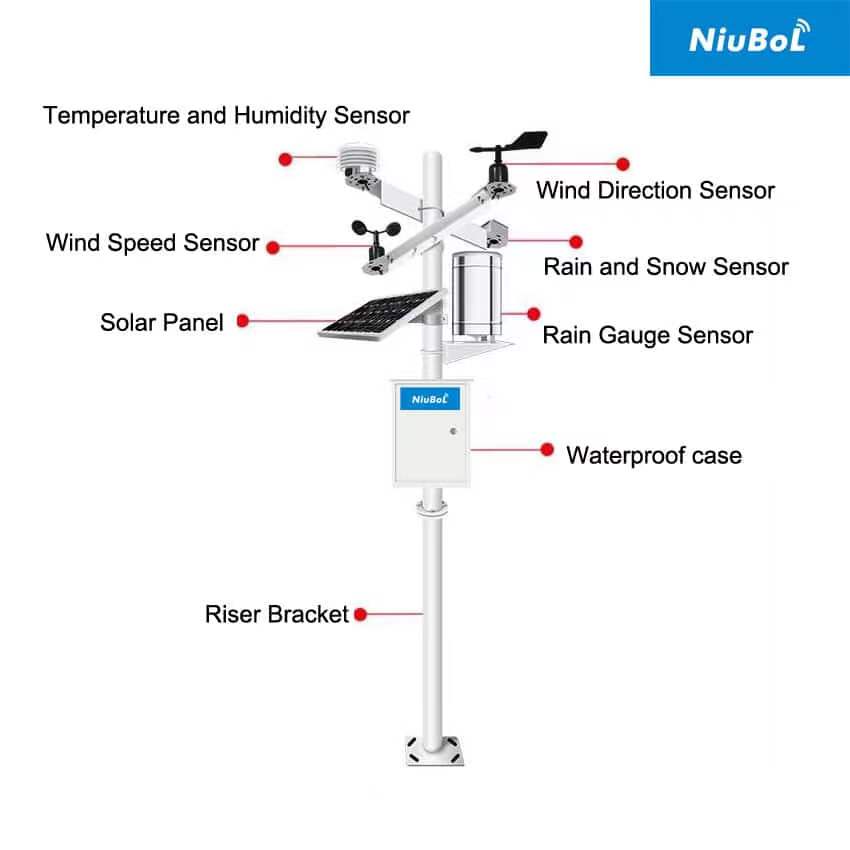
These classifications are not mutually exclusive. For example, a solar-powered agricultural weather station can also be automatic, permanently installed and equipped with wireless data transmission.
| Weather Station Type | Main Characteristic |
|---|---|
| Manual Weather Station | Requires human involvement in reading or recording observations. |
| Automatic Weather Station | Collects and records measurements automatically using sensors and data acquisition equipment. |
| Portable Weather Station | Designed for temporary deployment and transport between observation locations. |
| Mobile Weather Station | Performs observations on moving platforms or vehicles. |
| Compact Weather Station | Uses an integrated multi-parameter sensor assembly to simplify installation. |
| Agricultural Weather Station | Configured for crop, farm microclimate and irrigation-related monitoring. |
| Solar-Powered Weather Station | Uses a solar panel, charge controller and battery for electrical power. |
| Specialized Weather Station | Configured for a particular environment or measurement objective. |
One fundamental way to classify weather stations is by the degree of automation used to obtain and record measurements.
A manual weather station uses instruments that are observed or read by an operator. Traditional examples include liquid-in-glass thermometers, manual rain gauges, barometers and other instruments requiring periodic observation.
Manual observation may be suitable for education, small-scale research or locations where periodic measurements are sufficient. However, observation frequency depends on the available personnel and procedures.
An automatic weather station uses electronic sensors and data acquisition equipment to collect meteorological measurements at configured intervals without requiring an operator to read each instrument manually.
A typical AWS consists of meteorological sensors, a data logger, a mounting structure and a suitable power supply. A communication gateway or integrated transmitter can provide remote access to data when supported by the selected configuration.
Automatic operation does not necessarily mean that the station includes cloud storage, a cellular modem, weather prediction software or an alarm system. These capabilities depend on the data logger, communication equipment and monitoring platform.
Weather stations can also be classified according to how and where their instruments are installed.
A fixed weather station is permanently installed at a defined observation site. It is suitable for collecting consistent weather records from agricultural fields, meteorological observation sites, reservoirs, solar-energy installations and environmental monitoring stations.
The installation should provide suitable exposure for each measurement. Wind sensors, rain gauges, temperature probes and pyranometers may require different mounting positions to obtain representative observations.
A portable weather station is designed for temporary installation and relocation. It may be used for field surveys, short-term agricultural studies, emergency monitoring, educational activities and temporary construction-site observations.
Portable stations can measure wind speed, wind direction, temperature, humidity and other parameters depending on the sensor package. Portability describes the equipment arrangement, not a fixed limitation on which weather elements can be measured.
Compared with permanent stations, portable systems usually emphasize transportability, installation time, available power and ease of assembly.
For further information, see What Is a Portable Weather Station?
A mobile weather station is mounted on a moving platform, such as a vehicle or vessel. It collects meteorological measurements while the platform changes location.
These systems may require additional position, heading and motion information. For example, measuring true wind from a moving vessel or vehicle can require correction for platform movement.
Mobile weather stations are used in field research, environmental surveys, marine monitoring and other applications requiring observations along a route.
Another important distinction is the physical arrangement of the meteorological sensors.
Compact weather stations use one integrated sensor assembly to measure several meteorological parameters. Some ultrasonic weather sensors combine wind speed, wind direction, air temperature, humidity and atmospheric pressure in a single instrument.
Additional model configurations may include rainfall, solar radiation or other supported measurements. The exact number of parameters depends on the selected product.
A 5-in-1 or 7-in-1 integrated weather sensor is not automatically a complete standalone weather station. A full remote monitoring installation may also need a data logger, power supply, mounting structure and communication equipment.

A modular weather station uses separate instruments for individual measurements. For example, a station may include an independent cup anemometer, wind vane, temperature and humidity sensor, rain gauge and pyranometer.
A modular arrangement allows individual sensors to be selected and positioned according to the measurement requirements. It can also make it easier to replace or expand a particular measurement channel.
| Comparison | Compact Integrated Sensor | Modular Station |
|---|---|---|
| Sensor Arrangement | Multiple parameters within one assembly | Separate instruments |
| Installation | Compact mounting arrangement | Individual sensor positioning |
| Expansion | Depends on available model configuration | Additional compatible sensors may be added |
| Typical Selection | Compact agricultural or environmental installations | Sites requiring independently selected measurements |
Weather stations are frequently named according to their intended application rather than their measurement technology. For example, agricultural, marine and photovoltaic weather stations may all use automatic data loggers but require different sensor arrangements.
An agricultural weather station measures local conditions relevant to crop production and farm management. Common parameters include air temperature, humidity, rainfall, wind speed, wind direction and solar radiation.
Additional soil moisture, soil temperature, leaf wetness or PAR sensors can be installed when the agricultural application requires them. Sensor selection should reflect the crop, irrigation arrangement and monitoring objectives.
Weather stations for photovoltaic installations provide meteorological and irradiance data relevant to solar-resource assessment and system performance monitoring.
Depending on the application, measurements may include global horizontal irradiance (GHI), plane-of-array irradiance (POA), ambient temperature, wind and photovoltaic module temperature.
A suitable pyranometer measures solar irradiance over its field of view and measurement plane. The measurement quantity depends on the sensor orientation and the installation arrangement.
Marine and coastal stations observe weather conditions near ports, shorelines, offshore structures or vessels. Wind, air temperature, humidity and atmospheric pressure are common measurements.
Marine installations may need additional consideration of salt spray, corrosion, vibration, power availability and mounting exposure. Any required marine-specific approvals must be verified for the selected instruments.
Road-weather monitoring stations measure conditions relevant to transportation infrastructure, including temperature, wind, precipitation and visibility. Certain projects may require specialized pavement or road-surface sensors.
An ordinary agricultural weather station should not automatically be considered equivalent to a road-weather or certified aviation observation system. Required measurement performance, reporting standards and specialized instruments depend on the application.
Research stations may use additional instruments, defined installation heights, calibration procedures and measurement protocols to support scientific observations.
Reference observation networks are designed around specified measurement practices and data quality requirements. A station should not be described as a reference station solely because it contains high-accuracy sensors.
The terms solar-powered weather station and wireless weather station describe power or communication arrangements. They do not identify a unique meteorological sensing principle.
A solar-powered station uses a photovoltaic panel, charge controller and rechargeable battery to power its sensors and data acquisition equipment. The panel and battery capacity should be selected according to the electrical load, local solar conditions and required backup duration.
A wireless station transmits its data through a supported communication network, such as cellular or radio communication. The exact method depends on the gateway, modem or wireless sensor node.
RS485, RS232 and analog signals are local equipment interfaces. They should not be treated as equivalent to remote communication methods such as 4G, Wi-Fi or LoRaWAN.
Weather Sensors → RS485 / Analog / Pulse → Data Logger → Communication Gateway → Monitoring Platform
For a detailed explanation of solar station components and battery selection, see Weather Station with Solar Panel.
The appropriate weather station should be selected according to the required observations and operating conditions, not only according to the number of sensors or the terms automatic, compact or portable.
| Monitoring Requirement | Station Configuration to Consider |
|---|---|
| Long-Term Local Weather Records | Fixed automatic station with appropriate sensor exposure and data logging |
| Temporary Field Measurements | Portable station with suitable power and mounting equipment |
| Crop and Irrigation Monitoring | Agricultural station with required weather and optional soil sensors |
| Small Installation Area | Compact integrated sensor with compatible data acquisition equipment |
| Independent Sensor Positioning | Modular weather station |
| No Mains Electricity | Solar-powered station with correctly sized battery system |
| Remote Data Access | Automatic station with a compatible communication gateway |
| Specialized Aviation or Regulatory Monitoring | Purpose-designed equipment meeting the applicable technical requirements |
Sensor accuracy, measurement range, reporting interval, environmental protection, mounting height, data logger inputs and communication requirements should be confirmed for the selected application.
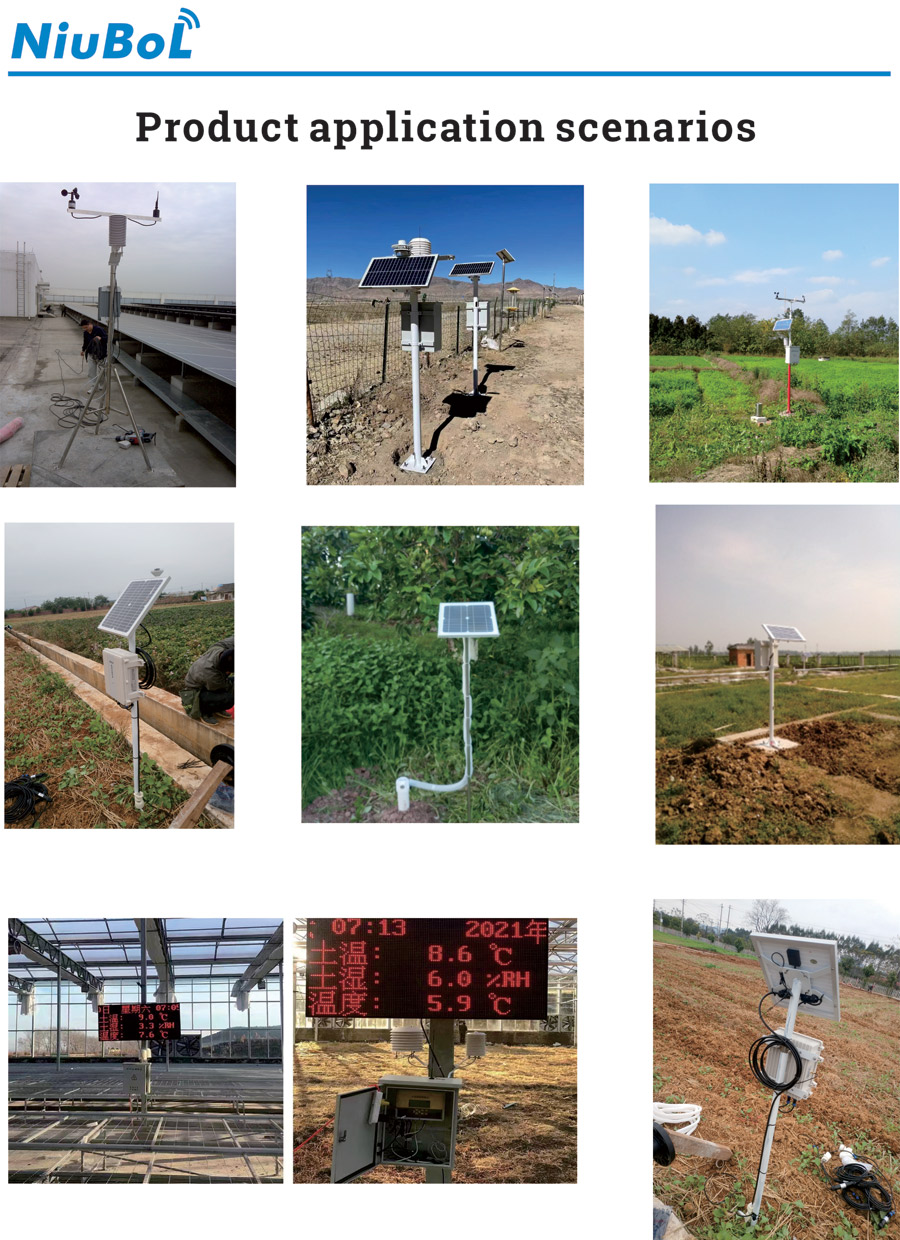
Weather stations are commonly classified as manual or automatic, fixed or portable, compact or modular, and by application such as agricultural, marine, solar-energy and research monitoring.
An automatic station collects measurements electronically at configured intervals. A manual station requires an observer to read or record at least some measurements.
Yes. Portable stations can measure wind speed, wind direction and other meteorological parameters when equipped with the appropriate instruments.
A compact weather sensor integrates several sensing functions into one assembly. A complete weather station additionally includes the required power, mounting, data acquisition and communication equipment for the intended application.
No. Some stations record data locally or use wired connections. Remote wireless communication requires the appropriate gateway, modem or wireless communication equipment.
NiuBoL provides weather station sensors and configurable automatic weather monitoring equipment for agriculture, hydrology, environmental monitoring, renewable energy and related applications.
For complete station selection, including sensors, mounting equipment, solar power, data logging and remote communication, visit the Automatic Weather Station selection page.
For a suitable configuration, specify the required weather parameters, installation environment, number of stations, output interfaces, power source, communication method and data destination.
Related recommendations
Sensors & Weather Stations Catalog
 Agriculture Sensors and Weather Stations Catalog-NiuBoL.pdf
Weather Stations Catalog-NiuBoL.pdf
Agriculture Sensors Catalog-NiuBoL.pdf
Water Quality Sensor Catalog-NiuBoL.pdf
Related products
 Combined air temperature and relative humidity sensor
 TDR Soil Moisture & Temperature Sensor for irrigation| RS485 |4-20mA| NBL-S-THR
 Soil pH sensor RS485 soil Testing instrument soil ph meter for agriculture |NBL-S-PH
 Wind Speed sensor Output Modbus/RS485/Analog/0-5V/4-20mA
 Tipping bucket rain gauge for weather monitoring auto rainfall sensor RS485/Outdoor/stainless steel
 Pyranometer Solar Radiation Sensor 4-20mA/RS485


Screenshot, WhatsApp to identify the QR code
WhatsApp number:+8615367865107
(Click on WhatsApp to copy and add friends)

