





— Blogs —
—Products—
 Consumer hotline +8618073152920
 WhatsApp:+8615367865107
Address:Room 102, District D, Houhu Industrial Park, Yuelu District, Changsha City, Hunan Province, China
Product knowledge
Time:2024-01-24 20:39:14 Popularity:3795
An IoT soil pH monitoring system combines a soil pH sensor, data acquisition device, communication network and software platform to measure soil acidity and alkalinity remotely.
In most industrial agricultural IoT systems, the soil pH sensor itself does not need to contain 4G, Wi-Fi or LoRaWAN. A practical architecture is to use an RS485 Modbus soil pH sensor connected to a PLC, data logger, RTU or LoRaWAN acquisition node. The gateway then sends the data to a cloud platform or the customer's private server.
This architecture is suitable for smart agriculture, greenhouses, orchards, irrigation projects, research farms and distributed soil-monitoring networks because the sensing, communication and cloud layers can be selected independently.
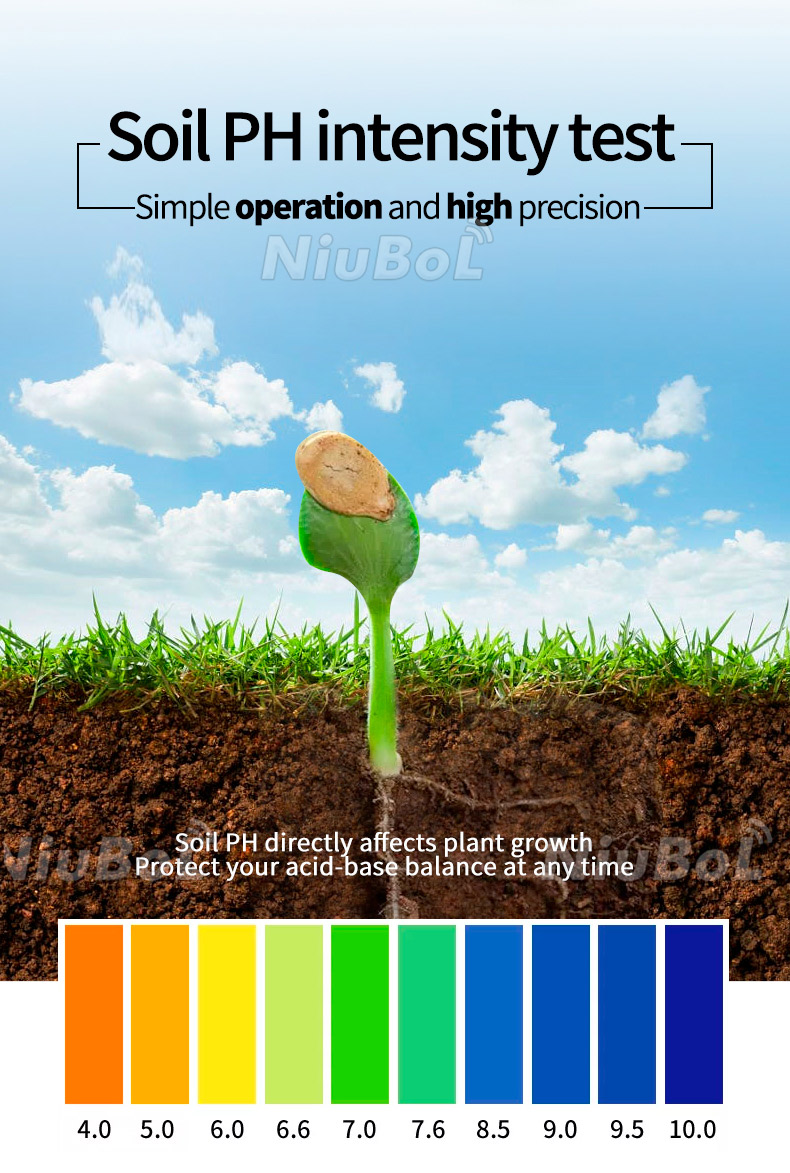
A soil pH sensor measures the acidity or alkalinity of the soil environment. For IoT applications, the measurement is converted into a digital or analog signal and then collected by another device for storage, remote transmission and visualization.
A typical system contains four layers:
| Layer | Equipment | Function |
|---|---|---|
| Sensing | Soil pH Sensor | Measures soil pH |
| Data Acquisition | PLC / RTU / Data Logger / LoRaWAN Node | Reads sensor data |
| Communication | 4G / Ethernet / Wi-Fi / LoRaWAN | Transfers field data |
| Application | Cloud / MQTT Broker / Private Server | Stores, displays and analyzes data |
Soil pH Sensor → RS485 Modbus → Data Logger / Gateway → 4G / Ethernet / LoRaWAN → MQTT / HTTP → Cloud or Private Server
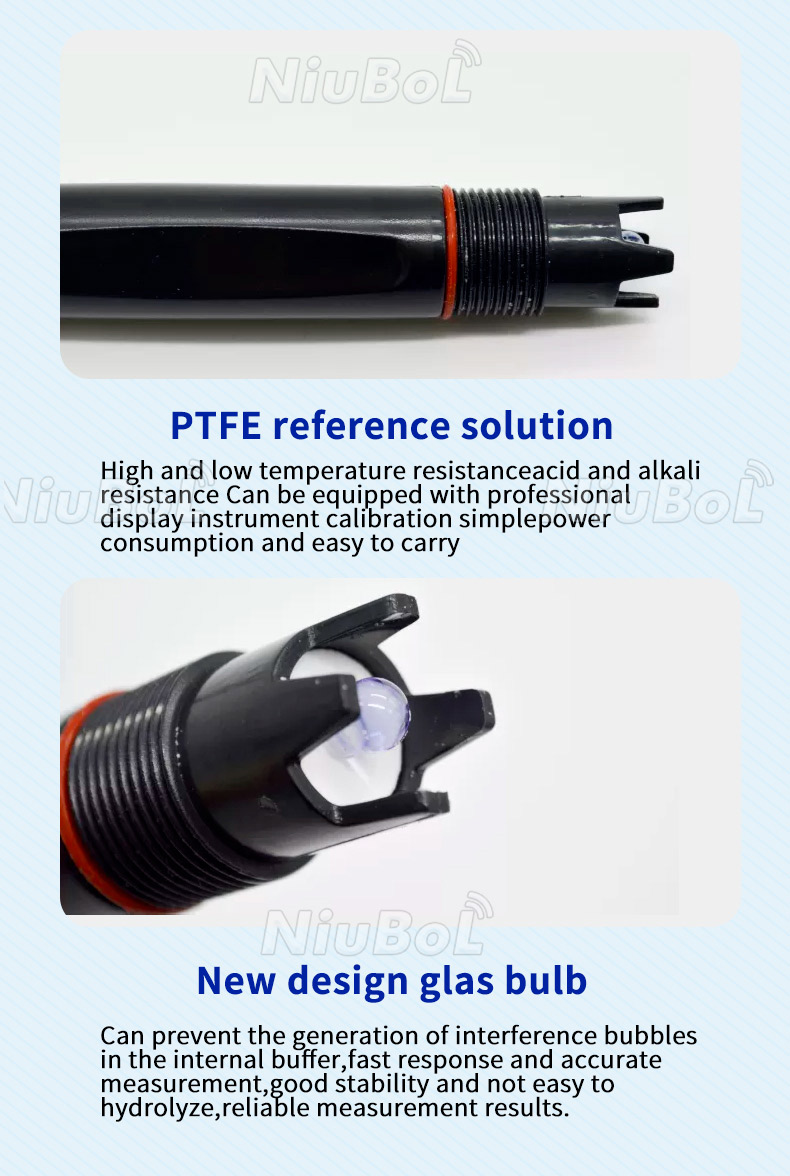
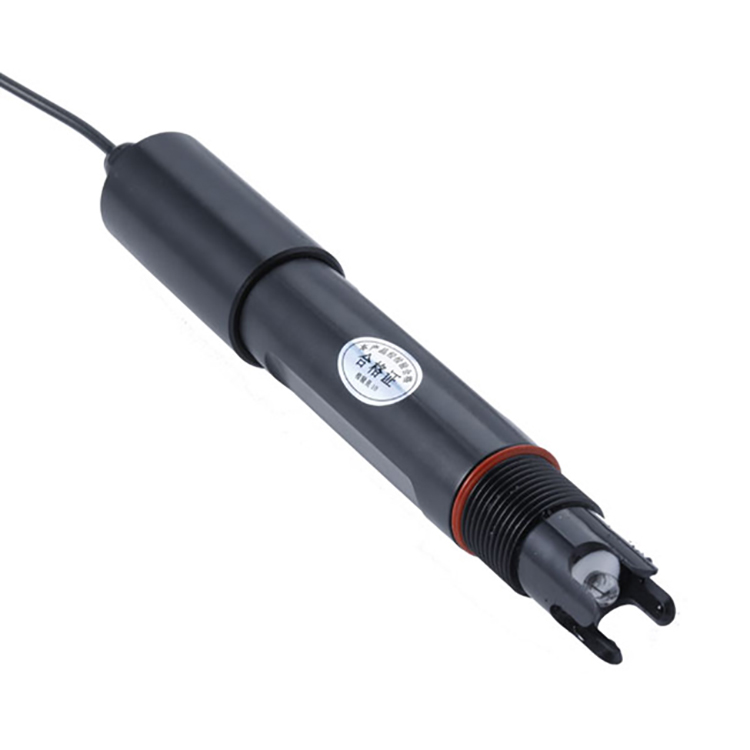
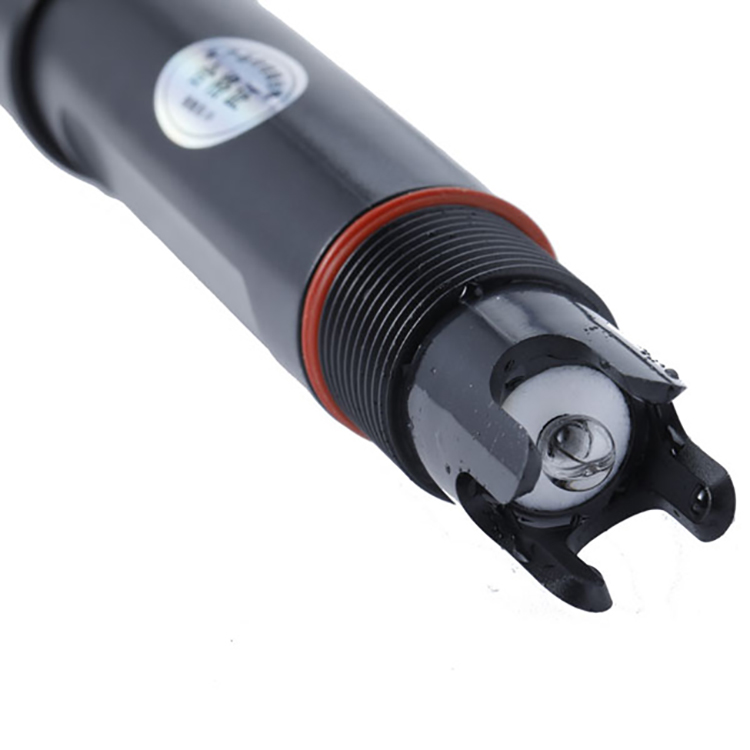
The NiuBoL NBL-S-PH is designed for soil pH monitoring in agriculture, greenhouse cultivation, horticulture and environmental monitoring. The RS485 version supports Modbus RTU and can connect to compatible PLCs, RTUs, data loggers and IoT gateways.
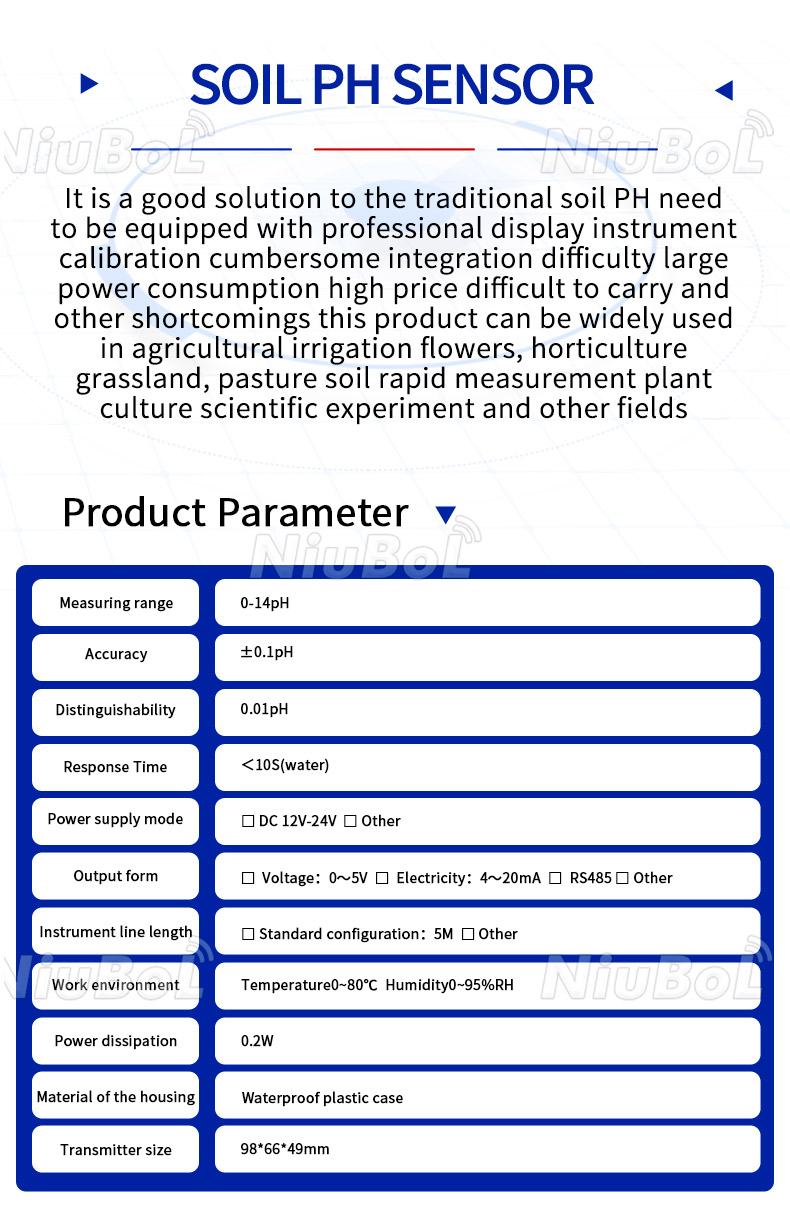
| Model | NBL-S-PH |
| Measurement Range | 0–14 pH |
| Accuracy | ±0.1 pH |
| Resolution | 0.01 pH |
| Power Supply | 12–24 V DC |
| Outputs | RS485 / 4–20 mA / 0–5 V |
| Protocol | Modbus RTU |
| Default Baud Rate | 9600 bps |
The soil pH probe first measures the local soil environment using an electrochemical pH electrode. The transmitter converts the electrode signal into a usable pH value.
The RS485 version then exposes the measurement through Modbus RTU. A controller or gateway periodically reads the pH register and can store the measurement locally or transmit it to a remote server.
The sensor therefore performs the measurement, while the gateway performs the network communication. This distinction is important when designing an IoT project.
RS485 is widely used in agricultural and industrial monitoring because it supports digital communication and allows multiple devices to share one bus.
For distributed sensor networks, RS485 provides several practical advantages:
Digital Modbus RTU communication
Longer cable runs than many low-level analog interfaces
Multiple sensors on one communication bus
Configurable device addresses
Easy integration with PLCs, RTUs and data loggers
Reduced analog signal-conversion error
Multiple soil pH sensors can share the same RS485 line if every device has a unique Modbus address.
pH Sensor #1 + pH Sensor #2 + pH Sensor #3 → RS485 Bus → Data Logger / PLC
For multi-sensor installations:
Assign a unique Modbus address to every sensor.
Use twisted-pair cable for RS485 A/B.
Prefer daisy-chain wiring where practical.
Check voltage drop on long power cables.
Use a suitable centralized DC power supply.
Add termination according to RS485 cable length and site conditions.
Keep sensor communication cables away from high-power motors and variable-frequency drives where possible.
A standard RS485 soil pH sensor can become part of a LoRaWAN system by connecting it to a compatible RS485-to-LoRaWAN acquisition node.
Soil pH Sensor → RS485 → LoRaWAN Node → LoRaWAN Gateway → Network Server → Application Server
The LoRaWAN node reads the Modbus value from the sensor and packages the measurement into a wireless payload. The LoRaWAN gateway forwards the packets to a network server such as ChirpStack or another compatible LoRaWAN platform.
LoRaWAN is useful for farmland, orchards and large greenhouses where sensors are distributed across multiple locations and long signal cables are inconvenient.
Frequency region, such as EU868 or another locally permitted band
Distance between sensor nodes and gateway
Number of monitoring points
Terrain, buildings and greenhouse structures
Battery or solar-power requirements
Upload interval
Payload format and decoder
OTAA / ABP requirements
Customer network server or manufacturer's platform
Where cellular coverage is available, an RS485 pH sensor can connect to a 4G data logger or RTU.
Soil pH Sensor → RS485 → 4G Data Logger → Mobile Network → MQTT / HTTP / TCP → Server
This method is suitable for farms, remote greenhouses and research sites that do not have fixed Ethernet or Wi-Fi.
MQTT is commonly used for IoT sensor data. The important point is that the NBL-S-PH communicates through Modbus RTU; the data logger or gateway converts the Modbus value into MQTT data.
Modbus Register → Gateway → JSON → MQTT Broker → Database / Dashboard / Application
A customer-defined MQTT message may look like:
{
  "device_id": "soil-ph-01",
  "ph": 6.82,
  "timestamp": "2026-09-22T10:30:00Z"
}
The actual MQTT topic, payload structure, authentication method and upload interval should be configured according to the customer's server requirements.
Yes. The monitoring system does not have to use a manufacturer's cloud. A suitable gateway can transmit measurements directly to a customer's own server.
| Protocol | Typical Application |
|---|---|
| MQTT | IoT broker and real-time sensor publishing |
| HTTP / HTTPS | Web API and REST integration |
| TCP | Custom socket-based transmission |
| Modbus TCP | Industrial Ethernet integration where supported |
Before integration, confirm the server domain or IP, port, authentication, MQTT topic or API format, payload structure, upload interval and TLS requirements.
| Project | Recommended Architecture |
|---|---|
| Small Greenhouse | RS485 Sensor → PLC / Local Logger |
| Commercial Greenhouse | Multiple RS485 Sensors → Gateway → Ethernet / 4G → Server |
| Distributed Farmland | RS485 Sensor → LoRaWAN Node → Gateway → Server |
| Remote Research Site | RS485 Sensor → Solar 4G Logger → Private Server |
| Existing PLC System | RS485 Modbus Sensor → PLC → SCADA |
Soil pH generally changes more slowly than air temperature, wind or rainfall. For many agricultural projects, very high-frequency cloud transmission provides little additional value while increasing mobile-data and battery consumption.
The correct interval depends on:
Research objectives
Required alarm response time
Number of sensors
Battery capacity
Solar-system size
Mobile-data consumption
Local data-logging capability
Where mains power is unavailable, soil pH sensors, data loggers and wireless equipment can be powered using a solar panel and rechargeable battery.
Solar sizing should be based on total daily system consumption, communication frequency, required battery autonomy, local solar conditions and power-system losses. There is no single solar-panel or battery size suitable for every soil-monitoring project.
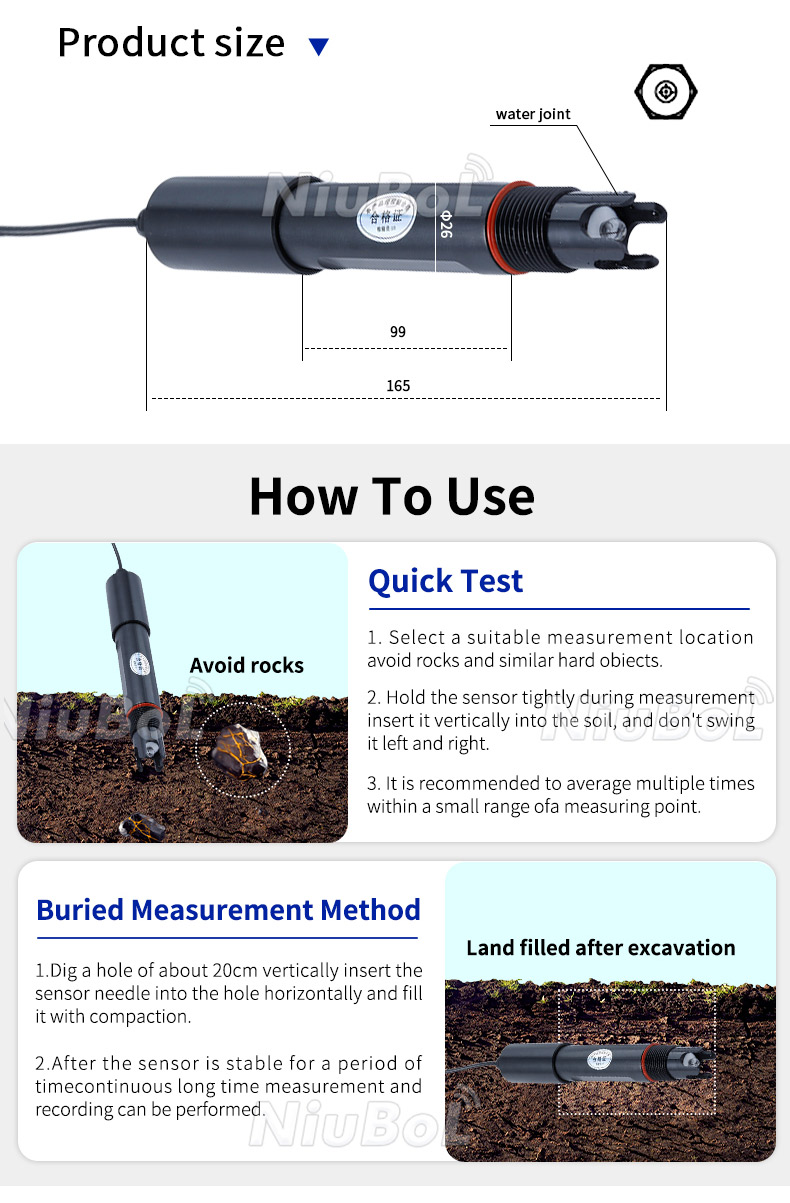
IoT communication does not improve a poor measurement. The pH probe still needs correct installation, sufficient soil moisture, good electrode contact and regular maintenance.
Select a representative monitoring location.
Avoid stones and large air gaps around the electrode.
Maintain sufficient soil moisture for electrochemical measurement.
Use consistent installation depth when comparing several sites.
Protect cables from farm machinery and rodents.
Make the probe accessible for inspection and maintenance.
A1. The standard NBL-S-PH uses RS485 or analog output. For LoRaWAN projects, the RS485 version can connect to a compatible RS485-to-LoRaWAN acquisition node.
A2. Yes. The RS485 version uses Modbus RTU and can connect to compatible PLCs, RTUs and data loggers.
A3. Yes. Each sensor must have a unique Modbus address, and the power supply, cable topology and RS485 termination should be designed correctly.
A4. Yes. The gateway reads the sensor through Modbus RTU and then publishes the measurement to an MQTT broker.
A5. Yes. A compatible gateway can send data using MQTT, HTTP, TCP or other supported protocols according to the server requirements.
A6. Yes, when compatible LoRaWAN nodes and gateways are used. The node payload format and decoder must be configured for the selected hardware.
A7. Yes. Remote systems can use solar panels and batteries, but sizing should be based on total sensor, logger and communication power consumption.
A8. No. Remote communication eliminates manual data collection, but the electrochemical pH electrode still requires inspection, cleaning and periodic calibration.
A9. Yes. Compatible RS485 sensors can share the same data-acquisition architecture if device addresses, power supply and gateway capacity are designed correctly.
A10. Provide the number of sensors, distance between monitoring points, available power, installation country, required communication method, upload interval and whether data should be sent to a cloud platform or private server.
1. NBL-S-PH Soil pH Sensor Instruction Manual
 NBL-S-PH-Soil-PH-Sensor-Instruction-Manual-V4.0.pdf
NiuBoL provides RS485 soil pH sensors, soil moisture sensors, EC sensors, multi-parameter soil sensors, data loggers and communication equipment for smart agriculture and environmental monitoring.
For system selection, provide the required parameters, number of monitoring points, distance between locations, communication method, power supply and whether data needs to be sent to a cloud platform or your own MQTT / HTTP server.
Related recommendations
Sensors & Weather Stations Catalog
 Agriculture Sensors and Weather Stations Catalog-NiuBoL.pdf
Weather Stations Catalog-NiuBoL.pdf
Agriculture Sensors Catalog-NiuBoL.pdf
Water Quality Sensor Catalog-NiuBoL.pdf
Related products
 Combined air temperature and relative humidity sensor
 TDR Soil Moisture & Temperature Sensor for irrigation| RS485 |4-20mA| NBL-S-THR
 Soil pH sensor RS485 soil Testing instrument soil ph meter for agriculture |NBL-S-PH
 Wind Speed sensor Output Modbus/RS485/Analog/0-5V/4-20mA
 Tipping bucket rain gauge for weather monitoring auto rainfall sensor RS485/Outdoor/stainless steel
 Pyranometer Solar Radiation Sensor 4-20mA/RS485

Screenshot, WhatsApp to identify the QR code
WhatsApp number:+8615367865107
(Click on WhatsApp to copy and add friends)

