





— Blogs —
—Products—
 Consumer hotline +8618073152920
 WhatsApp:+8615367865107
Address:Room 102, District D, Houhu Industrial Park, Yuelu District, Changsha City, Hunan Province, China
Product knowledge
Time:2026-05-28 15:59:48 Popularity:446
Quick Answer: Conductivity electrode constant calibration relates a measured conductance to a conductivity standard at a defined temperature. Use a suitable KCl conductivity standard and the calibration function supported by the complete probe-and-transmitter system. Before adjusting anything, exclude contaminated solution, trapped bubbles, incorrect temperature compensation and receiver scaling errors.
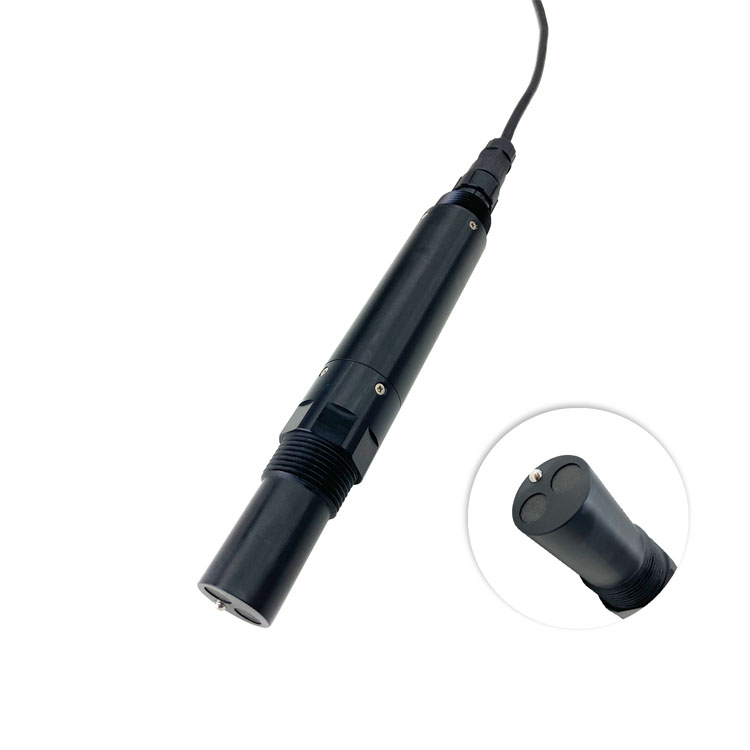
Conductance describes the electrical response of a particular cell containing a solution. Conductivity describes the solution's ability to conduct electricity after the cell geometry is accounted for. For a conventional contacting cell, conductivity = K x conductance, where K is the cell constant. With conductance in S and conductivity in S/cm, K has units of cm^-1.
As an illustrative calculation, suppose a standard has a certified conductivity of 1413 uS/cm at the test temperature and the measured conductance is 1390 uS. The effective constant is 1413 / 1390, approximately 1.017 cm^-1. This calculation requires conductance, not a conductivity value that has already been multiplied by a stored constant.
If a meter displays conductivity using an existing K value, its supported adjustment may instead use K(new) = K(old) x reference conductivity / displayed conductivity. Both values must use the same temperature basis. An integrated digital sensor may perform calibration internally rather than expose a user-editable K field; use its approved calibration operation.
K is primarily associated with cell geometry. Changes in sample concentration do not mean that the physical geometry has changed. Polarization, deposits and measurement-circuit behavior can produce an apparent change in response. Repeatedly changing K to conceal those effects makes later results harder to interpret.
A KCl conductivity standard needs a stated conductivity, reference temperature and uncertainty or traceability information. Concentration alone is insufficient unless the preparation and temperature relationship are also defined. Do not treat molarity, molality and older concentration conventions as interchangeable recipes.
NIST's work on electrolytic conductivity standards describes the importance of solution preparation and temperature. For routine field work, an appropriate certified solution avoids many of the weighing, water-purity and dilution uncertainties of preparing a standard at the installation.
Select a standard accepted by the ordered instrument and within its calibration range. A convenient bottle that lies outside that range cannot establish a valid slope adjustment. A standard near the operating region can support a useful verification, but one point cannot demonstrate performance across an arbitrarily wide span.
| Calibration item | Record or verify | Reason |
|---|---|---|
| Standard identity | Certified value, units, lot, expiry and reference temperature | A label such as KCl alone does not define the reference. |
| Instrument configuration | Probe type, range, stored calibration and temperature mode | Contacting and inductive arrangements need their own procedures. |
| Test geometry | Immersion, wall clearance and absence of trapped bubbles | The vessel and incomplete wetting can change the observed response. |
| Temperature basis | Liquid temperature and whether correction is enabled | Both sides of the comparison must describe the same condition. |
| Acceptance criterion | Application tolerance, sensor uncertainty and reference uncertainty | A display resolution is not a pass/fail uncertainty. |
Conductivity changes with liquid temperature. A transmitter may report the measured value at the current temperature or a calculated value referred to 25 degrees C. A temperature sensor provides the temperature input; it does not guarantee that the compensation model matches every solution.
For illustration only, a linear model with a coefficient of 2% per degree C would turn 1554.3 uS/cm at 30 degrees C into 1413 uS/cm at 25 degrees C: 1554.3 / [1 + 0.02 x (30 - 25)]. That coefficient is an assumption for the example, not a universal setting for KCl, acids, alkalis or process water.
When using the standard's temperature table, compare at the actual liquid temperature in the prescribed mode. When using a compensated comparison, confirm the reference temperature and model. Applying compensation twice or comparing a compensated reading with an uncompensated reference can look like a cell-constant error.
Do not use a fixed short waiting time as proof of thermal equilibrium. A probe moved from a cold process into a warm room may need longer than a probe already near the standard temperature. Watch the trend and the temperature channel rather than only the last displayed digit.
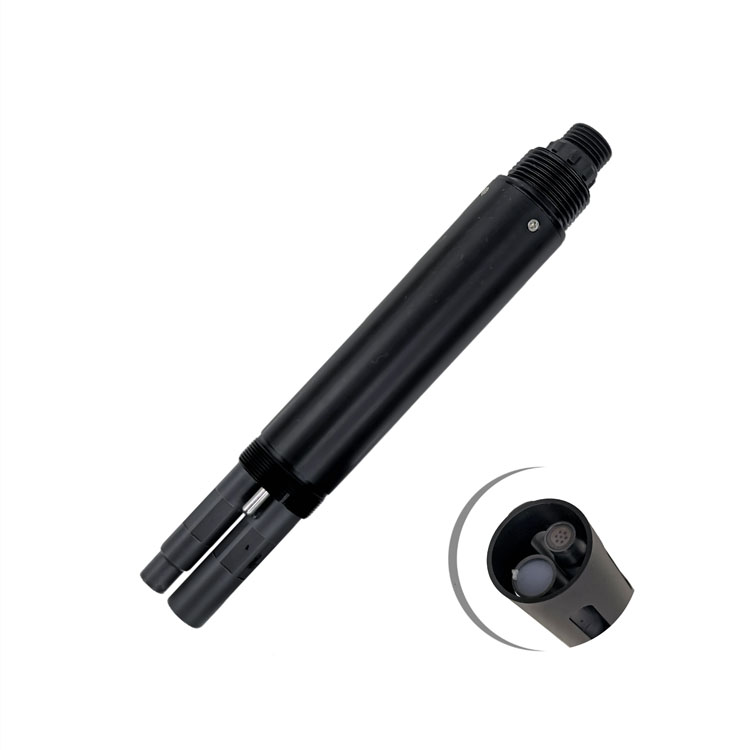
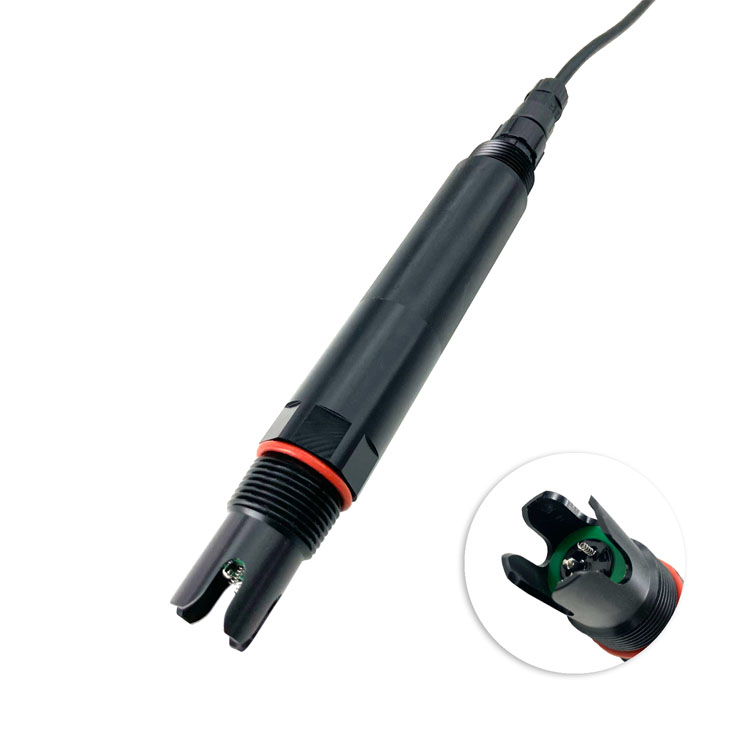
The NBL-WQ-EC family includes different ranges and sensing arrangements. The example below uses its 0-5000 uS/cm, 0-50 degrees C configuration. Keep the ordered revision's accuracy and environmental limits together instead of combining values from different versions.
| Parameter | Example configuration | Calibration implication |
|---|---|---|
| Range and resolution | 0-5000 uS/cm; 1 uS/cm | Choose a reference accepted within the calibration span. |
| Specified accuracy | +/-1% FS; temperature +/-0.3 degrees C | 1% of this full scale is 50 uS/cm, not 1% of every reading. |
| Operating conditions | 0-50 degrees C; pressure below 0.6 MPa | Remove or isolate safely; ingress protection is not pressure isolation. |
| Power and output | 12-24 VDC +/-10%; 0.2 W at 12 V; RS485 Modbus RTU | Read the calibrated value from the sensor before comparing the PLC display. |
| Temperature and calibration | Pt1000 automatic compensation; two-point calibration | Confirm compensation settings and the actual zero/slope operations. |
| Mechanical arrangement | 3/4 NPT; selected ABS, SUS316L or PVC wetted construction; IP68 | Specify the actual material and allow removal for cleaning and reference checks. |
| Cable | Standard 5 m; other lengths available | Confirm jacket suitability and keep terminations dry; length does not identify material. |
For this base calibration procedure, a clean, dried probe is allowed to stabilize in air before the zero operation, followed by slope adjustment in solution. Do not assume that air zeroing is valid for every conductivity instrument. For this conventional EC calibration setup, provide at least 5 cm bottom clearance and 2 cm side clearance during slope calibration.
A broad-range configuration may be unsuitable for a tight low-conductivity acceptance limit even when it displays several digits. Compare uncertainty in uS/cm with the process requirement before ordering. Calibration cannot turn a selected full-scale accuracy into a different accuracy class.
Industrial water treatment systems often acquire conductivity alongside ammonia nitrogen, residual chlorine, pH or dissolved oxygen. These are independent measurement channels with different sensing chemistry and maintenance needs. A successful EC calibration does not verify another probe connected to the same logger.
The ammonium channel uses its own suitable reference and conditioning procedure. Keep calibration liquids, vessels and records identified by parameter. KCl conductivity solution is not an ammonium concentration reference, and contaminating it with liquid from another sensor's service container can invalidate the EC check.
| Observed result | Check first | Useful distinction |
|---|---|---|
| Probe value agrees; PLC value differs | Units, scaling, register type and compensation applied by the receiver | A data-path error is not corrected by changing the electrode constant. |
| Value changes when the probe moves in the vessel | Bubbles, immersion and clearance | Resolve test geometry before adjusting sensitivity. |
| Repeated fresh aliquots disagree | Rinse carryover, contamination and temperature drift | Changing K repeatedly can conceal an unstable reference setup. |
| Standard passes but process comparison fails | Sample timing, temperature basis, local flow and fouling | A clean reference test does not establish sample representativeness. |
Save the before-and-after values and the reason for adjustment. Where several devices display the same sensor, make the correction in the intended measurement component rather than adding separate hidden factors in each display. Recheck a replacement probe with the receiving configuration that will actually be used.
Residual chlorine requires its own analytical comparison and sensor-specific service method. The same principle applies across the station: keep each parameter's reference separate. For NiuBoL calibration support, provide the sensor model and range, reference solution, temperature mode, local reading and receiving-system value so the discrepancy can be located.
No. For conductance in S and conductivity in S/cm, K is in cm^-1. Confusing conductance with already calculated conductivity produces an incorrect constant or an adjustment applied twice.
Not simply because concentration changes. Check electrode suitability, polarization, fouling and the measurement range. K primarily represents geometry; an apparent response change needs investigation before calibration.
Not as a routine slope reference. Its low conductivity is sensitive to contamination and air exposure, and it is not automatically a certified standard. Use the specified zero procedure and an appropriate reference solution.
Only with the prescribed temperature table or a compatible compensation method. Compare values on the same temperature basis and avoid applying correction both inside the sensor and again in the receiver.
No. It is part of the stated base NBL-WQ-EC procedure, not a universal rule for all contacting, four-electrode or inductive instruments. Follow the calibration sequence of the ordered configuration.
After the supported initial setup, replacement or cleaning where required, or when a controlled verification shows an unacceptable discrepancy. First exclude reference contamination, temperature and installation errors.
Identify the probe range and type, required reference solutions, vessel or flow-cell arrangement, access method and acceptance criteria. Specify whether verification, adjustment and the final record are all included.
Conductivity electrode constant calibration is useful only when units, reference temperature and the measurement arrangement are controlled. Verify the reference setup and data path before changing the stored calibration. A range-matched NiuBoL configuration, repeatable KCl check and clear maintenance record give operators a sound basis for accepting an online EC result.
 NBL-WQ-CL Water Quality Sensor Online Residual Chlorine Sensor.pdf
NBL-WQ-DO Online Fluorescence Dissolved Oxygen Sensor.pdf
NBL-WQ-NHN Ammonia Nitrogen Water Quality Sensor.pdf
NBL-WQ-COD Online Water Quality COD Sensor.pdf
NBL-WQ-PH Online pH Water Quality Sensor.pdf
NBL-WQ-EC water quality conductivity sensor.pdf
Prev:How to Use a Conductivity Meter: Units, Temperature and Range
Next:Water Pollution Analysis Indicators: What Each Measurement Can Tell You
Related recommendations
Sensors & Weather Stations Catalog
Agriculture Sensors and Weather Stations Catalog-NiuBoL.pdf
Weather Stations Catalog-NiuBoL.pdf
Agriculture Sensors Catalog-NiuBoL.pdf
Water Quality Sensor Catalog-NiuBoL.pdf
Related products
 Combined air temperature and relative humidity sensor
 TDR Soil Moisture & Temperature Sensor for irrigation| RS485 |4-20mA| NBL-S-THR
 Soil pH sensor RS485 soil Testing instrument soil ph meter for agriculture |NBL-S-PH
 Wind Speed sensor Output Modbus/RS485/Analog/0-5V/4-20mA
 Tipping bucket rain gauge for weather monitoring auto rainfall sensor RS485/Outdoor/stainless steel
 Pyranometer Solar Radiation Sensor 4-20mA/RS485

Screenshot, WhatsApp to identify the QR code
WhatsApp number:+8615367865107
(Click on WhatsApp to copy and add friends)

