





— Blogs —
—Products—
 Consumer hotline +8618073152920
WhatsApp:+8615367865107
Address:Room 102, District D, Houhu Industrial Park, Yuelu District, Changsha City, Hunan Province, China
Product knowledge
Time:2023-11-06 15:29:15 Popularity:11040
A pyranometer and a pyrheliometer are both instruments used to measure solar irradiance, but they measure different components of sunlight. A pyranometer measures solar irradiance incident on a flat receiving surface from the surrounding hemisphere, while a pyrheliometer measures direct solar irradiance arriving from the direction of the sun.
The key difference is that a horizontally installed, unshaded pyranometer measures Global Horizontal Irradiance (GHI), whereas a pyrheliometer measures Direct Normal Irradiance (DNI). Both instruments report solar irradiance in watts per square meter (W/m²).
Understanding the difference between a pyranometer and a pyrheliometer is important for meteorological observation, solar resource assessment, photovoltaic (PV) performance monitoring and solar energy research.
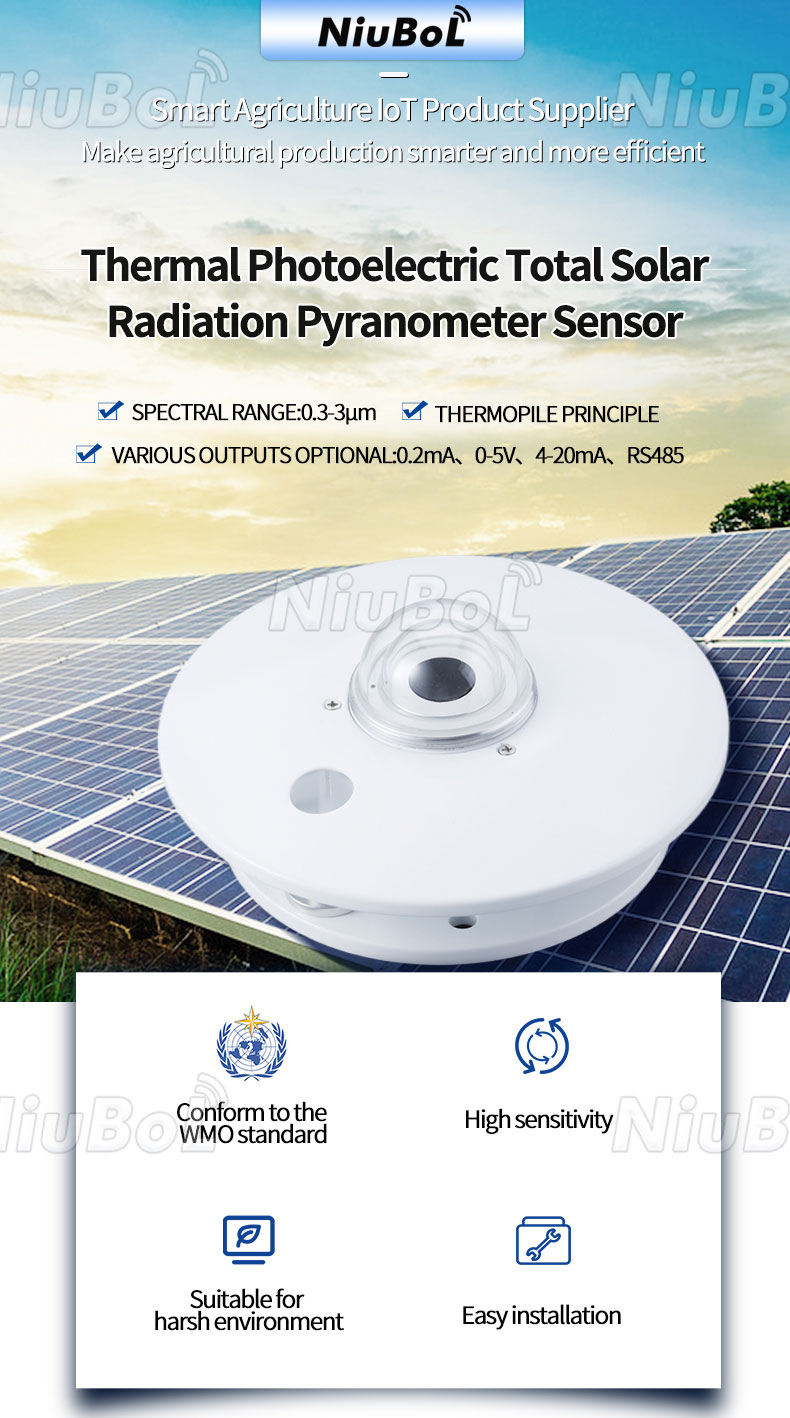
Although both instruments measure solar irradiance, their field of view, orientation and measurement objectives are different.
| Comparison | Pyranometer | Pyrheliometer |
|---|---|---|
| Primary Measurement | Hemispherical solar irradiance | Direct normal irradiance (DNI) |
| Typical Quantity | GHI, DHI or POA depending on installation | DNI |
| Field of View | Approximately 180° hemisphere | Narrow field centered on the sun |
| Solar Tracking | Not normally required for GHI measurement | Typically requires a solar tracker |
| Radiation Components | Direct and diffuse contributions on the receiving plane | Direct solar beam including a defined circumsolar contribution |
| Measurement Unit | W/m² | W/m² |
| Typical Applications | PV monitoring, weather stations, agricultural meteorology | Direct solar radiation measurement, solar resource research, concentrating solar systems |
A pyranometer is a solar radiation instrument designed to measure the solar irradiance received by a plane surface from the hemisphere above it.
When the sensing surface is horizontal and unobstructed, the instrument measures global horizontal irradiance, including both the direct solar beam projected onto the horizontal surface and diffuse solar radiation from the sky.
When the instrument is installed parallel to an inclined photovoltaic module surface, it measures the solar irradiance incident on that plane, commonly referred to as plane-of-array (POA) irradiance.
Many pyranometers use a thermopile sensing element with a radiation-absorbing surface. Solar radiation heats the sensing surface, creating a temperature difference between the sensing junctions and the instrument body.
The thermopile generates a small electrical voltage related to this temperature difference. Through the instrument's calibration relationship, the electrical output is converted into solar irradiance in W/m².
Other pyranometers use silicon photovoltaic sensing elements and appropriate optical structures. Their spectral response and measurement characteristics differ from thermopile instruments.
A pyranometer does not normally use a reflective black sphere to concentrate sunlight. Its optical design is intended to measure incoming irradiance over a defined field of view rather than focus light into a concentrated beam.
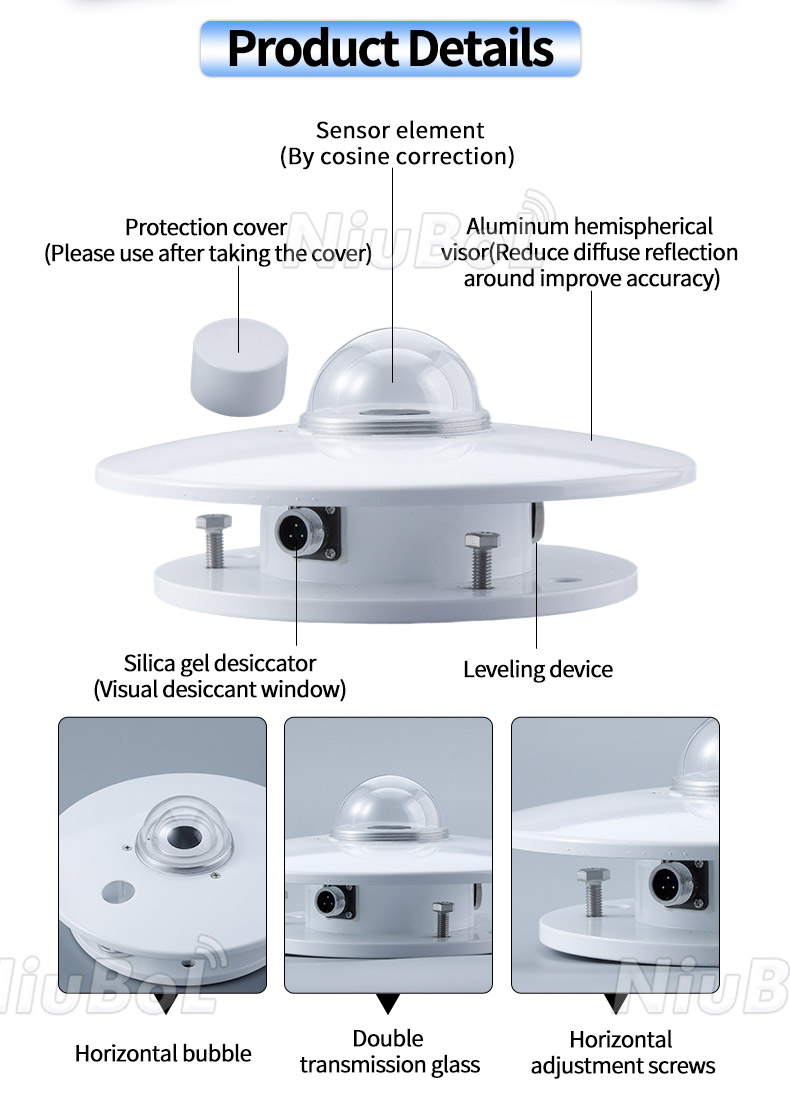
Depending on installation and auxiliary equipment, a suitable pyranometer may be used for several solar irradiance measurements:
| Measurement | Installation Method |
|---|---|
| Global Horizontal Irradiance (GHI) | Horizontally installed, unshaded pyranometer |
| Diffuse Horizontal Irradiance (DHI) | Horizontal pyranometer with suitable shading to block direct sunlight |
| Plane-of-Array Irradiance (POA) | Pyranometer mounted parallel to the photovoltaic module plane |
| Reflected Solar Irradiance | Suitable downward-facing measurement arrangement |
The measurement is determined by the pyranometer's orientation and field of view. A single unshaded pyranometer does not independently separate GHI into DNI and DHI without additional measurements or a suitable estimation method.
A conventional shortwave pyranometer also should not be described as separately measuring ultraviolet, visible, infrared and terrestrial long-wave radiation. Separate spectral or long-wave measurements require suitable dedicated instruments.
A pyrheliometer is a solar radiation instrument used to measure direct normal irradiance (DNI). DNI is the irradiance arriving from the direction of the sun on a receiving surface perpendicular to the incoming solar beam.
Unlike a pyranometer, a pyrheliometer has a narrow field of view. Its optical tube or collimating structure limits the incoming radiation to a small angular region centered on the solar disk, including a defined amount of surrounding circumsolar radiation.
A typical pyrheliometer uses an optical aperture and detector to measure solar radiation from the direct solar beam.
In a thermopile-based instrument, the incoming solar radiation produces a thermal response that is converted into an electrical signal and then into irradiance using the calibration factor.
For continuous outdoor measurements, the instrument is normally mounted on a solar tracker that keeps its measurement axis aligned with the sun as the sun moves across the sky.
A pyrheliometer does not determine DNI by subtracting blackbody thermal radiation from incoming sunlight. Its purpose is to measure direct solar irradiance through a defined narrow angular field of view.
DNI is defined relative to a plane perpendicular to the direction of the solar beam. If a pyrheliometer is not correctly aligned with the sun, the direct beam may not enter the instrument's intended measurement field.
A solar tracker maintains the instrument's orientation and supports continuous observations throughout the day. The required tracking performance depends on the pyrheliometer design and measurement objectives.
Global Horizontal Irradiance (GHI), Direct Normal Irradiance (DNI) and Diffuse Horizontal Irradiance (DHI) describe three important solar radiation quantities.
| Term | Definition | Typical Instrument |
|---|---|---|
| GHI | Total hemispherical solar irradiance received by a horizontal surface | Unshaded horizontal pyranometer |
| DNI | Direct solar irradiance received normal to the solar beam | Sun-tracking pyrheliometer |
| DHI | Diffuse solar irradiance received by a horizontal surface | Shaded horizontal pyranometer |
On a horizontal surface, global irradiance is related to direct and diffuse irradiance through the following expression:
GHI = DNI × cos(θz) + DHI
Here, θz is the solar zenith angle, defined as the angle between the direction of the sun and the local vertical. The expression applies to the usual solar irradiance component definitions and assumes compatible measurement geometry.
For example, when the solar zenith angle is 60°, the direct beam's contribution to a horizontal surface is half its direct normal irradiance because cos(60°) = 0.5.
DNI is therefore not simply added numerically to DHI to obtain GHI. Its projection onto the horizontal surface must be considered.
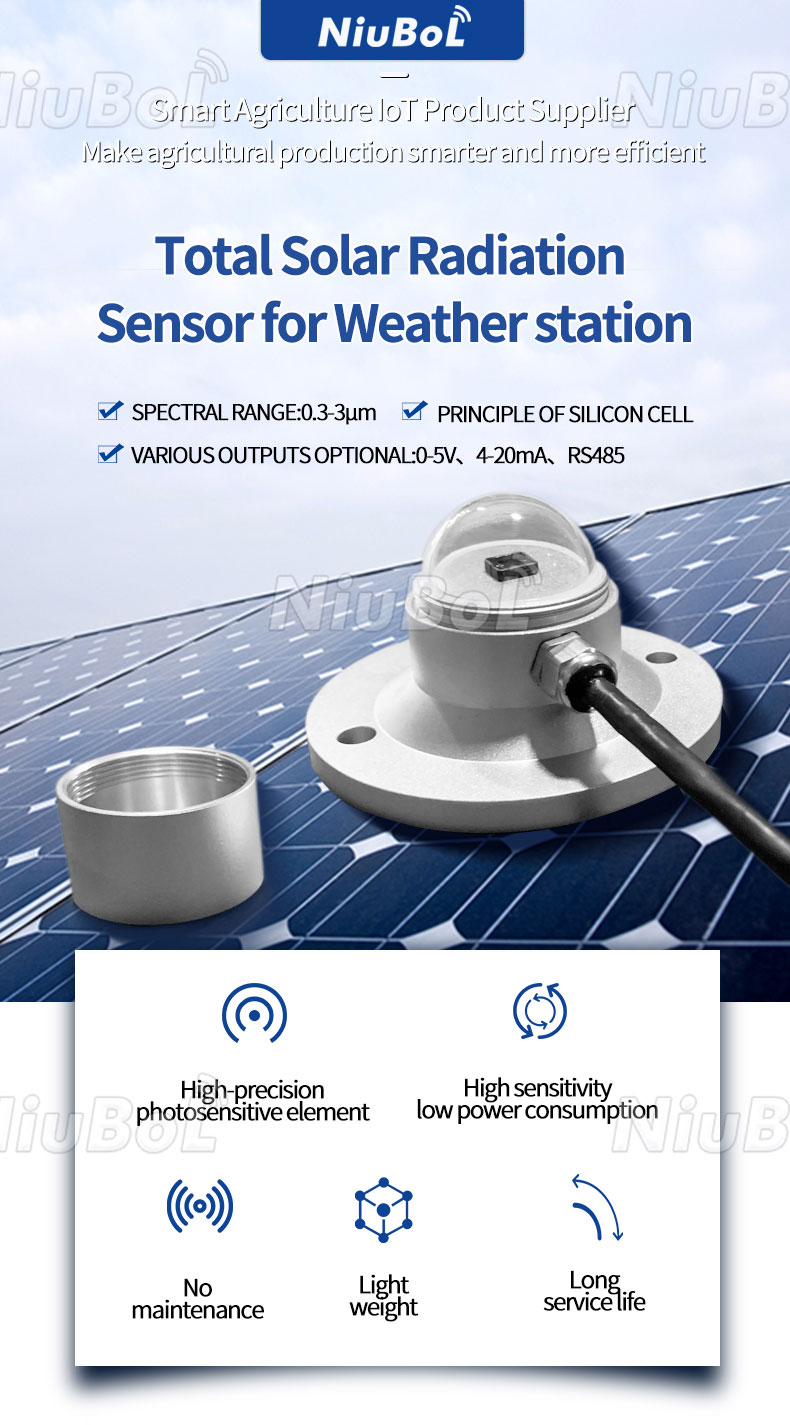
The measurement plane is important when interpreting data from a pyranometer.
For GHI measurement, the pyranometer is installed horizontally with an unobstructed view of the sky. The instrument measures the total shortwave solar irradiance incident on the horizontal plane within its spectral response.
For photovoltaic monitoring, a pyranometer can be installed parallel to the front surface of the solar modules. This provides the irradiance incident on the same tilted plane as the photovoltaic array.
POA irradiance includes the contributions of direct solar radiation, diffuse sky radiation and ground-reflected radiation incident on the selected plane.
The value may differ from GHI because the receiving surface is tilted and has a different orientation relative to the sun and surrounding environment.
A suitable downward-facing pyranometer can measure solar irradiance reflected by the ground or another surface. Combined incoming and reflected irradiance measurements may be used to estimate surface albedo under appropriate conditions.
The receiving surface orientation and measurement arrangement must be documented to interpret these measurements correctly.
The correct instrument depends primarily on which solar radiation component the project requires.
| Measurement Requirement | Instrument to Consider |
|---|---|
| Global Horizontal Irradiance (GHI) | Horizontal pyranometer |
| Direct Normal Irradiance (DNI) | Pyrheliometer with solar tracking |
| Diffuse Horizontal Irradiance (DHI) | Horizontal pyranometer with suitable direct-beam shading |
| PV Plane-of-Array Irradiance | Pyranometer aligned with the module plane |
| Surface-Reflected Solar Irradiance | Suitable downward-facing pyranometer |
| Complete GHI / DNI / DHI Monitoring | Appropriately configured pyranometers, pyrheliometer and tracking/shading equipment |
For conventional meteorological stations and photovoltaic irradiance monitoring, a pyranometer is commonly sufficient when GHI or POA irradiance is the required measurement.
For projects requiring direct normal irradiance, such as concentrating solar resource assessment or detailed solar radiation research, a pyrheliometer is the appropriate dedicated instrument.
Solar radiation measurements depend on the instrument's accuracy and installation conditions. Sensor orientation, shading, cleanliness and calibration can influence the measurement result.
| Consideration | Pyranometer | Pyrheliometer |
|---|---|---|
| Orientation | Horizontal for GHI; selected plane for POA | Aligned with the solar beam |
| Shading | Avoid unintended shading; deliberate shading for DHI | Requires unobstructed direct solar beam |
| Leveling / Alignment | Accurate leveling or plane alignment | Accurate sun tracking and pointing |
| Maintenance | Clean optical surface; inspect leveling and condition | Clean optical aperture; inspect tracker alignment and condition |
| Calibration | Follow instrument-specific calibration requirements | Follow instrument-specific calibration requirements |
For pyranometers, a clean sensing surface and correct mounting plane are particularly important. On solar farms, the measurement plane should be chosen according to whether GHI or POA irradiance is required.
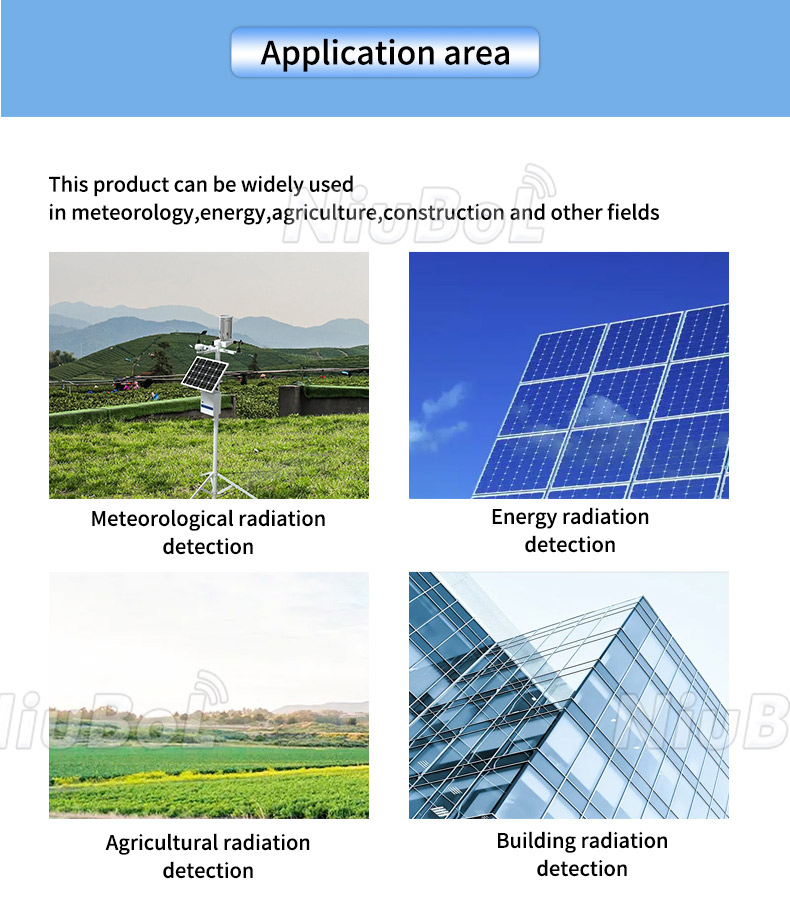
A1. A pyranometer measures hemispherical solar irradiance incident on a plane. A pyrheliometer measures direct normal irradiance from the direction of the sun through a narrow field of view.
A2. A conventional unshaded pyranometer does not directly isolate DNI. DNI normally requires a pyrheliometer or an appropriate indirect estimation method using other measurements.
A3. Yes. A suitable pyranometer can measure DHI when installed horizontally with shading equipment that blocks the direct solar beam.
A4. For continuous outdoor DNI monitoring, a pyrheliometer is normally installed on a solar tracker to maintain alignment with the changing position of the sun.
A5. A pyranometer is commonly used for GHI and POA irradiance monitoring. A pyrheliometer is required when direct normal irradiance must be independently measured.
A6. Yes. Both are expressed in W/m², but they refer to different receiving geometries and should not be treated as interchangeable measurements.
NiuBoL provides pyranometer solar radiation sensors for meteorological observation, photovoltaic monitoring, agricultural research and environmental data acquisition.
The NiuBoL Solar Radiation Sensor measures broadband solar irradiance according to the selected product configuration and installation arrangement.
For measurement projects requiring DNI, a dedicated pyrheliometer and appropriate tracking equipment should be selected. A standard NiuBoL pyranometer should not be presented as an independent DNI instrument.
For GHI or POA monitoring, confirm the required measurement range, spectral response, accuracy, mounting orientation, output interface, power supply and data logger compatibility.
The following manuals provide specifications and installation information for selected NiuBoL pyranometer solar radiation sensors.
 NBL-W-HPRS-Solar-Radiation-Sensor-Instruction-Manual-V3.0.pdf
NBL-W-SRS-Solar-radiation-sensor-instruction-manual-V4.0.pdf
These documents relate to NiuBoL solar radiation sensors and should not be interpreted as pyrheliometer manuals.
Prev:Pyranometer Prices
Next:Pyranometer is mainly used in meteorological monitoring and photovoltaic power plants
Related recommendations
Sensors & Weather Stations Catalog
 Agriculture Sensors and Weather Stations Catalog-NiuBoL.pdf
Weather Stations Catalog-NiuBoL.pdf
Agriculture Sensors Catalog-NiuBoL.pdf
Water Quality Sensor Catalog-NiuBoL.pdf
Related products
 Combined air temperature and relative humidity sensor
 TDR Soil Moisture & Temperature Sensor for irrigation| RS485 |4-20mA| NBL-S-THR
 Soil pH sensor RS485 soil Testing instrument soil ph meter for agriculture |NBL-S-PH
 Wind Speed sensor Output Modbus/RS485/Analog/0-5V/4-20mA
 Tipping bucket rain gauge for weather monitoring auto rainfall sensor RS485/Outdoor/stainless steel
 Pyranometer Solar Radiation Sensor 4-20mA/RS485


Screenshot, WhatsApp to identify the QR code
WhatsApp number:+8615367865107
(Click on WhatsApp to copy and add friends)

