





— Blogs —
—Products—
 Consumer hotline +8618073152920
 WhatsApp:+8615367865107
Address:Room 102, District D, Houhu Industrial Park, Yuelu District, Changsha City, Hunan Province, China
Product knowledge
Time:2026-09-07 16:27:31 Popularity:292
Quick Answer: Choose integrated weather sensors by their actual measurement channels, not the number printed in the product name. For the NiuBoL GUWS range, five core channels cover wind speed, wind direction, air temperature, relative humidity and pressure. Rainfall adds a sixth channel; solar radiation or illuminance can add a seventh. A 10-in-1 configuration adds particulate matter and noise, but it does not make every measurement suitable for every monitoring task.
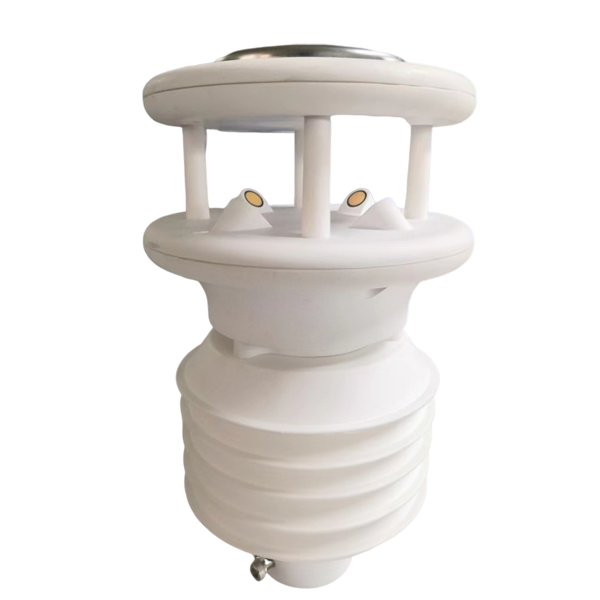
An integrated sensor reduces the number of housings, cables and mounting points at a site. That is useful when an integrator needs several weather measurements at the same location. The tradeoff is that those measurements share an installation height, exposure and service schedule. A compact head cannot remove a conflict between an unobstructed wind position and a shaded, poorly ventilated location chosen for convenient access.
Write a channel list before comparing 5-in-1, 6-in-1, 7-in-1 and 10-in-1 weather sensors. For each channel, state its unit, reporting interval and intended decision. A rainfall channel used to suspend irrigation has a different acceptance requirement from a rainfall record used in a research comparison. Likewise, environmental noise screening is not automatically a substitute for a specified compliance measurement.
| Configuration | Measurement combination | Reason to select it |
|---|---|---|
| NBL-W-51GUWS, 5-in-1 | Wind speed, wind direction, temperature, humidity and pressure | Weather context where rainfall and optical measurements are not needed, or are already measured separately |
| NBL-W-61GUWS, 6-in-1 | The five core channels plus piezoelectric rainfall | One monitoring head for weather and rainfall at the same point |
| NBL-W-71GUWS, 7-in-1 | The six channels above plus solar radiation or illuminance | A project needing irradiance in W/m2 or visible-light measurement in lux |
| NBL-W-10GUWS, 10-in-1 | Five core channels, rainfall, PM2.5, PM10, noise, and solar radiation or illuminance | Combined weather, dust and sound observations where one position suits the measurement objectives |
Solar radiation and illuminance are alternative configurations in the 7-in-1 and 10-in-1 products above. They are not two simultaneous channels in the standard combination. Include the chosen optical channel in the order description rather than relying on the model number alone. The NBL-W-71GUWS product page gives the corresponding seven-channel options.
Other integrated environmental instruments use a different set of five channels. For example, a temperature, humidity, pressure, illuminance and CO2 sensor contains neither wind speed nor wind direction. It may suit greenhouse environmental monitoring, but it cannot replace an ultrasonic weather sensor in a wind-monitoring specification. Compare the named channels and sensing principles before comparing the price or enclosure size.
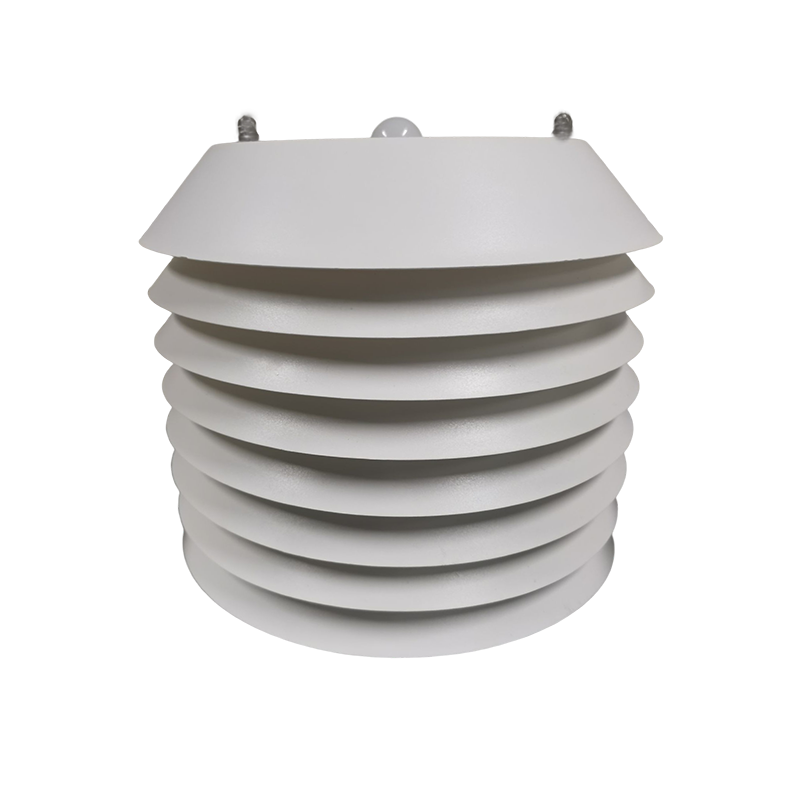
The GUWS rainfall option uses piezoelectric raindrop impact detection. It does not collect water in a tipping bucket. Its sensing surface therefore needs clear exposure to rainfall and separation from vibration, splashing and drips from nearby structures. A covered installation may report wind and temperature while producing an unrepresentative rainfall record.
Distinguish rainfall intensity, interval rainfall and cumulative rainfall in the logger. A value in mm/min is not an hourly accumulation in mm. When the application calculates interval rain from a cumulative counter, handle counter resets explicitly and verify the behavior after a power interruption. Never interpret a reset as negative rainfall or add the same cumulative amount at every sampling interval.
Solar irradiance in W/m2 describes radiant power per unit area. Illuminance in lux is weighted for human visual response. PAR or PPFD serves a different plant-light measurement purpose. A fixed conversion from lux to W/m2 or PPFD is not a defensible replacement for the required sensor under changing daylight spectra.
For a photovoltaic project, decide whether the weather head's radiation channel meets the required uncertainty and measurement plane. A dedicated pyranometer may be needed for array-plane measurements or a specified performance assessment. For crop-light studies, select a dedicated PAR channel when PPFD is the quantity required. Adding more unrelated channels does not address either requirement.
The 10-in-1 option is useful when a site needs dust and noise trends alongside local weather. However, a wind-exposed mounting position may not represent the breathing-zone dust concentration or the sound level at a property boundary. Decide which location the readings must represent before consolidating the instruments. Where a permit specifies a method or instrument class, assess that requirement separately from the number of channels.
The following figures apply to the NBL-W-10GUWS configuration and provide a concrete comparison point. They are not universal specifications for every NiuBoL integrated weather sensor. In particular, resolution is the displayed increment, not the measurement accuracy.
| Item | NBL-W-10GUWS specification | Selection implication |
|---|---|---|
| Wind speed | 0-60 m/s; accuracy +/-0.3 m/s + 3% F.S.; resolution 0.01 m/s | Compare the full-scale accuracy term with the site's required tolerance, not just the two decimal places |
| Wind direction | 0-359 degrees; accuracy +/-3 degrees; resolution 1 degree | Install with a geographic-north reference |
| Temperature and humidity | -40 to 80 C, +/-0.5 C; 0-100% RH, +/-5% RH | Avoid artificial heating and stagnant air around the head |
| Pressure | 10-1100 hPa; +/-1.5 hPa | Distinguish measured station pressure from any calculated sea-level value |
| Rainfall | 0-8 mm/min; +/-10%; rainfall resolution 0.01 mm | Check how intensity and accumulated rainfall are represented in the receiving system |
| Optional optical channel | Solar radiation: 0-1500 W/m2, +/-10%; or illuminance: 0-200,000 lux, +/-7% | Select one; do not substitute lux for irradiance |
| PM2.5 / PM10 | 0-1000 / 0-2000 ug/m3; +/-10% | Check suitability for the site's dust-monitoring purpose |
| Noise | 30-130 dB; +/-5 dB | Do not assume equivalence to a separately specified sound-level instrument |
| Power and interface | 9-24 VDC; RS485 Modbus RTU; 9600 bps | Check supply at the sensor and compatibility with the logger's serial driver |
| Average power | 0.4 W without PM sensing; approximately 1 W with PM sensing | Allow separately for optional heating, communications and other station loads |
| Outdoor operation | IP65; -40 to 80 C; operating humidity 0-95% RH | Measurement range and permitted operating conditions are different limits |
Cable jacket material, extension length and connector arrangement should be included in the quotation for the actual installation. Do not infer a UV, oil or salt-spray rating from IP65. Where icing is expected, specify the heating option and its electrical demand; the unheated power figure is not a winter power budget.
The sensor is a field measurement device. A PLC, RTU or data logger reads its registers; a compatible gateway provides the onward network connection. RS485 Modbus RTU does not itself provide cellular transmission, Ethernet, MQTT or a cloud account. Those functions belong to the selected acquisition and communications equipment.
Before installation, read the ordered unit using the intended logger. Match address, baud rate, parity, stop bits, function code, register locations and scaling. The GUWS interface uses function 03 for measurement reads and specifies at least 1000 ms between communications. Avoid assuming that register positions move when an optional channel is absent: an unpopulated position is not necessarily the next installed measurement.
Include a negative-temperature decoding test. A driver that treats a signed temperature register as unsigned can display a large positive value below freezing while the other channels look normal. Also inspect raw data and timestamps when one channel stops updating; a working serial connection does not establish that every measurement is current.
For a research installation with different required heights for wind, temperature and rainfall, separate instruments may be more appropriate. Integration is useful when the measurement locations can genuinely be shared. It is less useful when it forces a compromised position or means removing all channels to service one component.
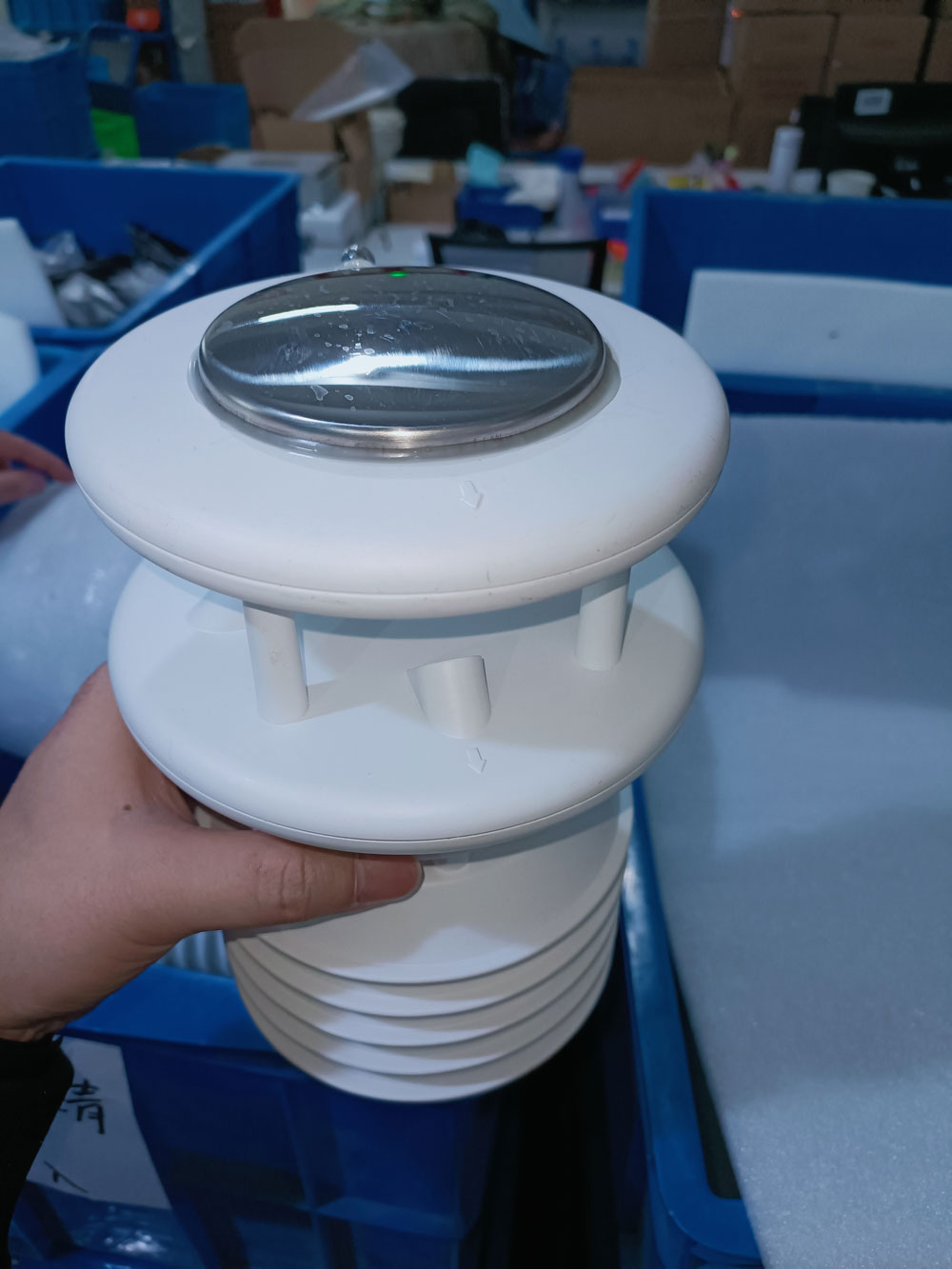
No. Additional channels have value only if they support a defined measurement task. Compare the selected sensor, logger compatibility, power demand and service access. If dust and noise are not used, a smaller configuration may satisfy the project with fewer channels to maintain and validate.
Do not assume so. Rainfall and optical measurements require the corresponding hardware. Ask whether the exact delivered unit supports a factory upgrade and whether its housing, firmware and register map would change. Software cannot create a measurement from a missing sensing element.
No. Multiple measurement values are read through the sensor's shared serial interface. The integration work is mapping and interpreting those values correctly. Additional standalone sensors may share a suitably designed bus, subject to addressing, electrical loading and polling requirements.
Only after checking the required method, resolution, reporting interval and acceptance tolerance. Piezoelectric impact measurement and tipping-bucket collection respond differently to field conditions. Compare representative events before changing an established monitoring method.
Send the named channel list, optical-channel choice, required measurement tolerances, mounting location, expected icing or salt exposure, cable route, supply voltage and logger model. Include the desired reporting interval and any prescribed measurement method. These details allow NiuBoL to quote the appropriate configuration rather than an unspecified parameter count.
Choose integrated weather sensors by measurement purpose, configuration and exposure. The difference between five, six, seven and ten channels matters only after the units, sensing principles and installation constraints are understood. A correctly configured head and a tested register map provide more useful data than a larger channel count with unsuitable positioning or unused measurements.
Prev:2D vs 3D Wind Sensors: Choosing Horizontal or Vector Measurements
Next:Tipping Bucket Rain Gauges: Resolution, Output and Calibration
Related recommendations
Sensors & Weather Stations Catalog
 Agriculture Sensors and Weather Stations Catalog-NiuBoL.pdf
Weather Stations Catalog-NiuBoL.pdf
Agriculture Sensors Catalog-NiuBoL.pdf
Water Quality Sensor Catalog-NiuBoL.pdf
Related products
 Combined air temperature and relative humidity sensor
 TDR Soil Moisture & Temperature Sensor for irrigation| RS485 |4-20mA| NBL-S-THR
 Soil pH sensor RS485 soil Testing instrument soil ph meter for agriculture |NBL-S-PH
 Wind Speed sensor Output Modbus/RS485/Analog/0-5V/4-20mA
 Tipping bucket rain gauge for weather monitoring auto rainfall sensor RS485/Outdoor/stainless steel
 Pyranometer Solar Radiation Sensor 4-20mA/RS485

Screenshot, WhatsApp to identify the QR code
WhatsApp number:+8615367865107
(Click on WhatsApp to copy and add friends)

