







A soil EC sensor reading after rain can rise or fall without a corresponding change in total salt mass. Added water can dilute the pore solution while improving the conductive pathways through the soil. Temperature and electrode contact add further influences. Temperature compensation addresses only one part of this problem: it does not normalize water content, establish salt loss or turn a field measurement into laboratory extract EC.
Identify which EC quantity is being compared
Bulk or apparent EC describes the electrical response of the soil volume sensed by the probe. Pore-water EC describes the liquid in the pores. Saturated-paste-extract EC, written ECe, is measured on solution extracted from a prepared soil paste. Their units can match while the quantities and sample conditions differ.
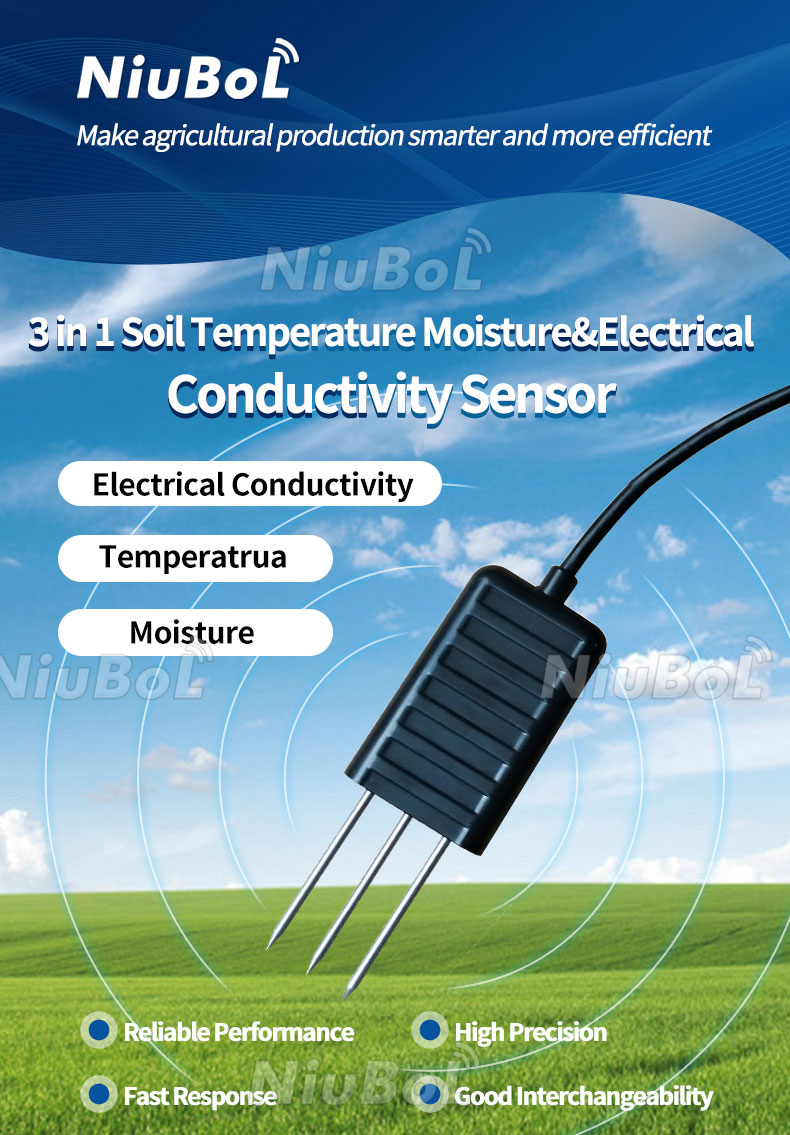
NBL-S-TMC product graphic: temperature, moisture and EC.
The NBL-S-TMC provides temperature, moisture and EC channels at one location. Its current product page lists an EC range of 0–10000 μS/cm, 1 μS/cm resolution and built-in temperature compensation over 0–50°C. These facts support paired trend logging, not an automatic conversion to ECe.
Keep the unit conversion separate from the measurement-method conversion:
1 mS/cm = 1000 μS/cm = 1 dS/m.
For example, 1200 μS/cm and 1.20 dS/m are the same conductivity expressed in different units. A bulk reading of 1.20 dS/m is not thereby an ECe of 1.20 dS/m. Colorado State University explains soil-salinity interpretation using saturated-paste-extract ECe.
Check whether compensation has already been applied
EC25 denotes conductivity referred to 25°C. Before adding a correction in software, establish whether the sensor's EC output is raw at the measured temperature or already compensated, and obtain the actual reference temperature and correction algorithm for the supplied version. A temperature channel beside the EC channel does not answer that question.
For an explicitly assumed linear response, the mathematical form is:
EC25 = EC(T) / [1 + α(T − 25)]
Here T is in °C and α is in °C⁻¹. This is not a universal soil-sensor calibration formula. Conductivity temperature response depends on the medium and the model used. The NBL-S-TMC product's stated compensation interval does not establish a coefficient of 0.019°C⁻¹ or confirm a 25°C reference.
To check the arithmetic only, assume a raw reading of 1.20 mS/cm at 12°C and an analyst-selected coefficient α = 0.019°C⁻¹. The denominator is 1 + 0.019 × (12 − 25) = 0.753. The calculated EC25 is 1.20/0.753 = 1.594 mS/cm, about 32.8% higher than the raw value. These are hypothetical inputs, not a NiuBoL correction or a field result.
Applying that calculation to an output that is already compensated would introduce an error. A matching second value constructed from the same formula is also not an independent validation of the sensor.
Why moisture can conceal—or imitate—a salt change
When water content changes, the conducting volume and connectivity change. Pore-water concentration may move in the opposite direction. Clay-surface conduction, pore structure and soil-solution composition complicate the relationship further. METER's TEROS 11/12 manual, sections 3.3.3–3.3.5, distinguishes bulk EC from pore-water and saturation-extract EC. Its conversion models apply to the instruments and conditions described there, not automatically to a NiuBoL probe.
There is no universal “EC is valid above 20% VWC” boundary across soil textures. Nor can a fixed EC change per percentage point of moisture be applied to every soil. A very dry sample may produce low bulk EC despite concentrated pore water; wetting does not guarantee that bulk EC will decrease.
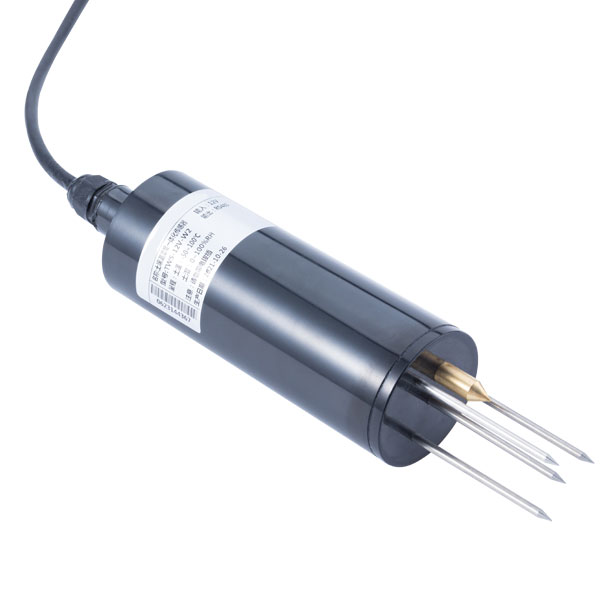
Temperature and moisture probe; not an EC-extract measurement.
The soil temperature and moisture probe shown here measures related conditions; it is not an EC or saturated-paste-extract instrument. If it is paired with a separate EC sensor, ensure that the two channels represent the same depth, soil and wetting zone rather than assuming proximity makes them equivalent.
For routine interpretation, compare periods with similar water content and the same documented compensation basis. Annotate rain, irrigation and fertilizer events. A conductivity change that persists after comparable moisture conditions return is worth investigating, but still is not proof of leaching: solution composition and probe contact may have changed too.
Build a local relationship when ECe is the decision variable
Use a study designed around the actual decision rather than searching for a universal multiplier:
- Define the target method. Specify laboratory saturated-paste-extract ECe or another named extraction method. Do not mix paste, 1:1 and 1:5 results under one “lab EC” label.
- Pair representative observations. Collect field EC, temperature and water content with time-matched samples from the corresponding depth and soil zone. Preserve sensor identities, units and compensation status.
- Cover the operating range. Include the moisture and salt conditions in which decisions will be made. Separate materially different soils instead of pooling them because the crop is the same.
- Check on withheld observations. Fit a relationship using part of the dataset and test it on independent sampling events. Examine residual error against moisture and temperature, not only overall correlation.
- Define where it may be used. Record the tested soil, depth, moisture range, method and prediction uncertainty. Recheck after changing the probe, management regime or relevant soil conditions.
A local relationship may support an ECe estimate; it does not transform the field channel into a direct laboratory measurement. A high correlation alone is insufficient if prediction errors are too large near the intended decision threshold.
Additional channels do not remove the confounding
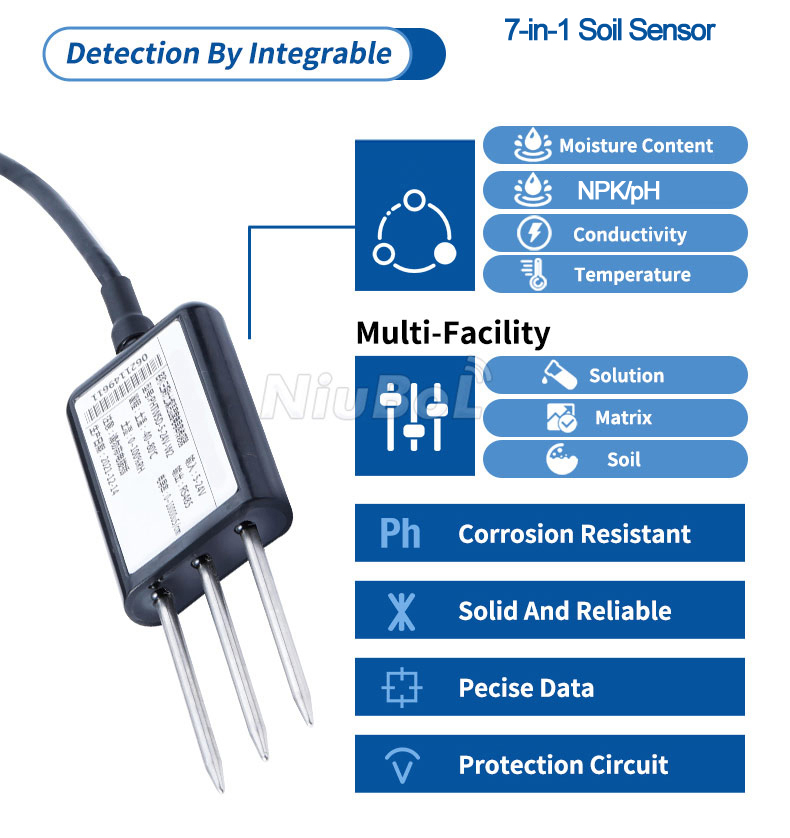
Integrated soil probe; nutrient estimates are not independent laboratory assays.
The NBL-S-TMC-7 integrated soil sensor offers several channels in one probe. More displayed parameters do not make EC independent of moisture. Its EC-related NPK outputs are empirical reference estimates, not independent chemical assays that can validate salt mass or fertilizer requirements.
This page concerns interpretation and calibration, not installation technique. For physical placement and contact guidance, see soil temperature, moisture and salinity sensor installation and use.
FAQ
Q1. Does EC25 remove the effect of rainfall?
No. It addresses a temperature reference, not dilution, conductive connectivity, salt redistribution or electrode contact. Keep moisture and event records alongside the compensated value.
Q2. Can two temperatures be compared using the sensor's accuracy percentage alone?
Not reliably. A comparison includes uncertainty from both observations, temperature correction, changing water content and contact. A published accuracy value is not automatically the acceptance limit for their difference.
Q3. When should a local conversion be suspended?
When readings move outside the tested conditions, the soil or extraction method changes, contact deteriorates, or validation checks show unacceptable errors. Retain raw measurements and obtain new paired samples rather than extrapolating silently.
Separate the corrections before interpreting the trend
First establish the reported EC quantity and temperature basis. Then compare moisture conditions and test any relationship with the laboratory method needed for the decision. EC25 is still a field EC value with moisture, composition and contact effects; it is neither a salt-mass balance nor a universal crop-salinity threshold.
For an interpretation or sensor-selection inquiry, provide:
- Exact sensor model/version, EC units and known compensation settings.
- Soil texture, depth and time-aligned EC, temperature and water-content records.
- Rain, irrigation and fertilizer history for the comparison period.
- Laboratory extraction method, paired results and intended decision threshold.
Contact NiuBoL with these records to discuss the appropriate measurement channels and the configuration information needed for local calibration.









