





— Blogs —
—Products—
 Consumer hotline +8618073152920
 WhatsApp:+8615367865107
Address:Room 102, District D, Houhu Industrial Park, Yuelu District, Changsha City, Hunan Province, China
Product knowledge
Time:2026-09-10 15:00:00 Popularity:222
Quick Answer: A soil temperature moisture salinity sensor helps distinguish root-zone drying from changes in electrical conductivity, but a salinity reading is not a laboratory soil-salinity classification. Install the probe in undisturbed soil, record moisture alongside EC, and compare salt trends under similar water conditions. The NiuBoL NBL-S-TMCS provides temperature, volumetric moisture, EC and salinity through RS485 Modbus RTU.
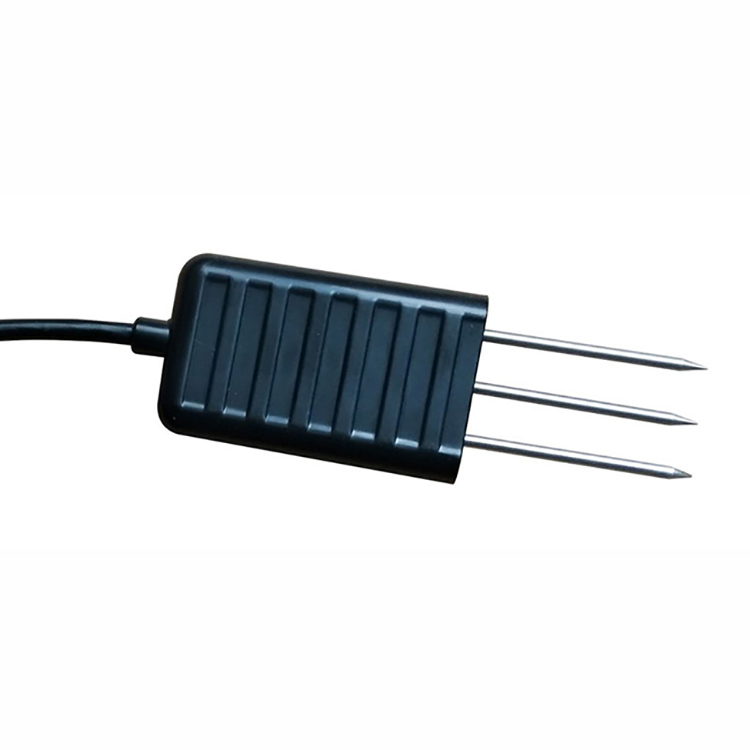
A rising EC trace does not automatically justify adding water or reducing fertilizer. Drying changes the conductive pathways between soil particles; irrigation changes both water content and the movement of dissolved salts. An operator needs the moisture and temperature traces from the same location before interpreting the electrical measurements.
For a greenhouse contractor, the useful question is whether salt-related readings rise repeatedly between irrigations and recover after a defined drainage event. For a reclamation project, the question may be whether salt moves below the monitored root zone. These are different monitoring tasks: the first needs representative crop-zone points, while the second may need several depths and independent soil sampling.
Choose a two-parameter moisture and temperature probe when water scheduling is the only requirement. Adding EC and salinity channels makes sense when the project has a method for interpreting them. It does not turn a probe into an instrument for identifying individual fertilizer ions.
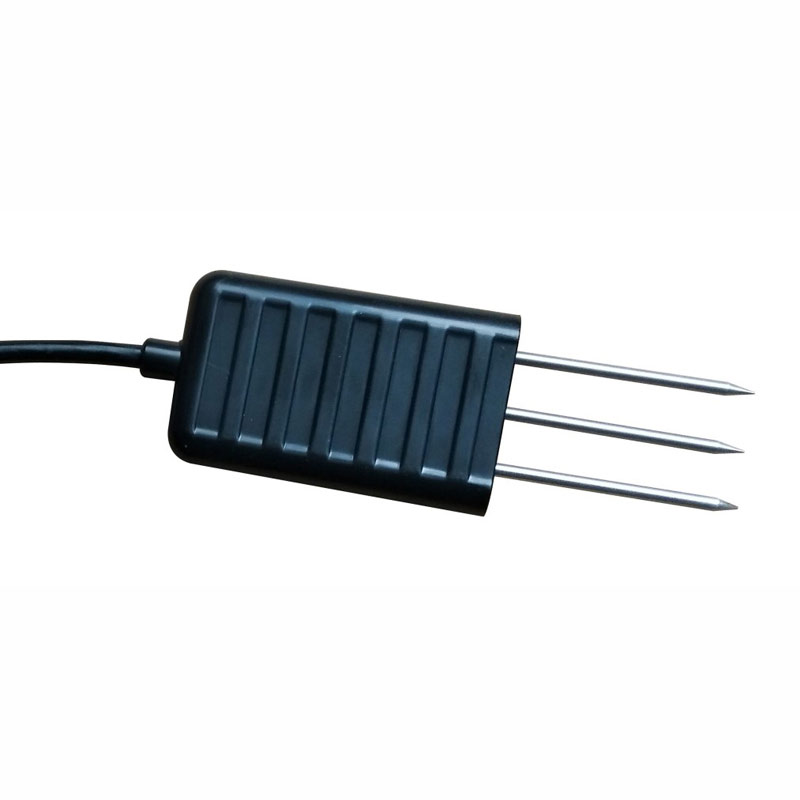
The NBL-S-TMCS four-parameter soil sensor uses FDR for moisture and an AC bridge method for conductivity. The following values apply to this model, not to every probe with a similar three-rod housing.
| Channel or component | NBL-S-TMCS specification |
|---|---|
| Soil temperature | -40 to 80 C; resolution 0.1 C; accuracy +/-0.5 C |
| Volumetric moisture | 0-100%; resolution 0.1%; nominal accuracy 5%; confirm the accuracy basis for the intended soil |
| Electrical conductivity | 0-10000 uS/cm; resolution 1 uS/cm; specified accuracy +/-5% within this range |
| Salinity output | 0-8000 mg/L; resolution 1 mg/L; no separate salinity accuracy is specified here |
| EC temperature compensation | Built-in; compensation range 0-50 C |
| Supply and output | DC 5-24 V or DC 12-24 V depending on configuration; RS485 Modbus RTU |
| Environmental protection | IP68 probe; operating environment -40 to 85 C |
| Housing and electrodes | Black flame-retardant epoxy sealing; corrosion-resistant special electrodes, 50 mm long |
| Cable and power budgeting | Standard cable length 5 m; request sheath material and maximum current for the ordered cable and electronics version |
The operating-environment limit does not extend the temperature measurement range. Similarly, 1 mg/L salinity resolution is a display increment, not evidence of 1 mg/L accuracy. These distinctions matter when a tender places a numerical acceptance limit on every channel.
Keep the reported quantity attached to each dataset. A direct soil-probe reading, irrigation-water EC and a laboratory soil-extract EC are not automatically interchangeable. Extraction ratio, soil preparation, temperature treatment and water content can change the comparison. Do not apply a crop threshold specified for one method directly to another method's output.
For example, 2000 uS/cm equals 2 mS/cm. This unit conversion is valid; it does not establish equivalence between field bulk-soil conductivity and a saturated-paste extract. The salinity channel also should not be treated as an independent measurement of sodium, chloride or nutrient availability.
At dry sites, weak electrical contact can make salt interpretation unreliable even while temperature appears reasonable. Agree a moisture condition for comparing EC trends, retain all four channels, and flag observations outside that condition. Do not water a permanent measuring point merely to obtain a more convenient number: that would change the condition being monitored.
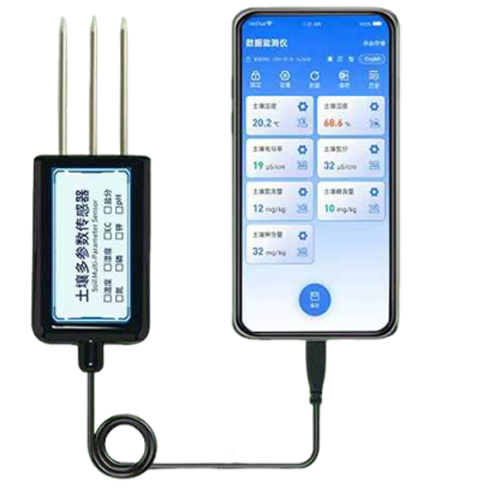
A portable Android-connected soil instrument can help survey spatial variation before permanent installation. It is a separate instrument and connection arrangement; its phone interface is not a feature of the fixed NBL-S-TMCS. Portable and installed readings should be compared at comparable depths and soil conditions rather than assumed identical.
There is no universal installation depth for every crop. A shallow vegetable root zone, a mature orchard and a drainage investigation need different positions. Two depths at one site show vertical behavior; they do not replace separate sites where the soil or irrigation treatment differs.
A fixed system follows this path: probe, RS485 bus, data logger or irrigation controller, then a separate communications gateway where remote access is needed. The probe does not supply cellular service or operate valves by itself. Keep the moisture channel and any salinity advisory separate from the final irrigation-control permission.
The NBL-S-TMCS uses 9600 bps, 8 data bits and no parity. Allow at least 1000 ms between communications. Set and test each device address individually before connecting several probes. Confirm the stop-bit setting and actual firmware register map with the receiving equipment rather than copying another soil model's configuration.
| Returned channel | Conversion and check |
|---|---|
| Temperature | Signed value in tenths of a degree; test a negative-temperature value in the decoder |
| Moisture | Raw decimal 176 represents 17.6% volumetric moisture |
| Salinity | Raw decimal 1568 represents 1568 mg/L |
| EC | Raw decimal 2133 represents 2133 uS/cm |
| Invalid or missing value | Handle 0x7FFF as invalid, not as an unusually high soil reading |
Preserve the original timestamp, channel unit and validity flag through the gateway. A cached value after a cable failure must not look like a fresh observation. Bench-test invalid-data handling as well as normal conversion; a plausible but stale moisture value can otherwise continue influencing an irrigation decision.
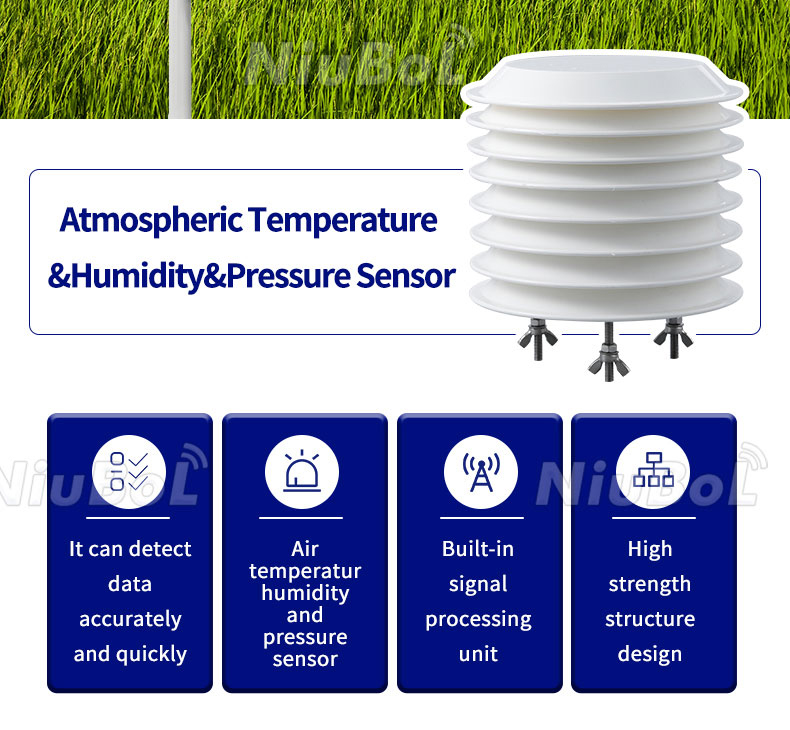
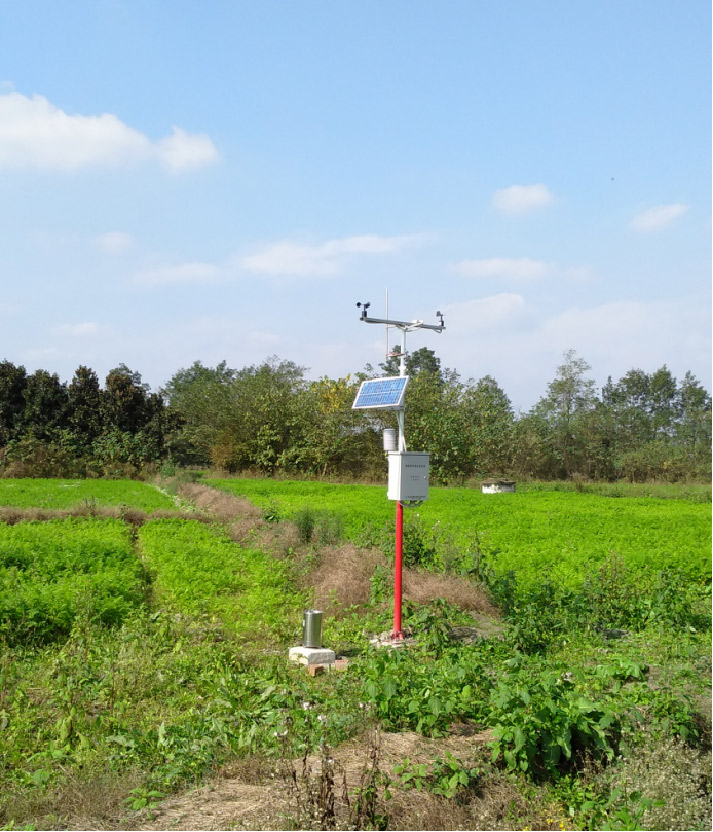
Air humidity and pressure can be useful context for a farm monitoring project, but an atmospheric sensor cannot verify buried soil moisture or soil temperature. The louvered instrument below is a separate environmental input. Label its tags as air measurements so operators do not compare relative humidity with volumetric soil moisture.
Following a fertilizer application, examine the sequence of irrigation, soil wetting, EC response and drainage. Following rain, check whether all monitored depths respond together or in sequence. Do not assign a fertilizer concentration from EC alone, and do not infer that a flat salinity trace proves uniform conditions throughout the plot.
| Observed behavior | First investigation |
|---|---|
| Moisture changes after cable work, without rain or irrigation | Check device identity, register scaling and whether the probe or soil contact moved |
| EC varies strongly as the soil dries | Review simultaneous moisture and compare observations within a similar moisture band |
| All channels stop changing | Check timestamps, polling status, supply voltage and cached gateway values |
| One point differs from adjacent rows | Check emitter position, texture and drainage before treating the difference as calibration failure |
For initial acceptance, compare host and local decoded values, record the installed depth, and observe a normal irrigation or rainfall response. A laboratory comparison should use an agreed sampling and extraction procedure. Set the acceptance tolerance around that procedure; a one-off comparison between different measurement methods is not a defensible pass/fail test.
No. It supports repeated observations at the installed point. Use laboratory analysis where the decision requires a defined extraction method, individual ions or a soil-salinity classification. Field trends can guide where and when to sample.
Not without validating the interpretation. Texture, water content, drainage and the measurement method affect the relationship between the reading and crop conditions. Establish a local baseline and keep the moisture record with the EC record.
Yes, when the PLC has a suitable RS485 Modbus RTU master interface and implements the correct timing, register conversions and invalid-value handling. An analog-only input requires different hardware; a gateway is not implicit in the probe price.
Only if that location matches the question. An emitter-adjacent probe mainly describes the wettest part of the irrigation pattern. Document the offset and use additional representative points when the decision concerns the wider root zone.
Specify the number of sites and depths, soil type, expected EC, output version, supply, cable length and existing logger. Ask for separate prices for probes, communications and installation accessories. There is no single station price implied by the sensor model.
No. Salinity and conductivity do not identify nitrogen, phosphorus and potassium independently. Fertilizer decisions requiring those quantities need an appropriate analytical method.
Select this combined probe when temperature, water content and salt-related trends need to be followed at the same root-zone point. For installation support, send NiuBoL a soil profile, emitter layout, proposed depths and logger details. Those details determine whether a fixed four-parameter probe, a simpler moisture sensor or a preliminary portable survey fits the work.
Prev:Soil Temperature Monitoring: Sensor Placement and Project Decisions
Next:Compact Ultrasonic Weather Sensor Installation Checklist
Related recommendations
Sensors & Weather Stations Catalog
 Agriculture Sensors and Weather Stations Catalog-NiuBoL.pdf
Weather Stations Catalog-NiuBoL.pdf
Agriculture Sensors Catalog-NiuBoL.pdf
Water Quality Sensor Catalog-NiuBoL.pdf
Related products
 Combined air temperature and relative humidity sensor
 TDR Soil Moisture & Temperature Sensor for irrigation| RS485 |4-20mA| NBL-S-THR
 Soil pH sensor RS485 soil Testing instrument soil ph meter for agriculture |NBL-S-PH
 Wind Speed sensor Output Modbus/RS485/Analog/0-5V/4-20mA
 Tipping bucket rain gauge for weather monitoring auto rainfall sensor RS485/Outdoor/stainless steel
 Pyranometer Solar Radiation Sensor 4-20mA/RS485

Screenshot, WhatsApp to identify the QR code
WhatsApp number:+8615367865107
(Click on WhatsApp to copy and add friends)

