

— Blogs —
—Products—
 Consumer hotline +8618073152920
WhatsApp:+8615367865107
Address:Room 102, District D, Houhu Industrial Park, Yuelu District, Changsha City, Hunan Province, China
Product knowledge
Time:2022-05-13 21:07:26 Popularity:2190
Quick Answer: A 3-in-1 soil sensor measures temperature, volumetric water content and electrical conductivity at one location. It reduces separate probe cables, but does not turn EC into a nutrient assay or one point into an entire root profile. Select the channel set and electrical version explicitly: a similar-looking temperature/moisture probe is not a substitute for a three-channel RS485 instrument.
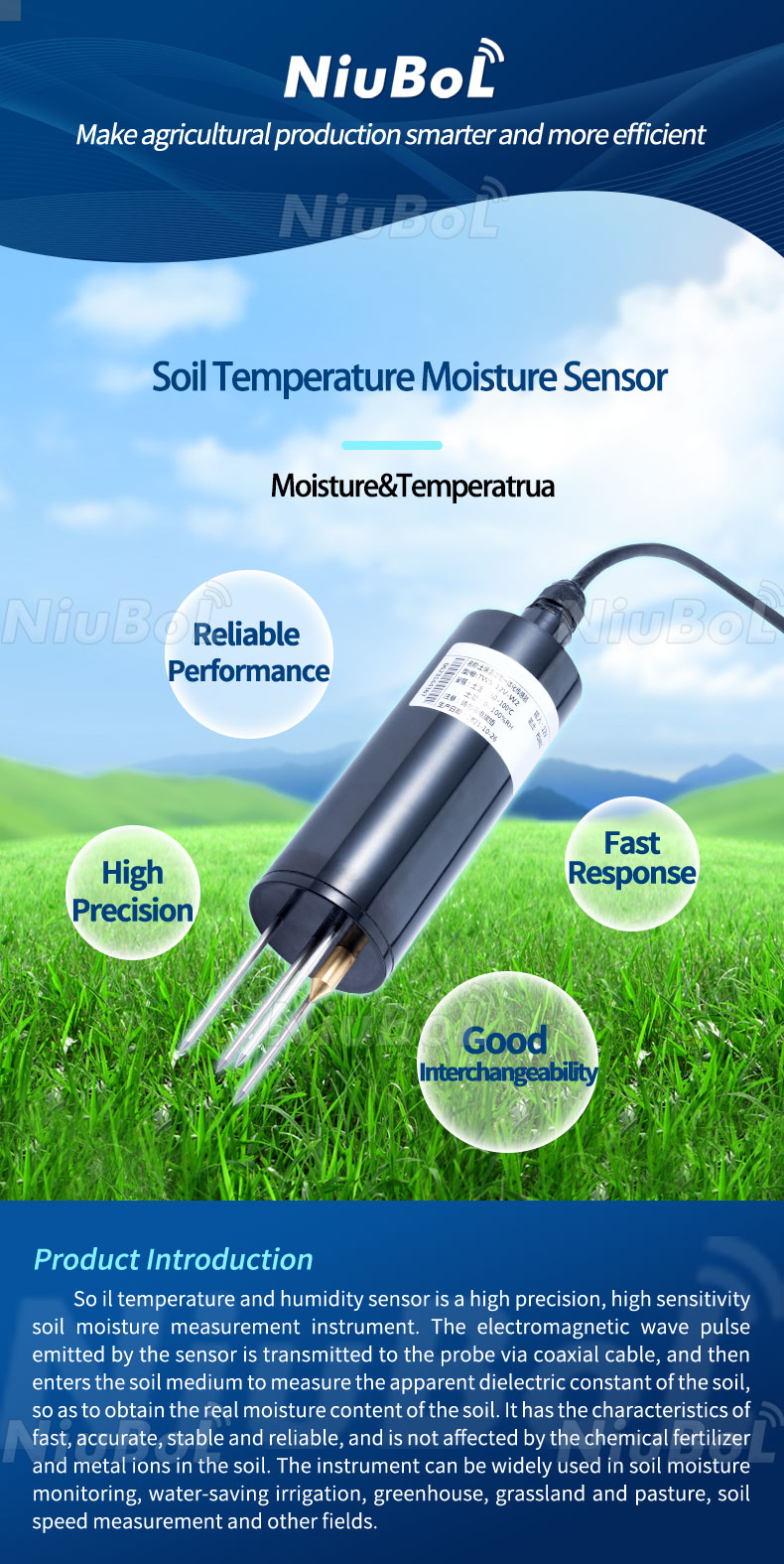
The NiuBoL NBL-S-TMC soil temperature moisture and EC sensor combines dielectric moisture measurement, temperature sensing and an AC conductivity measurement. It suits a location where the three variables need to be interpreted together. Separate probes can be preferable if the project needs different measurement positions, methods or replacement schedules.
The round-body temperature/moisture probe illustrated above is a different configuration from the three-channel NBL-S-TMC. Specify the model, included channels and output on the order, not just a photograph or connector shape. A voltage-output illustration also does not establish that the delivered instrument has an RS485 interface. These checks prevent a two-parameter replacement from being purchased for an existing three-channel installation.
| Measurement | Typical project use | Interpretation limit |
|---|---|---|
| Soil temperature | Root-zone condition, germination studies and temperature compensation | One depth may not represent the full root profile. |
| Volumetric water content | Irrigation thresholds, moisture trends and drainage assessment | Readings depend on contact and may require soil-specific correlation. |
| Electrical conductivity | Tracking changes related to salinity and dissolved ions | EC is affected by moisture and temperature and does not identify individual nutrients. |
The three channels are complementary. A rise in EC after fertigation has a different meaning when moisture is stable than when the soil is drying. Store all three values with the same timestamp so agronomists can interpret the pattern rather than one isolated number.
Soil EC interpretation needs the water condition at the sensing volume. When soil dries, electrical contact and connected water paths change as well as dissolved-ion concentration. The resulting field reading is therefore not a simple fertilizer concentration. A rising or falling trend should be compared under similar moisture and temperature conditions before attributing it to salt accumulation or removal.
For greenhouse fertigation monitoring, retain irrigation timing and solution information with the soil record. An increase immediately after fertigation can justify reviewing the delivered solution and subsequent trend. It does not independently establish excess nitrogen, a specific ion problem or an exact leaching volume. Direct soil measurements are also not automatically equivalent to a laboratory saturated-paste or other extract method used in an agronomic guideline.
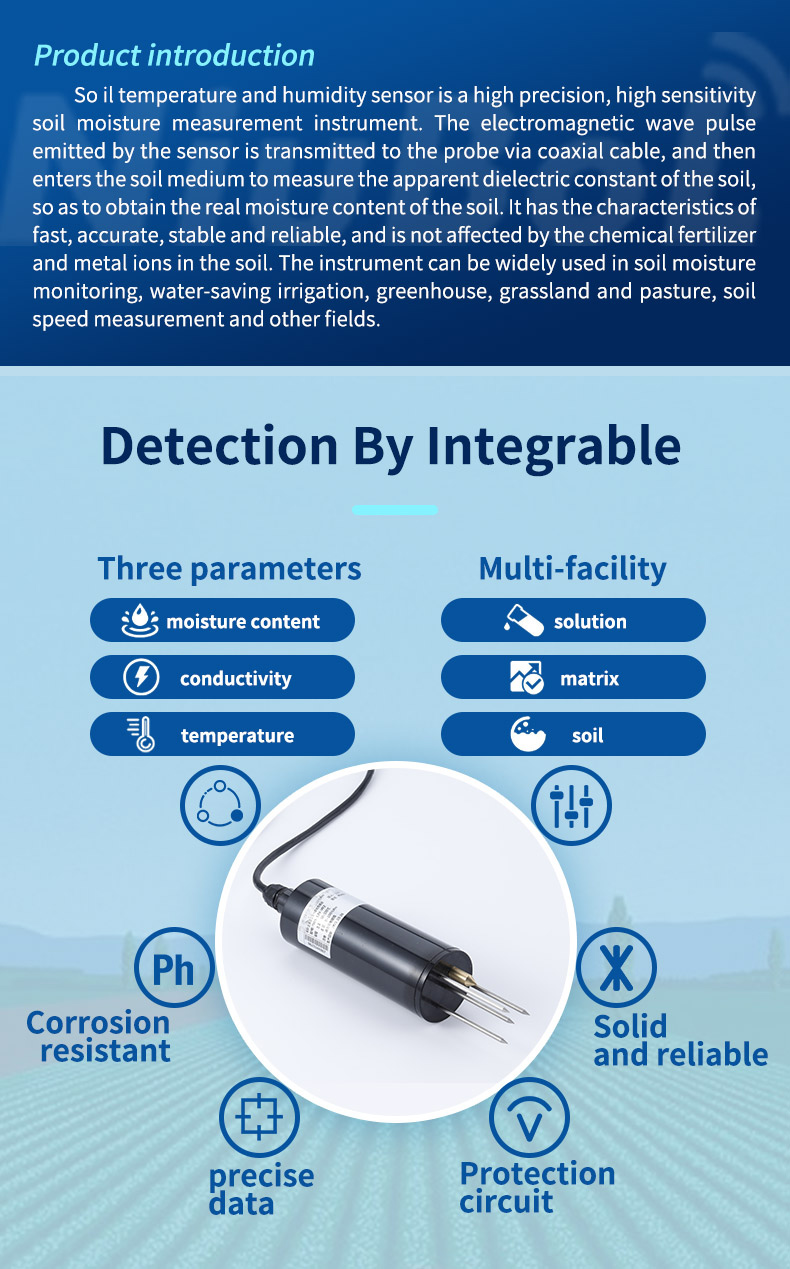
The table describes the NBL-S-TMC reference configuration, not every cylindrical or analog-output soil probe. Agree the actual accuracy terms and test conditions when specifying acceptance. A display increment is not the same thing as field uncertainty, and the presence of temperature compensation does not remove every soil-dependent effect.
| Item | NBL-S-TMC configuration | Engineering consequence |
|---|---|---|
| Soil temperature | -40 to +80 degrees C; 0.1 degree C resolution; +/-0.5 degrees C accuracy | Temperature belongs to the sensing location, not the surrounding air. |
| Moisture | 0-100% volumetric water content; 0.1% resolution; 5% specified accuracy | Agree the percentage basis and soil conditions for acceptance; do not treat this as a universal field error. |
| Conductivity | 0-10000 uS/cm; 1 uS/cm resolution; +/-5% for this reference configuration | Confirm the selected version and percentage basis before assigning an absolute error. |
| EC compensation | Built-in temperature measurement; 0-50 degrees C compensation interval | The wider probe operating interval does not extend this compensation interval. |
| Supply and power budget | 5-24 VDC or 12-24 VDC, depending on version | Specify actual consumption for the selected version; input voltage is not a power rating. |
| Digital output | RS485 / Modbus RTU; 9600 baud, eight data bits, no parity; communication interval at least 1000 ms | Obtain the exact point map and matching serial settings. |
| Protection / operating environment | IP68 probe; -40 to +85 degrees C operating environment | Protect the cable joints and receiver separately; ingress rating does not establish chemical compatibility with every medium. |
| Construction / size | Specially treated alloy electrodes; black flame-retardant epoxy seal; 45 x 15 x 135 mm body; 50 mm electrodes | Check the actual insertion and service geometry. |
| Cable | 5 m standard, with cold-pressed terminals | Specify extension, shielding and jacket requirements. Cable length does not identify jacket material. |
Keep the three-channel specification separate from the round-body variant parameters below. In particular, moisture shown with an RH-style label in a product illustration should not be interpreted as air relative humidity. The soil-water quantity is volumetric water content. A reading of 25% VWC means that water occupies approximately one quarter of the measured soil volume; it is not automatically 25% of the water available to the crop.
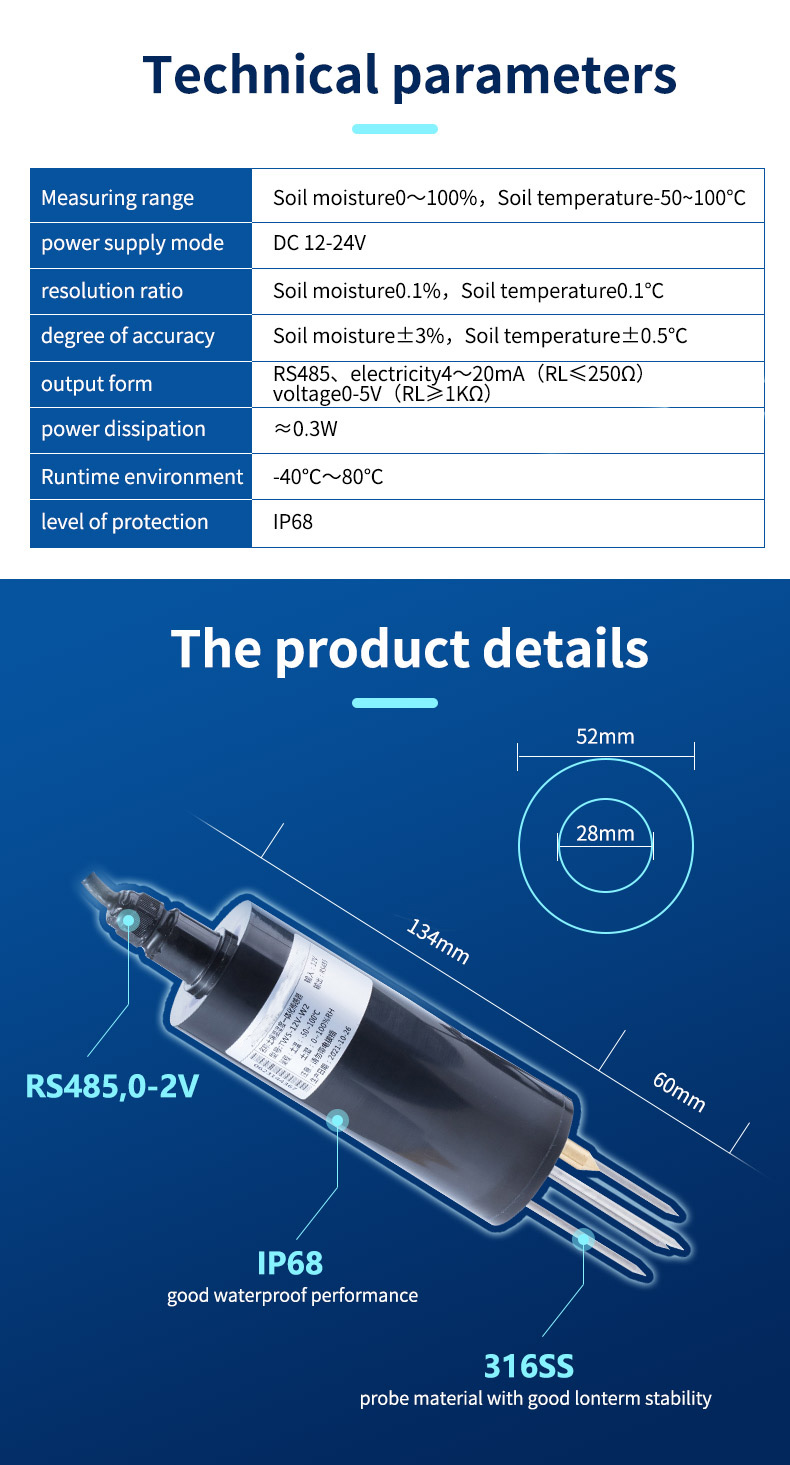
Install the probe in undisturbed soil where possible. The sensing rods or body must contact soil without an air pocket. Avoid forcing the probe through stones, and do not widen the hole by rocking it after insertion. For permanent installation, route the cable so cultivation, rodents, standing water and tensile loads cannot damage it.
Choose depth according to the active root zone and irrigation objective. A shallow probe may respond quickly to evaporation and light irrigation, while a deeper probe helps show whether water reaches the lower root layer. Projects that need a profile should use several depths or a multi-depth instrument rather than assume one probe represents the whole profile.
Under drip irrigation, record the position relative to the emitter and crop row as well as depth. Moving a probe a short distance can take it outside the wetted volume. For differently textured blocks, use separate representative observations rather than assuming that an identical VWC threshold has the same agronomic meaning. Identify an atypical wet patch as such instead of letting it represent the whole block.
When installing into an excavated profile, insert the electrodes into the selected sidewall layer and restore the excavation without creating a preferential water path. Support the cable away from the sensing body. Mark disturbed soil and installation water in the record, then examine subsequent natural or irrigation responses before defining a baseline. The illustrated burial depth is an example, not a universal root-zone requirement.
The V4.0 arrangement reads three 16-bit words beginning at register 0x0000 with function 0x03: temperature, moisture and EC. It uses 0x7FFF as invalid or missing for these channels. Test this status before numerical conversion so that an absent reading does not become a high but apparently valid measurement. Do not extend this mapping to a different model without checking its own data format.
| Illustrative valid word | Interpretation | Error to avoid |
|---|---|---|
| Temperature 0x00C3 | Signed value 195, scaled by 0.1: 19.5 degrees C | Displaying the unscaled integer as temperature |
| Temperature 0xFF3D | Signed two's-complement value -195: -19.5 degrees C | Treating a negative temperature as an unsigned integer |
| Moisture word 286 | With the 0.1 scale: 28.6% VWC | Applying the scale twice after the gateway already converted it |
| Any channel 0x7FFF | Invalid or missing status | Saving 32767 as a measurement or replacing the fault with zero |
For this configuration, power is red positive and black negative; yellow is RS485 A and blue is RS485 B. Check the delivered cable identification before applying power. Set addresses individually during commissioning and avoid connecting several units with the same address. A temperature/moisture/EC sensor is a slave measurement device, not a modem or an independent cloud connection.
Connect the probes to one compatible master on the serial segment. If a PLC already polls the bus, obtain its measurements through an approved interface rather than attaching another independent polling master. Retain acquisition time and channel quality in the data logger, not just the last numerical value seen by a dashboard. A successful reply verifies communication, not installation representativeness.
| Observation | Possible explanation | Focused check |
|---|---|---|
| EC changes with a strong drying trend | Changing water paths, contact and ion concentration | Compare under similar moisture conditions; do not immediately change fertilizer dosing. |
| All three values stop changing together | Acquisition or transmission interruption | Inspect local replies, timestamps and supply before disturbing the buried probe. |
| Newly installed probe shows unusually rapid deep wetting | A disturbed installation path or incorrect position label | Inspect the installation and depth mapping before inferring drainage. |
| Moisture seems implausibly low | Dry soil, poor contact, range or conversion issue | Inspect contact and compare an independent soil observation; do not water the point to force a plausible result. |
Functional checks should use controlled, appropriate conditions and known decoding. They do not replace a measurement verification procedure. Record any field calibration, reference method and soil preparation so future comparisons use the same basis. If the project requires a different medium, such as nutrient solution or a non-mineral substrate, confirm the selected configuration and its calibration before transferring soil thresholds.
For a NiuBoL quotation, identify how the three channels will be used, the soil or substrate, installation depth, number of points, expected EC, power and receiver. Ask for the model-specific wiring and map before completing the acquisition software. Include compatible spare units and the evidence required for acceptance; a probe count alone does not describe a functioning monitoring network.
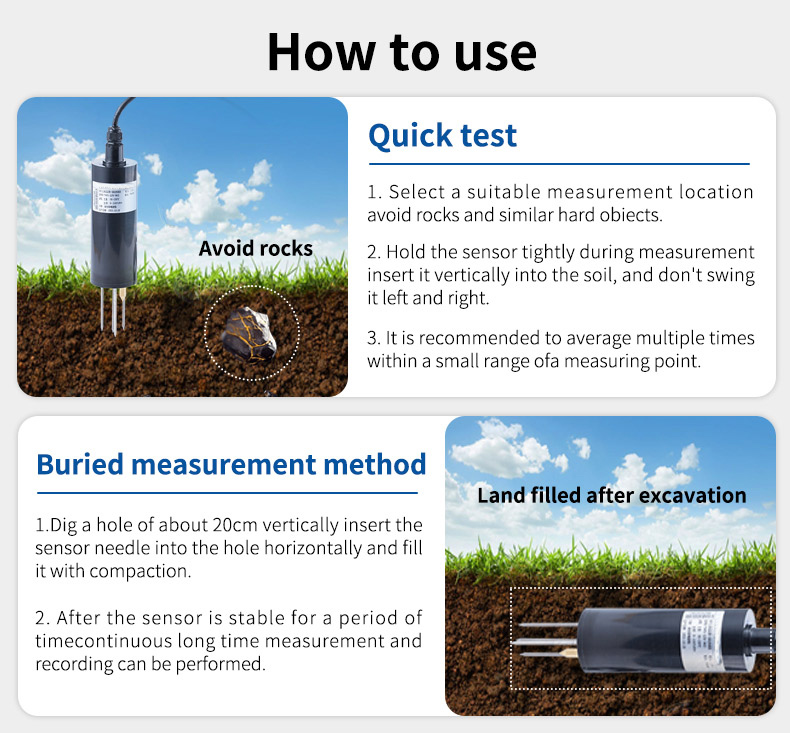
Not in the temperature, moisture and EC configuration described here. Those are the three channels. EC is not nitrogen, phosphorus or potassium concentration, and a corrosion-resistance illustration is not evidence of a pH channel. Specify additional measurements separately.
No. It observes one local volume. Use additional depths or a suitable profile instrument where vertical changes matter. Installation geometry must follow roots, soil layers and irrigation rather than an assumed depth from a generic illustration.
The method and water condition can differ. A direct soil reading and a prepared extract need not produce interchangeable values. Compare using a defined method and appropriate paired observations before applying a laboratory guideline to the field channel.
Distinguish operating environment, temperature measuring range and EC compensation. The reference NBL-S-TMC has a 0-50 degrees C conductivity compensation interval, narrower than its temperature channel and operating environment. Evaluate the channel accuracy needed outside that interval rather than assuming identical compensation.
Yes, within a properly designed network with compatible serial settings, unique addresses, adequate supply at each device and appropriate bus wiring. Check polling time and retries for the whole segment. A shared cable does not permit uncontrolled multiple masters.
Test recognition, all three channels, signed temperature conversion, missing-value handling and restart behavior on the actual logger. Then verify placement and soil contact at a pilot point. Keep the accepted configuration and depth labels available for later replacements.
A 3-in-1 soil sensor is useful when temperature, moisture and EC belong to the same observation point. Select NBL-S-TMC by its actual channels, electrical version and measurement limits, preserve soil contact and verify the three-value data path. The result is a more interpretable root-zone record, not an automatic nutrient prescription or a substitute for representative sampling.
Related recommendations
Sensors & Weather Stations Catalog
 Agriculture Sensors and Weather Stations Catalog-NiuBoL.pdf
Weather Stations Catalog-NiuBoL.pdf
Agriculture Sensors Catalog-NiuBoL.pdf
Water Quality Sensor Catalog-NiuBoL.pdf
Related products
 Combined air temperature and relative humidity sensor
 TDR Soil Moisture & Temperature Sensor for irrigation| RS485 |4-20mA| NBL-S-THR
 Soil pH sensor RS485 soil Testing instrument soil ph meter for agriculture |NBL-S-PH
 Wind Speed sensor Output Modbus/RS485/Analog/0-5V/4-20mA
 Tipping bucket rain gauge for weather monitoring auto rainfall sensor RS485/Outdoor/stainless steel
 Pyranometer Solar Radiation Sensor 4-20mA/RS485


Screenshot, WhatsApp to identify the QR code
WhatsApp number:+8615367865107
(Click on WhatsApp to copy and add friends)