





— Blogs —
—Products—
 Consumer hotline +8618073152920
 WhatsApp:+8615367865107
Address:Room 102, District D, Houhu Industrial Park, Yuelu District, Changsha City, Hunan Province, China
Product knowledge
Time:2026-06-19 17:03:59 Popularity:207
A soil temperature moisture sensor is a key sensing device for irrigation control, farmland monitoring, greenhouse management, and soil research projects. It gives project teams direct root-zone data, helping them understand whether the soil condition matches crop water demand and management objectives.

Soil is the direct growth environment for crops. Moisture affects root water uptake, irrigation timing, and drought stress, while soil temperature influences root activity, microbial processes, and crop growth conditions.
For smart agriculture projects, soil data is often more actionable than air data alone. Weather data describes atmospheric conditions, but soil sensors show what is happening in the root zone.
NBL-S-THR soil temperature moisture sensor uses a sealed probe structure suitable for long-term buried monitoring. It supports soil moisture and temperature measurement with stable output and strong field applicability.
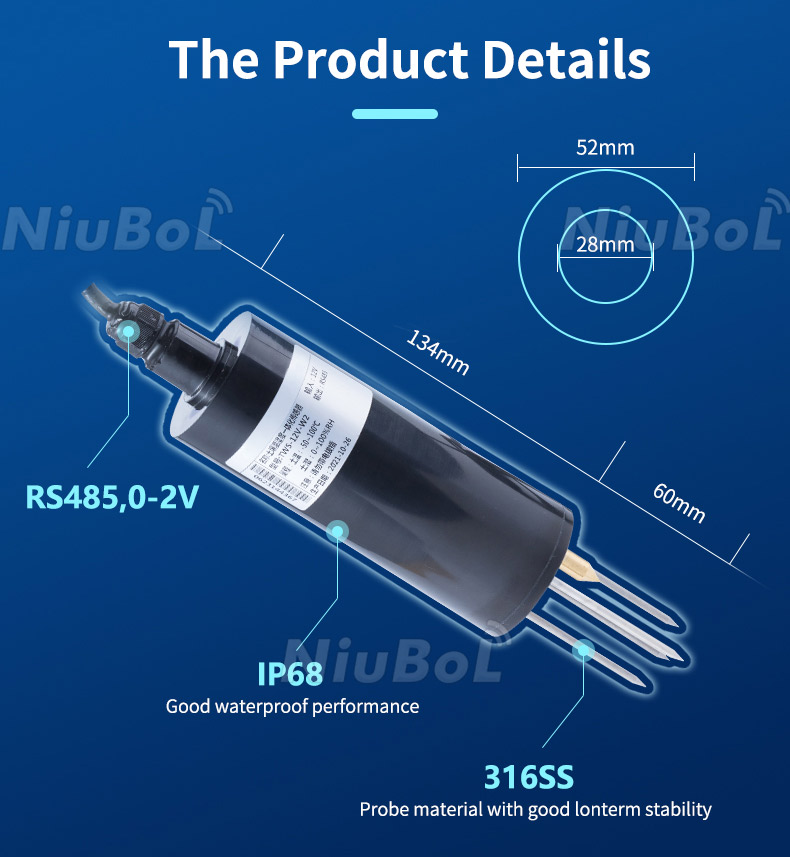
RS485, 4-20mA, and voltage output options can support different controller and platform architectures. The IP68 protection class allows buried operation in moist soil environments.
| Item | Specification | Project Use |
|---|---|---|
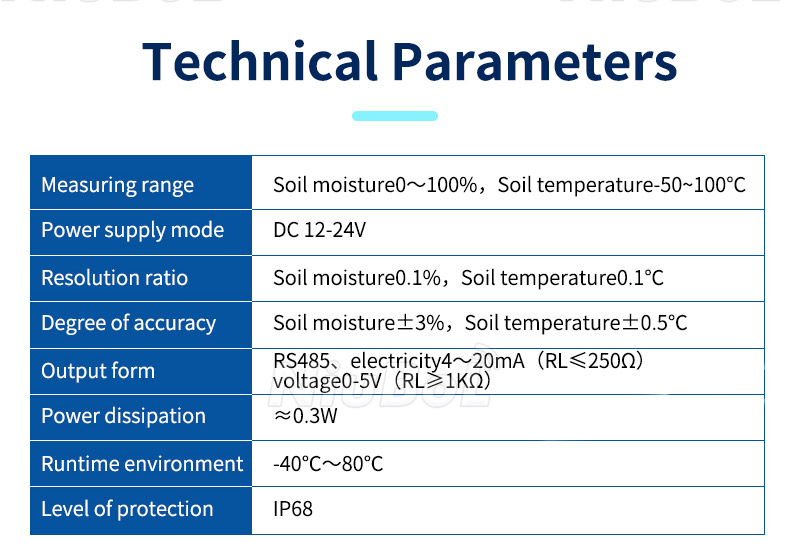
| Model | NBL-S-THR soil temperature moisture sensor | Root-zone monitoring and irrigation data acquisition |
| Soil Moisture Range | 0-100% | Soil water status monitoring |
| Soil Temperature Range | -50 to 100℃ | Root-zone temperature tracking |
| Power Supply | DC 12-24V | Field controller and gateway compatibility |
| Output | RS485, 4-20mA, 0-5V options | Flexible platform integration |
| Power Consumption | Approx. 0.3W | Low-power field deployment |
| Protection Class | IP68 | Buried soil installation |
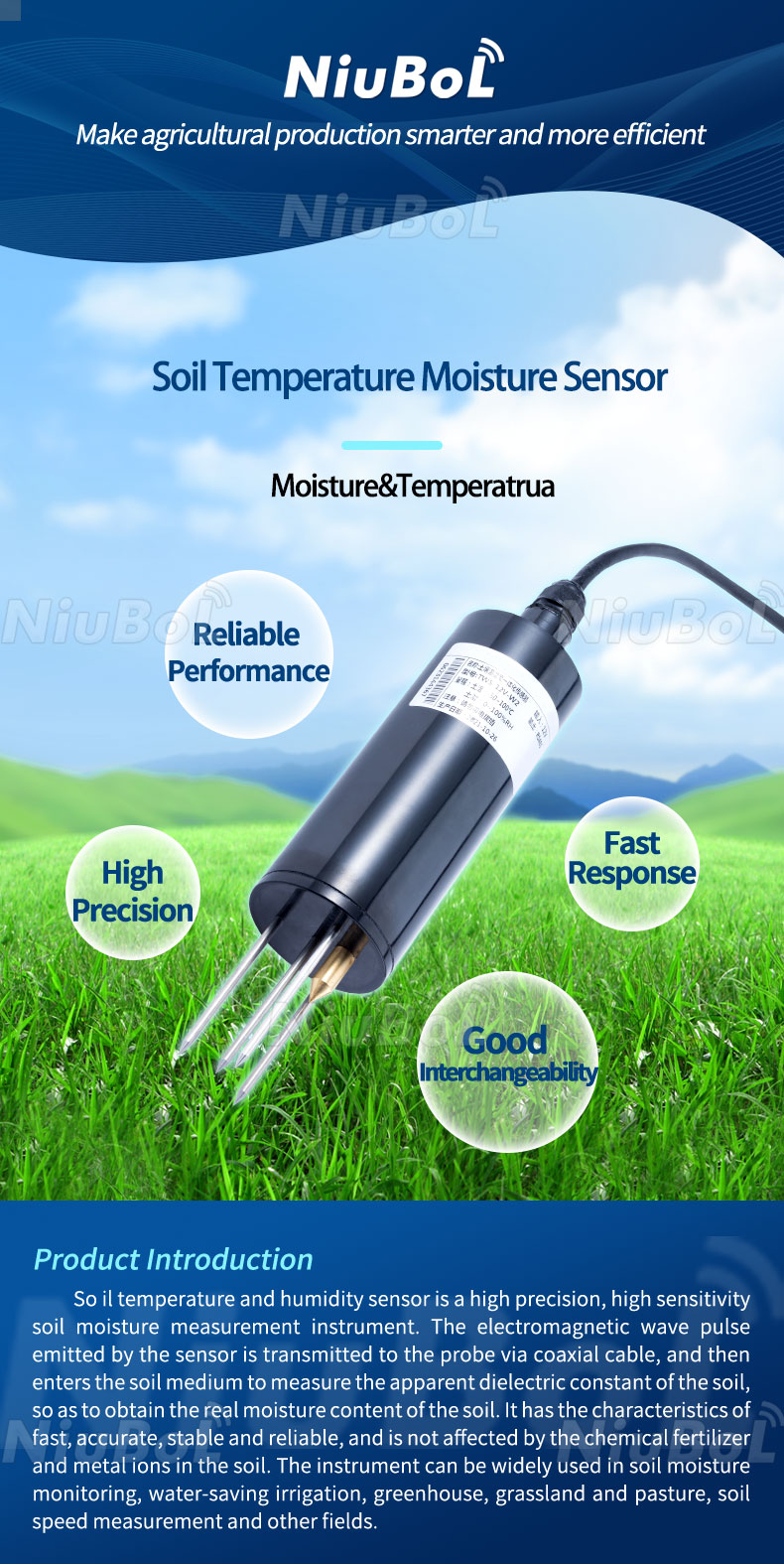
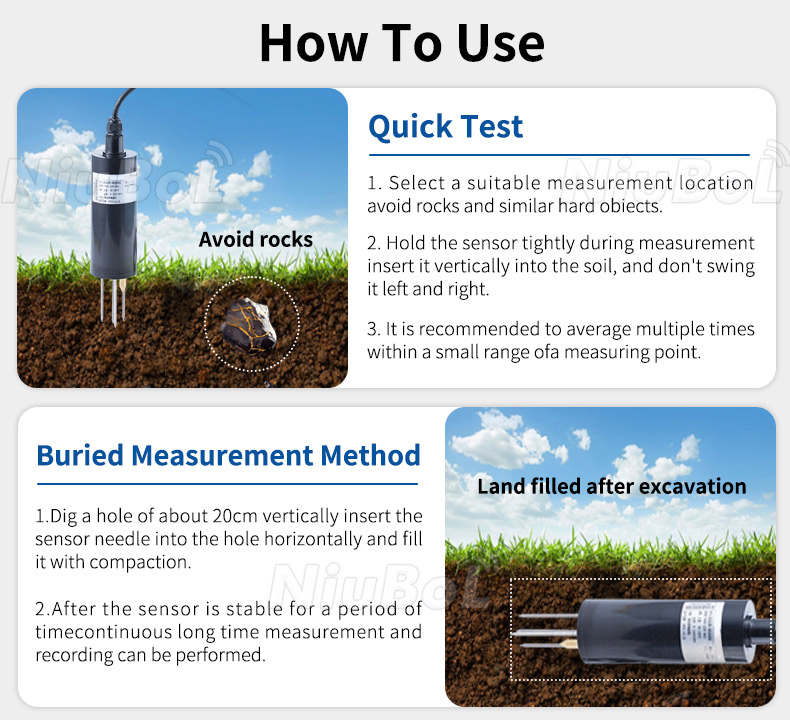
For quick measurement, the probe should be fully inserted into representative soil and kept in close contact with the medium. Avoid stones, hard objects, and loose contact that can affect readings.
For long-term monitoring, a pit can be dug to the required depth, the probe inserted horizontally into the soil wall, and the soil compacted back carefully. Stable contact is important for continuous data quality.
The sensor can be used in farmland irrigation, greenhouse monitoring, orchard irrigation, grassland management, soil research, seedling cultivation, and agricultural service stations.
In irrigation projects, multiple sensors can be installed at different zones or depths. The platform can compare moisture curves and support irrigation threshold adjustment.
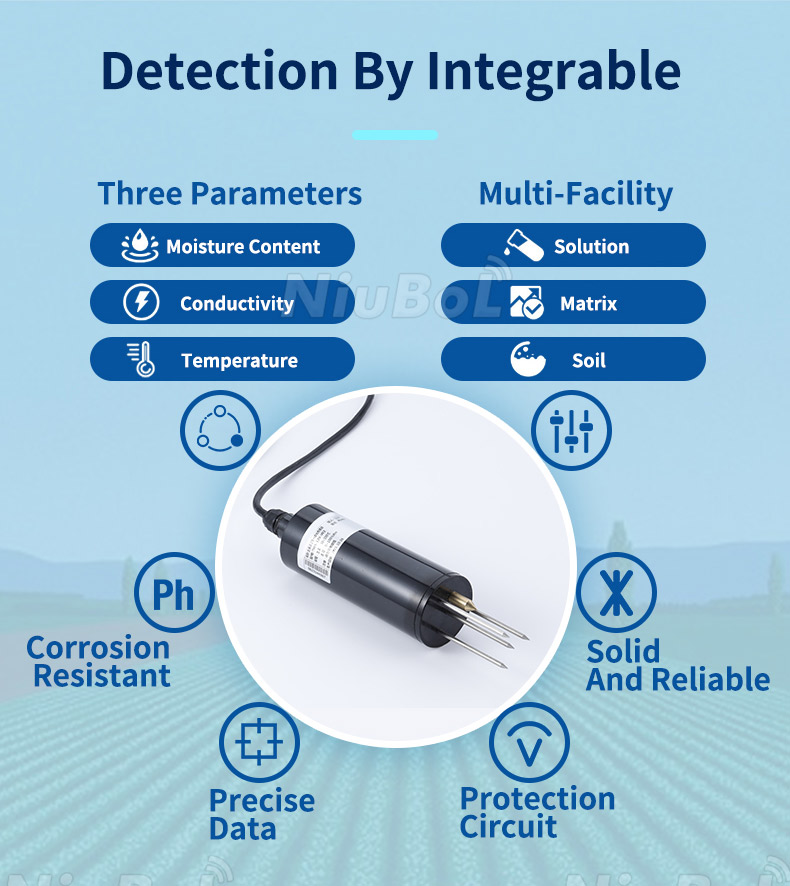
Soil data becomes stronger when combined with rainfall, temperature, humidity, radiation, and valve operation records. This helps managers understand whether rainfall or irrigation actually changed root-zone moisture.
For automated irrigation, the sensor should be connected to a controller or gateway with clear thresholds, delay rules, manual override, and alarm settings.
Select the sensor according to measurement range, output interface, protection level, cable length, installation depth, soil type, and platform requirements. For long-term buried use, cable protection and waterproof sealing are critical.
Maintenance should include checking cable condition, platform data continuity, abnormal flat curves, and sensor placement after field operations or seasonal changes.
In an irrigation project, soil sensors should be installed according to valve zones and crop root depth. A single sensor near the pump room cannot represent a whole field. The best layout places sensors where they reflect actual irrigation decisions.
When multiple soil sensors are connected to a controller or platform, each point should have a clear field name, depth, crop type, and irrigation zone. This allows the owner to compare zones and adjust watering strategy with evidence.
Common errors include leaving air gaps around the probe, inserting the sensor into loose soil, placing it near stones, installing it at the wrong depth, or failing to protect the cable. These problems may produce data that looks normal but does not represent root-zone water status.
For buried installation, the soil should be compacted back around the probe. For quick measurement, the probe should be fully inserted and kept stable during reading. Cable routes should be protected from machinery and pulling force.
Soil moisture thresholds should not be fixed without field adjustment. Crop stage, soil type, irrigation method, and weather conditions all influence the right threshold. A controller should include upper and lower limits, delay time, and manual override.
Soil temperature can also help interpret crop condition and seasonal changes. In greenhouse or nursery projects, soil temperature records may support heating, ventilation, or crop management decisions.
Sensor depth should follow crop root characteristics and irrigation strategy. Shallow-rooted vegetables, orchard trees, greenhouse crops, and field crops may require different installation depths or multiple monitoring layers.
If the project uses drip irrigation, the probe should represent the wetting area of the emitter. If the project uses sprinkler or flood irrigation, placement should reflect the average root-zone condition rather than a single wet spot.
A single soil moisture value should not automatically trigger irrigation without context. The trend over time, recent rainfall, crop stage, soil type, and expected weather should all be considered.
In platform design, soil moisture curves are often more useful than only live values. Curves show how quickly the soil dries after irrigation and whether the water reaches the monitored depth.
Buried sensors should be accepted with location records, depth records, cable routing photos, live readings, and platform field names. These records make future maintenance possible even when the sensor is no longer visible.
If data becomes abnormal, technicians should check cable damage, soil contact, waterlogging, sensor displacement, and platform settings before replacing the sensor.
Before installation, confirm the crop root depth, irrigation zone, soil texture, cable route, and measurement objective. A soil sensor installed without these details may produce data that is technically valid but not useful for decision-making.
During installation, avoid stones and air gaps, ensure close soil contact, and record the installation depth. If the project includes several sensors, each point should be labeled with field block, depth, and sensor number.
After commissioning, compare the first readings with field conditions. If a sensor reports values that do not match the visible soil condition, check installation contact, wiring, platform mapping, and sensor depth before adjusting irrigation thresholds.
Soil sensor data should be reviewed after installation. If the moisture curve does not respond after irrigation or rainfall, technicians should check sensor depth, soil contact, wiring, and platform mapping before changing the irrigation threshold.
A good platform should show both live values and historical curves. Curves help identify whether the soil is drying normally, staying saturated, or showing unrealistic flat data caused by an installation or communication issue.
Procurement should confirm model, output signal, cable length, protection class, installation depth, and controller compatibility. If the sensor will be buried permanently, cable protection and waterproof sealing should be treated as project requirements.
For irrigation automation, the buyer should also describe the valve zones, control cabinet, gateway, and platform. This helps the supplier recommend a configuration that matches the complete system rather than only the probe itself.
Large fields and orchards often need more than one soil sensor. Different irrigation zones, soil types, crop varieties, and slopes can create different moisture patterns. A multi-point layout helps managers compare zones and avoid decisions based on one unrepresentative location.
When multiple sensors are used, the platform should show each point with a clear name and depth. This makes data easier to understand for the owner and simplifies maintenance when a sensor needs inspection.
For high-value crops, two depths may be useful in one zone. A shallow sensor can show surface response after irrigation, while a deeper sensor can show whether water is reaching the main root layer.
The project team should avoid moving sensors frequently after data collection begins. Stable locations make historical comparison more meaningful across crop stages and seasons.
If sensors must be moved, the platform record should note the new location and depth. Without that note, historical curves may combine data from different soil conditions and become difficult to interpret.
For service providers, clear sensor records also make future troubleshooting easier. A technician can inspect the right field point instead of searching for buried equipment from memory.
Clear records also help the owner decide whether additional sensors are needed in a zone that shows unusual moisture behavior.
This keeps future expansion based on measured evidence.
It also supports clearer irrigation service reports.
It measures soil moisture and soil temperature in the crop root zone or monitored soil layer. These two parameters help evaluate irrigation need, root environment, and soil condition changes over time.
NBL-S-THR soil temperature moisture sensor provides stable soil moisture and temperature data with field-ready protection and multiple output options. It is suitable for irrigation, greenhouse, farmland, and research monitoring projects.
Install it at the target depth with close soil contact. For buried monitoring, insert the probe into the soil wall, refill and compact the soil, and protect the cable route from machinery and pulling force.
Yes. Depending on output configuration, it can connect to controllers, RTUs, gateways, or data loggers. The control logic should include thresholds, delay time, manual override, and alarm handling.
The number depends on field size, soil variability, crop type, irrigation zones, and required management resolution. Large orchards or farms usually need multiple monitoring points.
Poor soil contact, stones near the probe, incorrect depth, cable damage, waterlogging around only one point, or unrepresentative placement can affect readings. Installation quality is critical.
Yes. Combining soil moisture with rainfall, temperature, humidity, and wind data helps managers understand both atmospheric demand and root-zone response.
Include model, installation depth, location, output type, wiring record, live data screenshot, platform field name, and sample historical curve.
NBL-S-THR soil temperature moisture sensor gives smart agriculture projects direct root-zone data for irrigation, greenhouse, farmland, and research applications. Correct installation, RS485 MODBUS integration, and platform configuration determine the long-term value of the sensor.
Prev:Agricultural IoT Development Trends and Sensor Network Integration for Smart Farming Projects
Next:Construction Site Dust and Noise Monitoring System Functions for Environmental Supervision
Related recommendations
Sensors & Weather Stations Catalog
 Agriculture Sensors and Weather Stations Catalog-NiuBoL.pdf
Weather Stations Catalog-NiuBoL.pdf
Agriculture Sensors Catalog-NiuBoL.pdf
Water Quality Sensor Catalog-NiuBoL.pdf
Related products
 Combined air temperature and relative humidity sensor TDR Soil Moisture & Temperature Sensor for irrigation| RS485 |4-20mA| NBL-S-THR
 Soil pH sensor RS485 soil Testing instrument soil ph meter for agriculture |NBL-S-PH
 Wind Speed sensor Output Modbus/RS485/Analog/0-5V/4-20mA
 Tipping bucket rain gauge for weather monitoring auto rainfall sensor RS485/Outdoor/stainless steel
 Pyranometer Solar Radiation Sensor 4-20mA/RS485

Screenshot, WhatsApp to identify the QR code
WhatsApp number:+8615367865107
(Click on WhatsApp to copy and add friends)

